The Indie Artist Playbook Is Being Rewritten in Real Time




Making a Scene Presents – The Indie Artist Playbook Is Being Rewritten in Real Time
Listen to the Podcast Discussion
The Old Rules Are Breaking While Everyone Is Still Using Them
The indie artist playbook is being rewritten in real time, and a lot of artists are still trying to win with rules from a game that is already gone.
For the last fifteen years, the music business sold independent artists a simple dream. Get on the platforms. Build your followers. Chase playlist placements. Feed the algorithm. Post every day. Go viral. Convert attention into success.
That sounded good because it had just enough truth in it to be dangerous.
Yes, Spotify, Apple Music, YouTube, TikTok, Instagram, Facebook, and every other attention machine changed the way music is discovered. They opened doors that used to be locked by labels, radio programmers, distributors, publicists, retail buyers, and the old boys who guarded the front gate. An artist can now release music from a bedroom, reach fans in another country, sell merch from a phone, run ads for less than the price of a bad bar tab, and build a real career without asking a label president for permission.
That part is still true. It matters. We should not pretend it does not.
But here is the part too many artists are learning the hard way. Access is not ownership. Exposure is not a business model. Followers are not fans. Streams are not relationships. Likes are not income. Viral moments are not careers.
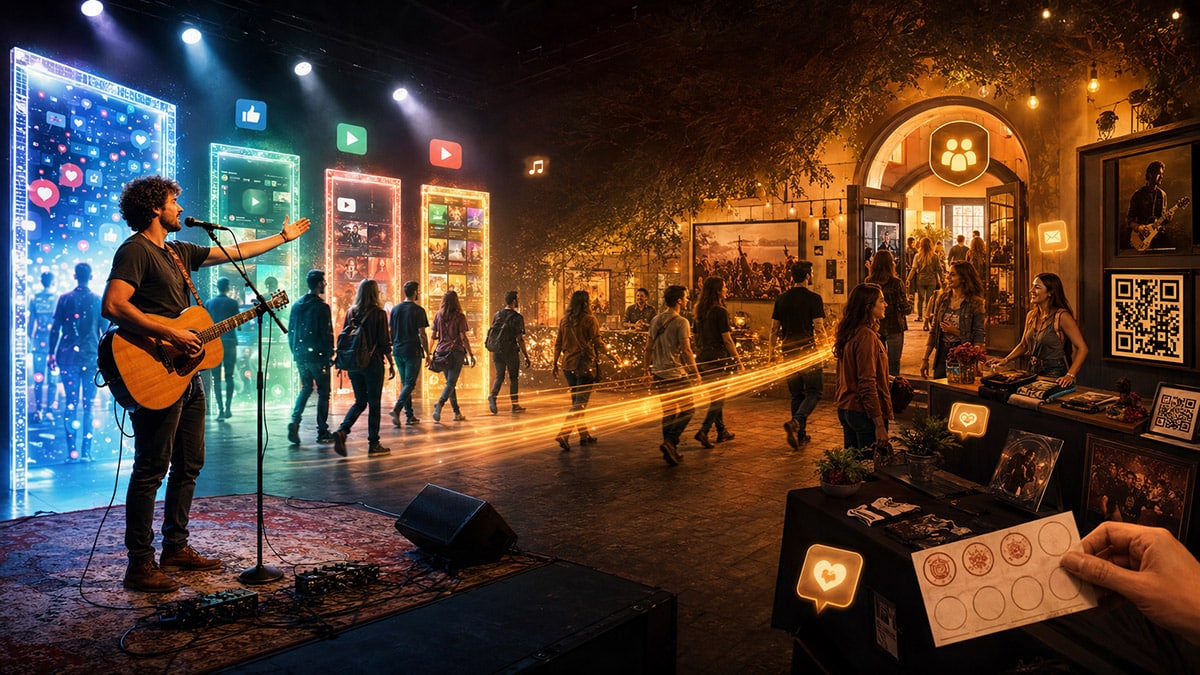
The industry is not moving away from platforms. That is not the point. The point is that platforms are no longer the destination. They are billboards. They are highways. They are rented stages. They are advertising systems. They can help strangers find you, but they do not give you the relationship unless you build a way to capture that relationship yourself.
That is the new playbook.
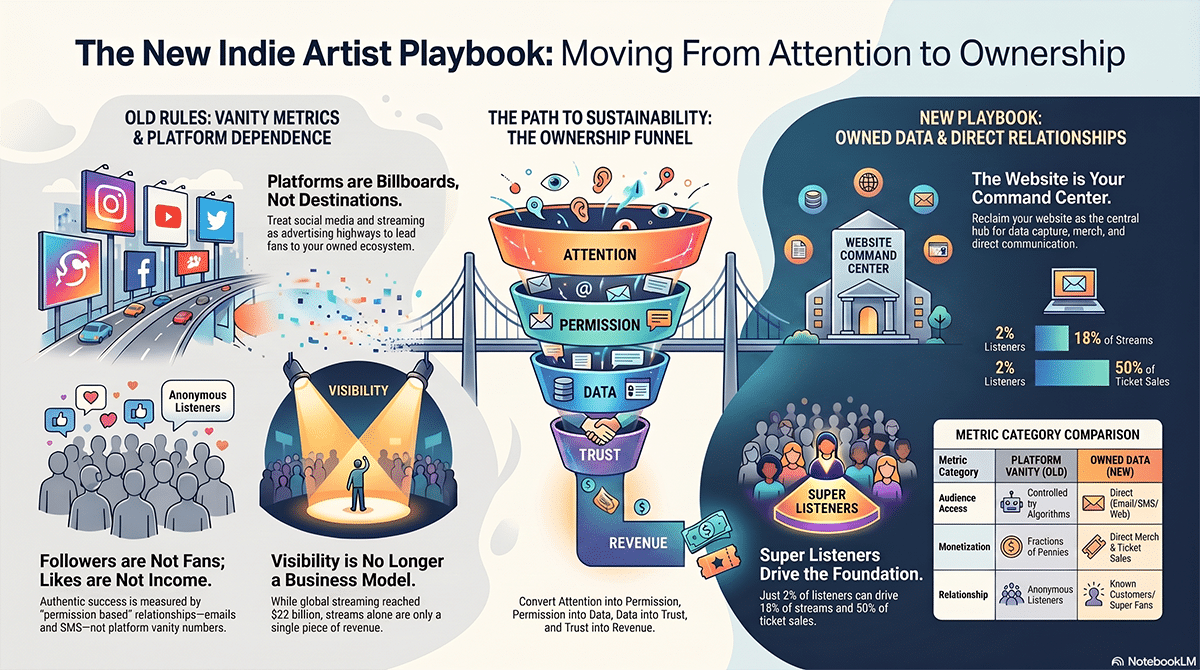
The artist who wins the next version of the music business will not be the artist with the biggest vanity numbers. It will be the artist who can turn attention into permission, permission into data, data into trust, and trust into direct revenue.
That is a very different game.
The Music Business Looks Healthy, But That Does Not Mean Indie Artists Are Safe
On paper, the recorded music business is doing well. According to IFPI’s Global Music Report 2026, global recorded music revenues grew 6.4% in 2025 to $31.7 billion, marking the eleventh year of consecutive growth. Streaming passed $22 billion and made up 69.6% of global recorded music income. Paid subscription streaming alone accounted for 52.4% of global revenue, with 837 million paid streaming subscription accounts worldwide.
In the United States, the RIAA reported that recorded music revenue reached a record wholesale value of $11.5 billion in 2025. Streaming grew to $9.5 billion and represented 82% of total U.S. recorded music revenue for the fifth straight year. Paid streaming reached 106.5 million accounts and generated $6.4 billion, or 55.3% of total U.S. revenue. Vinyl also crossed $1 billion in U.S. sales after nineteen straight years of growth.
So yes, money is moving through the music business. But indie artists need to ask the harder question. How much of that money is moving to you? That is where the old story starts to fall apart.
A growing market does not automatically create a stable middle class. Streaming can make the industry bigger while still leaving most artists with very little leverage. A platform can report growth while an artist still cannot sell 100 tickets in their own hometown. A song can rack up streams while the artist has no email list, no SMS list, no customer history, no merch buyer list, no fan location map, and no way to contact the people who supposedly love their music.
That is the dirty little trick in the modern music economy. The industry can be up while the individual artist remains invisible inside their own audience.
This is why the next phase of indie music cannot be judged by streams alone. Streams matter. They can generate royalties. They can help discovery. They can provide signals. But streams are not the whole business. They are one piece of a much larger revenue system.
The artist who treats streaming as the finish line is still playing the old game. The artist who treats streaming as the top of the funnel is starting to understand the new one.
What Is Changing: Attention Is Getting Cheaper, But Trust Is Getting More Valuable
The biggest change in the music business is not just technology. It is the value of attention.
Attention used to be scarce. If you got press, radio play, MTV rotation, a record store display, or a booking agent’s attention, that meant something. There were fewer channels. Fewer artists had access. Gatekeepers controlled visibility, and visibility itself had high value.
Now attention is everywhere. That sounds like good news, but it creates a new problem. When everyone can publish, everyone is competing with everyone else, all the time, across every screen.
The artist is no longer competing only with other artists in the same genre. They are competing with comedians, influencers, podcasters, politics, sports clips, cooking videos, AI content, movie trailers, breaking news, memes, and the bottomless scroll.
That means attention is easier to get in small bursts, but harder to hold. A view can happen by accident. A like can happen without intent. A follow can happen and then mean almost nothing. People follow thousands of accounts. Algorithms decide what they actually see. The artist does not control the relationship.
This is where indie artists must get brutally honest.
A person who watches ten seconds of your video is not yet a fan. A person who likes a post is not yet a fan. A person who streams one song from an autoplay playlist is not yet a fan. A person who follows you on Instagram may never see your next post. A person who hears your song on Spotify radio may not even remember your name.
That does not mean those moments are worthless. It means they are incomplete.
The job of the modern indie artist is to complete the journey.
Discovery is only step one. The real work begins after discovery. You have to move that person from a platform you do not control into a relationship you do control. That means your website. Your email list. Your SMS list. Your merch store. Your ticketing system. Your membership. Your direct fan community. Your fan rewards. Your data. Your ecosystem.
That is why fan data has become the true indicator of success or failure.
Not because data is cold. Not because artists should become tech bros with guitars. But because fan data tells you whether attention is turning into a real relationship.
What Is Staying: Great Songs Still Matter
Before anybody panics and starts thinking the future of music is just dashboards and automation, let’s be clear.
Great songs still matter.
The human part of music is not going away. The story matters. The voice matters. The sound matters. The show matters. The community around the artist matters. The reason people care still matters.
No amount of data can save boring music. No email funnel can fix an artist who does not connect. No fan passport, CRM, ad campaign, or AI tool can replace the emotional hit of a song that lands at the exact right moment in somebody’s life.
That part has not changed.
What has changed is what happens after the song connects.
In the old industry, the artist hoped the connection would be recognized by someone with power. A label. A radio programmer. A booking agent. A magazine editor. A playlist gatekeeper. A manager with access.
In the new industry, the artist must recognize the connection directly.
If someone buys your vinyl, that is a signal. If someone scans a QR code at your merch table, that is a signal. If someone joins your email list after a show, that is a signal. If someone saves your song, watches your video, then buys a ticket, that is a stronger signal. If someone attends three shows, buys a shirt, joins your membership, and brings two friends, that is not just a fan. That is part of your business foundation.
The song still opens the door. The artist-owned system keeps the door from closing.
Social Media Metrics Are Mostly Advertising Metrics
This is where the music industry needs to unlearn one of its worst habits.
Social media numbers are not career numbers.
Followers, likes, views, comments, and shares can be useful. They can show momentum. They can help a publicist tell a story. They can help a manager spot patterns. They can help a promoter see that something is happening. They can help an artist test content and learn what sparks attention.
But by themselves, they are not proof of a career.
A million views on TikTok does not mean a thousand people will buy tickets. Fifty thousand Instagram followers do not mean you can sell 200 shirts. A playlist spike does not mean those listeners know who you are. A viral post does not mean your next release will perform. A social media audience is not the same thing as a permission-based fanbase.
Platforms are built to keep users on the platform. That is their business. TikTok wants people on TikTok. Instagram wants people on Instagram. YouTube wants people on YouTube. Facebook wants people on Facebook. X wants people on X. Spotify wants people on Spotify.
That does not make them evil. It makes them platforms.
The artist’s job is different. The artist’s job is to turn platform attention into owned fan relationships.
TikTok itself, in a 2025 report with Luminate, pointed to its power as a music discovery engine. The report said 84% of songs that entered the Billboard Global 200 in 2024 had gone viral on TikTok first, that TikTok’s “Add to Music App” feature had generated more than one billion track saves, and that U.S. TikTok users spent 46% more money on music each month than the average U.S. music listener.
That is important. It proves the platform can help create discovery and off-platform action.
But it also proves the deeper point. The valuable part is not the view. The valuable part is what happens after the view. Did the listener save the song? Did they follow the artist on a streaming service? Did they buy a ticket? Did they join the email list? Did they scan a QR code? Did they enter the artist’s world?
A social metric is only meaningful when it leads to a fan action.
If it does not, it is just noise with a pretty number attached.
Streaming Is Not the Enemy, But It Is Not the Whole Career
Streaming is not the villain. Let’s not be lazy about this.
Streaming solved real problems. It made music easier to access. It reduced piracy. It created global reach. It lets an indie artist be heard in places they may never tour. It gives artists data that did not exist in the CD era. It can create discovery and repeat listening. It can help prove demand.
But streaming also trained artists to think too small about value.
Too many artists now ask, “How do I get more streams?” when the better question is, “How do I build more fans who spend money, show up, share, and stay?”
Spotify’s own artist-facing data points in that direction. Spotify says super listeners make up about 2% of an artist’s monthly listeners but drive over 18% of monthly streams. It also says those super listeners account for 50% of an artist’s ticket sales through Spotify and are nine times more likely to share music with their network than other listeners.
That should make every indie artist stop and think.
The money is not in the crowd. The money is in the relationship with the people who care most.
The old playbook told artists to chase scale first. Get more followers. Get more streams. Get more views. Get bigger numbers.
The new playbook says find the real fans, learn who they are, and build around them.
That does not mean ignore growth. It means stop confusing shallow reach with deep demand.
A thousand passive listeners are not always more valuable than fifty active fans. Ten thousand video views may be worth less than twenty people who join your text list. A playlist placement may feel exciting, but a fan who buys a ticket, a shirt, a vinyl record, and a membership is building your career in a way an anonymous stream cannot.
Streaming is part of the system. It should be respected. It should be optimized. But it should not be worshiped.
Fan Data Is the New Career Compass
Fan data is not just a spreadsheet. It is the artist’s map.
It tells you where your fans are. It tells you who opens your emails. It tells you who buys tickets. It tells you who buys merch. It tells you who supports every release. It tells you which city is heating up. It tells you which fans are casual listeners and which fans are ready to go deeper.
This is what makes fan data different from social media metrics.
Social media metrics tell you what happened on someone else’s platform. Fan data tells you what is happening in your business.
A like says, “Someone noticed.” An email signup says, “Someone gave you permission.” A merch purchase says, “Someone spent money.” A ticket purchase says, “Someone will show up.” A repeat purchase says, “Someone trusts you.” A fan who opts in to location, email, SMS, show alerts, rewards, and membership is not a vanity metric. That is an asset.
And that asset belongs to the artist when it is collected with clear consent.
That consent part matters. The new artist-owned economy cannot be built on sneaky data grabs or shady forms. Fans should know what they are signing up for. They should know why it benefits them. They should be able to choose what they share. They should be able to unsubscribe. They should trust that the artist is using the relationship with respect.
That is the difference between ownership and exploitation.
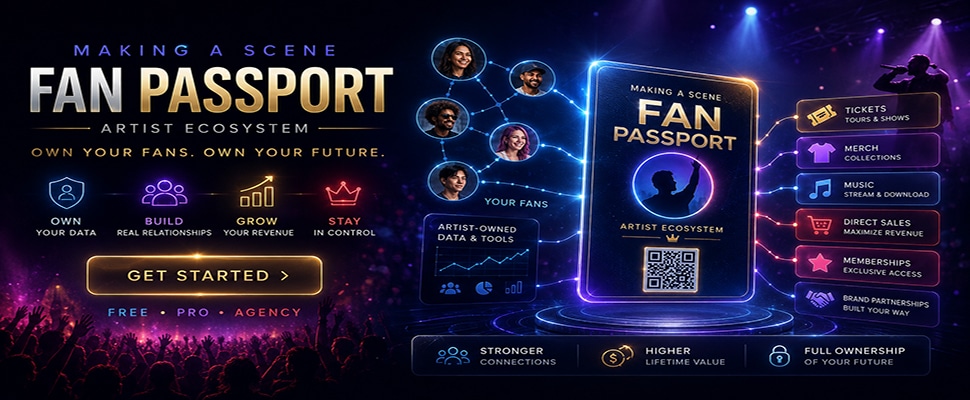
This is where systems like the Making A Scene Artist Ecosystem and Fan Passport, moving toward beta through Making A Scene, become important. The idea is not to replace the artist with technology. The idea is to give the artist a way to turn scattered attention into a consent-based fan relationship. A fan hears the music, scans a QR code, follows the artist, collects stamps, joins the list, gets show alerts, receives rewards, and becomes part of an artist-owned ecosystem.
That is not hype. That is basic business.
Every real business knows who its customers are. Restaurants know regulars. Local shops know repeat buyers. Venues know ticket buyers. Online stores know customer history. Yet musicians have been trained to accept a career where the most important people in their world are hidden behind platform dashboards.
That has to end.
The New Playbook Starts With Unlearning
The hardest part of this transition is not learning new tools. It is unlearning bad habits.
Artists must unlearn the idea that a platform audience is the same thing as a fanbase.
An Instagram follower is not yours. A TikTok viewer is not yours. A Spotify monthly listener is not yours. A YouTube subscriber is closer, but still tied to a platform you do not control. These people can become yours in the relationship sense, but only if they take a step into your ecosystem.
Artists must unlearn the idea that releasing more music automatically builds a career.
Release schedules matter. Consistency matters. But dumping songs into the platform ocean without a fan conversion plan is not a strategy. It is hope dressed up as productivity.
Artists must unlearn the idea that the algorithm is their manager.
The algorithm does not care if you can pay rent. It does not care if your tour works. It does not care if your drummer needs gas money. It does not care if your fans actually see the post about your show. It cares about engagement on its platform.
Artists must unlearn the idea that “going viral” is a business plan.
A viral moment can be useful. It can open a door. It can create a spike. But if the artist has no system to catch the wave, the wave passes. The artist is left with a screenshot, a dopamine crash, and the same empty calendar.
Artists must unlearn the idea that marketing is begging.
Marketing is not begging when it is rooted in service. If someone loves your music, you are not bothering them by letting them know about a show, a vinyl release, a new shirt, a private livestream, a listening party, a fan reward, or a limited membership. You are inviting them deeper into something they already care about.
Artists must unlearn the idea that data is somehow less authentic than art.
Data does not replace emotion. It helps you honor it. If 300 fans in Atlanta keep opening your emails and buying merch, maybe you should play Atlanta. If your acoustic demos get more saves than your polished singles, maybe your audience is telling you something. If fans who buy vinyl also join your membership, maybe physical products are a bridge into community.
Data is not the enemy of soul. Bad data and lazy interpretation are the enemy.
The Artist Website Comes Back From the Dead
For years, artists treated websites like digital brochures. A bio, a few photos, a music player, some tour dates, maybe a contact form nobody checked. Meanwhile, all the real energy went to social media.
That was a mistake.
The artist website has to come back, but not as a static page. It has to come back as the artist’s command center.
Your website should be where fans join your list. Where they buy merch. Where they get tickets. Where they join memberships. Where they see tour dates. Where they collect rewards. Where they find your EPK. Where venues and publicists get real information. Where you control the story. Where you own the data.
The website should not be a museum. It should be a working system.
This matters because social platforms are unstable by design. Algorithms change. Reach drops. Accounts get hacked. Trends vanish. Ad costs move. Policies shift. One platform rises while another falls. Even when a platform is working, the artist is still operating inside someone else’s rules.
Your website is different. Your email list is different. Your customer data is different. Your fan community is different.
Those are not perfect either. You still have to maintain them. You still have to respect privacy laws. You still have to give fans a reason to stay. But they give you something platforms do not give you: leverage.
The next version of the indie artist playbook will treat the website like the central station, not the afterthought.
Social media sends people there. Streaming sends people there. QR codes send people there. Press sends people there. Shows send people there. Playlists send people there. Interviews send people there. The artist’s job is to make sure every doorway leads somewhere they control.
Direct-to-Fan Is Not a Buzzword Anymore
Direct-to-fan used to sound like a niche idea for artists with cult audiences. Now it is becoming the core of the independent business model.
Look at Bandcamp. Bandcamp says that when a fan buys something on the platform, an average of 82% of the money goes to the artist or label, usually within 24 to 48 hours. That is a very different relationship than waiting for fractions of pennies to accumulate from anonymous streams.
Look at Patreon. Patreon crossed more than $10 billion in payments to creators since its founding, with more than 25 million paid memberships and more than $2 billion flowing to creators annually, according to reporting from Axios.
Look at Substack, Shopify, Mailchimp, ConvertKit, Bandsintown, Eventbrite, Songkick, Square, Stripe, and artist-owned WordPress sites powered by WordPress. These are not just tools. They are parts of a larger shift.
The artist is no longer just a content supplier for platforms. The artist is becoming a small media company, a live event business, a merch business, a licensing business, a data business, and a community business.
That might sound overwhelming, but it is also liberating.
For decades, artists were told they needed permission to build a real career. Permission from labels. Permission from radio. Permission from press. Permission from retail. Permission from playlist editors. Permission from investors. Permission from gatekeepers.
Now the permission that matters most is fan permission.
Can you earn the right to contact your fans directly? Can you earn the right to tell them about a new release? Can you earn the right to invite them to a show? Can you earn the right to offer them something special? Can you earn the right to know what city they live in and what kind of support they want to give?
That is the new direct-to-fan economy.
Not spam. Not manipulation. Not hustle culture. Relationship.
What Managers Must Understand
Managers who still judge artists mainly by follower counts are going to miss the real story.
The better manager will ask different questions.
How many fans can the artist contact directly? How fast is the email list growing? What percentage of show attendees are being captured into the database? Which cities show real engagement? How many fans buy more than once? How many fans move from streaming to tickets? How many merch buyers are being invited into membership? What is the lifetime value of a real fan?
The manager’s job is becoming less about chasing industry validation and more about building artist-owned infrastructure.
That does not mean managers stop pitching labels, agents, festivals, sync companies, or brand partners. It means they walk into those conversations with better leverage. A manager who can say, “This artist has 2,000 fans in this region who open emails, buy tickets, and respond to offers” is in a stronger position than one who says, “This artist had a Reel do well last month.”
Managers need to stop treating fan data as admin work. It is strategy.
What Labels Must Understand
Labels are not dead. That line has been wrong for years.
The better question is what labels are for.
If a label brings capital, global marketing, radio relationships, sync muscle, creative support, tour support, data science, and real partnership, that can still matter. But the old label promise of “we will make you visible” is less powerful than it used to be, because artists can create visibility without a label.
What artists need now is not just visibility. They need conversion.
A modern label should help artists turn attention into owned demand. If the label only drives streams but does not help build the artist’s fanbase, customer base, and long-term business, then it is strengthening the platform more than the artist.
The label of the future should care about first-party fan data, ethical consent, customer journeys, regional demand, direct commerce, fan rewards, and long-term community value.
If it does not, it is still selling an old product in a new market.
What Publicists Must Understand
Publicity still matters, but the press hit cannot be the end of the campaign.
A review, interview, podcast appearance, playlist feature, or premiere should send readers and listeners somewhere useful. Not just “stream the single.” Not just “follow on Instagram.” Those are fine calls to action, but they are incomplete.
A publicist should be asking, “Where does this attention go?”
Does the article link to the artist’s website? Is there an email signup? Is there a tour page? Is there a new fan offer? Is there a QR code for print or live events? Is there a fan reward tied to the campaign? Is there a way to measure whether press created real fan movement?
The publicist of the next era is not just chasing mentions. They are helping build conversion pathways.
Press without capture is applause fading into the air.
What Venues Must Understand
Venues are sitting on one of the most valuable points in the fan journey: the moment of real-world connection.
A fan at a show is not a passive scroller. They got dressed, left the house, traveled, paid money, and stood in a room to experience music in person. That is a powerful signal.
Yet too many shows end with no data captured at all. The artist leaves with memories and maybe some merch sales. The venue keeps its ticketing data. The fan goes home. The relationship weakens.
The next playbook changes that.
Artists need QR codes at the door, at the merch table, on stage screens, on posters, on wristbands, on receipts, and in post-show emails. Fans should be able to join the artist’s list, collect a show stamp, unlock a live recording, get a merch discount, receive the next show alert, or join a local fan circle.
Venues that help artists build direct fan relationships will become more valuable partners. Venues that hoard data and treat artists like disposable content will become less attractive to serious independents.
A healthy local scene needs repeat relationships, not one-night transactions.
What Local Music Organizations Must Understand
Local music organizations, music societies, arts councils, local scene groups, and nonprofit music groups need to pay close attention.
The old local scene model was built around calendars, showcases, newsletters, sponsorships, and community goodwill. Those still matter. But the new local scene will be built around shared infrastructure.
Can local artists capture fans at shows? Can venues and artists collaborate without violating trust? Can regional audiences discover artists by genre, location, and live activity? Can fans support a scene, not just one act? Can sponsors see real engagement instead of vague impressions? Can a local music organization help artists build data, not just exposure?
This is where a local scene becomes more than a calendar. It becomes an ecosystem.
If a local music organization can help artists build consent-based fan relationships, it becomes part of the new music economy. If it only posts flyers on social media, it risks becoming another voice shouting into the feed.
The Practical New Indie Artist Playbook
The new playbook begins with a simple mindset shift. Every platform is a doorway. Your ecosystem is the destination.
That means every TikTok video, Instagram Reel, YouTube Short, Spotify profile, Bandcamp page, interview, live show, QR code, podcast appearance, and press feature should point toward a place where the fan can take the next step with you directly.
Your first job is to build a home base. That should be your website, not a link page alone. A link page can be useful, but it should not be the whole house. The artist website should collect email and SMS permissions, display tour dates, sell merch, host your EPK, connect to your streaming platforms, and give fans a reason to return.
Your second job is to create a fan capture moment at every point of contact. At shows, that might be a QR code for a free live track, a show stamp, a merch discount, or a private after-show video. Online, it might be an unreleased demo, a lyric sheet, early access, a fan club invite, a local show alert, or a direct message that sends people to your site.
Your third job is to segment your fans by behavior. A casual listener is not the same as a ticket buyer. A vinyl buyer is not the same as a playlist listener. A fan in Chicago is not the same as a fan in Atlanta. A fan who opens every email is not the same as someone who joined once and disappeared. Treating all fans the same is lazy. Treating them based on real engagement is respectful.
Your fourth job is to build offers that match the fan’s level of commitment. A new fan may want a free download, a playlist, or show alerts. A deeper fan may want vinyl, merch, tickets, or a livestream. A core fan may want membership, VIP access, private demos, handwritten notes, limited releases, or a direct role in supporting the next project.
Your fifth job is to measure what matters. Stop asking only how many people saw something. Ask how many people acted. How many joined? How many bought? How many came back? How many shared with intent? How many moved from listener to fan? How many moved from fan to supporter?
This is not about becoming robotic. It is about becoming free.
The more you understand your audience, the less you have to beg the algorithm.
The Future Belongs to Artists Who Build the Bridge
We are in a transitional phase. That is why everything feels confusing.
The old gatekeepers have less control, but they are not gone. The platforms are powerful, but they are not enough. Streaming is still growing, but growth is slowing in key ways. Luminate’s 2025 Midyear Music Report described the industry as sitting at the intersection of growth and disruption, noting that U.S. on-demand audio streaming growth slowed to 5% and global growth slowed to 10%, compared with 8% and 15% respectively in 2024.
That is the moment we are in.
Business is booming, but the easy growth era is fading. AI is flooding the system with more content. Streaming fraud is a growing concern. IFPI specifically warned that streaming fraud siphons revenue away from artists and called for action across platforms, aggregators, and distributors. The feed is crowded. The catalog is endless. The platforms are louder. The artist has more tools and more pressure at the same time.
So the answer is not to quit platforms.
The answer is to use them correctly.
Use TikTok for discovery. Use Instagram for story and visibility. Use YouTube for search, video, and depth. Use Spotify and Apple Music for listening and fan signals. Use Bandcamp for direct music and merch sales. Use Patreon or Memberful for memberships if they fit your audience. Use Mailchimp, Kit, or another email platform to communicate directly. Use Shopify, Square, or Stripe to sell. Use Bandsintown and Songkick to support tour discovery. Use WordPress to own your home base.
But do not confuse tools with strategy.
The strategy is ownership.
Own the relationship. Own the data. Own the customer path. Own the story. Own the community. Own the business layer around the music.
That is how indie artists build a middle class in the next music industry.
Not by waiting for rescue. Not by worshiping the algorithm. Not by chasing empty numbers. Not by pretending a million passive impressions are the same as a thousand real fans. Not by handing the entire fan relationship to platforms that may never let you reach those people again.
The artist who wins now is the artist who builds the bridge.
From attention to permission. From permission to trust. From trust to support. From support to sustainability. That is the new playbook. And it is being rewritten right now, in public, while the old industry is still trying to sell last year’s map.
The good news is that indie artists do not have to wait for the future to arrive. They can start building it at the next show, the next post, the next release, the next email, the next QR code, the next fan who says, “I love what you do.”
That is the moment. Do not waste it.
 |  Spotify |  Deezer |  Breaker |
 Pocket Cast |  Radio Public |  Stitcher |  TuneIn |
 IHeart Radio |  Mixcloud |  PlayerFM |  Amazon |
 Jiosaavn |  Gaana |  Vurbl |  Audius |
 Reason.Fm | |||
Find our Podcasts on these outlets
Subscribe to Our Newsletter
Discover more from Making A Scene!
Subscribe to get the latest posts sent to your email.


