Why Ownership Is the Only Metric That Matters Anymore




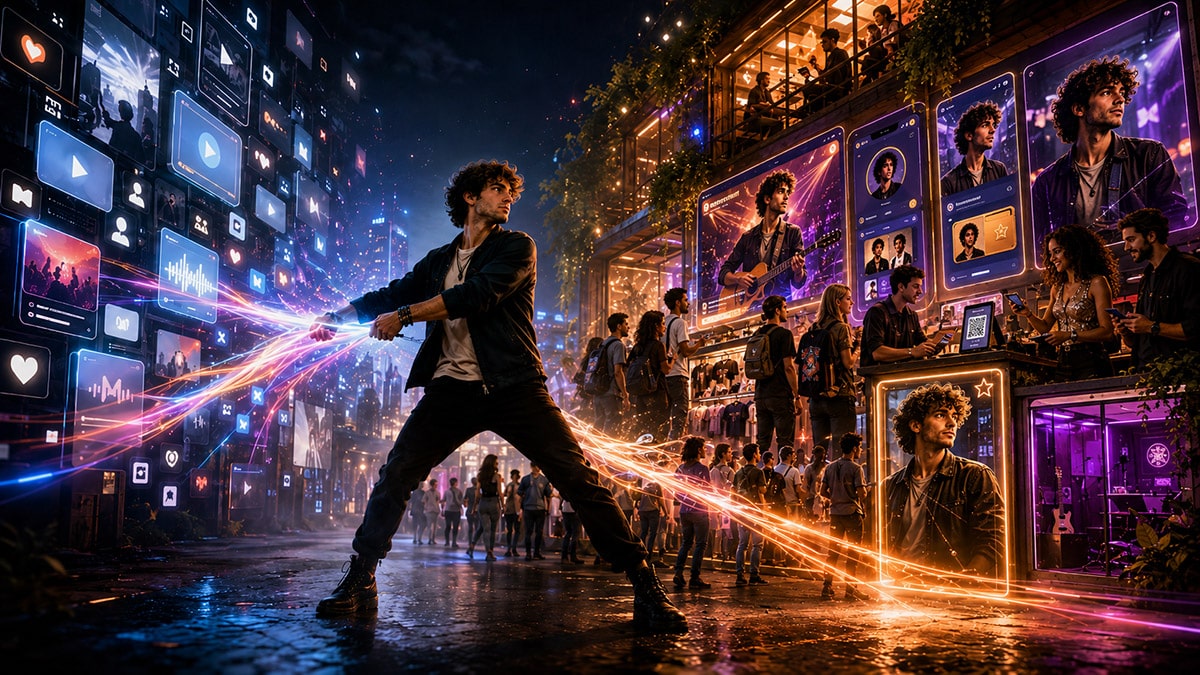
Making a Scene Presents – Why Ownership Is the Only Metric That Matters Anymore
Listen to the Podcast Discussion
The New Scoreboard for Independent Music
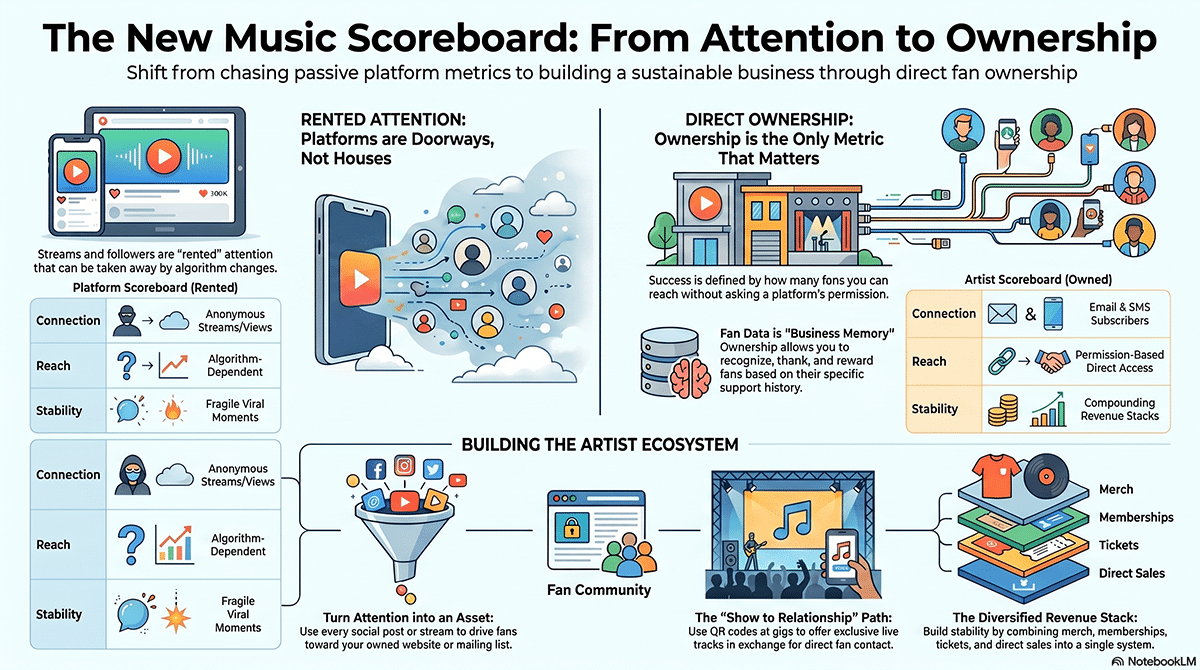
For most of the digital music era, artists were trained to chase numbers that looked impressive from the outside. Streams. Followers. Views. Likes. Shares. Monthly listeners. Playlist adds. Short-form video plays. The whole industry built a scoreboard around attention and then convinced artists that attention and success were the same thing.
They are not.
Attention matters. Discovery matters. Social media matters. Streaming matters. Nobody building a serious music career should pretend Spotify, TikTok, Instagram, Facebook, YouTube, Bandcamp, Patreon, Substack, Shopify, Square, Stripe, Mailchimp, SendGrid, or any of the other tools in the modern artist toolbox are irrelevant. That would be foolish. These platforms are the roads where fans move around. They are the windows where people first see you. They are the doorways that can lead someone into your world.
But a doorway is not a house.
A stream is not a customer. A follower is not a relationship. A view is not a fan. A like is not permission. A playlist add is not a business model. A viral moment is not an asset unless the artist has a system to capture that moment and turn it into something they own.
That is the real shift happening in the music business. Success is no longer just about how many people saw you. Success is about how many people you can reach again without asking permission from an algorithm, a label, a platform, a promoter, or a gatekeeper with a dashboard.
That is why ownership is becoming the only metric that matters anymore.
The old music industry measured access. Who could get into the studio? Who could get radio promotion? Who could get physical distribution? Who could get into the label system? The first digital music business measured exposure. Who could get streams? Who could get playlisted? Who could get followers? Who could get video views?
The next music business will measure ownership.
Who owns the fan relationship? Who owns the data? Who owns the mailing list? Who owns the direct sales channel? Who owns the website? Who owns the community? Who owns the customer history? Who owns the ability to speak directly to the people who care?
That is the line between being popular and being powerful.
Streams Are Useful, But They Are Not a Business System
Let’s start with the sacred number: streams.
Streaming changed music forever. It made recorded music available at a scale that would have looked like science fiction thirty years ago. Spotify, at https://www.spotify.com, gave listeners access to a giant catalog. Spotify for Artists, at https://artists.spotify.com, gave artists and teams tools to understand audience and playlist activity. Apple Music, YouTube Music, Amazon Music, Pandora, Deezer, Tidal, and other services gave fans more ways to listen than ever before.
That matters.
For an independent artist, streaming can help people discover the music. It can make songs available around the world. It can provide royalty income, even if that income is often small for artists who do not have huge volume. It can help build proof that people are listening. It can help with booking, press, sync pitches, and industry conversations. A strong streaming presence is not worthless.
But the stream itself is passive.
A listener can hear your song in the background while cooking dinner. They can hear it in a playlist while driving. They can let it play while they are working. They can hear thirty seconds, skip, forget your name, and never come back. They may like the song and still not know who you are. They may know who you are and still have no direct connection to you.
A stream does not tell you the listener’s name. It does not give you their email address. It does not tell you whether they would come to a show. It does not let you send them a thank-you note. It does not let you offer them a live recording from the concert they attended. It does not automatically lead to a merch sale, a membership, a ticket purchase, a licensing opportunity, or a long-term community.
A stream can create a royalty. But a stream count by itself is not a revenue stack.
That distinction matters because too many artists treat streaming numbers like the end goal. They are not. They are one signal inside a much larger business. A song that gets a modest number of streams but brings fans into an owned email list, a direct merch store, a membership, a house concert network, a licensing catalog, and a community may be more valuable than a song that gets a bigger streaming number and leaves the artist with no fan relationship.
That sounds upside down only if we accept the platform scoreboard as the artist scoreboard.
The platform wants engagement. The artist needs a business.
Those two things can overlap, but they are not the same thing.
Followers Are Rented Attention
Followers look like ownership because they appear on your profile. They sit beside your name. They are public. They make you look bigger. They can help people take you more seriously. In a world where social proof matters, a healthy follower count can open doors.
Instagram, at https://www.instagram.com, TikTok, at https://www.tiktok.com, Facebook, at https://www.facebook.com, YouTube, at https://www.youtube.com, and X, at https://x.com, are all part of the modern discovery machine. TikTok for Artists, at https://artists.tiktok.com, gives music teams insights into music and fan activity on TikTok. YouTube for Artists, at https://artists.youtube, gives artists tools around their official artist presence. Instagram Creators, at https://creators.instagram.com, and Meta for Business, at https://business.meta.com, offer education and marketing tools for creators and businesses.
These tools matter. Used well, they can be powerful.
But followers are not owned fans.
A follower is a person who clicked a button inside someone else’s house. That house can change the rules. The feed can change. Reach can drop. Accounts can get hacked. A platform can remove a feature, change a payout program, prioritize different content, throttle links, favor paid ads, push short-form video, bury still images, push shopping, push AI-generated content, or simply decide that what worked last year no longer works this year.
That is not an artist business. That is rented attention.
A follower may become a customer. A follower may buy a ticket. A follower may join your mailing list. A follower may scan your QR code at the merch table. A follower may join your Fan Passport. But until that happens, the relationship is still being mediated by the platform.
This is why the sentence “I have 50,000 followers” does not mean what it used to mean.
The better question is: how many of them can you reach directly?
How many have given you permission to contact them? How many have bought from you? How many have come to a show? How many have joined your community? How many have collected a reward? How many are part of your actual business system?
The follower count is the crowd outside the venue.
Ownership is the guest list, the merch table, the email list, the ticket history, the community, and the relationship that continues after the show ends.
Views Are Not Commitment
Views may be the most seductive number of all because they can explode fast. One video catches. One clip moves. One song moment fits a trend. One guitar riff, vocal hook, behind-the-scenes moment, or emotional performance gets pushed by the algorithm, and suddenly the numbers look huge.
That can be exciting. It can also be dangerous.
A view requires almost no commitment from the fan. A person can watch three seconds and scroll. They can laugh, cry, tap, swipe, and disappear. They can love the clip and never know the artist’s name. They can use the sound and never buy the song. They can comment and never come to a show.
That does not mean views are bad. Views are proof of attention. Attention can become opportunity. A video view can be the first handshake. A fan may discover you through TikTok, follow you on Instagram, watch a longer performance on YouTube, stream your song on Spotify, and then eventually buy a ticket.
That path is real.
But it does not happen by magic.
The artist has to build the bridge.
The mistake is believing that views automatically become fans. They do not. Views become fans when the artist gives people somewhere to go next. That “next” has to be owned. It has to be an artist website, an email list, a Fan Passport, a reward wallet, a direct merch store, a membership, a community, a show notification system, or some kind of direct relationship channel.
Otherwise, the artist becomes content for the platform instead of using the platform as a doorway into the artist’s own world.
That is the trap. Platforms reward artists for feeding the machine. Artists need to reward themselves by building an asset every time the machine gives them attention.
The Difference Between Attention and Ownership
Attention is temporary.
Ownership compounds.
That is the whole argument in one line.
A stream happens once. A view happens once. A like happens once. A follower may or may not see the next post. But an owned fan relationship can grow over time. It can begin with one email address. Then a show attendance record. Then a merch purchase. Then a Fan Passport stamp. Then a reward. Then a VIP membership. Then a house concert invite. Then a direct purchase of a live recording. Then a limited vinyl order. Then a licensing referral. Then a long-term supporter who tells other people.
That is what a business system does.
It does not treat every fan action as a disconnected event. It connects the dots.
In the old model, artists were told to build buzz. In the new model, artists need to build memory.
Memory is the missing piece in most independent music careers. The artist posts every day, performs every week, releases music, sends people to streaming services, gets a bump of activity, and then loses track of who did what. A fan came to a show, bought a shirt, streamed a song, liked three posts, and told two friends. But unless that fan enters an owned system, the artist has no clean way to recognize, thank, reward, and build on that relationship.
That is insane when you think about it.
A restaurant knows who made a reservation. A small shop knows who bought something. A local gym knows who checked in. A nonprofit knows who donated. A theater knows who bought tickets. A smart business knows the difference between a stranger, a first-time customer, a repeat customer, and a supporter.
Artists are expected to run blind.
They are told to “build a fanbase,” but most of the tools they are pushed toward do not actually give them control of the fan relationship. They give the artist dashboards. They give the artist graphs. They give the artist impressions, reach, engagement, saves, skips, and demographic slices. Those are useful signals. But they are not the same as ownership.
Ownership means the artist can say: these are my fans, they gave me permission to contact them, I know how they connect with my work, I can serve them better, and I can build direct revenue with them in a way that respects their privacy and rewards their support.
That is not hype. That is basic business.
The Owned Metrics That Actually Matter
The new artist scoreboard is not mysterious. It is just more honest.
How many email subscribers do you have? How many fans have opted in to hear from you directly? How many fans are connected to your artist website? How many people have scanned your show QR code? How many have collected a Fan Passport stamp? How many have joined your reward wallet? How many fans have bought merch? How many have bought tickets? How many have joined a membership? How many have purchased exclusive recordings? How many have given permission for SMS or push notifications? How many fans are active in your community? How many fans came back a second time? How many fans brought a friend?
Those are ownership metrics.
They are not as flashy as a viral view count, but they are far more useful. They tell the artist what kind of business is being built. They show whether attention is turning into relationships. They show whether relationships are turning into revenue. They show whether revenue is coming from one fragile source or a real stack of sources.
A real revenue stack might include live shows, merch, vinyl, CDs, downloads, exclusive live recordings, memberships, VIP experiences, house concerts, licensing, publishing, direct tips, fan support, teaching, workshops, private events, digital products, sponsorships that fit the artist’s values, and special fan experiences.
The stack will look different for every artist. A touring band may lean on shows, merch, VIP, and live recordings. A songwriter may lean on publishing, sync licensing, Patreon-style memberships, and direct-to-fan releases. A producer may add sample packs, mixing services, education, and licensing. A local scene artist may build around live events, community support, direct merch, and regional partnerships.
The point is not that every artist needs the same stack.
The point is that every artist needs a stack they own.
Why Email Still Matters More Than the Algorithm
Email may not be sexy. It does not dance. It does not come with trending audio. It does not have a shiny viral scoreboard. But email remains one of the most important owned assets an artist can build.
Mailchimp, at https://mailchimp.com, SendGrid, at https://www.twilio.com/en-us/sendgrid, ConvertKit, now Kit, at https://kit.com, and other email services exist because direct communication still works. Not every email gets opened. Not every email leads to a sale. But an email list is still a direct channel where the artist has more control than on a social feed.
When someone joins an email list, they have done more than click follow. They have given permission. That tiny act matters. It means they are willing to let the artist into their inbox. That is a higher level of intent than a passive view.
And when email is connected to fan behavior, it becomes even stronger.
Imagine an artist plays a show on Friday night. Fans see a QR code at the door, on the merch table, on the screen, or on a small sign near the stage. The QR code invites them to join the artist’s Fan Passport, collect a show stamp, and unlock a thank-you gift. They scan. They opt in. They choose what information they want to share. Maybe they provide email. Maybe they add their city and state. Maybe they choose whether to receive show alerts, release news, rewards, or no notifications at all.
The next morning, the artist sends a message.
Not a generic blast. Not “buy my thing.” Not “stream my new single again because the algorithm needs food.” A real thank-you.
“Thank you for being at the show last night. That room was special. Here is a live recording of one of the songs we played, only for the people who were there.”
That one email changes the relationship.
The fan is no longer just a face in the room. The fan is recognized. The show becomes part of the fan’s story. The artist turns a live moment into a direct connection. That live recording becomes a gift, not bait. Then, naturally, the artist can say: if you want more recordings like this, we are opening a VIP membership where members get access to live tracks, rehearsal-room versions, alternate mixes, behind-the-scenes videos, early ticket offers, and special rewards that are not available anywhere else.
That is how a revenue stack begins.
Not by begging. Not by spamming. Not by chasing strangers. By recognizing the fans who already showed up.
The Fan Passport as a New Kind of Relationship Layer
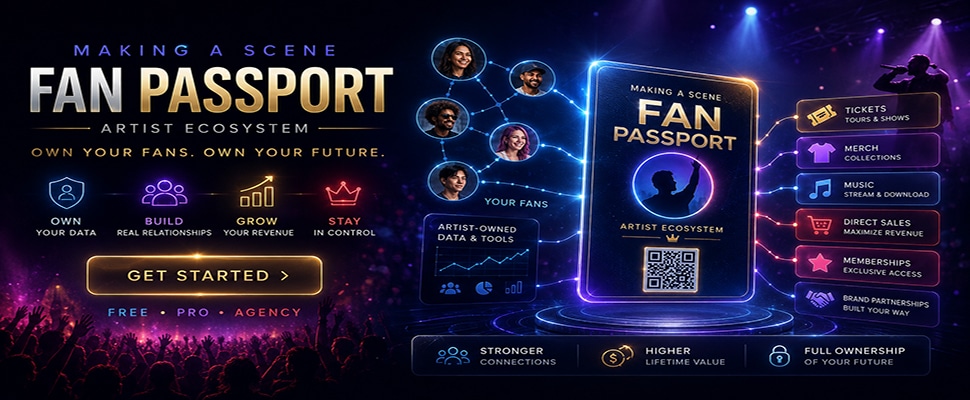
This is where the Making a Scene Artist Ecosystem and Fan Passport come into the picture.
The Making a Scene Artist Ecosystem and the free iOS and Android Fan Passport app are being built around a simple idea: artists need a complete business system, not another disconnected promotion tool.
The launch is planned for sometime this summer, and the goal is not to replace streaming platforms or social platforms. That would miss the point. Spotify, TikTok, Instagram, Facebook, YouTube, Bandcamp, Patreon, Substack, and all the other digital doorways still matter. The difference is that the Making a Scene system treats those platforms as entrances into an artist-owned ecosystem, not as the final destination.
The Fan Passport app gives fans a way to follow artists, collect stamps, receive rewards, manage preferences, and take part in a built-in reward wallet. For the fan, it feels like a music passport. It remembers the artists they follow, the shows they attend, the stamps they collect, the rewards they earn, and the special experiences they unlock.
For the artist, it becomes something more valuable.
It becomes an artist-owned relationship layer.
That phrase matters. The relationship layer is where anonymous attention becomes known support. A fan scans a QR code at a show. A fan joins through an artist website. A fan collects a stamp. A fan unlocks a reward. A fan opts in for email. A fan buys merch. A fan joins a membership. A fan attends another show. Each action becomes part of the relationship instead of disappearing into platform fog.
This has to be permission-based. Fans should always know what they are joining, what they are sharing, and how they can manage their choices. Ownership does not mean artists should grab data like mini tech companies. That is the wrong lesson from Silicon Valley. Artist ownership should be built on trust. The fan gives permission because they want a better relationship with the artist. The artist uses that permission to serve the fan better, not exploit them.
That is the difference between surveillance and community.
The Artist Ecosystem Is the Missing Business Backbone
Most independent artists do not fail because they lack talent. They fail because their business is scattered across too many disconnected places.
The website is over here. The email list is over there. The merch store is somewhere else. The ticket link changes every show. The social links are scattered. The streaming links go to platforms the artist does not control. Fan messages are trapped inside DMs. Sales data lives in one system. Email lives in another. Show history lives in a spreadsheet. Merch inventory lives in someone’s head. The most loyal fans are often invisible unless they happen to comment a lot.
That is not a business. That is a junk drawer with a login problem.
The Making a Scene Artist Ecosystem is designed to pull these pieces into one artist-centered system. The idea is to give the artist a foundation where the website, Fan Passport, fan capture, QR codes, email readiness, show tools, media, community, rewards, and revenue tracking all work together.
Think of it like the difference between owning random tools and owning a workshop.
A hammer, a saw, a drill, and a pile of wood are useful. But a workshop lets you build. The Artist Ecosystem is meant to be that workshop for the independent artist.
The free version gives artists a core foundation. The Pro version adds deeper business tools. The Premium modules add advanced growth, intelligence, commerce, touring, local scene, and Web3-style fan wallet possibilities. Together with the free iOS and Android Fan Passport app, the system is meant to create a bridge between the fan’s phone and the artist’s business.
That is the part most platforms do not do.
They may help you get attention. They may help you sell one thing. They may help you post, send, stream, or collect payments. But they are usually not built from the ground up as an integrated artist-owned business system.
The Making a Scene Artist Ecosystem is being built around the artist’s long-term independence. That changes the design.
What the Free/Core System Gives the Artist
The Free/Core level is important because ownership cannot only be for artists who already have money. If the goal is to build a real music industry middle class, the foundation has to be accessible.
The Free/Core Artist Ecosystem is meant to give artists the basic tools to start building an owned fan relationship without needing to become a tech expert. That includes an artist website foundation, basic Fan Passport connection, QR and smart-link tools, fan capture, email readiness, basic show and list tools, setup guidance, mobile/cloud connection, and beginner-friendly templates that help artists avoid the dreaded blank screen.
That last part may sound small, but it is not. Many artists know they need a better website, better fan capture, and better direct communication. They get stuck because the setup process feels like homework assigned by a robot who hates musicians. A good template is not just decoration. It is a starting point. It lets the artist move faster.
The Free/Core system is not about giving artists every advanced feature on day one. It is about getting them into the ownership mindset.
Can a fan find the artist’s real home base? Can they join the artist’s world? Can they scan a QR code? Can they opt in? Can they receive a thank-you? Can the artist start building a list? Can a show become more than a one-night event? Can a fan relationship continue after the last song?
That is the foundation.
And once an artist has that foundation, the rest of the business starts to make sense.
A social post can send people to the artist website. A TikTok video can point people toward a Fan Passport reward. An Instagram story can promote a QR code for an exclusive live track. A YouTube description can send viewers to a direct signup. A Spotify profile can point toward merch, shows, and the artist’s owned world. A Bandcamp release can connect to a deeper membership. A Patreon or Substack offer can become part of a broader fan journey instead of a side island.
The Free/Core level is the first step away from platform dependency.
What Pro Adds to the Business
The Pro level is where the system starts to become a more serious business engine.
At this stage, the artist is not just capturing fans. The artist is learning what fans do, how they engage, where revenue comes from, and how to follow up in a smarter way.
Pro features can include deeper fan funnel tools, reports and insights, reward automation, merch table mode, membership and content library tools, ticketing and door list features, show return-on-investment tracking, importers, social scheduling, and more advanced fan journey tools.
This is where the artist starts to see the business as a connected system.
Merch table mode matters because the merch table is one of the most underused data capture points in independent music. Artists already know how important merch is. A good night at the merch table can pay for gas, lodging, meals, and the next round of promotion. But too often, the merch table only captures money. It does not capture the relationship.
That is a missed opportunity.
With a connected system, the merch table can do more. A fan buys a shirt, scans a QR code, collects a stamp, joins the Fan Passport, unlocks a reward, and gets added to the artist’s direct relationship system with consent. The artist can later thank that fan, offer a discount, invite them to the next show, or unlock a special recording.
Ticketing and door list tools matter for the same reason. A show should not vanish after load-out. A show should create data, stories, content, and revenue opportunities. Who came? Who checked in? Who joined? Who bought merch? Which city is heating up? Which venue produced real fans, not just bodies in the room? Which fans are becoming repeat supporters?
Show ROI matters because artists need to know whether a gig is helping the business. The old way measured the night by applause and maybe the cash in the box. The new way can measure tickets, merch, signups, Fan Passport activity, rewards claimed, follow-up sales, and future engagement.
That does not make music cold. It makes the business visible.
Artists cannot fix what they cannot see.
What Premium Opens Up
The Premium modules are where the system can move beyond basic ownership and into deeper growth.
Premium can include AI marketing intelligence, advanced artist commerce, fan growth automation, touring and live revenue tools, local scene tools, and Web3-inspired fan wallet features. The key is not to throw shiny tech at artists because shiny tech is fun. The key is to use advanced tools to solve real artist problems.
AI should help the artist understand the fanbase, plan smarter campaigns, write better follow-up messages, organize releases, identify stronger cities, improve offers, and save time. AI should not replace the artist’s voice. It should give the artist the kind of support staff that labels used to keep behind expensive doors.
Web3 should not be treated like magic beans. The music industry already had enough hype cycles to fill a landfill. The useful part of Web3 is not cartoon apes, speculative tokens, or making fans feel like they need a finance degree to support a song. The useful part is portable identity, ownership records, access, rewards, fan wallets, digital collectibles with real utility, and direct artist-to-fan value.
That is why the Fan Passport app and built-in reward wallet are a better way to explain it. Fans do not need to start by thinking about crypto. They can think about what they already understand: I follow this artist. I went to this show. I collected this stamp. I earned this reward. I unlocked this song. I have access to this experience. I can carry my relationship with the artist in my pocket.
That is a human use case.
Premium should also help artists build stronger revenue stacks. Advanced commerce tools can help with bundles, limited drops, product profit tracking, and direct offers. Touring tools can help artists understand which markets are real. Local scene tools can connect artists, venues, fans, and community activity. Fan growth automation can help artists follow up without losing the personal touch.
The goal is not automation for its own sake.
The goal is a business that remembers.
The Show Is the Perfect Example
Let’s make this real.
An independent artist plays a Friday night show. The room holds 150 people. Maybe 100 show up. Under the old model, the artist hopes people follow them on Instagram, stream the single, buy a shirt, and remember them later. Some do. Most drift away. Not because they did not care. Because there was no system to carry the moment forward.
Now imagine the same show with an ownership system.
Before the first song, the artist has a QR code at the merch table, another near the door, and maybe one on a small sign that says fans can collect a show stamp and receive a private live recording after the show. During the set, the artist mentions it once in plain language. No hard sell. No carnival barking. Just: “Scan the code, grab tonight’s stamp, and tomorrow I’ll send you a live recording from this show as a thank-you.”
That is not spam. That is a gift.
A fan scans the code. They follow the artist in the Fan Passport app. They opt in with email. They choose what kind of updates they want. They collect the show stamp. Maybe they buy a shirt. Maybe they buy a vinyl record. Maybe they just join the list.
The next day, the artist sends a message to everyone who came.
“Thank you for being part of last night’s show. Here is a live recording of one song from the night. This is just for the people who were in the room.”
That is powerful because it connects the recording to a real memory. The fan is not being marketed to as a random lead. They are being thanked as someone who shared a moment.
Then the artist opens the next door.
“We are building a VIP membership for fans who want more of this. Members get access to live recordings from the road, alternate versions, behind-the-scenes video, early ticket access, special merch, and private listening sessions.”
Now the artist has a natural path from show attendance to direct fan relationship to exclusive content to membership revenue.
That is a revenue stack in motion.
The same fan may later buy tickets again, bring a friend, purchase a limited merch bundle, support a crowdfunding campaign, license a song for a local film project, or host a house concert. Not every fan will do all of that. Most will not. But the artist no longer needs every casual listener to become a superfan. The artist needs a system that can recognize the people who are moving closer.
That is how a middle-class music business is built.
Not by waiting for one big break.
By stacking small, owned relationships until they become a foundation.
Platforms Should Be Doors, Not Destinations
This is where the argument needs balance.
It is easy to yell at platforms. Sometimes they deserve it. The modern digital music economy has trained artists to feed systems they do not control, chase metrics that do not always pay, and confuse visibility with stability. That deserves criticism.
But the answer is not to abandon platforms.
That is not realistic, and it is not smart.
Spotify, at https://www.spotify.com, is still where many fans listen. TikTok, at https://www.tiktok.com, is still a major discovery engine. Instagram, at https://www.instagram.com, is still a place where artists show identity, personality, and daily life. Facebook, at https://www.facebook.com, still matters for events, groups, and older fan communities. YouTube, at https://www.youtube.com, is still one of the most important places for video, performance, education, and search-driven discovery. Bandcamp, at https://bandcamp.com/artists, is still important for direct music sales and fan support. Patreon, at https://www.patreon.com, can still be useful for memberships. Substack, at https://substack.com, can still support newsletters and paid writing or media. Shopify, at https://www.shopify.com, Square, at https://squareup.com/us/en, and Stripe, at https://stripe.com, can all play roles in commerce and payments. WordPress, at https://wordpress.org, and WooCommerce, at https://woocommerce.com, remain powerful building blocks for artist-owned websites and stores.
The problem is not that these tools exist.
The problem is when artists build their whole career inside tools they do not control.
The smarter model is to use platforms as doorways. Every profile, every video, every stream, every post, every link, every show flyer, every merch tag, every email signature, every QR code should point toward the artist’s owned ecosystem.
That does not mean every post needs to scream “join my list.” It means the artist’s digital life should have a center of gravity. There should be one place where fans can go deeper. One place where the artist controls the relationship. One place where attention becomes memory.
That place is not a social profile.
It is the artist’s own business system.
Why Fan Data Is Not Just Data
The phrase “fan data” can sound cold, like something cooked up in a tech conference by people who say “engagement funnel” without blinking.
But fan data, handled with consent and respect, is really just memory.
It is knowing that someone came to the Atlanta show. It is knowing that they prefer vinyl. It is knowing that they joined the VIP list after hearing a live version of a song. It is knowing that they like behind-the-scenes studio videos more than polished promo clips. It is knowing that they want show alerts but not weekly newsletters. It is knowing that they bought a shirt last time, so maybe they should see the new hoodie first. It is knowing that they have collected five stamps and deserve something special.
That is not manipulation.
That is relationship.
The local record store owner used to know who loved blues records, who wanted jazz imports, who came in every Friday, and who would buy a new release if it was put behind the counter. The bartender at the music club knew who came for singer-songwriters and who came for loud guitar bands. The old scene had memory built into the room.
Digital music broke a lot of that memory.
Now artists have to rebuild it with tools.
The Fan Passport is one way to bring that memory back. It turns support into something visible. It lets fans collect proof of participation. It lets artists recognize fans without relying only on platform comments or memory from the merch table. It gives the relationship a container.
That matters because people support artists more deeply when they feel seen.
A fan who is thanked comes back. A fan who is rewarded tells a friend. A fan who feels part of the story becomes more than a listener. They become community.
Community Is the Real Moat
A moat is the thing that protects a business from being easily copied.
Songs can be copied. Sounds can be copied. Visual styles can be copied. Content formats can be copied. Even production tricks can be copied. In the age of AI, more things will be copied faster than ever.
But community is harder to copy.
A real community forms around trust, consistency, shared memory, values, and experience. It forms because fans feel connected to the artist and to each other. That cannot be faked with a bot farm. It cannot be bought with one ad campaign. It cannot be manufactured by a playlist placement.
Community is built through repeated meaningful contact.
That contact may happen at shows, in email, through the Fan Passport app, in a membership area, in comments, in private livestreams, at merch tables, in local scenes, or through special releases. The channel matters less than the ownership of the relationship.
When an artist owns the community channel, they can make better decisions.
They can ask fans where they should tour. They can test merch ideas before spending money. They can offer exclusive recordings to people who actually care. They can build local street teams. They can identify cities with real demand. They can reward superfans without ignoring casual fans. They can create a ladder of participation where each fan chooses how deep they want to go.
That is a far stronger business than hoping the next post gets pushed.
The algorithm is not community.
The algorithm is traffic.
Traffic can be useful. But community is what remains when traffic slows down.
The Revenue Stack Is the New Record Deal
For decades, artists were told that the goal was to get signed. The record deal was the dream. The label had money, marketing, distribution, radio relationships, press contacts, tour support, and industry power.
Some artists still benefit from labels. This is not a fairy tale where every label is evil and every independent path is easy. The right partner can help. The wrong partner can wreck you. Same as it ever was.
But the big shift is that many of the tools once locked behind labels are now available to independent artists in some form. Distribution exists. Direct commerce exists. Email tools exist. Payment tools exist. Website tools exist. AI tools exist. Fan relationship tools are emerging. Data tools exist. Community tools exist. Content tools exist. Recording tools exist. Merch tools exist.
The missing piece is integration.
That is why the revenue stack matters.
A revenue stack is not one magic income source. It is a group of income sources that support each other. Streaming may be one small layer. Live shows may be another. Merch may be another. Direct music sales may be another. Membership may be another. Licensing and publishing may be another. VIP experiences may be another. Fan support may be another. Digital products may be another. Teaching, workshops, session work, production, and private events may all be part of the stack depending on the artist.
The old dream was one gatekeeper writing one big check.
The new dream is hundreds or thousands of fans creating many smaller streams of income that the artist controls.
That is not as glamorous as the old fantasy. It is also much healthier.
One viral platform moment can disappear. One playlist can drop you. One social account can get hacked. One label deal can go bad. One booking agent can stop calling.
A diversified revenue stack gives the artist options.
Ownership is what makes that stack possible.
The Future Belongs to Artists Who Build Systems
The artists who win the next era will not be the ones who reject technology. They will be the ones who use technology without surrendering their independence.
They will still release music to streaming platforms. They will still post on social media. They will still use video. They will still use discovery tools. They will still build public attention.
But they will not stop there.
They will ask a different question every time attention appears.
How do I turn this into an owned relationship?
That question changes everything.
A TikTok clip is not just a clip. It is a doorway to a Fan Passport reward. An Instagram post is not just a post. It is a path to the artist website. A YouTube performance is not just content. It is an invitation to join the list for more live recordings. A Spotify listener is not just a number. They are a potential ticket buyer if the artist can move them into a direct channel. A show is not just a show. It is a chance to capture memories, thank fans, and build the next layer of the business.
This is the difference between promotion and infrastructure.
Promotion gets attention.
Infrastructure keeps it.
The Making a Scene Artist Ecosystem and Fan Passport are being built around that infrastructure idea. Not as a magic button. Not as a replacement for the hard work of making great music, playing strong shows, communicating honestly, and serving fans. No software can do that part for you, and any software company that says otherwise should be watched carefully.
But the right system can make the work count.
It can help the artist stop losing fans between platforms. It can help a show become a relationship. It can help a relationship become a community. It can help a community become direct revenue. It can help direct revenue become independence.
That is the mission.
The Only Metric That Survives the Next Platform Change
Every platform changes.
The feed changes. The payout changes. The recommendation engine changes. The upload rules change. The verification system changes. The ad tools change. The link policy changes. The design changes. The audience behavior changes. The industry panic changes.
Ownership survives those changes better than anything else.
If an artist owns the email list, that list has value even if reach drops on Instagram. If an artist owns the fan relationship, that relationship has value even if a TikTok trend fades. If an artist owns the website, that website has value even if a platform changes its layout. If an artist owns the direct store, that store has value even if merch links become harder to see on social media. If an artist owns the community, that community has value even if streaming numbers rise and fall.
This does not make the artist invincible.
Nothing does.
But ownership gives the artist leverage. It gives them choices. It gives them a base of operations. It lets them build something that is not wiped out every time a platform decides to rearrange the furniture.
That is why ownership is the only metric that matters anymore.
Not because streams, followers, and views are useless.
Because they are incomplete.
Streams tell you someone listened. Followers tell you someone clicked. Views tell you someone watched. Ownership tells you whether the artist is building a business.
That is the new scoreboard.
The artist of the future will not ask only, “How many people saw me?”
They will ask, “How many relationships did I build?”
They will not ask only, “How many streams did I get?”
They will ask, “How many fans moved into my world?”
They will not ask only, “How many followers do I have?”
They will ask, “How many people gave me permission to reach them again?”
They will not ask only, “Did the algorithm like me today?”
They will ask, “What do I own tomorrow?”
That is the difference between chasing the music business and building one.
The old gatekeepers wanted artists dependent. The new platforms often make artists visible but still dependent. The next step is not just visibility. It is ownership.
Own the music. Own the data. Own the fan relationship. Own the website. Own the communication channel. Own the community. Own the revenue stack.
That is not a slogan.
That is the business.
And for independent artists who are tired of being told to be grateful for exposure while everyone else builds platforms, catalogs, ad markets, and data empires around their work, it may be the most important truth in the modern music industry.
Attention is the spark.
Ownership is the fire.
And fire, when an artist controls it, can light the whole scene.
 |  Spotify |  Deezer |  Breaker |
 Pocket Cast |  Radio Public |  Stitcher |  TuneIn |
 IHeart Radio |  Mixcloud |  PlayerFM |  Amazon |
 Jiosaavn |  Gaana |  Vurbl |  Audius |
 Reason.Fm | |||
Find our Podcasts on these outlets
Subscribe to Our Newsletter
Discover more from Making A Scene!
Subscribe to get the latest posts sent to your email.


