Build a Content Strategy That Brings Fans Home




Making a Scene Presents – Build a Content Strategy That Brings Fans Home
Listen to the Podcast Discussion
Every independent artist has heard the same advice. Post more. Make more videos. Be consistent. Feed the algorithm. Dance near the chorus. Point at floating words. Pretend your drummer did something shocking in the studio.
Some of that may help people discover you. None of it automatically gives you a music business.
A social media post can earn thousands of views and still leave the artist with no useful way to contact the people who watched it. A song can land on a playlist, gain streams, and disappear from the listener’s life as soon as the platform serves the next track. A video can go viral while ticket sales remain stubbornly committed to remaining exactly where they were.
The problem is not that social media and streaming are useless. They are extremely useful when given the right job.
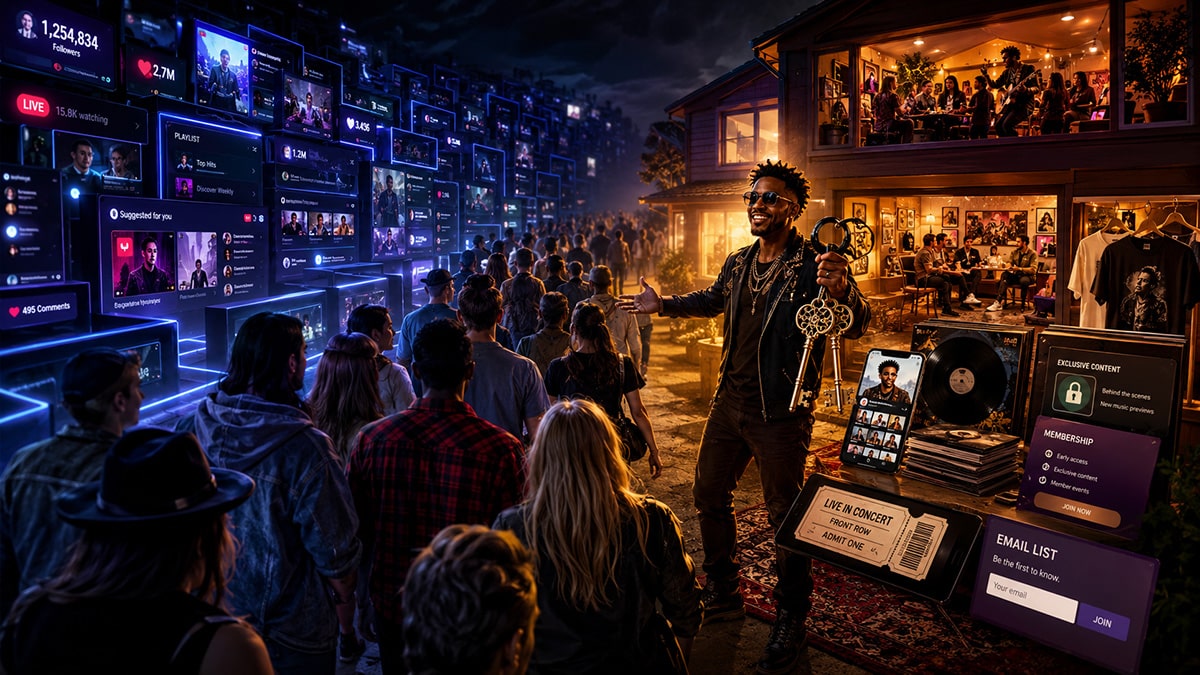
They are doors of discovery.
They are not the house.
A useful content strategy does not simply chase attention. It gives that attention somewhere meaningful to go. It moves interested people from a platform the artist rents into an ecosystem the artist controls. Once there, the fan can choose to share permission-based contact information, receive something valuable, learn more about the artist, attend a show, buy music or merchandise, join a membership, and become part of a lasting relationship.
That is the difference between building an audience and merely borrowing one.
Content Is an Invitation, Not the Final Product
Artists are often encouraged to treat content as if content itself were the business. The goal becomes more views, more reactions, more followers, and more tiny hearts floating upward on a screen.
Those numbers can be useful. They can show that a song, video, idea, or story is connecting with people. They can also help a platform decide whether to show the content to more users.
But attention becomes much more valuable when it leads to another action.
A person watches a live clip and visits the artist’s website. A listener hears a song and joins a hometown show-alert list. A fan scans a QR code at the merchandise table and opens an artist-branded fan page. A vinyl buyer signs up for bonus tracks and care instructions. A concertgoer joins the artist’s Fan Passport community and begins collecting show stamps or rewards.
In each case, the content has done its real job. It has opened a door.
The content does not need to close a sale every time. In fact, a feed made entirely of sales pitches soon begins to feel like a furniture store going-out-of-business commercial that has somehow been going out of business since 1997.
Some content should entertain. Some should explain. Some should tell a story. Some should make people laugh. Some should show the energy of a live performance. Some should introduce the people behind the music. Some should help fans understand what a song means.
Every so often, however, the artist needs to invite the audience to take a next step.
That next step is where a content strategy begins turning into a business strategy.
The Platforms Own the Room
When an artist builds a following on a social platform, the artist does not own the platform, the software, the feed, or the rules that decide who sees a post.
The platform can change its recommendation system. It can reduce organic reach. It can redesign the profile. It can remove a feature. It can restrict an account. It can close. It can be sold to somebody who wakes up on Tuesday and decides every useful button should now be hidden behind three menus and a small picture of a rocket.
The artist may have thousands of followers and still be unable to download a useful list containing those followers’ names, email addresses, locations, purchase histories, communication preferences, and permission records.
The same problem exists with streaming. A streaming service may introduce listeners to an artist, but the artist normally does not receive the listener’s email address or gain permission to contact that person directly. The artist sees aggregated activity instead of a customer relationship.
That does not make the platforms enemies. It makes them rented discovery channels.
A billboard is useful because drivers see it. Nobody builds a store inside the billboard.
Social media should attract attention. Streaming should let people hear the music. Video platforms should show the story and the performance. The artist’s owned ecosystem should give interested fans a place to continue the relationship.
What Permission-Based Fan Data Really Means
Permission-based fan data is information a fan knowingly chooses to share with an artist for a clearly explained purpose.
That information may include an email address, mobile number, first name, city, ZIP code, musical interests, show attendance, merchandise purchases, membership status, communication choices, or favorite types of artist content.
The important word is permission.
A person who buys a ticket has purchased admission to a show. That does not always mean the person has agreed to receive unrelated marketing forever. Someone who writes to ask about booking has not necessarily volunteered for a weekly newsletter. A pile of business cards collected at a conference is not automatically an email list. An address found on somebody’s website is not a magical invitation to begin sending album-release countdowns.
Permission should be clear and connected to the communication the fan expects.
A useful signup statement might tell the person that joining will provide new-release news, nearby show alerts, and occasional artist offers. The form should not quietly enroll the fan in six unrelated lists, share the information with mystery partners, or hide the unsubscribe link somewhere beneath a paragraph written in seven-point gray type.
In the United States, the CAN-SPAM Act sets rules for commercial email. The Federal Trade Commission explains that commercial messages must use accurate header information, avoid deceptive subject lines, identify advertising where required, provide a valid physical postal address, offer a clear opt-out method, and honor opt-out requests within the required period. The FTC’s official compliance guide is available at https://www.ftc.gov/business-guidance/resources/can-spam-act-compliance-guide-business.
CAN-SPAM is not a permission law in exactly the same way as some international privacy rules. An artist should still build an opt-in list because permission creates a healthier relationship, better expectations, and a record showing why the artist is contacting that person.
Artists communicating with people in other countries may face stricter rules. The United Kingdom Information Commissioner’s Office explains that organizations normally need consent before sending unsolicited electronic marketing to individual subscribers under the Privacy and Electronic Communications Regulations. It also explains that valid consent should involve an active choice, such as an unticked box the person deliberately selects. The guidance is available at https://ico.org.uk/for-organisations/direct-marketing-and-privacy-and-electronic-communications/guidance-on-direct-marketing-using-electronic-mail/how-do-we-comply-with-the-pecr-electronic-mail-marketing-rules/.
Text messaging needs even greater care. The Federal Communications Commission states that certain automated calls and texts require prior consent under the Telephone Consumer Protection Act and related FCC rules. The exact requirements depend on the technology, purpose, and circumstances, so artists using an automated SMS platform should follow the provider’s compliance process and obtain legal advice when needed. The FCC’s consumer guidance is at https://www.fcc.gov/consumers/guides/stop-unwanted-robocalls-and-texts.
This article provides business education, not legal advice. Privacy and marketing laws vary by location and can change. The sensible rule is simple: clearly explain what the fan is joining, collect only the information needed, keep a record of consent, protect the data, and make leaving easy.
Trust is difficult to build and remarkably easy to destroy. One shady list import can make a careful artist look like a discount roofing company that somehow knows everybody’s first name.
Your Real Destination Needs to Earn the Click
Telling fans to leave a social platform is only half of the job. The artist must give them a worthwhile place to land.
A destination can be an artist-owned website, a focused landing page, a direct-to-fan store, a membership area, or a fan hub connected to an artist-controlled database. It does not need to be enormous. It needs to be useful.
The page should load quickly on a phone. The artist’s name should be obvious. A new visitor should understand the music and the offer within a few seconds. There should be a clear action to take.
Many artist websites fail because they try to do everything at once. The visitor arrives and is immediately attacked by fifteen icons, three videos that start playing together, a biography long enough to qualify as maritime law, and a popup asking for an email address before the fan has even confirmed that the page belongs to the right artist.
A focused landing page is different.
It is created for one audience, one campaign, and one primary action.
A fan who clicks from a local show video might reach a page offering hometown show alerts and a free live recording. A person who scans a QR code at the merchandise table might land on a page offering a digital set list, show stamp, or bonus track. A listener coming from a smart link might reach a release page with the song, story, lyrics, video, mailing-list invitation, merchandise, and upcoming dates.
The destination should answer four quiet questions in the fan’s mind.
Am I in the right place? Why should I care? What will I receive? What should I do next?
The answer should not require detective work.
What the Artist-Owned Home Should Contain
An artist’s main website should serve as the permanent center of the business.
It should clearly show the artist’s identity, music, story, current activity, show schedule, direct offers, and contact options. It should provide a simple way to join the artist’s email list or fan community. It should include privacy information and give the fan a reasonable idea of what messages will arrive.
A useful homepage should lead with something current. That could be a new release, an upcoming tour, a hometown show, a membership invitation, or a compelling introduction to the artist.
The site should also make listening easy without making streaming the only possible action. A fan may want to hear the song on Spotify or Apple Music, but the same page can offer lyrics, credits, vinyl, downloads, tickets, a video, or an invitation to join the artist directly.
Upcoming shows should be easy to find. Merchandise should be easy to buy. The checkout process should work on a phone. Contact information should be clear enough for legitimate fans, press, venues, and licensing professionals to know where to go.
An electronic press kit can exist within the same ecosystem, but it should not take over the fan experience. A fan looking for a T-shirt should not need to wade through stage plots, technical riders, and a 6,000-pixel publicity photograph of the bass player staring into the middle distance.
The artist’s destination should feel alive. Old tour dates, dead links, missing images, and a “new album coming soon” notice from four years ago quietly tell visitors that nobody is home.
Use Fan Passport to Create Focused Fan-Capture Pages
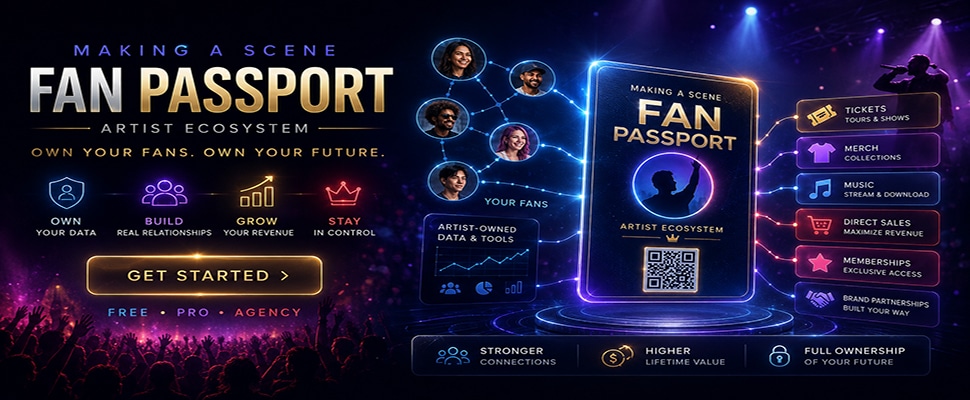
The Making a Scene Fan Passport system can become the bridge between discovery content and the artist’s owned fan ecosystem.
Instead of sending every fan to the same general homepage, an artist can create focused fan-capture pages connected to specific songs, shows, cities, tours, offers, and content campaigns.
The public home for the system is https://masfanpassport.com/. Making a Scene has also published an overview of the Artist Fan Passport OS at https://www.makingascene.org/making-a-scene-artist-fan-passport-os-the-free-gateway-to-an-artist-owned-music-economy/. The Fan Passport mobile experience is designed around direct artist-fan connection, show check-ins, QR engagement, passport stamps, rewards, artist updates, and fan activity that can continue beyond a social feed.
A Fan Passport capture page should have one clear purpose.
For a local show, the page might invite the fan to join the artist’s hometown list, check in, collect a show stamp, and receive a live recording after the performance. The form might request a first name, email address, and ZIP code. It should explain that the artist will use the information for show announcements, music news, and selected fan offers.
For a regional tour, the artist can create separate capture pages for Atlanta, Nashville, Charlotte, and Birmingham. Each page can carry the city name, venue, date, ticket link, local incentive, and permission form. When fans join through the Atlanta page, the artist gains useful location and campaign context instead of one giant mystery list labeled “people from the Internet.”
For a release campaign, the artist can build a page around the new song. The page can feature the track, video, story, credits, lyrics, artwork, purchase options, and a signup invitation for an acoustic version or release-night livestream.
The capture page should not feel like paperwork. It should feel like the beginning of an experience.
A fan might scan a code at a show, join in less than a minute, collect a digital stamp, and unlock something connected to that night. The artist then has permission to continue the relationship according to the terms shown on the page.
The value of Fan Passport is not simply that it can collect an email address. A basic form can do that. The larger opportunity is to connect the signup with a fan journey involving shows, rewards, activity, direct communication, and future offers inside an artist-owned system.
The capture page becomes the front door. The fan record becomes the memory. The welcome message becomes the first conversation. The next show, release, or offer becomes the next chapter.
Give Each Piece of Content a Job
A practical content strategy becomes easier when the artist stops asking, “What should I post today?” and starts asking, “What job does this content need to do?”
Discovery content introduces the artist to people who may not know the music. It may include short performance clips, collaborations, music reactions, entertaining stories, genre discussions, searchable videos, interviews, covers, or behind-the-scenes moments.
Trust content helps the audience understand the person and the work. It may explain the story behind a song, show the recording process, introduce the band, share a tour lesson, answer a fan question, or reveal why a certain lyric matters.
Proof content shows that the artist experience is worth joining. A strong crowd clip can demonstrate the live show. A well-recorded acoustic performance can prove musicianship. Fan photographs can show community. A packing video can show merchandise quality. A licensing placement can demonstrate professional activity when the artist is allowed to discuss it.
Conversion content gives the audience a specific invitation. It points to a Fan Passport capture page, ticket page, store, membership, release page, or signup offer.
Retention content serves the people who already joined. It may include welcome messages, exclusive videos, early access, fan polls, personal updates, local show alerts, rewards, and direct offers.
A healthy strategy uses all of these jobs. The discovery post brings someone to the door. Trust content gives that person a reason to care. Conversion content asks for a next step. Retention content proves that joining was worthwhile.
Build Calls to Action That Actually Say Something
“Link in bio” tells the fan where to click. It does not explain why.
“Check it out” may refer to a new song, a tour, a sandwich, or the strange sound coming from the van’s transmission.
A strong call to action gives the fan a reason to leave the platform.
“Join the Atlanta list and get first notice when tickets go on sale” is specific.
“Scan the code to collect tonight’s Fan Passport stamp and receive the live encore tomorrow” is specific.
“Join the release page for the acoustic version and the story behind the song” is specific.
“Get the free lyric book and hear about new music directly from us” is specific.
The call to action should match the content. A video about the story behind a song should lead to a deeper release page. A rehearsal clip for an upcoming concert should lead to tickets or a city-based show-alert page. A merchandise video should lead to the exact product, not the artist’s homepage where the fan must begin a digital scavenger hunt.
An artist does not need to include five calls to action in every post. One strong invitation is usually easier to understand than a choice between streaming, subscribing, donating, joining, shopping, voting, following, saving, preordering, and becoming the band’s emergency keyboard technician.
Offer Something Worth Joining For
A fan rarely wakes up thinking, “Today I hope to join another mailing list.”
The artist must frame the invitation around the value the fan will receive.
That value might be an unreleased song, a live recording, a digital lyric book, early ticket access, a hometown show alert, a tour diary, an acoustic session, a merchandise discount, a sample pack, guitar tabs, production notes, behind-the-scenes video, a fan reward, or access to a member community.
The best incentive connects naturally to the artist.
A blues guitarist might offer a live bootleg from a hometown club. A producer might share a small sample pack. A songwriter might provide a lyric book with notes about each song. A touring band might offer city-specific presales and road updates. A local artist might offer a monthly list of nearby performances.
The incentive does not always need to be free music. Fans may already have easy access to the recorded song. The more valuable offer may be context, access, recognition, convenience, or belonging.
The artist should also avoid creating an incentive that becomes a second unpaid career. Promising a new exclusive documentary every week may sound exciting until Thursday arrives and the artist is editing footage at 3:00 in the morning while wondering whether civilization truly needs episode four of “Loading the Van.”
Make the offer valuable, repeatable, and realistic.
Welcome the Fan Immediately
The first message after signup is one of the most important parts of the funnel.
The fan has just taken action. Interest is high. The artist should confirm the signup, deliver the promised item, explain what happens next, and make the communication feel human.
The welcome message might thank the fan, provide the download or access link, explain how often updates are sent, and invite one small reply.
An artist could ask which city the fan lives near, which song led them to the page, or what kind of content they would enjoy. That response can begin a conversation and improve future segmentation.
The welcome sequence does not need to become a twenty-seven-email psychological maze. A few useful messages can introduce the artist, share the strongest music, explain the story, point to upcoming shows, and invite the fan to a relevant offer.
The goal is not to trick a new subscriber into buying something before the digital ink dries on the signup form. The goal is to prove that joining the artist’s ecosystem was a good decision.
Move Fans Through a Human Funnel
The phrase “fan funnel” can sound like something invented by a consultant who owns twelve whiteboards.
In practice, it is simply a way to understand how relationships develop.
A stranger discovers a clip. That person listens to a song. The listener visits the artist’s capture page. The visitor grants permission to receive updates. The new contact begins opening emails or using Fan Passport. The active fan attends a show or purchases something. The buyer has a good experience and becomes a repeat supporter.
Not everybody follows the same path. Some people will listen for years before attending a concert. Some will buy vinyl during their first visit. Some will attend every local show but never join a membership. Some will support a crowdfunding campaign because a particular project speaks to them.
The funnel should not force everybody toward the same purchase.
It should help the artist offer relevant next steps based on what the fan has already done.
A person who joined for local show alerts should receive nearby show information. A vinyl buyer may be interested in signed editions and direct releases. A fan who checked in at three concerts may appreciate a loyalty reward, VIP opportunity, or early ticket access.
The funnel is not about squeezing money out of people. It is about reducing the distance between interest and a useful opportunity to support the artist.
A Local Artist Can Start This Weekend
Imagine a local artist performing at a neighborhood venue on Friday.
On Monday, the artist posts a rehearsal clip with a clear invitation to join a Fan Passport capture page for local show alerts and a free recording from Friday’s set.
On Wednesday, the artist shares the story behind one song and links to the same page.
On Friday, a QR code appears at the entrance and merchandise table. Fans scan it, join with permission, check in, and receive a show stamp or reward.
On Saturday, the artist sends a thank-you message with the promised live track, a photograph from the show, and an invitation to the next date.
The artist now has more than a crowd memory and a few tagged photographs. The artist has a group of people who attended, opted in, and can be invited back.
The process can also help the artist learn whether fans are coming from the immediate neighborhood, another part of the city, or surrounding towns. That information can guide venue choices, advertising, collaborations, and merchandise decisions.
The local artist does not need a national campaign. Ten permission-based contacts from a real show may be more useful than a large batch of random followers who live thousands of miles away and have never heard a complete song.
A Regional Artist Needs Location Intelligence
Regional touring creates a different challenge.
The artist may have fans spread across several cities, but a single general list makes it difficult to send useful messages. Announcing every date to everybody can exhaust subscribers. Announcing only the full tour once may cause interested fans to miss the show.
City-based Fan Passport capture pages solve part of this problem.
A regional artist can send Nashville content to a Nashville page, Charlotte content to a Charlotte page, and Atlanta content to an Atlanta page. Each signup carries useful context about where the fan entered.
The artist can then announce a show to fans in or near that market. A second message can go to people who clicked but did not buy. A post-show message can thank attendees, provide photographs or a reward, and invite them to the next regional date.
Over time, the artist can see which markets contain active supporters. That does not guarantee ticket sales, but it creates better information for routing, venue conversations, local advertising, street-team activity, house concerts, and repeat visits.
A map of permission-based fans is not the same as a map of social followers. It represents people who deliberately asked to hear from the artist.
That is business intelligence an independent artist can actually use.
A National Touring Artist Needs Segmentation and Systems
At the national level, the same idea becomes more organized.
A touring artist may segment fans by city, state, past show attendance, purchase history, membership status, release interest, and communication preference.
The artist can create separate Fan Passport capture pages for a tour announcement, VIP campaign, album preorder, festival appearance, livestream, and membership drive.
The database should preserve where the person joined, what permission was given, which offer was shown, and what actions followed.
That information helps the artist avoid treating every fan as identical.
A fan who attended four shows and bought vinyl may receive a loyalty invitation. A fan who joined for a livestream may receive digital offers. A fan who repeatedly visits tour pages may receive a presale notice. A music supervisor or industry contact should not be mixed into the same messages as consumer fans unless that person deliberately chose to join.
More advanced segmentation should make communication more relevant, not more creepy. The artist does not need to tell a fan, “We noticed you looked at the blue hoodie for forty-three seconds at 2:14 a.m.”
Use the information to serve people better. Do not make them feel watched through the curtains.
Turn One Creative Event Into a Content System
Artists often believe a content strategy requires creating something new every day.
That is a wonderful way to become tired of both music and the Internet.
A more practical strategy begins with a real creative event. That event could be a song release, rehearsal, recording session, concert, interview, video shoot, songwriting session, merchandise launch, or tour day.
A recording session can produce a full behind-the-scenes video, several short clips, photographs, a studio diary, a technical explanation, a lyric discussion, an email, a Fan Passport update, and a release-page story.
A live show can produce performance clips, crowd moments, a set-list download, a post-show message, fan photographs, a future show advertisement, a live track, and a city-specific capture page.
An interview can become an article, short video clips, quotations, an email story, a podcast excerpt, and several answers to common fan questions.
Each version should fit the platform where it appears, but all versions should point toward the same artist-owned destination.
The social clip creates curiosity. The website provides the full story. The Fan Passport page captures permission. The welcome message continues the relationship. The offer creates a revenue opportunity.
That is a content system.
Email Is Still the Backbone
Email remains useful because it allows an artist to communicate directly with people who have provided an address and agreed to receive messages.
An artist can use email for welcome messages, releases, show announcements, presales, merchandise, memberships, tour stories, surveys, direct sales, and personal updates.
Email platforms also commonly provide forms, tags, segments, automations, and reporting. Kit, at https://kit.com/, offers creator-focused landing pages, forms, email marketing, segmentation, automations, and commerce tools. Its landing-page information is available at https://kit.com/features/landing-pages.
Mailchimp, at https://mailchimp.com/, provides audience tools, forms, email campaigns, and export options. Its documentation explains that audiences and segments can be exported as CSV files, and its import guidance reminds users that subscribed contacts should have permission to receive marketing. The export instructions are at https://mailchimp.com/help/view-export-contacts/ and the import instructions are at https://mailchimp.com/help/import-contacts-mailchimp/.
Bandzoogle, at https://bandzoogle.com/, provides musician websites with tools for music, tour dates, merchandise, ticketing, mailing lists, and landing pages. Its help documentation explains how artists can create email opt-in landing pages and collect addresses through their music websites. The relevant guide is at https://bandzoogle.com/help/articles/588-how-to-create-an-email-opt-in-landing-page.
These are examples, not universal recommendations. Artists should compare pricing, subscriber limits, sending limits, automation features, integrations, customer support, data-export tools, and terms before choosing a service.
Whatever service is selected should connect cleanly with the artist’s website, Fan Passport pages, store, ticketing, and larger fan database.
Data Portability Is Part of Ownership
An artist does not truly control fan data if the information cannot be exported in a useful form.
Before choosing a platform, the artist should find out whether contacts can be exported as a standard CSV file. The export should preserve useful fields such as email address, signup date, source, tags, location, status, and consent information where available.
Purchase history, show attendance, membership status, and fan activity should also be portable whenever the system collects them.
The artist should maintain regular backups. Those backups must be protected because fan data is personal information, not a box of old guitar cables that can be left beside the water heater.
The artist should also understand what happens to unsubscribe records. Moving a list without preserving opt-outs can cause the artist to begin mailing people who already asked to leave.
A platform that calls itself artist-owned while trapping all useful records behind an unexportable wall has simply built a more fashionable cage.
Connect Streaming to Ownership
A smart link can help listeners choose their preferred streaming service. That is useful.
The problem begins when the smart link sends fans from one rented platform directly into another rented platform and offers no route back to the artist.
A release page should contain the streaming choices, but it should also offer direct listening, direct sales where appropriate, lyrics, credits, merchandise, tickets, and an invitation to join the artist.
The streaming platform introduces the music. The artist’s page expands the experience.
An artist might place a Fan Passport invitation beneath the streaming buttons. The offer could provide an acoustic version, release notes, a listening-party invitation, early tour access, or a digital stamp connected to the release.
Now the stream becomes the first step instead of the final destination.
Turn Live Shows Into Relationship-Building Events
Live shows are among the best places to invite fans into an owned ecosystem because the fan is already physically present and emotionally engaged.
The invitation must still be respectful.
A QR code can appear on the merchandise table, table tent, poster, screen, ticket insert, or printed set list. The person scanning it should immediately see the artist’s name, the show, the offer, and the permission statement.
Staff can explain the benefit in one sentence. “Scan here to collect tonight’s Fan Passport stamp and get the live encore tomorrow” is much stronger than “Give us your data.”
The artist might create a venue-specific capture page so the source is recorded automatically. The fan checks in, receives a reward, and joins the artist’s communication system.
After the show, the artist can send a thank-you message, photographs, a live track, the next date, or a merchandise offer.
That follow-up changes a one-night encounter into the beginning of a repeat relationship.
The merch table should also support the system. A buyer may be invited to register a limited product, unlock bonus material, receive care instructions, collect a reward, or join future release announcements.
The permission should remain clear. Buying a shirt is not always the same as agreeing to every form of future marketing.
Measure What Happens After the Post
Content performance should not end with views and likes.
The artist should ask what happened next.
Did people visit the profile? Did they click the link? Did they reach the capture page? Did they complete the form? Did they buy a ticket? Did they purchase merchandise? Did they return later? Did the campaign create revenue?
Tagged links can help identify where traffic originated. Google Analytics supports campaign parameters commonly used to identify referring campaigns and traffic sources. Google’s marketer guidance explains how URL tagging can be used to identify campaigns that send visitors to a site. The official information is at https://developers.google.com/analytics/learn/marketers.
An artist can create different links for Instagram, Facebook, YouTube, an email, a venue poster, and a merchandise-table QR code. Each link can lead to the same capture page while identifying the source.
Fan Passport capture pages can provide another layer of context by connecting a signup to a city, show, release, reward, or campaign.
The artist does not need an enormous analytics department. A simple monthly review can reveal which content created useful activity.
A post with fewer views may produce more signups or ticket sales than a viral clip. That makes the smaller post more valuable to the business.
Vanity metrics tell the artist who looked.
Business metrics help reveal who moved closer.
Use AI as an Assistant, Not an Imaginary Employee
AI tools can help an artist turn one idea into multiple pieces of content.
An artist might use AI to brainstorm angles for a song story, summarize a long interview, draft a content calendar, reshape a transcript, create first drafts of captions, suggest email subject lines, categorize campaign notes, or identify repeated fan questions.
AI can also help organize content by purpose. It can suggest which pieces are designed for discovery, trust, conversion, and retention.
Every output should be reviewed.
AI should not invent press quotes, fan testimonials, venue names, tour dates, ticket links, sales numbers, licensing placements, awards, or stories from the artist’s life. It should not be allowed to turn “We once played near Chicago” into “The band sold out Soldier Field before a roaring crowd of 60,000.”
Artists should also be careful about uploading private fan records, email lists, purchase data, contracts, unreleased music, or sensitive business information into AI services without understanding the service’s privacy and data-use terms.
The best use of AI is to remove repetitive office work, not to replace the artist’s voice or the fan’s trust.
AI should help the artist create more time for music, shows, relationships, and revenue-producing work.
Web3 Should Solve a Real Problem
Web3 tools may support portable identity, digital membership, verified ownership, token-gated access, digital collectibles, and artist-controlled community systems.
The useful idea is portability.
A fan identity or membership should not need to disappear because one community platform closes. An artist should be able to verify that a fan holds a membership, attended an event, purchased an item, or earned a reward without depending completely on one corporation’s private database.
That does not mean every fan needs a crypto wallet, a twelve-word recovery phrase, and the emotional resilience required to understand gas fees before hearing the new single.
The technology should remain in the background.
The fan experience should remain simple. Join. Attend. Support. Collect. Unlock. Return.
Fan Passport can use the idea of a portable fan identity and reward history without requiring the artist’s audience to become blockchain technicians. The goal is not to sell technology. The goal is to create a durable artist-fan relationship that is less dependent on closed platforms.
Connect the Funnel to Real Revenue
Permission-based fan data becomes valuable when it helps the artist serve people with relevant opportunities.
A local fan can be invited to a nearby show. A frequent attendee can receive early ticket access. A vinyl buyer can hear about a signed edition. A musician who follows the artist’s production content may be interested in lessons, workshops, presets, sample packs, or studio services. A highly engaged supporter may join a membership or crowdfunding campaign.
The same ecosystem can support house concerts, livestream tickets, direct downloads, merchandise bundles, tips, fan experiences, subscriptions, teaching, production, session work, publishing opportunities, and sync-related announcements.
The artist should not treat every subscriber as a wallet with an email address.
Revenue follows trust when the offer matches the relationship.
A person who joined yesterday may need more music and story before receiving a major offer. A longtime fan who attends shows and buys records may appreciate a premium package or membership. A fan who lives across the country may prefer livestreams, direct music, or shipped merchandise.
The purpose of the database is not to squeeze everyone through the same checkout.
It is to understand enough about the relationship to make better invitations.
Build the First Version With What You Have
An artist does not need a giant technology stack to begin.
Start with one owned destination. That may be an existing website or a Fan Passport capture page.
Choose one useful offer. It might be local show alerts, an unreleased track, a live recording, a lyric book, a tour diary, early tickets, or a show stamp.
Create one form that asks only for the information needed. Explain what the person will receive and how the artist will communicate.
Write one welcome message that thanks the fan and delivers the offer.
Update the artist’s social profiles so the main link leads to the page. Pin a post explaining why fans should join.
Create several pieces of discovery and trust content that naturally lead to the same invitation.
Place the capture page’s QR code at shows and the merchandise table.
After a few weeks, review the results. Look at visits, signups, replies, ticket activity, sales, and fan questions. Improve the page and offer based on what actually happened.
That is already a working funnel.
Advanced automation, tagging, city segmentation, membership tools, integrated ticketing, and staff access can be added as the audience grows.
Do not wait until every system is perfect. A small, clear, respectful funnel operating today is more useful than a magnificent master plan trapped in a document called FINAL-CONTENT-STRATEGY-V27-REALLY-FINAL.
Common Ways Artists Break Their Own Funnel
The first mistake is posting without giving people a destination.
The second is sending everyone to a homepage with no clear action.
The third is asking for too much information too soon. A first name and email address may be enough for an initial relationship. The artist probably does not need the fan’s employer, birthday, favorite sandwich, and mother’s maiden name to deliver an acoustic track.
Another mistake is offering nothing specific in return for joining.
Some artists collect addresses and then send no welcome message. Others disappear for six months and return with an urgent demand that everybody preorder a deluxe box set.
Some send too often. Some never segment by location. Some promote every show to every fan. Some keep dead links active. Some forget to test the page on a phone.
A serious mistake is failing to export and back up data. Another is importing contacts without clear permission. Another is treating social followers as if they already belong to the artist’s direct list.
The fan experience should be tested from beginning to end.
Click the social link. Open the page. Read the offer. Complete the form. Check the welcome message. Download the item. Visit the store. Test the ticket link. Try to unsubscribe.
The artist should experience the funnel exactly as the fan does.
That one afternoon of testing may reveal more than three months of staring at an analytics dashboard while making thoughtful noises.
The Fan Should Feel the Difference
A healthy artist-owned ecosystem should not feel like a database wearing a band T-shirt.
It should feel welcoming.
The fan should know where they are, why the page exists, and what happens after joining. The site should work on a phone. The offer should be easy to understand. The artist’s identity should be clear. The privacy language should be readable. The unsubscribe process should be simple.
The fan should receive something worth having.
That might be access, information, music, recognition, rewards, convenience, or community.
The relationship should improve over time. Messages should become more relevant. Show information should match the fan’s location. Offers should connect to real interests. Purchases should be fulfilled properly. Membership promises should be kept.
A fan should never feel that joining was a trick.
The best fan funnel does not feel like a funnel from the fan’s side.
It feels like getting closer to an artist they care about.
Bring the Fans Home
Social media is useful. Streaming is useful. Video platforms are useful. Playlists are useful.
They can introduce an independent artist to people who might never discover the music otherwise.
But they are doors.
The artist’s website is the home. The permission-based database is the memory. Email and direct communication are the connection. Fan Passport can become the front entrance that links discovery, live shows, fan capture pages, check-ins, rewards, and ongoing activity. The store, ticketing system, membership area, and content library create places where support can turn into income.
An artist-owned ecosystem can survive an algorithm change because the artist still has direct contact with the fans. It can survive a platform decline because the records are portable. It can survive a changing trend because the relationship is based on music, value, and trust rather than one style of post.
Content is not the final product. Content is the invitation.
The fan relationship is the asset. Trust is the foundation. Permission is the doorway. The artist-owned ecosystem is the destination.
Revenue is what becomes possible when the artist serves those fans well, respects their choices, and gives them meaningful ways to support the music over time.
Stop feeding the algorithm as though it is eventually going to become your manager, booking agent, and retirement plan. Use it to open the door. Then bring the fans home.
 |  Spotify |  Deezer |  Breaker |
 Pocket Cast |  Radio Public |  Stitcher |  TuneIn |
 IHeart Radio |  Mixcloud |  PlayerFM |  Amazon |
 Jiosaavn |  Gaana |  Vurbl |  Audius |
 Reason.Fm | |||
Find our Podcasts on these outlets
Subscribe to Our Newsletter
Discover more from Making A Scene!
Subscribe to get the latest posts sent to your email.


