TikTok Is Still Music Discovery, But the Money Is Moving Behind Closed Doors




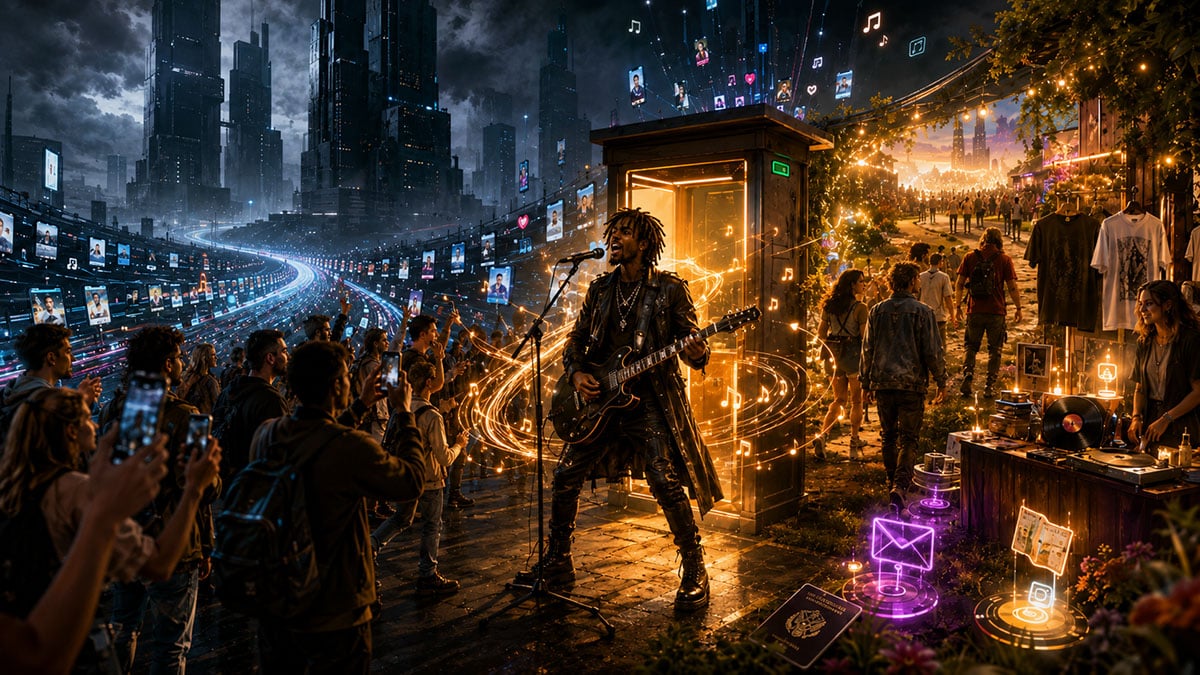
Making a Scene Presents – TikTok Is Still Music Discovery, But the Money Is Moving Behind Closed Doors
Listen to the Podcast Discussion
TikTok Is Not Your Fanbase. It Is a Discovery Tollbooth.
For the last few years, the music industry has sold artists a simple dream. Post the right clip on TikTok. Catch the algorithm at the right moment. Get a sound moving. Watch the streams roll in. Maybe a label calls. Maybe a playlist adds you. Maybe lightning hits.
That dream was not fake. TikTok really did change music discovery. A song could come from a bedroom, a garage, a tiny studio, or a laptop on a kitchen table and suddenly land in the ears of millions. That was powerful. For independent artists, it felt like a crack in the old wall. You no longer had to beg radio programmers, label scouts, or magazine editors to let you into the room. You could kick the door open with a 20-second clip.
But here is the part artists need to understand now. TikTok is still music discovery, but the money is moving behind closed doors.
The new multi-year global licensing agreement between Universal Music Group and TikTok makes that very clear. This is not just a deal about letting songs sit in a video library. It is not just about users dancing to catalog tracks or creators lip-syncing to hooks. The deal includes expanded marketing, advertising campaigns, ecommerce tools, artist-centered tools, AI protections, attribution, fan engagement, and social-media monetization. That tells us something important. TikTok is no longer just a place where music gets discovered. It is becoming a licensing, commerce, advertising, data, and fan-engagement battleground.
And if you are an independent artist, you need to pay close attention.
Because while the major labels are negotiating for better terms, better tools, better protection, and better access, most indie artists are still being told to “just post more content.” That is not a strategy. That is unpaid labor for the platform.
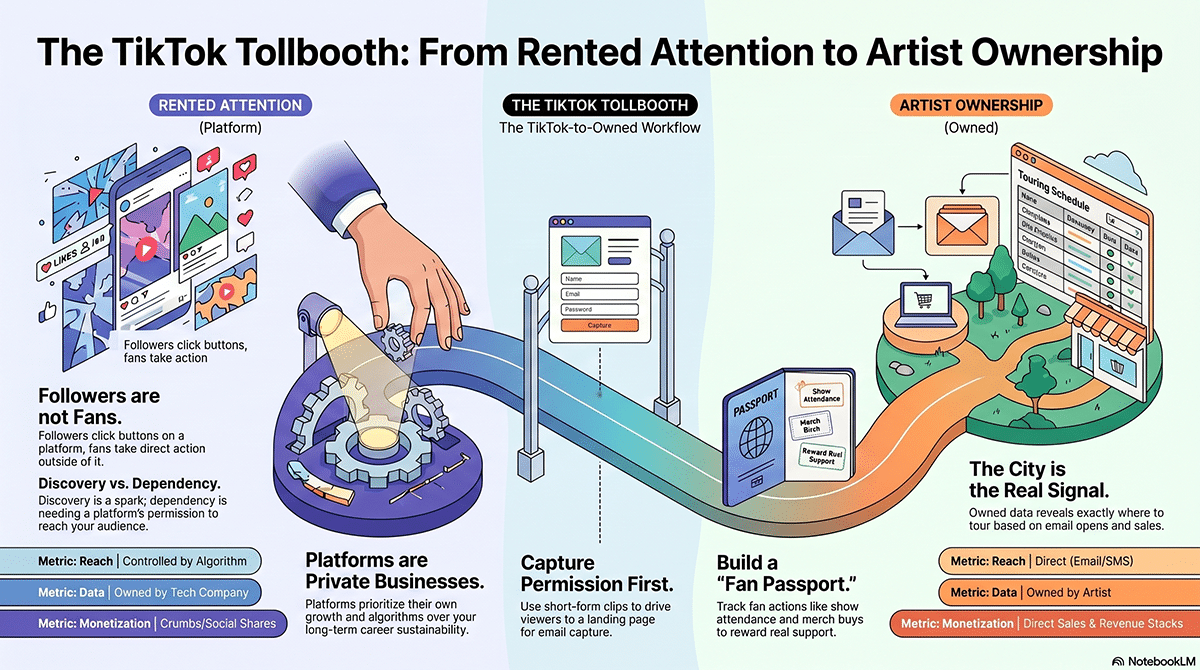
TikTok is not your fanbase. TikTok is a discovery tollbooth. It can put you in front of people, but it owns the road. It controls the signs. It sets the speed limit. It decides which cars get waved through and which ones get stuck in traffic. If you build your whole career on that road, you are not building a business. You are renting attention from someone else’s machine.
The job now is not to leave TikTok. That would be foolish. The job is to stop confusing TikTok attention with artist-owned value.
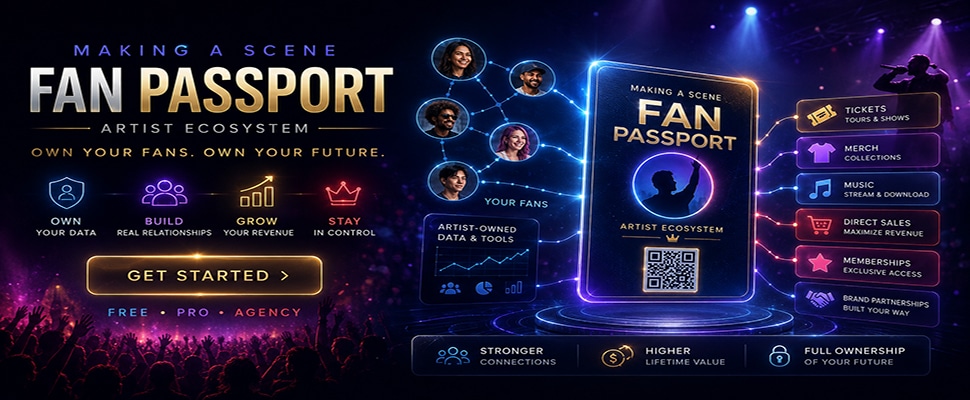
Use TikTok. Use Instagram Reels. Use YouTube Shorts. Use every short-form video platform that can put your music in front of new people. But do not stop there. Move those people into a world you control. Move them to your website. Move them to your email list. Move them to your merch store. Move them to your show alerts. Move them into a fan passport system where their actions, location, purchases, support, and relationship with you become part of a long-term artist-owned revenue stack.
Discovery is not the finish line. Discovery is the front door.
And right now, the front door has a toll collector.
What the UMG and TikTok Deal Really Says
The new UMG and TikTok deal is being presented in the clean language of corporate partnership. The companies talk about creative opportunity, artist development, ecommerce, better monetization, AI protection, and fan engagement. All of that matters. But artists should read between the lines.
When a company like UMG signs a major licensing agreement with TikTok, it is not only thinking about exposure. UMG is not walking into that room saying, “Please let our artists go viral.” UMG is thinking about rights. It is thinking about catalog value. It is thinking about compensation. It is thinking about how music feeds social video, advertising, commerce, and AI systems. It is thinking about where the next layer of money will come from.
That is the real story.
TikTok became one of the most powerful music discovery engines in the world because music makes short-form video work. A silent TikTok feed would be a pretty sad little slot machine. Music gives clips emotion. It turns product demos into stories. It turns jokes into trends. It turns strangers into participants. It turns a chorus into a cultural signal. It gives users something to copy, remix, share, and repeat.
That means music is not decoration on TikTok. Music is fuel.
UMG knows this. TikTok knows this. The labels know this. Advertisers know this. The tech companies know this. The only people who are still being asked to act like exposure is the main reward are the artists.
The 2024 UMG and TikTok standoff already showed how serious this had become. When UMG’s prior agreement expired, music by major artists connected to Universal started disappearing from TikTok. That was not a small argument. It was a public fight over artist and songwriter compensation, AI protections, and online safety. It showed that music’s value inside short-form video was no longer some side issue. It was central to the platform economy.
Now the new deal shows the next stage. The fight is not just over whether songs appear on TikTok. The fight is over who gets paid, who gets protected, who gets tools, who gets data, who gets access to commerce, and who gets to turn discovery into real money.
That is why independent artists should not look at this deal as some faraway major-label story. This is not just about Taylor Swift, Drake, Billie Eilish, Olivia Rodrigo, Ariana Grande, Bad Bunny, or any other major act whose catalog has global leverage. This is about the future shape of music marketing. The majors are negotiating the platform layer while indie artists are still trying to decode why one video got 400 views and another got 40,000.
That gap matters.
If the new music business is being built inside private licensing deals, ad products, ecommerce integrations, and AI protection systems, then the independent artist has to ask a hard question. Where is my leverage?
The answer is not to complain about platforms. The answer is to build your own.
TikTok Still Matters. Let’s Not Be Silly.
There is a lazy version of this argument that says, “TikTok is bad, so artists should leave.” That is not serious.
TikTok still matters. Short-form video still matters. Music discovery has changed forever because people now discover songs through moments, not just through albums, radio, reviews, or playlists. A guitar riff can hit because it soundtracks a cooking video. A chorus can travel because people use it to tell their own story. A lyric can spread because it gives people words for something they already feel. A beat can move because it fits a visual joke, a dance, a transformation, a memory, or a mood.
That is not going away.
For independent artists, this is still a huge opportunity. TikTok can introduce your music to people who never would have searched for you. Reels can push your face, your sound, and your story into scenes you could not reach alone. Shorts can turn old catalog tracks into new entry points. A song does not have to be new to be discovered. It only has to be useful in the culture.
That is a big deal.
The problem is not discovery. The problem is dependency.
Discovery is when someone hears your song and wants to know more. Dependency is when the only way you can reach that person again is by asking the same platform for permission. Discovery is when TikTok introduces you to a fan. Dependency is when TikTok keeps the fan and rents you access to them later. Discovery is a spark. Dependency is a cage with neon lights.
Artists need to understand the difference.
The short-form platforms are great at creating moments. They are not built to create artist-owned careers. Their job is to keep people scrolling. Your job is to build a fan relationship that lasts after the scroll is over. Those two goals overlap for about three seconds. After that, they split.
TikTok wants the user to watch another video. You want the listener to become a fan.
That is the whole battle.
The Platform Is Not the Audience
One of the biggest mistakes artists make is thinking that followers are fans.
They are not the same thing.
A follower is someone who clicked a button inside a platform. A fan is someone who will take action for you outside the platform. A follower might like a video. A fan might buy a shirt. A follower might save a clip. A fan might drive 40 minutes to see you play. A follower might comment with fire emojis. A fan might join your email list, buy vinyl, subscribe to your community, tell friends, and show up again next month.
Followers are rented attention. Fans are relationships.
This is why TikTok is not your fanbase. TikTok is the room where some of your future fans may first see you. That is useful. That is important. That is worth working. But the room belongs to TikTok.
If TikTok changes the algorithm, your reach can drop. If TikTok changes its music rules, your sound can get muted. If TikTok shifts toward paid promotion, your organic reach can get squeezed. If TikTok gets pulled into political or regulatory fights, your access can be threatened. If TikTok decides another content format is more profitable, your strategy can go stale overnight.
The same is true of Instagram. The same is true of YouTube. The same is true of any platform where you do not control the relationship.
This is not paranoia. This is just how platforms work.
Platforms are not public utilities. They are private businesses. Their job is to grow their own value. If your content helps them do that, they may reward you with reach. If your content no longer fits the machine, the machine moves on. It is not personal. It is colder than personal. It is math.
That is why artists need their own center of gravity.
Your website should not be a dusty digital business card. It should be your headquarters. Your email list should not be an afterthought. It should be your direct line to fans. Your merch store should not just sit there waiting for strangers. It should be connected to your content, your shows, your releases, and your fan journey. Your show alerts should not depend only on social posts. They should reach the people who already told you where they live. Your fan passport should not be a gimmick. It should be the record of the relationship between you and the people who actually support you.
That is the difference between being discovered and being owned.
The Money Is Moving Into the Stack
The phrase “revenue stack” may sound like business-school nonsense, but for artists it is very simple.
A revenue stack is all the ways your music creates money. Streaming is one layer. Live shows are another. Merch is another. Direct music sales are another. Licensing is another. Publishing is another. Fan memberships are another. VIP events are another. Crowdfunding is another. Sync opportunities are another. Teaching, production, session work, beat packs, stems, digital collectibles, private performances, and community access can all become layers too.
The old industry trained artists to chase one big door. Get signed. Get on radio. Get on MTV. Get on playlists. Get on the right tour. Get blessed by the gatekeeper.
The new industry requires a different mindset. You do not need one door. You need many doors that all lead back to your own house.
This is where TikTok becomes dangerous if artists misunderstand it. A viral moment can feel like success because the numbers are big. But big numbers are not the same as a business. A million views with no email list, no merch offer, no show strategy, no fan data, no direct relationship, and no follow-up system can vanish like smoke.
A smaller audience that you own can be more valuable than a huge audience you cannot reach.
That is not romantic. That is math.
If 500 people on your email list care enough to open your messages, buy your merch, attend your shows, and support your work, that can mean more than 50,000 passive followers who never leave the feed. If 100 fans in one city have bought from you, streamed you, scanned a show code, or joined your fan passport, that city matters. That is tour data. That is merch data. That is booking data. That is proof of demand.
TikTok can help start that process. But TikTok cannot be the whole process.
The money is moving into the stack. That means the independent artist has to build a stack too.
What the Majors Understand That Indie Artists Must Learn
Major labels are not always smarter than independent artists. Let’s be clear about that. Plenty of major-label thinking is slow, bloated, and still addicted to old control systems. But the majors do understand one thing very well.
They understand leverage.
UMG did not fight TikTok because it hated exposure. UMG fought TikTok because exposure without proper value capture is a bad deal when your catalog is helping power the platform. The label understood that songs are not just promotional objects. Songs are assets. They generate culture, attention, advertising value, user retention, data, and commerce.
That is the lesson independent artists should steal.
Your music is not just content. Your music is an asset.
Your story is an asset. Your audience is an asset. Your fan data is an asset. Your live draw is an asset. Your merch demand is an asset. Your email list is an asset. Your city-by-city fan map is an asset. Your direct relationship with supporters is an asset.
If you treat all of that like disposable content, the platforms will happily treat it the same way.
The majors negotiate because they control valuable catalogs. Indie artists may not have that kind of catalog leverage, but they can build relationship leverage. They can know who their fans are. They can know where they live. They can know what they buy. They can know who shows up. They can know which songs move people. They can know which clips bring real supporters and which clips only bring empty views.
That is the indie advantage.
The major-label system is built around scale. The independent artist’s advantage is closeness. You can know your fans in a way a multinational corporation never will. You can talk directly to them. You can remember them. You can reward them. You can build scenes around them. You can see which 200 people are doing more for your career than 20,000 strangers.
But only if you collect the relationship.
That is where the fan passport idea becomes powerful.
The Fan Passport Is the Anti-Algorithm
A fan passport is not just a cute loyalty card. It is a different way to think about fan relationships.
The platform model says the fan belongs to the platform. The fan passport model says the fan has a direct relationship with the artist. The platform model tracks engagement to sell ads. The fan passport model tracks engagement to reward support, build community, plan smarter shows, and create real income for the artist.
Think of it like this. A fan hears your song on TikTok. They click the link in your profile. They land on your website. They sign up for a free track, early ticket access, a behind-the-scenes video, or a discount at your merch table. They enter their email and city. Maybe they add a phone number if they want show alerts. They get a digital fan passport. From that point forward, their actions can matter.
They buy a shirt. Stamp.
They attend a show. Stamp.
They bring a friend. Stamp.
They buy vinyl. Stamp.
They join a listening party. Stamp.
They support a release campaign. Stamp.
They street-team a poster or share a tour alert. Stamp.
This is not about turning fans into data points like some creepy tech bro fever dream. This is about recognizing support. It is about saying, “You are not just a follower lost in the feed. You are part of this artist’s story.”
That changes everything.
Now the artist knows which fans are active. The artist knows which cities have real heat. The artist knows which merch sells in which markets. The artist knows who should get early access. The artist knows who should get rewarded. The artist knows where to route a tour. The artist knows which fans are casual listeners and which ones are becoming the core.
That is artist-owned intelligence.
And unlike TikTok analytics, it does not disappear when the platform changes the dashboard.
The TikTok-to-Owned Workflow
The smartest independent artists will not use TikTok as a destination. They will use it as an entry point.
The workflow should be simple, but it must be intentional. A short-form video should not just say, “Listen to my song.” It should create a reason for the viewer to take the next step. That step should lead somewhere the artist controls.
A clip might show the most emotional line in the song. The caption might invite people to hear the full story. The profile link should not send them to a messy page with ten platform buttons. That is how you lose people. The link should send them to one clear landing page on the artist’s own website.
That page should have one job.
It might offer the full song, an acoustic version, a lyric breakdown, a free download, a private video, a tour alert signup, or early access to merch. The fan gives an email address and location to unlock the next step. That is the trade. The artist gives value. The fan gives permission.
From there, the relationship begins.
The first message should welcome them like a human being, not like a corporate receipt. It should give them what they came for. The next message can tell the story behind the song. Another message can ask what city they are in or what kind of show they would attend. Another can invite them into the fan passport, where future support gets recognized.
Now TikTok has done its job. It introduced the artist to a potential fan. But the artist did not leave the relationship trapped inside TikTok.
That is the whole point.
Once the fan is inside the artist-owned ecosystem, the artist can connect the dots. If enough people from Atlanta sign up, Atlanta becomes a real market signal. If fans in Pittsburgh are opening every show alert, that matters. If people in Chicago are buying shirts but no show is booked there, that is useful. If a certain song brings in email signups but another song only gets likes, that tells the artist something about emotional connection.
This is how attention becomes strategy.
Stop Sending Fans Back to the Platforms
One of the strangest habits in indie music marketing is the way artists work hard to get someone’s attention, then immediately send that person away.
A fan sees a TikTok. They click the bio. The artist sends them to a link page. The link page sends them to Spotify, Apple Music, Bandcamp, YouTube, Instagram, merch, tour dates, and six other places. The fan gets a menu instead of a path.
That is not a funnel. That is a junk drawer.
Every platform in that list may have a role. Spotify can help with listening. Apple Music can help with catalog access. Bandcamp can help with direct sales. YouTube can help with video discovery. Instagram can help with social proof. But the artist’s first goal should not be to scatter the fan across the internet.
The first goal should be to capture permission.
Get the email. Get the city. Get the opt-in. Then send them where they need to go.
This is not about being greedy. It is about survival. You cannot build a career if you cannot reach your people. You cannot route shows if you do not know where your people are. You cannot sell merch if you do not know who buys. You cannot build community if every relationship lives behind someone else’s login screen.
The platforms already understand this. That is why they try to keep users inside their own walls. TikTok wants commerce inside TikTok. Instagram wants shopping and messaging inside Instagram. YouTube wants viewers inside YouTube. Spotify wants listeners inside Spotify.
Why should artists be the only ones sending value away?
Your website must become the center. Not because websites are trendy. They are not. They are almost aggressively unsexy, which may be their greatest strength. A website does not need to be cool. It needs to be yours.
AI Makes This Even More Urgent
The UMG and TikTok deal also points to AI protections, unauthorized AI-generated music, and better attribution. That matters because the next phase of music platforms will not only be about human users making videos. It will also be about AI systems learning from, remixing, generating, tagging, recommending, and monetizing music-related content.
This is where things get messy fast.
Artists are already facing a world where fake songs, voice clones, AI-generated tracks, and low-effort synthetic content can flood platforms. Some AI tools can be useful in the hands of artists. AI can help with marketing plans, fan segmentation, email writing, tour planning, audio cleanup, mix notes, content repurposing, and business analysis. Used correctly, AI can help independent artists work smarter and compete with bigger teams.
But AI inside major platforms is a different story.
If a platform uses music to train systems, generate recommendations, create ad products, match sounds, power remixes, or build new forms of fan engagement, artists need protection and payment. They need consent. They need attribution. They need a way to know when their work is being used. They need to know whether money is flowing back to the human creators.
Major labels are now negotiating over those questions because they know AI can either protect catalog value or drain it.
Independent artists need the same awareness, even if they do not have the same lawyers.
This is another reason to build an owned fan system. If platform feeds become crowded with AI slop, real fan relationships become more valuable. If discovery gets noisier, trust becomes more valuable. If songs can be generated endlessly, human connection becomes more valuable. If fake engagement becomes easier to manufacture, direct support becomes more valuable.
A fan passport is not just a marketing tool in that world. It is proof of real human relationship.
A bot can stream. A bot can view. A bot can like. A bot can comment. A bot can flood the feed.
A real fan shows up.
Ecommerce Is the New Front Line
The new UMG/TikTok deal also points toward ecommerce. That should make every independent artist sit up straight.
For years, music platforms were treated mainly as places to promote songs. Now the smarter companies are trying to connect music, content, shopping, advertising, and fan behavior into one loop. TikTok is not just a place where someone hears a song. It can also be a place where someone buys a product, follows a creator, joins a campaign, responds to an ad, or gets pulled into a branded experience.
For major labels, that means new ways to package artists, songs, merch, campaigns, and culture. For advertisers, it means music can help sell products. For TikTok, it means the platform can keep more money inside its own ecosystem.
For indie artists, the lesson is simple. Merch can no longer be treated like a table in the corner.
Merch is data. Merch is identity. Merch is fan signal. Merch is tour planning. Merch is cash flow. Merch is a way for fans to say, “I am part of this.” A shirt sale is not just a shirt sale. It tells you someone cared enough to spend money. A vinyl sale tells you something different than a stream. A hoodie sale in one city tells you something different than a like from an unknown location.
The problem is that if all of that commerce happens inside a platform you do not control, you may get the sale but lose part of the relationship. That may still be worth doing in some cases. Artists should not be allergic to platform commerce. If TikTok Shop or another tool helps sell merch, fine. Use it. Money is money, and rent is rude.
But do not let platform commerce become your only commerce.
Your own store matters. Your own customer list matters. Your own sales history matters. Your own ability to connect purchases to shows, songs, cities, and campaigns matters.
The artist-owned store is not just a cash register. It is part of the intelligence system.
The Major Label Advantage Is Access. The Indie Advantage Must Be Ownership.
UMG can get meetings that most independent artists cannot get. Major labels can negotiate at scale. They can walk into the room with catalogs that platforms need. They can demand protections, promotional tools, campaign access, and better monetization paths.
That is their advantage.
Independent artists are not going to beat that by pretending the game is fair. It is not. The music business has never been fair. It has just changed outfits. The old gatekeepers wore suits and controlled radio, retail, press, and distribution. The new gatekeepers wear hoodies and control feeds, data, discovery, ads, and recommendation systems.
Different costume. Same velvet rope.
But independent artists do have an advantage if they choose to use it. They can build direct ownership from the ground up. They can move faster. They can serve smaller fanbases better. They can make every show, every drop, every email, every sale, and every fan action part of a living system.
A major label needs mass scale to care. An indie artist can make a real business from a few thousand serious fans.
That is the future of the music industry middle class.
Not superstardom for everyone. Not fake promises. Not “go viral and get rich.” That is lottery-ticket thinking, and lottery tickets are a tax on desperation.
The real future is artists building sustainable revenue stacks from owned relationships. Enough fans in enough places, supporting enough layers of income, with enough direct contact to survive when the platforms shift.
That is not glamorous. It is better than glamorous.
It is durable.
The Problem With “Just Post More”
The modern artist is drowning in advice.
Post three times a day. Use trending sounds. Show your face. Tell your story. Be authentic. Be vulnerable. Be funny. Go live. Use hooks. Use captions. Use jump cuts. Reply to comments. Make content from your content. Turn your song into 20 clips. Turn those clips into 40 more clips. Study retention. Study watch time. Study saves. Study shares. Study the algorithm until your brain starts making dial-up noises.
Some of this advice is useful. Some of it is exhausting nonsense dressed up as strategy.
The problem with “just post more” is that it treats the artist like fuel for the feed instead of the owner of a business. It asks the artist to constantly feed the machine but does not ask what the machine is feeding back.
Did the video grow your email list?
Did it sell merch?
Did it help route a show?
Did it create a fan relationship?
Did it drive direct music sales?
Did it increase demand in a city?
Did it bring people into your world?
If not, what did it do besides briefly raise your dopamine and then disappear?
Artists do not need more content for the sake of content. They need content with a job.
Every TikTok should have a purpose. Some clips build awareness. Some build trust. Some tell the story behind a song. Some invite participation. Some move people to the website. Some sell the show. Some sell merch. Some reward existing fans. Some revive old catalog. Some test new material. Some reveal personality. Some create emotional connection.
But all of it should point somewhere.
The feed is not the kingdom. The feed is the street outside the venue.
Build the Artist-Owned Website Like a Venue
A good artist website should feel less like a brochure and more like a venue.
When a fan arrives, they should know where to go. They should be able to hear the music, watch the story, join the list, buy something, see the shows, unlock something special, and understand why this artist matters. The site should not be cluttered with random links. It should guide the fan.
The homepage should act like a front door. The music section should not just send people back to streaming. It should let them listen, learn, and go deeper. The store should connect to the artist’s world, not feel like a cold product shelf. The tour page should collect location interest, not just list dates. The email signup should offer real value. The fan passport should make support feel recognized.
This is where the independent artist starts to become more than a content creator.
A content creator feeds platforms. An artist-owned business builds an ecosystem.
That ecosystem does not need to be complicated at first. It needs to be clear. A fan should be able to move from discovery to connection in one smooth path. TikTok clip to website. Website to email signup. Email to story. Story to song. Song to merch. Merch to fan passport. Fan passport to show alert. Show alert to ticket. Ticket to attendance stamp. Attendance stamp to reward. Reward to deeper loyalty.
That is how you turn attention into momentum.
Not everyone will take the journey. That is fine. The goal is not to own every viewer. The goal is to identify the real fans and serve them better.
The City Is More Important Than the View Count
One of the biggest traps in social media is that it makes artists chase total numbers while ignoring useful numbers.
A video with 100,000 views feels great. But if those views are scattered across the world and none of those people join your list, buy anything, or show up anywhere, the business value may be thin. A video with 3,000 views from people in a city where you are about to play may be far more valuable.
Artists need to think like working musicians, not just content accounts.
Where are the fans? Which cities are opening emails? Which cities are buying merch? Which cities are saving songs? Which cities are watching videos all the way through? Which cities are scanning show codes? Which cities are bringing friends? Which cities are asking when you are coming?
That is the information that builds a career.
A fan passport system can help turn scattered signals into a map. The artist can see which places are active, not just which posts performed. That matters for routing tours, planning house concerts, pitching venues, targeting ads, stocking merch, and deciding where to spend time.
TikTok might tell you a clip is working. Your owned system tells you where your career is growing.
Those are not the same thing.
If you are an independent artist, your job is not to become famous everywhere at once. Your job is to build pockets of real support and connect them. One city becomes three. Three become ten. Ten become a tour. A tour becomes data. Data becomes smarter releases. Smarter releases become better campaigns. Better campaigns become more direct income.
That is how a middle-class music career gets built.
Brick by brick. Fan by fan. City by city.
Social Media Monetization Is Not the Same as Artist Monetization
The UMG/TikTok deal talks about improving social-media monetization. That phrase sounds good. Artists should support anything that helps money flow to creators and songwriters. But independent artists need to be careful with the language.
Social-media monetization often means money moving inside systems controlled by social platforms. It can mean ad revenue shares, creator funds, brand campaigns, affiliate tools, in-app shopping, licensed music use, or other platform-defined payments. Some of that can help. Some of it can be meaningful. Some of it can be crumbs with confetti on top.
Artist monetization is bigger.
Artist monetization means building a business where the artist controls more of the path between attention and income. It means direct fan payments. It means merch margins. It means ticket sales. It means publishing income. It means licensing. It means memberships. It means fan clubs. It means community. It means direct data. It means owning the relationship enough to make choices without asking a platform for permission.
The platform wants monetization inside the platform.
The artist needs monetization beyond the platform.
Those goals are not always enemies, but they are not the same. Artists can use platform tools while still building outside them. The danger comes when artists mistake a platform feature for a business model.
A feature can disappear. A business model should survive.
What Independent Artists Should Do Now
The new TikTok era requires a simple mindset shift. Stop treating short-form video as the whole strategy. Treat it as the spark.
Artists should still make videos. They should still test hooks, stories, behind-the-scenes clips, live footage, lyric moments, studio moments, fan reactions, and personality-driven content. They should still learn what moves people. They should still pay attention to culture.
But each piece of content should be connected to an owned next step.
A new release should have a landing page. A tour should have city-based show alerts. A merch drop should connect to fan history. A live show should include a QR code that moves people into the fan passport. A viral clip should lead to an email capture. A behind-the-scenes series should invite fans deeper into the artist’s world. A presave campaign should not be the only goal. Presaves help platforms. Email and fan data help the artist.
That last point matters.
For years, artists have been trained to push fans toward actions that benefit platforms first. Presave this. Follow me there. Stream me here. Watch me on that. Some of those actions are useful, but they are not enough. If every call to action sends fans back into someone else’s system, the artist stays dependent.
The new call to action should be different.
Join the list. Get the song. Unlock the story. Get show alerts for your city. Join the fan passport. Get first access. Bring a friend. Collect your show stamp. Get rewarded for support. Help build the scene.
That language creates a different relationship. It does not treat fans like numbers. It invites them into the mission.
This Is Not Anti-TikTok. It Is Pro-Artist.
Let’s be very clear. This is not an anti-TikTok argument. It is a pro-artist argument.
TikTok is useful. Reels are useful. Shorts are useful. Streaming platforms are useful. Marketplaces are useful. Discovery tools are useful. The modern independent artist should not be afraid of tools. Tools are not the problem.
The problem is surrender.
When artists surrender their fan relationships, surrender their data, surrender their sales path, surrender their communication, and surrender their strategy, they become dependent on systems that were not built for their independence.
That is the trap.
The Making a Scene philosophy has always been about building a music industry middle class. That does not happen by waiting for platforms to become kinder. It happens when artists own more of the chain. Own the music. Own the publishing. Own the fan relationship. Own the data. Own the store. Own the community. Own the path from discovery to revenue.
TikTok can be part of that path.
But TikTok cannot be the destination.
The destination is the artist-owned ecosystem.
The Tollbooth Is Getting Smarter
The UMG and TikTok deal is a sign of where the business is going. The tollbooth is getting smarter. It is no longer just charging attention. It is connecting music to ads, commerce, attribution, AI rules, fan engagement, and platform-controlled monetization.
That does not mean indie artists are doomed. It means indie artists need to stop playing checkers while the platforms and majors play chess with lawyers, catalogs, data, and commerce tools.
The good news is that artists do not need to become corporations to compete. They need to become intentional.
Use TikTok to reach strangers. Use Reels to tell stories. Use Shorts to keep songs alive. Use streaming to make music easy to access. Use social platforms to create sparks. But build the fire at home.
Your website is home.
Your email list is home.
Your merch store is home.
Your show alerts are home.
Your fan passport is home.
Your community is home.
Your data is home.
The artist who understands this will not panic every time the algorithm changes. They will adjust, keep creating, and keep moving fans into the system they own. The artist who does not understand this will keep chasing views and wondering why the numbers feel big but the bank account does not.
That is the choice.
TikTok is still music discovery. No serious person should deny that. But the money is moving behind closed doors, into licensing deals, ad products, ecommerce systems, AI protections, attribution rules, and private platform partnerships.
Independent artists may not be invited into every one of those rooms.
So build your own room.
Then use every platform, every clip, every song, every show, and every fan interaction to bring people into it.
That is not just marketing.
That is how artists stop renting attention and start building power.
 |  Spotify |  Deezer |  Breaker |
 Pocket Cast |  Radio Public |  Stitcher |  TuneIn |
 IHeart Radio |  Mixcloud |  PlayerFM |  Amazon |
 Jiosaavn |  Gaana |  Vurbl |  Audius |
 Reason.Fm | |||
Find our Podcasts on these outlets
Subscribe to Our Newsletter
Discover more from Making A Scene!
Subscribe to get the latest posts sent to your email.


