
The Rise of Micro-Fanbases and Why 1,000 True Fans Is What Really Matters




Making a Scene Presents – The Rise of Micro-Fanbases and Why 1,000 True Fans Is What Really Matters
Listen to the Podcast Discussion
The Old Music Business Wanted Everybody. The New Music Business Needs Somebody.
For decades, the music industry sold artists the same shiny dream: reach the masses, get famous, get signed, get played everywhere, and somehow money will fall from the sky like confetti. It was a beautiful story if you were the label, the radio chain, the distributor, the playlist gatekeeper, the ticketing monopoly, or the platform sitting between the artist and the fan. For the artist, it was usually a lottery ticket dressed up as a career plan.
The old model was built on mass appeal. You needed radio spins. You needed press. You needed a label. You needed a booking agent. You needed a manager who knew somebody who knew somebody. Later, the same idea got dressed in digital clothes. You needed followers. You needed streams. You needed viral clips. You needed playlist placement. You needed the algorithm to notice you. The names changed, but the trap stayed the same. Artists were still being told to chase a crowd they did not own, inside systems they did not control.
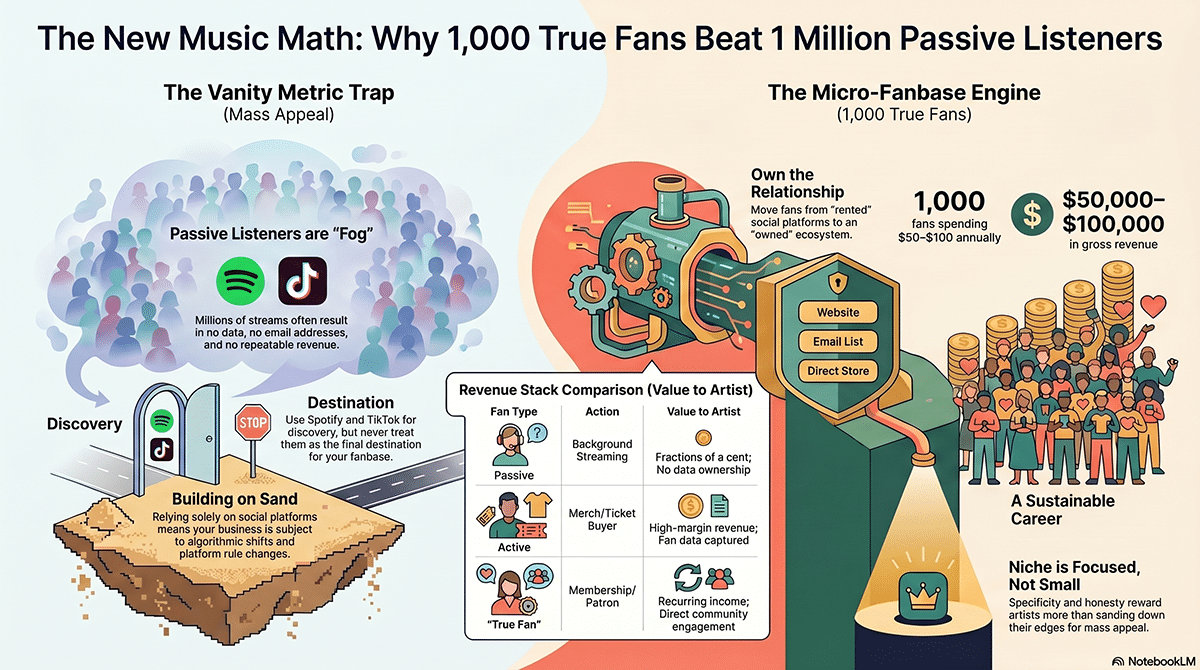
But something important is happening now. Quietly, steadily, and without asking permission from the old gatekeepers, niche audiences are becoming more valuable than mass audiences. Not because big audiences no longer matter. They do. But because most big audiences are shallow. A million passive listeners who do not know your name, never visit your website, never buy a ticket, never purchase a shirt, never join your email list, and never tell a friend may look good on a screenshot, but they are not a business. They are fog.
A micro-fanbase is different. It is smaller, but deeper. It is made of people who care. They know the songs. They read the stories. They come to the shows. They buy the vinyl. They grab the shirt. They reply to the newsletter. They bring a friend. They join the fan club. They want to be part of the journey, not just consume the product. That kind of fan is not a number on a dashboard. That kind of fan is infrastructure.
The old industry chased scale first and relationship later. The new independent artist has to flip that. Build the relationship first. Scale only matters when it grows from something real.
The 1,000 True Fans Idea Still Has Teeth
The idea behind “1,000 true fans” has been around for years, and it still refuses to die because the core truth is simple: an artist does not need everyone. An artist needs enough people who care enough to support the work directly. Kevin Kelly helped popularize this idea years ago, but the real power of it is not in the exact number. The number is a symbol. It forces artists to stop thinking like lottery players and start thinking like business owners.
One thousand true fans does not mean one thousand people who clicked “like” once in 2019. It does not mean one thousand people who followed you because you posted a funny reel. It does not mean one thousand monthly listeners who found you on a background playlist while folding laundry. It means one thousand people who would spend money with you over time because your music, your story, your shows, and your community mean something to them.
That is a different kind of goal. It is more human. It is also more useful.
Let’s say an artist builds a community of 1,000 serious supporters. Not fantasy fans. Real ones. Some might spend $10 a year. Some might spend $50. Some might spend $200. A few might spend much more through house concerts, VIP experiences, limited vinyl, patron support, licensing help, or direct sponsorship. The point is not that every fan will spend the same amount. They will not. The point is that when the artist owns the relationship, the artist can build different doors for different levels of support.
One fan buys a digital album on Bandcamp. Another joins a $5-a-month membership on Patreon. Another buys a ticket through Eventbrite or follows tour dates through Bandsintown for Artists. Another buys a shirt from a WooCommerce store on the artist’s own WordPress website. Another signs up for the artist newsletter through The Newsletter Plugin, Mailchimp, or Kit. Another unlocks private content through a membership layer, a fan club, or a token-gated experience using tools like Unlock Protocol or a digital attendance collectible through POAP. Each action is small by itself. Together, they become a career.
That is the part the old music business never wanted artists to understand. You do not need to own the whole market. You need to own the relationship with the people who already believe in you.
Vanity Metrics Are Not a Business Model
The modern artist is drowning in numbers. Monthly listeners. Followers. Views. Likes. Saves. Shares. Watch time. Completion rate. Playlist adds. Impressions. Engagement percentage. Some of these numbers are useful. Some are smoke from the algorithm’s little circus cannon.
The problem is not data. Data can be powerful. The problem is confusing attention with ownership.
A song can get 100,000 streams and still leave the artist with no clear path to rent money. A reel can get 50,000 views and produce no email addresses, no ticket sales, no merch orders, and no repeatable fan relationship. A playlist can drive listeners to a track but never tell the artist who those listeners are, where they live, what they buy, or whether they would come to a show.
That does not mean streaming is useless. Far from it. Streaming is discovery. Social media is discovery. YouTube is discovery. TikTok is discovery. Spotify is discovery. The mistake is treating discovery like the destination.
Even Spotify for Artists now includes tools around merch, tickets, videos, pre-release activity, and fan support links, which shows that the platform itself understands artists need more than passive listening. Spotify’s Fan Support feature lets artists add a fundraising link, and Spotify says it does not take a cut from that money. That is useful. But it still does not replace the need for an artist-owned system where the artist controls the data, the communication, and the long-term fan relationship.
The real question is not “How do I get more views?” The real question is “What happens after somebody cares?”
If the answer is “they go back to scrolling,” the artist lost the moment. If the answer is “they land on my website, hear my story, join my list, buy something, unlock something, or get invited into my community,” then the artist is building a business.
The Micro-Fanbase Is the New Middle Class Engine
Making a Scene has been saying this in one form or another for years: the future of independent music belongs to artists who own their masters, own their publishing, own their fan data, and own the pathway between attention and income. That is how we build a music industry middle class. Not by begging platforms to be nicer. Not by waiting for labels to rediscover artist development. Not by pretending exposure pays the light bill.
A micro-fanbase gives an artist leverage because it is built around direct support. It is not about being famous to strangers. It is about being important to the right people.
Think about the artist who can draw 75 people in five different towns. That might not impress a major label spreadsheet. But to a working indie artist, that is information with a pulse. If those 75 people are on an email list, if the artist knows the city, if the artist tracks merch purchases, if the artist can identify repeat fans, if the artist knows who brought friends, then that tiny market becomes a real asset. It can help decide where to tour, what merch to bring, which venue to call, which fans deserve early access, and where to run a small ad campaign.
Now multiply that by ten towns. Then twenty. That is not hype. That is routing intelligence. That is inventory planning. That is community building. That is how an artist stops guessing.
This is where tools like Chartmetric can help on the discovery side, because they track music performance across streaming, social, and other channels. But the artist still needs to bring that outside signal into an owned system. Platform analytics can tell you where smoke might be rising. Your own fan data tells you where the fire is actually burning.
That is the difference between being a content account and being an artist business.
The Artist Website Has to Become the Hub Again
For a while, many artists treated their website like a dusty digital business card. A bio, a photo, a few links, maybe a tour page last updated during the Obama administration. Meanwhile, all the real action moved to social platforms. That was a mistake. A understandable mistake, but still a mistake.
The artist website has to come back, but not as a static brochure. It has to come back as the artist-owned ecosystem.
That means the website should be the place where everything connects. Music, videos, merch, tickets, email signup, fan club, private content, blog posts, tour history, lyrics, credits, licensing information, community spaces, and rewards should all live under the artist’s control. Social media should point there. Streaming profiles should point there. QR codes at shows should point there. Posters should point there. Business cards should point there. Every piece of attention should be trained to return to the artist’s home base.
This is why open systems matter. WordPress gives artists a flexible publishing platform. WooCommerce can turn that site into a store where the artist has more control over checkout, content, and customer data. Shopify can also be useful for artists who want a hosted commerce system with less technical management. The point is not that every artist needs the same stack. The point is that every artist needs a stack that brings fan relationships closer to home instead of sending them back into the platform maze.
A good artist site should not be a place people visit once. It should be a place fans return to. It should feel alive. It should reward attention. It should capture data with permission. It should make buying easy. It should make joining easy. It should make supporting the artist feel meaningful, not like tossing a dollar into a digital tip jar and disappearing into the void.
Direct Engagement Beats Algorithmic Begging
The algorithm is not your fanbase. It is a weather system. Sometimes it helps. Sometimes it buries you. Sometimes it changes overnight and pretends nothing happened.
Direct engagement is different. When a fan gives an artist an email address, joins a membership, buys merch, scans a QR code at a show, or signs up for early ticket access, that fan is raising their hand. They are saying, “I want to hear from you again.” That is gold.
Email still matters because it is one of the few communication channels where artists can reach fans without needing a platform to bless the message. It is not perfect. Deliverability takes work. Lists need care. Spam laws matter. But an email list is still more valuable than a follower count because it can be moved, segmented, backed up, and used to drive real action.
A strong micro-fanbase does not need to be hammered with constant sales pitches. It needs to be invited into the story. Tell them why the song exists. Show them the studio process. Let them vote on a vinyl color. Give them first access to tickets. Offer a private livestream. Share the story behind the guitar tone. Give them a demo version. Ask what city they want you to play. Let them become part of the engine.
That is where communities on platforms like Discord or Mighty Networks can help, especially for artists who want deeper fan conversation. But even then, the artist should avoid building the entire kingdom on rented ground. Community platforms can be useful rooms. The artist website should still be the house.
The Revenue Stack Is Where the Magic Happens
A micro-fanbase becomes powerful when the artist stops looking for one magic income stream and starts building a revenue stack.
Streaming may create awareness. Direct music sales may bring in higher-margin purchases from serious fans. Bandcamp, for example, says artist accounts are free and lists a 15% revenue share on digital music and 10% on merch, with payment processor fees separate. That kind of direct-buy environment can be valuable because the fan is not just listening. The fan is making a purchase.
Live shows turn attention into experience. Merch turns identity into support. Memberships turn casual interest into recurring income. Email turns scattered listeners into reachable fans. Licensing turns songs into assets. Publishing turns composition ownership into long-term value. VIP experiences turn the most committed fans into major supporters. Fan clubs turn the whole thing into community instead of a transaction.
Now let’s make the math plain without pretending every artist’s path is the same.
If 1,000 real fans each spend an average of $50 a year with an artist across tickets, merch, music, memberships, livestreams, or direct support, that is $50,000 in gross revenue. If the average rises to $100, that is $100,000 gross. Those are not guaranteed numbers. They are not promises. Costs matter. Taxes matter. Travel matters. Production matters. Platform fees matter. But the math shows why small committed audiences are worth more than large passive ones.
The key word is average. Not every fan spends equally. Some will only stream. Some will buy one shirt. Some will join the fan club. Some will bring five friends to every show. Some will pay for a house concert. Some will license a song for a film project. Some will become patrons because the music helped them through a hard year and they want the artist to keep going.
The artist’s job is not to squeeze fans. The artist’s job is to build honest ways for fans to support at the level that feels right.
AI and Web3 Should Serve the Relationship, Not Replace It
AI and Web3 are often sold with big, goofy promises. Some of it sounds like it was invented by a venture capitalist trapped inside a lava lamp. But under the hype, there are useful tools if artists keep the mission straight.
AI can help an artist understand their fanbase better. It can summarize email replies. It can help segment fans by city. It can compare merch sales by market. It can help write better subject lines, plan tour outreach, draft sponsorship decks, analyze social posts, and turn scattered data into practical next steps. Used correctly, AI is not the artist. It is the assistant sitting beside the artist, pointing to patterns the artist might have missed.
Web3 can also be useful when it focuses on ownership, access, and proof instead of speculation. Token-gated content can give fans access to special songs, livestreams, stems, videos, or community rooms. POAP-style attendance collectibles can become digital memories from shows. Unlock Protocol-style memberships can connect access to time-based membership status. Audius and other decentralized music tools show how some artists are exploring alternatives to platform-controlled streaming and distribution.
The warning is simple: do not use technology to make the fan relationship colder. Use it to make the relationship clearer, easier, and more valuable.
Nobody needs a complicated crypto scavenger hunt just to hear a bonus track. Nobody wants to need three wallets and a prayer candle to join a fan club. The best technology disappears into the experience. The fan scans a code, unlocks a reward, gets remembered, receives a thank-you, and feels closer to the artist.
That is where the future gets interesting.
The Coming Fan Passport Model
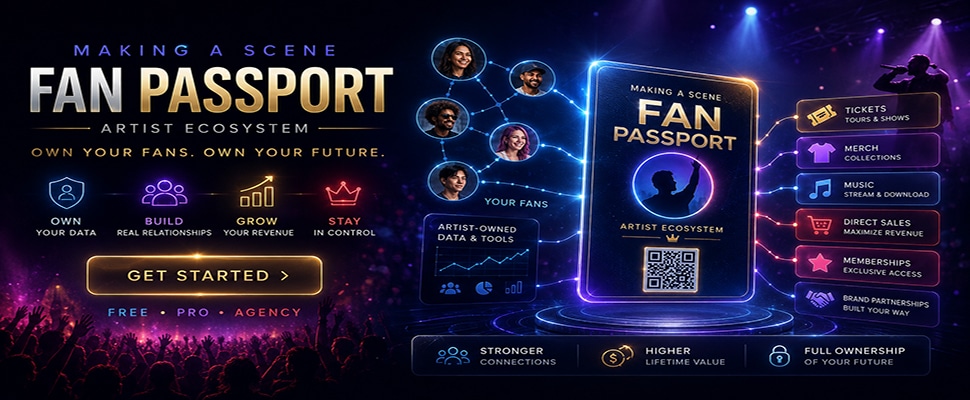
This is why the coming Making a Scene Fan Passport system and Indie Artist Website Ecosystem matters. The idea is not just another plugin, another website theme, or another shiny dashboard. The idea is to help artists build a living fan economy around their own work.
Imagine a fan goes to a show and scans a QR code at the merch table. That scan creates a show stamp. The artist now knows that fan attended that event in that city on that date. If the fan buys a shirt, that can become a merch stamp. If the fan joins the email list, that becomes part of the fan profile. If the fan later buys a ticket in another city, joins a membership, unlocks exclusive video, or supports a campaign, those actions begin to tell a story.
Now the artist is not guessing. The artist can see which cities are growing. Which fans are most active. Which rewards work. Which merch sells where. Which tour stops deserve another date. Which fans should get first access. Which markets are full of listeners but weak on buyers. Which fans have been inactive and might need a special invite back into the circle.
That is not just fan engagement. That is artist-owned intelligence.
The artist website becomes the center. The Fan Passport becomes the memory. The newsletter becomes the communication line. The store becomes the revenue engine. The show calendar becomes the routing map. The content library becomes the reward system. AI becomes the business assistant that helps the artist read the signals. Web3 becomes the access layer when it actually helps.
This is how independent artists move from “please follow me” to “come build this with me.”
Niche Is Not Small. Niche Is Focused.
One of the biggest lies in the music business is that niche means limited. It does not. Niche means focused.
A blues artist does not need to convert every pop fan on earth. A jazz artist does not need to chase every playlist trend. A punk band does not need to soften every edge to please an invisible committee. A folk singer does not need to become a dancing content machine unless they actually want to. A hip-hop artist, electronic producer, country songwriter, Americana band, metal act, soul singer, or experimental composer can build a career by finding the people who already care about that world and then serving them with consistency and respect.
Mass appeal often makes artists sand down the very thing that made them interesting. Micro-fanbases reward the opposite. They reward specificity. They reward story. They reward honesty. They reward artists who know who they are.
That does not mean artists should ignore growth. Growth matters. But growth should deepen the relationship, not dilute it. A fanbase that grows from 300 true fans to 1,000 true fans to 5,000 true fans is far stronger than a giant pile of casual attention that vanishes the second the algorithm looks away.
The future belongs to artists who stop chasing strangers and start organizing believers.
Stop Building on Sand
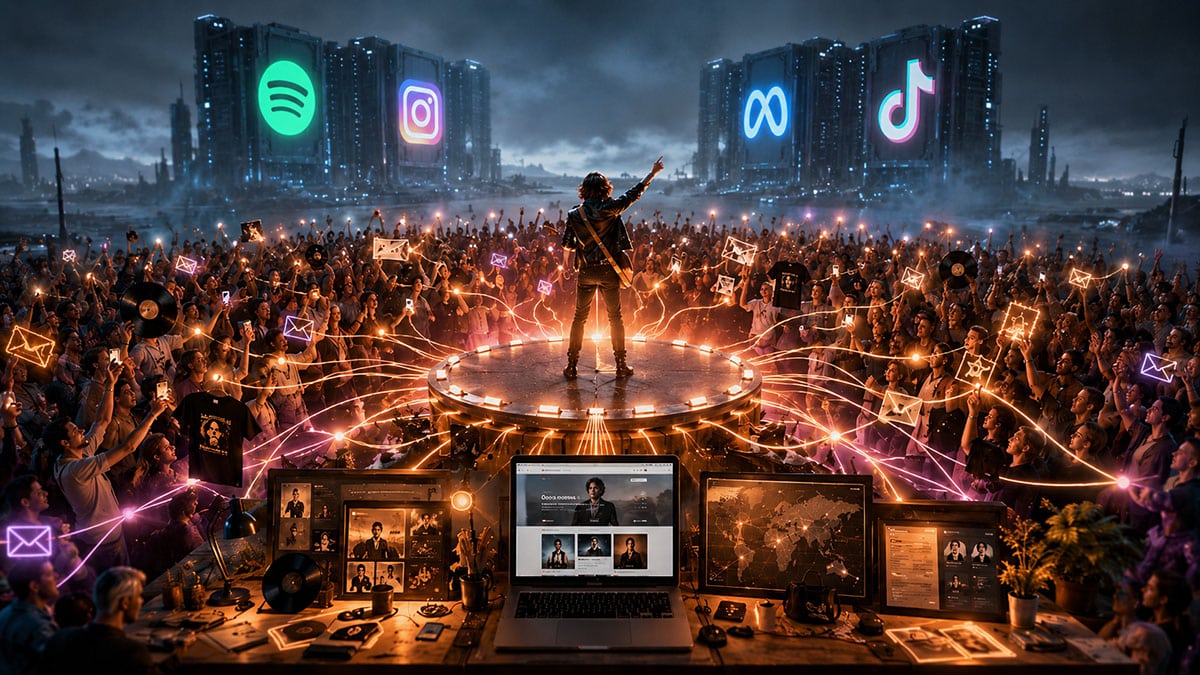
Here is the hard truth. If an artist’s entire business lives on Spotify, Instagram, TikTok, YouTube, Facebook, or any other platform, that artist is building on sand. The platform can change the rules. The reach can drop. The account can be hacked. The payout model can shift. The audience can be throttled. The algorithm can decide yesterday’s strategy is today’s trash.
That does not mean artists should abandon platforms. Use them. Learn them. Feed them. Study them. But do not worship them.
Put your music where people discover music. Put your videos where people watch videos. Put your short clips where people scroll. Put your tour dates where fans search for concerts. Use Spotify for Artists, Bandsintown, Eventbrite, DICE, YouTube, Instagram, TikTok, and every other useful doorway. But every doorway should lead back to the artist-owned house.
That house should have a mailing list. It should have a store. It should have a fan club. It should have tour dates. It should have direct support options. It should have a reason to come back. It should collect permission-based fan data. It should respect fans. It should not feel like a desperate sales funnel built by a robot with a clipboard.
The artist-owned ecosystem is not about hiding from the modern internet. It is about refusing to be owned by it.
The Call to Action: Build the 1,000 Before Chasing the Million
The next era of independent music will not be won by the artists with the biggest vanity numbers. It will be won by the artists who understand the difference between reach and relationship.
A million people hearing you once can be exciting. One thousand people caring for years can be life-changing.
So stop treating your fans like traffic. Stop treating your website like an afterthought. Stop treating email like old technology. Stop treating merch like a side hustle. Stop treating shows like isolated events. Stop treating data like something only labels and platforms get to understand.
Start building the system.
Use streaming for discovery. Use social media for attention. Use your website for ownership. Use email for communication. Use merch for identity. Use memberships for recurring support. Use live shows for connection. Use AI for insight. Use Web3 for access when it makes sense. Use fan passports, QR codes, and owned data to remember the people who show up.
The old music industry wanted artists to believe success meant being chosen. The new independent music business is built on artists choosing themselves, then giving fans a real way to choose them back.
That is the rise of the micro-fanbase.
That is why 1,000 true fans still matters.
And that is how we build a music industry middle class one real relationship at a time.
 |  Spotify |  Deezer |  Breaker |
 Pocket Cast |  Radio Public |  Stitcher |  TuneIn |
 IHeart Radio |  Mixcloud |  PlayerFM |  Amazon |
 Jiosaavn |  Gaana |  Vurbl |  Audius |
 Reason.Fm | |||
Find our Podcasts on these outlets
Subscribe to Our Newsletter
Discover more from Making A Scene!
Subscribe to get the latest posts sent to your email.


