Stop Sending Your Fans Back to YouTube




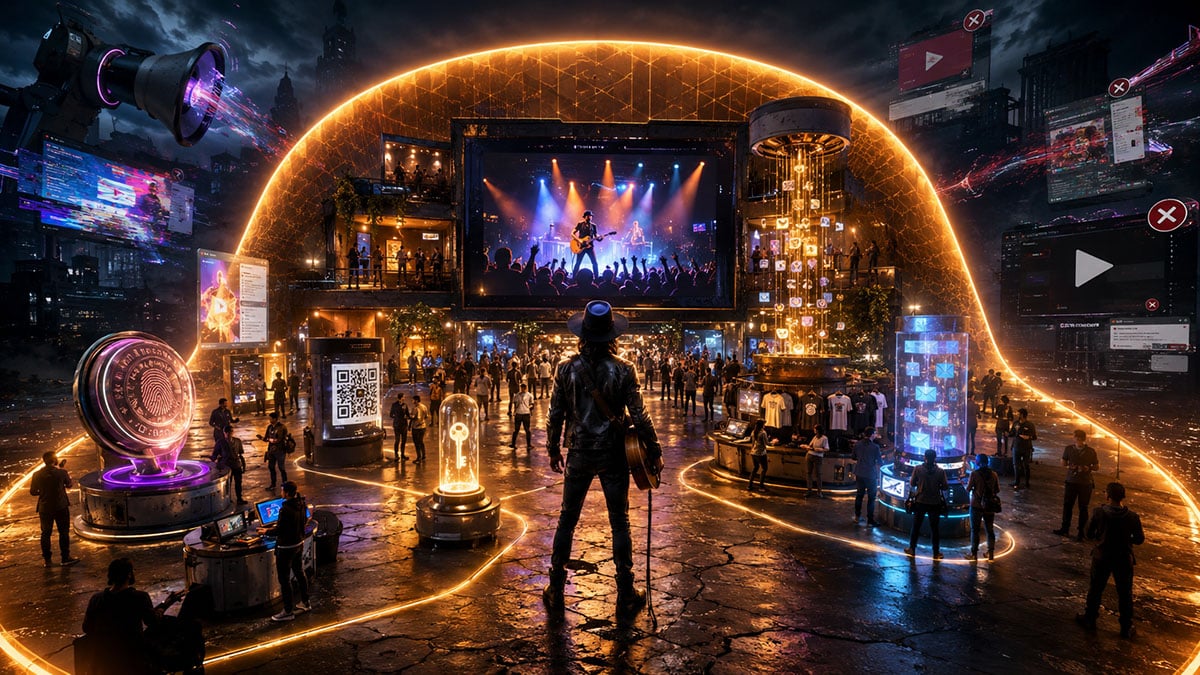
Making a Scene Presents – Stop Sending Your Fans Back to YouTube: How Indie Artists Can Embed Token-Gated Video Inside Their Own Website
Listen to the Podcast Discussion
Your Website Is Not a Poster. It Is the Artist’s World.
For years, indie artist websites were treated like digital flyers. You had a homepage, a bio, some tour dates, a few press photos, a store link, and maybe a YouTube video dropped into the middle of the page. That was fine when the website’s only job was to prove you existed. But that is not enough anymore.
Today, an indie artist’s website should be built like a self-contained ecosystem. It should not be a dead end. It should be the place where fans listen, watch, join, buy, collect, comment, support, and come back. The artist’s website should feel less like a brochure and more like the artist’s own private venue, merch table, fan club, video room, record store, email hub, and community space all living under one roof.
That is where video becomes a major turning point.
Video is one of the most powerful tools an artist has. A video can sell the emotion of a song faster than a paragraph ever could. It can show the power of a live show, the story behind a lyric, the energy of a studio session, the personality of the band, and the reason a fan should care. But if all of that video lives on YouTube, the artist is still building part of their fan relationship inside somebody else’s platform.
YouTube is useful. Let’s not pretend otherwise. It is still one of the biggest discovery engines in music. But discovery is not the same thing as ownership. YouTube should help people find the artist. It should not be where the deepest fan relationship lives.
The problem is simple. When artists embed YouTube videos on their own websites, they may still be bringing YouTube’s business model into their own house. YouTube’s own help documentation says embedded videos honor the same ad settings as videos on YouTube itself, meaning ads can be served inside the YouTube player when monetization is enabled.
That may be fine for a public music video. It is not fine for a fan-only acoustic session, a paid concert film, a private studio diary, or a VIP tour documentary. If a fan joins your membership or unlocks a special video through your fan passport system, the last thing you want is a third-party ad sitting between you and that fan. That is like charging admission to your own club and letting a billboard company set up in front of the stage.
The New Rule: Discovery Outside, Relationship Inside
The smarter model is not to abandon YouTube. The smarter model is to demote it.
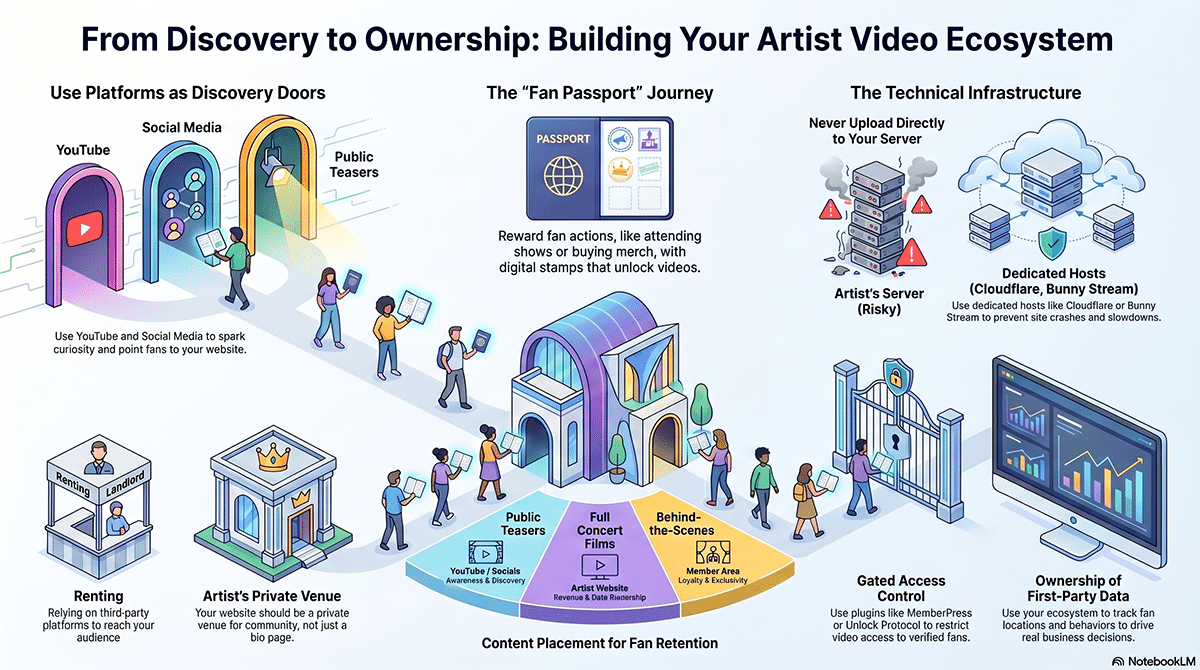
Use YouTube, TikTok, Instagram, Facebook, and Spotify as discovery doors. Let those platforms create awareness. Let them feed curiosity. Let them point people toward the artist. But once a fan shows interest, bring them back to the artist’s website, where the artist controls the experience and owns the relationship.
That means the public teaser can live on YouTube. The full performance lives on the artist’s website. A short clip can live on Instagram. The full behind-the-scenes documentary lives inside the member area. A livestream announcement can happen on Facebook. The replay can live inside the artist’s own fan passport ecosystem.
This is not just a tech choice. It is a business choice.
When the fan stays on the artist’s website, the artist can invite them to join the email list, collect a fan passport stamp, buy merch, unlock a reward, join a membership, purchase a ticket, or support a new release. That is how video becomes part of a revenue system instead of just another piece of content floating around the internet.
A stream on someone else’s platform may give the artist exposure. A video inside the artist’s own ecosystem can give the artist data, sales, loyalty, and fan movement. That is the difference between renting attention and building a business.
Do Not Upload Giant Videos to Your Web Hosting Server
Here is where some artists make a very understandable mistake. They hear “own your website” and think that means they should upload every video directly into the WordPress Media Library.
Please do not do that unless you enjoy slow websites, angry fans, hosting warnings, and support tickets from your web host.
Video files are huge. A single HD concert video can be several gigabytes. If hundreds of fans start watching that file from your regular hosting server, your site can slow down, bandwidth can spike, and your hosting plan can get crushed. Your website server is there to run the site. It is not supposed to become your personal Netflix machine.
The better model is simple. Your website controls the fan experience, but a proper video hosting platform handles the heavy media delivery.
Think of it this way. Your website is the venue. Your video host is the power grid. Fans enter through your front door. They log in through your system. They unlock content through your membership, token gate, or fan passport. But the actual video is streamed through infrastructure built for video delivery.
That way, the artist gets control without destroying the site’s performance.
Cloudflare Stream is one strong option because it is built for live and on-demand video storage, encoding, delivery, and analytics without the artist having to maintain video infrastructure. Cloudflare’s Stream documentation says it bills based on minutes stored and minutes delivered, and its security docs include signed URLs that can prevent public playback links from working unless the proper signed access is used.
Bunny Stream is another practical option for indie artists because it focuses on fast video hosting and delivery without turning the artist’s own server into the delivery engine. Bunny’s documentation also includes embed view token authentication and CDN token authentication for protecting premium content and preventing unauthorized playback or embedding.
Vimeo can also work for artists who want a clean player, privacy settings, password protection, and domain-level embed controls. Vimeo’s help documentation explains options like password protection, hiding videos from Vimeo, and allowing embeds only on approved domains.
Wistia is more of a video marketing platform, but it can be useful when an artist wants strong analytics, lead capture, and a branded ad-free viewing experience. Wistia’s own materials describe video hosting, marketing tools, insights, and Turnstile email capture inside videos.
The point is not that every artist needs the same platform. The point is that the video should be stored and streamed from a video platform, while the fan experience should live on the artist’s website.
The Fan Passport Turns Video Into a Journey
This is where the fan passport system becomes the connective tissue of the whole ecosystem.
A normal website page says, “Here is a video.” A fan passport system says, “Here is where you are in the artist’s world.”
That difference is huge.
The fan passport can track meaningful fan actions. A fan attends a show and gets a stamp. A fan joins the email list and gets a stamp. A fan buys vinyl and gets a stamp. A fan watches an exclusive video and gets a stamp. A fan supports a crowdfunding campaign, buys merch, joins a membership, scans a QR code at the merch table, or attends a livestream, and each action becomes part of their fan history.
Now connect that to video.
A fan attends the Atlanta show. At the merch table, they scan a QR code. That QR code brings them to the artist’s website, where they enter their first name, email, city, and maybe SMS number. They receive a digital attendance stamp in their fan passport. The next day, that stamp unlocks the private video recap from the Atlanta show. A week later, the same fan gets an offer to buy the live recording, join the tour diary membership, or unlock a backstage Q&A.
That is not just a video. That is a fan relationship.
The artist can build different video gates around different fan actions. A live-show stamp unlocks the show recap. A vinyl purchase unlocks the album documentary. A VIP membership unlocks the full tour video library. A street team stamp unlocks a private thank-you performance. A fan who collects five city stamps unlocks a special acoustic set. A fan who buys the deluxe bundle gets early access to a video premiere.
This is where the website stops being a static destination and starts behaving like an artist-owned platform.
Token Gating Gives the Fan a Digital Key
Token gating is one way to control access to these private video experiences. The idea is simple. A fan must hold the right digital key to unlock the content. That key could be an NFT membership, a proof-of-attendance token, a fan passport credential, or another digital access pass.
Unlock Protocol is one of the most useful tools in this space. Unlock describes token gating as restricting access to content such as articles, videos, and website sections to holders of a particular NFT. It also has a WordPress plugin that lets creators add locks to posts and pages so only paying visitors can view the content.
That matters because an indie artist does not need to build a whole custom blockchain app just to experiment with token-gated content. The artist can create a locked page on their own site, place an exclusive video inside that page, and let the token act as the access key.
But here is the warning. Do not make the fan experience feel like homework.
Most fans do not wake up thinking, “I hope my favorite artist makes me connect a wallet, switch networks, approve a transaction, and learn five new Web3 terms before I can watch a video.” The technology should serve the fan experience, not bury it.
That is why the fan passport concept is so important. The fan does not need to think like a crypto trader. They just need to feel like they earned access. They went to the show. They collected the stamp. They unlocked the video. They moved deeper into the artist’s world.
For artists who want proof-of-attendance style rewards, POAP is one example of how shared moments can become digital mementos. POAP describes itself as Proof of Attendance Protocol and explains that POAPs can be used to mint memories as digital mementos.
That idea fits beautifully with live music. A concert ticket proves a transaction. A fan passport stamp proves a relationship.
Membership Gates Still Matter
Token gating is powerful, but not every gate needs to be blockchain-based. In fact, most indie artists should start with traditional memberships and then add Web3 access once the system makes sense.
A simple membership gate can do a lot. Fans can join for $5 a month and unlock private videos. Fans who buy a deluxe bundle can be added to a special access group. Fans who support a livestream can get replay access. Fans who join a higher tier can unlock the video archive.
MemberPress is a popular WordPress membership plugin that lets site owners monetize a WordPress site, control who sees content, sell online courses and digital downloads, and accept payments.
Paid Memberships Pro is another strong option. Its documentation explains that it can restrict access to WordPress content by page, post, block, shortcode, and membership level. Paid Memberships Pro also has an Unlock Protocol Integration for connecting membership access to Unlock Protocol.
WooCommerce Memberships is useful when the artist wants access tied directly to purchases. WooCommerce’s documentation says memberships can restrict content so it is only accessible to members, and customers can get membership access by purchasing a product, registering for an account, or being manually assigned.
This is where the business model gets real. A fan buys the vinyl and unlocks the album documentary. A fan buys a ticket and unlocks the concert replay. A fan buys a VIP bundle and unlocks the private video vault. A fan joins the monthly membership and gets a new exclusive video every month.
The fan passport can sit above all of this and track the journey. Membership is the payment layer. Token gating is the access key. Video is the reward. The fan passport is the memory and data layer that ties it all together.
The Player Matters Too
Once the artist chooses a video host and an access system, the next step is how the video appears on the site.
A good video player should feel like part of the artist’s world. It should not feel like a random external box dropped into the page. It should load quickly, work on phones, support private videos when possible, and avoid unnecessary branding or recommendations.
Presto Player is one strong WordPress option. It supports popular video hosting providers, promotes private video features and dynamic URLs, and has documentation for integrating Bunny.net video libraries.
That kind of tool matters because the artist’s site should feel clean and intentional. If the fan unlocks a private video through a fan passport stamp, the playback experience should feel like they entered the artist’s own private screening room, not like they wandered into a random embed farm.
The video page should also be designed for the next action. After the fan watches the video, what happens? Do they get invited to buy the live recording? Join the membership? Share a referral link? Collect another stamp? Buy the shirt from that tour? Vote on the next cover song? Unlock the next chapter?
The video should never just end. It should move the fan somewhere.
Building the Actual Ecosystem
Here is what a practical artist-owned video ecosystem looks like.
The artist uses WordPress as the main website. The public homepage has music, tour dates, email signup, merch, press, and a clear fan entry point. The artist uses The Newsletter Plugin to collect and manage email subscribers inside WordPress. The Newsletter Plugin describes itself as a newsletter and email marketing system for WordPress that helps users build lists and send campaigns.
The artist creates a splash page for fan capture, using something like the Making a Scene Fan Funnel Plugin or a similar dedicated landing page system. The page offers something valuable, like a private video preview, a live clip, an unreleased acoustic performance, or access to the fan passport.
The fan enters their information. The fan gets added to the email list. The fan receives a fan passport identity or stamp. That stamp unlocks a video page.
The video itself is hosted on Cloudflare Stream, Bunny Stream, Vimeo, or Wistia, not dumped onto the artist’s regular hosting account. The page is restricted using MemberPress, Paid Memberships Pro, WooCommerce Memberships, or Unlock Protocol. The video is embedded with a clean player like Presto Player when that fits the stack.
Now the artist has a real system.
A social post leads to a video teaser. The teaser leads to the artist’s website. The website captures the fan. The fan passport records the action. The stamp unlocks the video. The video creates a deeper bond. The page offers merch, membership, tickets, or direct support. The fan gets rewarded for coming back. The artist learns who the real fans are.
That is not theory. That is a working direct-to-fan machine.
Protect the Page and the Stream
A private page is good. A protected stream is better.
If a fan can copy the raw video link and send it to everyone, the gate is weak. That is why artists should understand the difference between protecting the page and protecting the video file.
The page gate decides who can see the page. The stream protection decides whether the video itself can be played outside the approved environment. Cloudflare Stream signed URLs and Bunny token authentication are examples of tools designed to reduce unauthorized playback or embedding.
No system can stop every kind of copying. Someone can always point another phone at a screen. That is reality. But artists do not need perfect protection to build a better business. They need practical protection that stops casual sharing, keeps premium content from floating freely, and makes the artist’s site the main doorway.
For most indie artists, start simple. Protect the page with a membership or fan passport gate. Use a video host that gives you privacy or domain controls. As the audience grows, add signed URLs, token authentication, or deeper access control.
Do not let technical perfection stop you from building the system.
What Should Artists Put Behind the Gate?
The best gated video content feels personal, useful, or connected to a moment. It should not feel like leftovers.
A fan passport-based video vault could include private live performances, city-specific show recaps, acoustic versions, rehearsal videos, studio diaries, songwriting breakdowns, gear walkthroughs, producer notes, drummer groove breakdowns, lyric explanations, tour van updates, private livestream replays, fan Q&A sessions, alternate music video cuts, or mini-documentaries about the making of an album.
The most valuable videos often come from things the artist is already doing. Record the soundcheck. Record the merch table setup. Record a two-song acoustic session backstage. Record a short thank-you video after each show. Record the story behind the new single. Record the producer explaining one weird sound in the mix. Record the band reacting to an old demo. Record the crowd singing the chorus in a small club.
Then attach those videos to fan actions.
Fans who attended the show unlock the city recap. Fans who bought merch unlock a behind-the-scenes clip. Fans who joined the membership unlock the full archive. Fans who collected three stamps unlock the acoustic session. Fans who supported the album campaign unlock the studio documentary.
This turns the fan passport into more than a loyalty card. It becomes a living map of the fan’s relationship with the artist.
The Real Payoff: Fan Data That Belongs to the Artist
The biggest value here is not just ad-free video. The biggest value is first-party fan data.
A YouTube view tells YouTube a lot. It tells the artist only a little.
An artist-owned video ecosystem can tell the artist which fans watched, which city they came from, which show they attended, what they unlocked, what they bought, what emails they opened, what rewards they earned, and what kind of content moved them closer to support.
That information can shape real business decisions.
If a lot of fans in Nashville keep unlocking live videos and buying merch, maybe Nashville deserves another show. If fans who watch studio diaries are more likely to buy vinyl, maybe the next album campaign should include a behind-the-scenes video series. If VIP fans keep watching gear videos, maybe a paid production workshop makes sense. If fans in three cities are collecting passport stamps, maybe the next tour route should be built around them.
This is the new middle-class music business. Not fantasy numbers. Not vanity metrics. Not empty followers. Real fans. Real actions. Real revenue.
The Future Is a Website That Behaves Like a Platform
The indie artist website has to grow up.
It can no longer be just a place where fans read a bio and leave. It has to become a place where the artist’s world lives. The music plays there. The videos unlock there. The fan passport grows there. The membership lives there. The store sells there. The email list builds there. The community gathers there.
YouTube can still help people discover the artist. Spotify can still be a discovery door. Instagram can still create awareness. TikTok can still spark curiosity. But none of those platforms should be the center of the artist’s economy.
The center should be the artist’s own website.
That is where video becomes powerful. Not because it is hidden. Not because it is trendy. Not because it uses Web3 language. It becomes powerful because it is connected to a system the artist owns.
A fan watches. A fan joins. A fan collects a passport stamp. A fan unlocks a private video. A fan buys the record. A fan comes to the show. A fan earns the next reward. A fan becomes part of the story.
That is how artists stop feeding the platform machine and start building their own.
The old internet trained artists to say, “Go watch me over there.”
The new artist-owned model says, “Come into my world.”
That is the shift. That is the power. And that is how indie artists build a real video ecosystem without ads, without server overload, and without giving away the fan relationship.
 |  Spotify |  Deezer |  Breaker |
 Pocket Cast |  Radio Public |  Stitcher |  TuneIn |
 IHeart Radio |  Mixcloud |  PlayerFM |  Amazon |
 Jiosaavn |  Gaana |  Vurbl |  Audius |
 Reason.Fm | |||
Find our Podcasts on these outlets
Subscribe to Our Newsletter
Discover more from Making A Scene!
Subscribe to get the latest posts sent to your email.


