

Delay vs Reverb: When to Use Each (and Why Most People Overuse Reverb)





Making a Scene Presents – Delay vs Reverb: When to Use Each (and Why Most People Overuse Reverb)
Listen TO the Podcast Discussion
There is a sound you have heard a thousand times, even if you never knew what caused it. A singer enters on the first line of a chorus and suddenly feels larger than life. A snare drum explodes through the speakers and seems to live in its own perfect room. A guitar line trails into the horizon after the phrase ends, creating emotion long after the note is gone. Space is one of the secret weapons of recorded music, and two tools have shaped that space more than any others: delay and reverb.
For independent artists building records in home studios, understanding the difference between these two effects can be the line between a mix that sounds expensive and a mix that sounds like wet cardboard. Too many people reach for reverb first because it is dramatic, familiar, and instantly flattering. But that habit has created an entire generation of muddy vocals, washed-out choruses, and mixes that collapse the moment they hit a phone speaker or car stereo. In many cases, what artists really needed was not reverb at all. They needed delay, restraint, and a clearer plan.
That matters now more than ever. Indie artists are no longer competing only with the band down the street. They are competing with every release uploaded to streaming platforms each Friday. If your song loses clarity because the ambience is swallowing the lyric, the listener is gone in seconds. The good news is that once you understand how delay and reverb actually work, you can make smarter choices immediately. You do not need a million-dollar studio to create depth. You need intention.
Why Reverb Became Everyone’s First Mistake
Reverb is seductive because it sounds beautiful almost instantly. A dry vocal can feel naked and unfinished, then one click later it becomes dramatic and emotional. A snare can go from lifeless to arena-sized in seconds. Acoustic guitars suddenly seem to breathe. In isolation, reverb often feels like magic.
That is the trap.
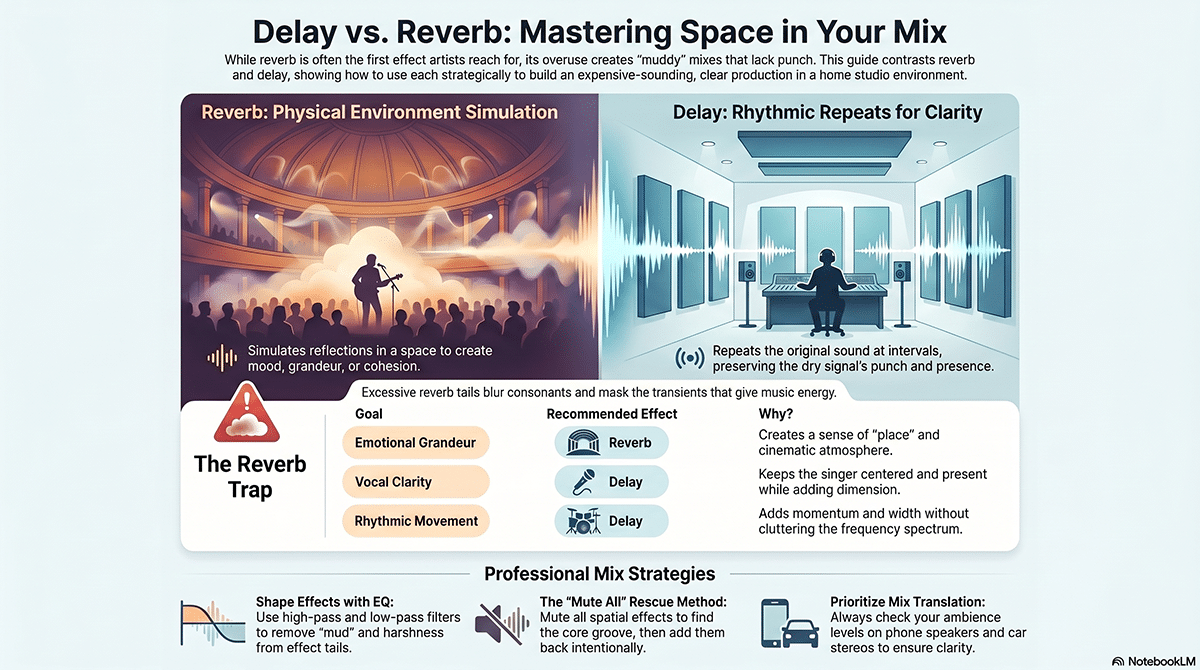
What sounds gorgeous in solo can be destructive in context. A long hall reverb on a vocal may sound cinematic by itself, but once the drums, bass, guitars, keys, and backing vocals enter, that same reverb tail can blur consonants, mask transients, and pile low-mid energy into the mix. Suddenly the singer is harder to understand. The snare loses punch. The arrangement feels crowded. The artist responds by boosting EQ, compressing harder, and turning things up. The real issue was never loudness. It was too much space in the wrong form.
This is why so many modern home studio mixes sound cloudy. Reverb is often added emotionally instead of strategically. It is used as decoration rather than design. And once too many tracks have long tails hanging behind them, the mix becomes harder to fix with every new move.
What Reverb Actually Does
Reverb simulates the reflections of sound in a physical environment. When a singer performs in a church, warehouse, bedroom, club, or hallway, the voice bounces off walls, floors, ceilings, and objects before returning to the ear. Your brain interprets those reflections as room size, distance, and mood. Reverb plugins recreate that phenomenon.
That makes reverb incredibly powerful because it tells the listener where the performance seems to exist. A short room reverb can make drums feel cohesive and believable. A plate reverb can give a vocal sheen and sustain without sounding too distant. A lush hall can create grandeur in a ballad. A spring reverb can evoke vintage blues and surf tones instantly.
Tools like Valhalla VintageVerb, FabFilter Pro-R 2, iZotope Neoverb, and Waves H-Reverb are all respected options, but even stock reverbs in Fender Studio Pro 8, Logic Pro, Cubase, and REAPER are more than capable when used well.
The problem has never been access to quality reverbs. The problem has always been overuse.
Why Delay Is the Smarter Secret Weapon
Delay works differently. Instead of surrounding the sound with thousands of reflections, delay repeats the original sound after a chosen amount of time. Those repeats may happen once, several times, rhythmically in sync with the tempo, or in wide stereo movement. Because the dry sound remains intact and the repeats happen around it, delay often preserves clarity better than reverb.
That is why so many professional vocals feel huge while still sounding direct. The secret is often not a giant hall reverb. It is a carefully tucked delay doing subtle work in the background.
A quarter-note delay can make a vocal feel larger without burying the lyric. A slapback delay can add thickness and confidence to a blues or country vocal. A stereo eighth-note delay can make guitars feel wide while staying out of the singer’s lane. A filtered echo throw on the last word of a line can create excitement more effectively than drenching the entire performance in ambience.
Plugins like Soundtoys EchoBoy, Valhalla Delay, FabFilter Timeless 3, and Waves H-Delay have become staples for a reason. Delay is one of the cleanest ways to create perceived size.
Why Vocals Often Need Delay More Than Reverb
Lyrics are the front line of many songs. If the words do not connect, the emotional impact weakens immediately. Too much reverb tends to soften consonants and push a vocal backward in the mix. That can be beautiful in certain genres, but it is disastrous when clarity is essential.
Delay solves that problem elegantly. The dry vocal remains centered and understandable, while the repeats create dimension behind it. That means the singer feels present and expensive at the same time. It is one of the oldest tricks in modern production because it works.
A practical vocal setup might use a subtle slapback delay for body, a low-level quarter-note delay for width, and just a touch of plate reverb for polish. That combination often sounds larger and clearer than a giant hall reverb alone. Country, rock, pop, blues, Americana, and alternative records have relied on this principle for decades.
If your vocal sounds muddy, the smartest move is often to mute the reverb first and experiment with delay before touching EQ.
Genre by Genre: Where These Choices Matter
Many independent artists build their mixes in bedrooms, spare rooms, garages, or entirely on headphones, and that environment has a major impact on how delay and reverb are perceived. A pair of headphones can make reverb feel smooth, wide, and luxurious because there are no room reflections interfering with what you hear. In contrast, an untreated room can either hide reverb tails or exaggerate them depending on where the speakers are placed, how reflective the walls are, and where you are sitting. As a result, a mix that sounds balanced and spacious at the desk can become muddy and unclear the moment it is played somewhere else.
This is why mix translation matters far more than owning expensive plugins. A great mix should hold together on multiple playback systems, not just in the room where it was created. That means checking your work on headphones, studio monitors, a phone speaker, a car stereo, and even a small Bluetooth speaker. If the reverb suddenly takes over on a phone speaker, it is probably too loud. If the lead vocal sinks into the track in the car, the ambience may be masking the clarity of the performance. If the delay grabs your attention on every system, it is likely too obvious and needs to be pulled back.
Your mixing room can mislead you, especially if it is untreated or unfamiliar. Different playback systems, however, quickly reveal what is really happening. They expose whether the vocal still connects, whether the groove still hits, and whether your use of space is helping the song or hurting it. In the end, speakers in the real world tell the truth far better than the room where the mix was made.
The Professional Move Most Beginners Skip
One of the fastest and most effective ways to clean up reverb and delay in a mix is to shape the sound of the effect with EQ. Many artists load a reverb plugin, find a preset they like, and leave it exactly as it is. The problem is that a full-range reverb often carries everything with it, including muddy low frequencies, harsh upper mids, and bright top end that can quickly clutter a mix. What sounded lush in solo can become cloudy and distracting once the full arrangement is playing.
The good news is that many modern reverb plugins already include built-in high-pass and low-pass filters. Tools like current reverbs from companies such as Valhalla, FabFilter, Waves, and iZotope often let you trim unwanted lows and highs directly inside the plugin. A high-pass filter can remove rumble and unnecessary bass energy that causes mud, while a low-pass filter can soften harsh brightness and push the reverb further behind the lead sound. These built-in filters are often the first place to start because they are quick, musical, and designed to work with the reverb itself.
Even with those filters available, adding a separate EQ after the reverb can still be incredibly useful. A dedicated EQ gives you more precision and control than the basic filters inside many effects plugins. For example, you may want to cut a narrow muddy area around 300Hz, reduce nasal buildup in the midrange, or tame a harsh frequency that only appears when the chorus gets busy. You can also shape the tone differently for different songs, turning the same reverb plugin into a warm vintage space on one track and a cleaner modern ambience on another.
Experienced mixers use the same thinking with delay. Rather than leaving repeats bright and full-range, they often darken them with EQ so the echoes sit behind the original vocal or instrument instead of competing with it. A filtered delay can create depth and movement while keeping the lead signal clear and focused. Bright, unshaped repeats may sound exciting at first, but they often crowd the mix over time.
This simple habit can make even a stock reverb or delay plugin sound polished and professional. Many expensive plugins are misused every day because their output is left unchecked, while basic built-in effects can sound excellent when carefully shaped. The real difference between amateur and professional use of space is rarely the plugin itself. More often, it is the discipline and judgment applied after the plugin is loaded.
Where AI Can Help
Modern AI-assisted mixing tools can be extremely useful when they are treated as helpers rather than replacements for judgment. Their greatest value is often speed. Instead of spending long periods guessing at settings or chasing problems blindly, these tools can point you in the right direction and help you make decisions faster. For independent artists working alone in home studios, that can mean more time creating music and less time getting stuck in technical loops.
Tools like sonible smart:reverb can analyze the source material and suggest ambience settings that better match the sound you are working with. Rather than loading random presets and hoping one fits, the plugin can help steer you toward reverb choices that are more controlled and musical. This can be especially helpful when trying to add space without washing out vocals or instruments.
iZotope Neutron is useful for identifying masking problems that often appear after reverb is added. For example, a vocal may seem clear before effects are applied, but once the ambience enters, important frequencies can become buried under guitars, keyboards, or other dense elements. Neutron can help reveal those conflicts so you can make smarter EQ, level, or reverb decisions.
iZotope Ozone can also be valuable during the final stages of mixing and mastering. Muddy ambience often reduces perceived clarity, punch, and loudness, even when the levels seem fine. Ozone can help show where excessive reverb or poorly controlled low mids are weakening the final presentation, making it easier to correct those issues before release.
In Fender Studio Pro 8, efficient routing tools, streamlined workflow design, and quick access to mix functions help artists spend less time navigating menus and more time listening critically. That may sound like a small advantage, but it is not. Better workflow often leads to better decisions because your focus stays on the music instead of the software.
The most important thing to remember is that AI should never replace taste, instinct, or human judgment. It cannot know the emotional intent of your song or decide what kind of space best serves the lyric. What it can do is remove friction, reveal blind spots, and speed up technical tasks so your own taste has more room to lead the process.
The Fastest Rescue Method for a Cloudy Mix
If your mix starts to feel cloudy, crowded, or unfocused, one of the best troubleshooting moves is also one of the simplest: mute every reverb send and listen to the song again from the top. Many artists are surprised by what happens next. The drums often regain their punch, the vocal becomes clearer, the groove tightens up, and instruments suddenly feel more defined. What seemed like a complicated mixing problem can sometimes be traced back to too much ambience stacking across the session.
Once you hear the dry mix again, begin adding effects back one at a time. Start with a single main reverb that gives the track an overall sense of space. Then add one useful delay that supports the vocal or key instrument without cluttering the arrangement. If the song needs something more dramatic, such as a throw echo, a long transition tail, or a special texture, add that intentionally as a creative choice. Any additional effect beyond those basics should have a clear purpose and improve the song in an obvious way.
This process teaches an important lesson that many mixers learn the hard way. A lot of songs were already working before excessive ambience covered up their strengths. The groove was there. The vocal connected. The arrangement had energy. Too many effects simply blurred what was already good. Sometimes the smartest move is not adding more, but removing what is getting in the way.
The Real Lesson
Independent artists are constantly marketed the idea that professional results come from buying more tools. More plugins, more presets, more processing chains, and more complicated signal paths are often presented as the secret to sounding competitive. It is an easy story to believe, especially when you are trying to make records in a home studio and want your work to stand beside major releases. But real professionalism usually comes from the opposite approach. It comes from restraint, clarity of purpose, and knowing when not to add something that the song does not need.
Reverb is not proof that a mix is polished, and delay is not just a flashy trick effect. Both are creative tools that help tell the story of a song when used with intention. Reverb is most powerful when you need to create a believable sense of place, add emotional depth, or help separate tracks feel like they belong in the same musical world. Delay is often the better choice when you want movement, width, energy, or a larger sound while still keeping the lead vocal or instrument clear and present. There are also moments when both effects can work together beautifully, but only when the arrangement and emotion of the song truly call for it.
When in doubt, the smartest approach is usually to use less than you think you need. Effects often feel exciting in the moment, but too much ambience can slowly hide the very qualities that made the song strong in the first place. Pulling back often reveals more impact, more clarity, and more emotional connection.
Listeners rarely care about the technical details behind a mix. They do not fall in love with a song because the reverb decay time was perfect or because the delay synced flawlessly to the tempo. They respond because the lyric connected, the chorus hit with force, and the emotion came through clearly. That is the real purpose of space in a mix. It is not there to impress engineers or show off gear. It is there to help move people.
 |  Spotify |  Deezer |  Breaker |
 Pocket Cast |  Radio Public |  Stitcher |  TuneIn |
 IHeart Radio |  Mixcloud |  PlayerFM |  Amazon |
 Jiosaavn |  Gaana |  Vurbl |  Audius |
 Reason.Fm | |||
Find our Podcasts on these outlets

Subscribe to Our Newsletter
Discover more from Making A Scene!
Subscribe to get the latest posts sent to your email.


