The Artist-Owned Ecosystem: Replacing the Label, Distributor, and Platform




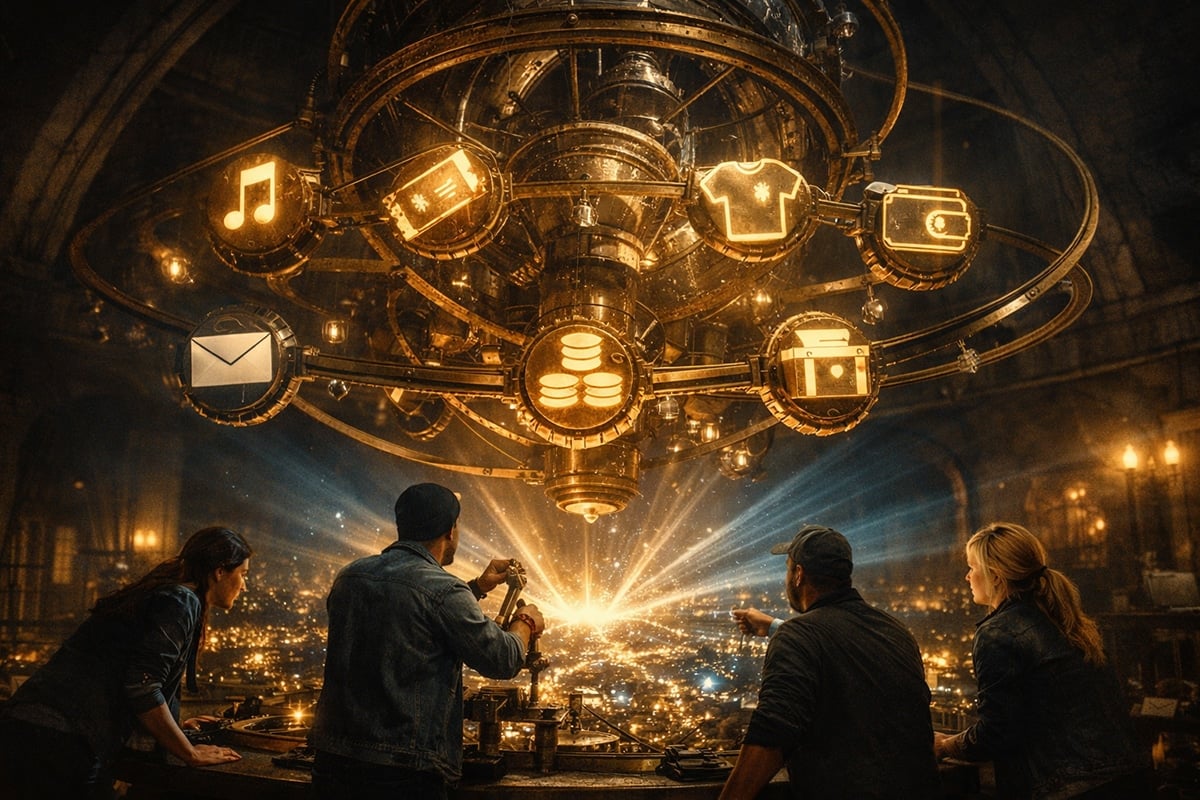
Making a Scene Presents – The Artist-Owned Ecosystem: Replacing the Label, Distributor, and Platform
Listen to the Podcast Discussion
The night the old deal stopped making sense
It usually happens after the show.
Not onstage. Not in the comments. Not when the playlist adds hit. It happens when the room is half empty, the drummer is packing hardware, somebody is folding shirts at the merch table, and the artist is looking at a phone full of “engagement” that does not pay tomorrow’s hotel bill. That is the moment the old music business starts to look less like a dream and more like a machine built to turn artist momentum into platform traffic, label leverage, and somebody else’s data.
For years, the industry sold one big fantasy. Get signed. Get distributed. Get promoted. Get placed in front of the audience. Then the money will come. But the modern version of that deal has a nasty twist. Even when artists do get attention, they often do not get ownership. The fan relationship lives on someone else’s platform. The audience data sits in someone else’s dashboard. The checkout happens inside someone else’s system. The artist becomes the fuel, while the infrastructure belongs to everybody else. That is not a career. That is a dependency. And dependency is not the same thing as growth.
This is where the artist-owned ecosystem comes in. Not as a cute tech stack. Not as a pile of apps. Not as some crypto fever dream where a JPEG saves your band. This is a system. A real operating model. A label-in-a-box built by the artist, for the artist, with the artist still holding the keys. In that system, distribution is decentralized, marketing is automated and informed by AI, fan management is built on direct contact plus wallet identity, and revenue is spread across memberships, merch, tickets, collectibles, and repeat purchases. The point is not to chase a new trend. The point is to replace fragile attention with durable business.
The label was never magic. It was a bundle of jobs.
A lot of artists still talk about “the label” like it is one thing. It is not. It is a bundle of functions. Money. Distribution. Marketing. Audience development. Retail. Rights management. Ticketing relationships. Community building. Data collection. Packaging. Brand story. If you break the label apart, it stops looking like a throne and starts looking like a workflow.
That is good news, because workflows can be rebuilt.
Today, a self-hosted publishing and commerce base can be built on WordPress and Woocommerce, where the site, checkout, and customer experience live under the artist’s control. Email collection and newsletter publishing can live on the same property through The Newsletter Plugin, with delivery support through Sendgrid. Payments and subscriptions can run through Stripe. Ticketing can run on the artist’s own site through Tickera, which explicitly positions itself as a self-hosted ticketing solution that does not take a cut, and it can also work alongside WooCommerce. In plain English, the storefront, the box office, the mailing list, and the billing office no longer have to be rented from the same gatekeepers who control discovery.
That matters because independence is not just about creative control. It is about operational control. If your album rollout works but you cannot retarget buyers, message ticket holders directly, segment superfans, or see who bought what, you do not own your momentum. You borrowed it. An artist-owned ecosystem flips that. Every release, every RSVP, every purchase, every membership, and every attendance signal becomes part of a living business record the artist can use again. That is how a fan stops being a stream count and becomes a customer, a member, a local draw, a street team ally, or a long-term supporter.
Stop buying tools. Start building flow.
This is where a lot of artists get lost. They hear about Audius. Then IPFS. Then wallets. Then NFTs. Then AI agents. Then email automation. Then Discord roles. Then ticketing plugins. After a while it feels like somebody dumped a bag of cables on the floor and called it “the future.”
That is the wrong way to think about it.
The right way is flow. How does a stranger become a fan? How does a fan become a buyer? How does a buyer become a repeat buyer? How does a repeat buyer become a member? How does a member become part of a local support base that helps sell tickets, move merch, and build turnout city by city? If a tool does not improve that flow, it is noise. If it does improve that flow, it belongs in the system.
So the artist-owned ecosystem should be read like a map. Discovery leads to identity. Identity leads to communication. Communication leads to offer. Offer leads to transaction. Transaction leads to retention. Retention leads to predictable revenue. Once you understand that, the chaos clears up. Audius is not “a cool Web3 platform.” It is one possible discovery and distribution layer. IPFS is not “nerd storage.” It is a durability layer for media and metadata. Unlock is not “an NFT thing.” It is a membership layer. POAP is not “a collectible gimmick.” It is a memory and proof layer. AI tools are not there to replace artists. They are there to lower the cost of planning, creating, segmenting, and repeating the work.
Layer one: the home base has to belong to the artist
Every ecosystem needs a center of gravity. In the old model, that center was the label. In the platform era, it became Spotify, Instagram, TikTok, YouTube, or whatever algorithm happened to be hot that month. In the artist-owned model, the center has to be the artist’s own property.
That usually means a site the artist controls, not just a profile the artist borrows. WordPress describes itself as an open source publishing platform, and WooCommerce describes itself as an open-source commerce platform for WordPress that gives users control over checkout, data, and costs. That is not a minor feature. That is the heart of the whole strategy.
Your website is not your online business card. It is your venue lobby, merch table, fan club desk, box office, and data room. It is where the artist story lives in full, where offers are made, where email is collected, where tickets are sold, where exclusive content can be gated, and where transactions are tied back to actual people you can reach again.
This is also why the “just send them to your link-in-bio page” habit is so weak. A link hub is a hallway. An owned site is a building. One sends people away. The other lets them stay, browse, buy, join, and return. If artists want a middle class instead of a moment, they need infrastructure, not shortcuts. The home base is where the rest of the system plugs in.
Layer two: distribution without surrender
The old distribution model asked artists to hand music to an intermediary and hope for reach. The artist-owned model asks a better question: where does the music live, who can access it, and what data comes back when people do?
Audius is useful here because its own developer docs describe it as a decentralized, community-owned, artist-controlled music-sharing protocol. The docs also show that artists can upload tracks, create albums, and either use registered content nodes or run a content node themselves. That matters because it moves the idea of music distribution closer to artist-controlled infrastructure and further from the classic model where a central service is the only road to the listener. Audius is not the whole answer, but it is a real example of distribution being treated as a protocol and not just a storefront.
IPFS, pushes this further. IPFS describes itself as a set of open protocols for addressing, routing, and transferring data on the web using content addressing and peer-to-peer networking. In simpler terms, it gives your files a fingerprint, called a CID, and lets those files live in a distributed network instead of one brittle server. That matters for music, cover art, collectible files, gated downloads, stems, liner notes, and fan assets because it creates a more durable layer than “hope the platform never changes its terms.” Pinning services like Pinata help keep content available on IPFS, and NFT Storage is built around long-term, verifiable NFT storage and preservation. The smart move is to think of Audius as a distribution and fan-facing layer, and IPFS as a preservation and asset layer. One gets the music into circulation. The other helps make sure your digital property does not vanish because a startup pivoted.
None of this means artists should rip themselves off the mainstream internet overnight. That would be dumb. Discovery still happens where people already are. The smarter move is to use mainstream channels as traffic sources while moving the center of ownership back home. In other words, let rented platforms advertise the artist. Do not let them become the artist’s whole business.
Layer three: fan identity has to be deeper than an email, but email still matters
A lot of Web3 talk gets weird because people act like wallets are here to replace everything. They are not. A wallet is not a magic wand. It is one more identity layer. A strong system uses both wallet identity and direct contact identity.
For direct contact, email still matters because it is one of the few channels the artist can control more directly than social feeds. The Newsletter Plugin says it lets creators manage newsletters from inside WordPress, place signup forms around a site, sort subscribers into lists, send welcome emails, and automate newsletters. SendGrid, now under Twilio, still offers email API and marketing campaign tools, and its own guidance makes clear that inbox placement depends heavily on recipient engagement. That is the point. When fans opt in on your property, your communication is tied to a relationship you can grow, segment, and measure. Not all email stacks are equal, but the principle is simple: if you do not own the list, you are renting your reach.
Wallet identity adds another layer that email alone cannot do. MetaMask is a self-custodial wallet, meaning the user controls access to the wallet and its assets. Sign-In with Ethereum a standard that lets users authenticate with their Ethereum account and ENS profile rather than a traditional intermediary. ENS gives people human-readable names instead of ugly wallet strings. Put that together and you get something powerful: a fan can prove ownership, access gated perks, carry collectible credentials, and move across experiences without the artist having to rebuild identity from scratch every time. Email says, “Here is how I reach you.” A wallet says, “Here is what you hold, where you have been, what access you have earned, and what community you belong to.” Strong systems use both.
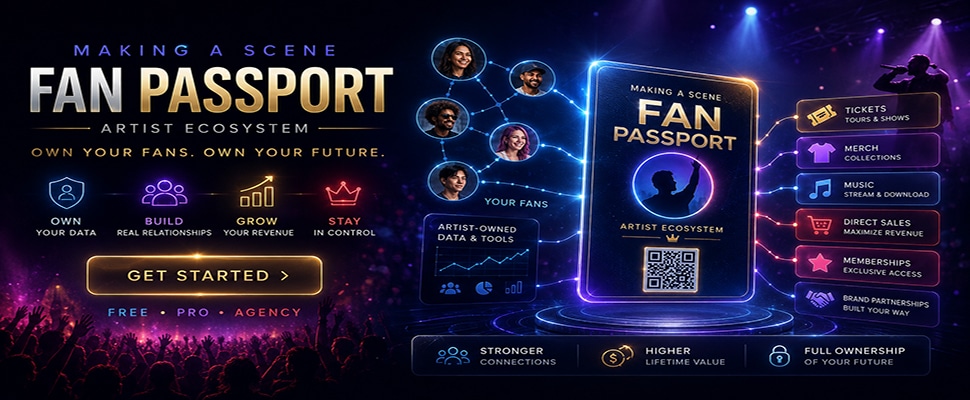
This is also where the fan passport concept starts to get really interesting. A fan passport is not just a loyalty card with cool branding. It is a portable relationship record. It can track attendance, purchases, participation, referrals, and community status. It can recognize the fan who bought the vinyl, showed up twice in six months, brought three people to the last gig, and joined the membership tier. That is not vanity data. That is touring intelligence and revenue intelligence.
Layer four: the fan passport turns memories into usable business signals
Making a Scene has been circling this idea for a reason. The fan passport solves a problem artists have had forever: most audience activity disappears the moment the night ends. Somebody came to the show. Somebody bought a shirt. Somebody joined the email list. Somebody posted about it. Somebody drove an hour and came back next month. Under the old system, those moments vanish into a blur. Under an artist-owned system, those moments become signals.
POAP, describes itself as Proof of Attendance Protocol and says it lets people mint digital mementos tied to shared moments. Its help materials also describe POAPs as digital proof that someone attended or participated in an event and note that they can later qualify collectors for utility. That makes POAP useful as a memory layer, a participation layer, and a reward layer. You can give a POAP to everyone who attended a hometown release show, but you can also treat that attendance as the first stamp in a larger journey.
Unlock Protocol, takes the next step. Unlock describes itself as a set of smart contracts built specifically for memberships and subscription NFTs, with time constraints, recurring payments, renewals, walletless onboarding options, and guides for WordPress integration, membership sales, ticketing, and even credit card payments. That means an artist can create membership access that feels more like a real fan club business and less like random token chaos. A fan passport can begin with POAP-style proof, deepen into Unlock-based membership, and then connect to gated content, early access, special pricing, private livestreams, meet-and-greets, backstage Q&As, regional fan groups, or presale windows. The important part is not the token. The important part is the relationship logic.
Guild, adds community structure on top of that. Guild describes itself as a platform for building communities with integrations, token gating, quests, rewards, and role management. Its docs talk about gating access based on wallet holdings and rewarding active members with roles, NFTs, tokens, early access, or custom perks. So now the fan passport is not just a receipt. It is a living status system. The fan does not just buy. The fan levels up. That is how belonging starts to become measurable and monetizable without becoming gross.
Layer five: marketing becomes a studio, not a guessing game
Traditional label marketing was expensive because it depended on labor, gatekeepers, and waste. You paid for campaigns that were hard to test, hard to personalize, and often too broad. The AI layer changes that. Not because AI is a magic marketer, but because it lowers the cost of planning, producing, adapting, tagging, scheduling, and learning.
For writing, planning, research, and campaign variation, artists can use tools like ChatGPT and Claude. Canva’s AI tools emphasize customizable design assistance, while Descript positions itself as audio and video editing that works like editing text. Workflow platforms like Zapier and Make are now openly pushing AI workflow orchestration, letting creators connect AI steps to thousands of apps without needing full-time developers. Put together, that means a small artist team can plan a release calendar, generate multiple message angles, resize creative for different channels, cut short-form clips, trigger follow-up emails, and route fan activity into a CRM-like record without hiring a big label staff.
But the deeper value of AI is not speed. It is pattern recognition. Chartmetric describes itself as a music analytics suite that tracks streaming, social, and live data, while Cyanite offers AI tagging, descriptions, and search around song mood, genre, instrumentation, and lyrical themes. That means marketing can become more precise. An artist can stop shouting “new single out now” into the void and start making smart moves. Which cities are heating up? Which songs share a mood that could support a sync pitch? Which audience segment keeps buying acoustic live versions? Which members show up for intimate content instead of loud social posts? That is label thinking. Except now the label is a dashboard the artist controls.
This is the part the old gatekeepers should be nervous about. Because once AI lets small teams move like big teams, the advantage of scale starts to shrink. The artist who owns the data, owns the list, owns the story, and owns the release schedule can start making decisions faster than an organization built on meetings and middlemen.
Revenue is where the ecosystem proves it is real
Let’s get rebellious for a second. Streams are not a business model for most independent artists. They are a signal. They are awareness. They are top-of-funnel. They can matter, but they are not the thing that pays the rent unless you already have massive volume. The artist-owned ecosystem works because it treats streaming and discovery as the front door, not the whole house.
The house is built on stacked revenue. One-time sales. Recurring memberships. Tickets. Merch. Premium access. Digital collectibles. Bundles. Limited drops. Fan club tiers. VIP upgrades. Direct experiences. The reason this matters is simple: predictable income does not come from one giant spike. It comes from layers that repeat. Stripe Billing explicitly supports one-time purchases, recurring billing, usage-based billing, payment links, and subscription management. Unlock is built for time-based memberships, renewals, recurring payments, and easy onboarding, including credit-card paths. Tickera is built for selling tickets on an artist’s own WordPress site without handing over a cut. That means the business does not have to wait for the next viral moment. It can run every month.
Here is what that looks like in practice. The casual listener finds a song. The artist captures that person with an owned landing page. The fan joins email and claims a free passport stamp. A week later they are offered a paid membership tier with access to demos, behind-the-scenes video, early ticket access, and a members-only livestream. When the local date gets announced, that fan gets a presale window. At the show, the ticket gets checked in, a new passport stamp is issued, and the merch table recognizes that member status for a bundle discount. After the show, the artist follows up with photos, a live recording, and an offer for a limited collectible tied to that night. None of that is random. It is a loop. And loops are how businesses become stable.
NFTs belong in this picture, but only when they do a job. An NFT that just exists is a souvenir with no system around it. An NFT that unlocks membership, access, attendance proof, discount tiers, or collectible history can become part of the operating system. That is the difference between speculation and utility. The point is not to sell a “token” because the word sounds futuristic. The point is to package access, memory, and belonging in a way the artist can program and reuse.
Stability comes from loops, not hype
This is the part artists, managers, and small teams need to tattoo on the inside of their foreheads. Stability is not created by one platform. Stability is created when each part of the system feeds the next part.
A show is not just ticket revenue. It is also fan data capture, attendance proof, merch conversion, local demand mapping, content creation, and membership recruitment. A new single is not just a stream. It is also a reason to bring people into the list, text messaging, tag audience taste, offer a bundle, and move listeners toward a higher-value relationship. A membership is not just monthly cash. It is also a way to identify the fans most likely to buy tickets, bring friends, support campaigns, and fund creative risk. A fan passport is not just a collectible. It is a map of who is becoming part of the core.
That is why this model creates more predictable income than the old chase. Labels and platforms love spikes. Independent artists need repeat behavior. If fifty fans pay every month, buy two drops a year, and show up when the artist comes through town, that is worth more than ten thousand cold listeners who never leave the app. Harsh? Maybe. True? Absolutely.
A middle class is not built on applause. It is built on repeat transactions with people who know where to find you.
The bridge matters as much as the destination
Now for the sober part. Most artists are not going to wake up tomorrow, launch a wallet-integrated membership layer, pin their catalog to IPFS, start issuing POAPs, and suddenly retire the old system. There is a bridge phase. Ignore that and the whole idea sounds fake.
The bridge starts by separating exposure from ownership. Keep using discovery channels. Keep releasing into the places where listeners already search. Keep the socials alive. Keep the videos coming. But every campaign should point somewhere owned. That owned place should collect email. It should offer something worth joining for. It should begin the fan passport. It should offer one product, one membership, one event, or one reason to come back. The artist is not quitting the internet. The artist is changing where the relationship deepens.
From there, add layers in the order that builds the most leverage. First, own the website and list. Second, own the store and ticketing flow. Third, add simple automation. Fourth, add community and membership logic. Fifth, add wallet features and passport mechanics for the people who want more. This is also why Unlock’s support for walletless onboarding and credit-card payments matters so much. Beginner fans should not need a PhD in crypto to support a band. The best systems make the deep tech optional at first and valuable later.
That is how decentralized infrastructure actually wins. Not by forcing every fan through a confusing ritual, but by making the new system better than the old one. Easier to join. More rewarding to stay. More valuable to the artist every time it is used.
What this means for bands, managers, and small teams
For solo artists, this ecosystem is a way to stop acting like a full-time content intern for somebody else’s platform. For bands, it is a way to build shared infrastructure that survives lineup changes, slow seasons, and gaps between releases. For managers, it is a way to turn artist development into owned assets instead of temporary platform heat. For small teams, it is a way to operate like a label without surrendering the company.
A manager using this model is not just “promoting the record.” They are building a business spine. They are making sure the website captures leads, the list gets segmented, the offers are timed, the tour data gets logged, and the membership layer keeps working between cycles. A band using this model is not just selling tickets. They are turning every town into a data point and every repeat fan into a stronger local base. A small team using this model is not just running social. They are creating a controlled path from public attention to private value.
And because the tools now exist in usable form, the staffing model changes too. One person can handle release planning with ChatGPT or Claude. One person can cut content fast in Descript and build visuals in Canva. One person can wire together automations in Zapier or Make. One person can study demand trends in Chartmetric and use Cyanite to make better tagging, sync, and catalog decisions. That does not eliminate the need for human taste. It makes human taste more valuable because less time gets burned on dumb repetition.
A practical label-in-a-box stack, without losing the plot
If you wanted to sketch the stack today without turning this article into a shopping cart, it might look like this.
The owned base runs on WordPress and Woocommerce.
The Mailing list layer runs on The Newsletter Plugin with delivery through Sendgrid.
The payment layer runs on Stripe.
The ticket layer runs through Tickera or, for onchain membership-style ticketing, Unlock Protocol.
The distribution and asset layer uses Audius, IPFS, Pinata, and NFT Storage.
The identity layer uses Metamask, Ethereum, and ENS.
The community and reward layer uses POAP, Unlock Protocol, and Guild.
The AI marketing and operations layer uses ChatGPT, Claude, Canva, Descript , Zapier, Make, Chartmetric, and Cyanite.
But the real point is this: the stack only matters if the flow is right. If the site is pretty but captures nothing, it fails. If the membership exists but offers no clear value, it fails. If the passport tracks moments but those moments never lead to better offers, it fails. If the AI writes ten posts a day but none of them move fans toward owned channels, it fails. The system works when every layer moves the fan closer to a deeper relationship and the artist closer to repeatable income.
The new deal is not “Do It Alone.” It is “Own the Core.”
There is still room in music for partners. Good publicists can help. Great booking agents can help. Smart distributors can help. Ethical managers can help. The artist-owned ecosystem is not anti-help. It is anti-dependence.
That is the real attitude here. We are not waiting for the old system to become fair. We are not begging platforms to suddenly care about artist stability. We are not treating data poverty like some noble struggle. We are building the middle class ourselves, with owned masters, owned fan relationships, owned commerce, owned identity layers, and owned repeat business.
The label-in-a-box is not a toy. It is the blueprint for what comes after the platform era. It says the artist can be the brand, the publisher, the storefront, the club, the data owner, and the membership engine. It says the website matters again. It says the mailing list matters again. It says the show is not just a show but a node in a living system. It says AI is useful when it cuts costs and sharpens action. It says Web3 is useful when it makes ownership portable, verifiable, and programmable. It says the fan relationship is the real asset, not the dashboard screenshot.
And maybe that is the biggest shift of all. The future independent artist is not trying to replace one king with another. They are building a town they own, one street at a time.
 |  Spotify |  Deezer |  Breaker |
 Pocket Cast |  Radio Public |  Stitcher |  TuneIn |
 IHeart Radio |  Mixcloud |  PlayerFM |  Amazon |
 Jiosaavn |  Gaana |  Vurbl |  Audius |
 Reason.Fm | |||
Find our Podcasts on these outlets
Subscribe to Our Newsletter
Discover more from Making A Scene!
Subscribe to get the latest posts sent to your email.


