When YouTube Removes the Cash Register: What the Creator Music Change Means for Indie Artists




Making a Scene Presents – When YouTube Removes the Cash Register: What the Creator Music Change Means for Indie Artists
Listen to the Podcast Discussion
For the last few years, YouTube Creator Music offered independent musicians something worth paying attention to. A video creator could find certain songs inside YouTube’s licensing marketplace, pay an upfront fee for permission to use one of those tracks, and then use that music in an eligible monetized video while keeping the normal revenue share from the video.
For the music rights holder, the arrangement created something that looked remarkably like a small-scale synchronization licensing marketplace. It was not Hollywood money, and nobody was ordering a new swimming pool because a cooking channel licensed their instrumental, but it created a relatively simple way for music owners and video creators to do business with each other.
Now that paid part of Creator Music is going away.
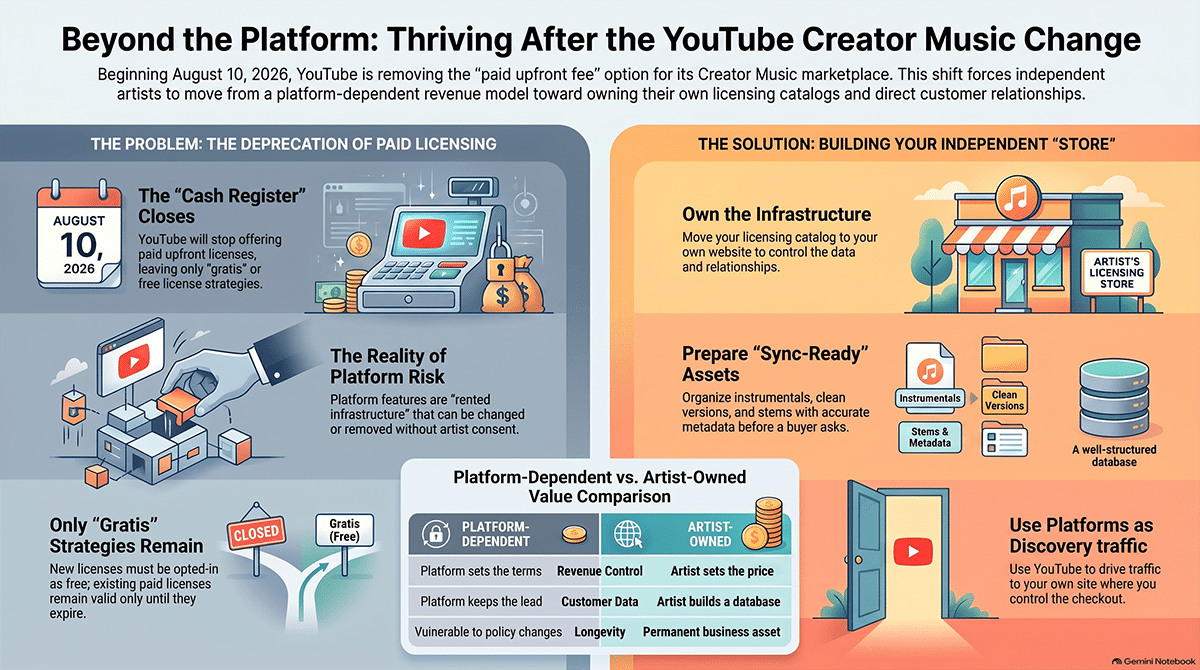
YouTube’s current documentation says that paid Creator Music licenses are being deprecated beginning August 10, 2026. After that change, participating rights holders will only be able to establish what YouTube calls gratis, or free, Creator Music license strategies.
Existing paid and free licenses do not immediately disappear when the change happens. YouTube says those licenses remain valid through the end of their existing terms, but they cannot be renewed under the old terms once those terms expire.
That distinction is important because it would be easy to describe this as YouTube merely redesigning its paid marketplace. According to the company’s current documentation, that is not what is happening. The paid upfront licensing option itself is being removed from Creator Music while free licensing remains.
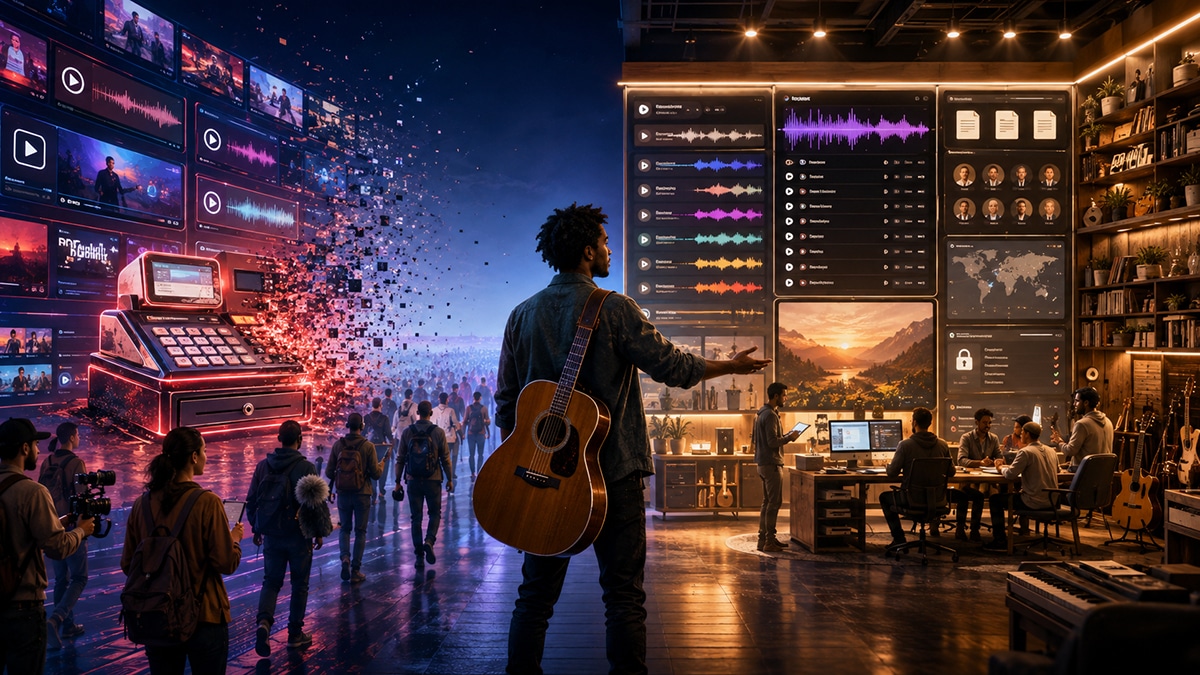
For independent artists, the bigger story is not simply the disappearance of another button inside YouTube Studio. It is another reminder of one of the most important rules of the modern music business: when somebody else owns the store, somebody else gets to decide where the doors go, what is sitting on the shelves, and whether there is still a cash register when you arrive Monday morning.
That does not make YouTube evil. It makes YouTube a platform with its own business interests, priorities, experiments, and changing strategies.
Independent artists need to behave the same way.
What YouTube Is Actually Changing
Creator Music itself is not simply being shut down. YouTube’s documentation specifically says that paid licensing within Creator Music is being deprecated, while the service will continue focusing on free licenses made available by participating rights holders.
As of August 9, 2026, YouTube’s creator documentation still describes the system that existed before this change. Some Creator Music tracks could be licensed by paying an upfront fee, while other tracks could be licensed at no cost under the terms shown for that particular recording.
When a creator purchased an eligible paid license, YouTube said that creator could use the music under the listed conditions and keep the normal revenue share from the video. Creator Music also included a separate revenue-sharing model for certain music, creating different ways for music rights holders and video creators to participate in the same ecosystem.
YouTube currently documents Creator Music as being available to eligible U.S. creators in the YouTube Partner Program. The company has previously described expansion outside the United States as something that would come later, so Creator Music was never a universal licensing marketplace available to every person who had ever discovered the upload button.
YouTube’s official Creator Music information is available through its Help Center at https://support.google.com/youtube/answer/11273150?hl=en.
For music rights holders, however, the important part of the August change is quite clear. Once paid licenses are deprecated, YouTube says participating rights holders will only be able to establish free Creator Music licensing strategies, and tracks will need to be intentionally opted into that system.
In other words, independent musicians should not build next year’s revenue forecast around YouTube continuing to collect upfront Creator Music licensing payments. If your business depends on that particular cash register, August 10 is a fairly strong reminder that it belongs to somebody else.
Creator Music Was an Interesting Little Sync Experiment
Creator Music mattered because it tried to remove some of the friction that has always surrounded music licensing. Traditional synchronization licensing can involve emails, negotiations, master owners, publishers, managers, contracts, invoices, music supervisors, attorneys, and the ancient music-business custom of waiting eleven days for somebody to answer a four-line email.
Creator Music attempted to turn at least part of that process into something much closer to online shopping. A creator could search for music, look at the conditions attached to a track, determine what the license cost, pay for the permission where required, and attach that license to a video.
Before the August 2026 change, rights holders could establish pricing strategies for eligible music. YouTube’s documentation described systems in which prices could vary depending on the size of the creator’s channel and included preset approaches aimed at different pricing levels.
The creator-facing documentation explained that paying an upfront Creator Music licensing price could allow a creator to retain the normal video monetization share rather than sharing that revenue with the music rights holder. More information about how paid Creator Music licensing worked can be found at https://support.google.com/youtube/answer/11609509?hl=en.
That made Creator Music resemble what we might reasonably describe as a micro-sync licensing marketplace. That is not YouTube’s official term for the service, but it describes the economic idea pretty well.
Instead of hoping that your instrumental somehow found its way onto the desk of a major film music supervisor, smaller creators could discover music and license it inside a platform they were already using. That could make licensing accessible to people who were making monetized online videos rather than multimillion-dollar television commercials.
The particular YouTube implementation is changing, but the demand that made the idea useful has not disappeared. Video creators still need music, and musicians still own recordings that could serve those creators.
That means the underlying business opportunity has not vanished. It may simply be moving somewhere else.
Sync Licensing Is Not Streaming With Better Shoes
Independent artists also need to understand what is actually being licensed. Music licensing becomes confusing very quickly because the thing most people casually call “a song” can involve more than one separate copyright.
The U.S. Copyright Office explains that a recorded song commonly contains two separate copyright-protected works. One is the musical work, which generally means the underlying composition and lyrics, while the other is the sound recording, meaning the particular recorded performance of that composition.
Those copyrights can have different owners. A songwriter or publisher might control some or all of the composition, while a record label, artist, or another party might control the sound recording.
The Copyright Office provides useful basic information for musicians at https://www.copyright.gov/engage/musicians/.
When music is combined with moving images, the permission involving the composition is commonly called a synchronization license. If the producer also wants to use a particular existing recording of that composition, permission for the sound recording is commonly described as a master-use license.
The Copyright Office explains that these permissions are generally negotiated voluntarily rather than being provided through a compulsory synchronization licensing system. Its educational material about music income and licensing is available at https://www.copyright.gov/music-modernization/educational-materials/musicians-income.pdf.
For indie artists, this creates an important potential advantage. If you control both the composition and the master recording, you may be able to clear a project quickly without a buyer chasing five different companies for permission.
That advantage disappears if the artist does not actually know who owns what. If there are co-writers, publishers, labels, samples, contractual approval rights, producers with ownership interests, or other parties involved, those realities still exist regardless of how independent the artist feels.
Owning your music is powerful. Knowing precisely what you own is even more powerful.
Platform Revenue Is Rented Revenue
The Creator Music change gives us another clear example of platform risk. A company creates a feature, musicians begin adapting their businesses to it, and eventually the company decides that the feature needs to change.
That does not mean the feature was a scam or that using it was a mistake. It simply means that a platform feature is rented infrastructure rather than something the artist owns.
YouTube can change YouTube because YouTube owns YouTube. Spotify can change Spotify, TikTok can change TikTok, and Instagram can redesign Instagram without asking whether your promotional calendar was emotionally prepared for the experience.
Artists should absolutely use these platforms. They are extraordinarily powerful tools for reaching audiences, distributing content, creating discovery, and connecting with people around the world.
The mistake comes when the artist quietly allows one of those tools to become the foundation underneath the entire business. If the foundation belongs to somebody else, the owner of the foundation gets a vote about what happens next.
This is why Making A Scene continues to push the same basic philosophy. Platforms should be discovery doors that bring people into an artist-owned business rather than destinations where the entire artist business is permanently parked.
Your website is an asset you control. Your permission-based fan database is an asset, your masters are assets, your publishing rights are assets, your licensing catalog is an asset, and the relationships you create directly with fans and business customers are assets.
A feature inside somebody else’s dashboard is useful, but it is still somebody else’s feature. That difference becomes much easier to see the day the feature disappears.
Build Your Own Licensing Catalog
The end of paid Creator Music licensing makes an artist-owned licensing catalog considerably more attractive. Instead of thinking of YouTube as the store where your music is licensed, you can begin thinking of YouTube as one of several places where potential licensing customers discover your store.
That store can live on your own website.
An artist could create a dedicated licensing section specifically designed for people who make media. Instead of forcing filmmakers, YouTubers, editors, advertisers, podcasters, and game developers to listen through an entire streaming catalog and guess which tracks might work, the artist could organize music according to the way licensing customers actually search.
That catalog might contain the full vocal recording along with instrumentals, clean versions, alternate mixes, short edits, underscore versions, ambient mixes, or stems when the artist has the authority to offer them. The catalog could also contain unreleased instrumentals created specifically for licensing rather than forcing every potential buyer to work only with commercial album releases.
Each recording could include useful descriptive information such as mood, tempo, instrumentation, energy, lyrical subject, vocal style, duration, available edits, ownership information, and licensing availability. A person searching for music for a project often cares about these qualities much more than whatever genre label musicians have spent three years arguing about on social media.
Your fans may be fascinated that you describe the music as psychedelic Americana with postmodern Delta influences. The editor making a 45-second tourism video may simply want something warm, energetic, acoustic, and instrumental.
Both descriptions can exist. Only one may help close the license before lunch.
Not Every Track Has the Same Value
One of the worst reactions to YouTube removing paid licenses would be for artists to decide that every piece of music should therefore become free. That would confuse the rules of one platform with the actual economic value of the artist’s catalog.
Different recordings can serve different purposes.
An instrumental from a release that came out several years ago might make sense as a promotional creator license. An artist might decide that allowing smaller video creators to use that recording without an upfront fee could help generate discovery, attribution, traffic, or interest in the rest of the catalog.
That can be an intelligent strategy when the terms are clear and the artist knows what they are trying to accomplish. Free can be a price, but it should never become the absence of a strategy.
Another recording might be extremely attractive for commercials, television, games, trailers, or documentary work. Giving that track away under broad commercial rights simply because YouTube changed a licensing feature would make about as much sense as learning that one coffee shop ended table service and responding by giving away the building.
The type of project also matters. An independent online creator, a national advertising campaign, a student film, a regional business commercial, and a major video game are not economically identical customers.
The value can also change depending on whether the license is exclusive or nonexclusive, how long the music can be used, where the project will appear, whether the music can be included in paid advertising, and how broadly the project will be distributed.
The goal is not to make licensing so complicated that every person requesting a track needs a lawyer, a cartographer, and three hours of uninterrupted free time. The goal is to recognize that different uses can carry different values.
Free Licensing Can Still Be Smart Business
Free licensing itself is not automatically a bad idea. In the right situation, free can function as marketing rather than surrender.
An artist may decide that certain recordings should travel as widely as possible. A particular instrumental might be offered to independent content creators under clearly defined conditions because the artist wants to encourage videos that introduce the music to new audiences.
The important question is what happens after that exposure occurs. If thousands of people hear your track in somebody’s video but cannot identify the song, find the artist, visit a website, join an email list, buy a ticket, purchase merchandise, or hear the next release, the promotional value may be extremely limited.
Exposure becomes economically useful when there is a path connecting attention to something the artist owns.
A free creator license can work beautifully when attribution points back to a strong artist website. That website can introduce the new listener to the artist, offer music and merchandise, promote upcoming shows, invite people into a permission-based mailing list, and build a longer relationship.
Without that system, the artist may simply have supplied free background music. That can still be a choice, but it should be an intentional one.
The Making A Scene philosophy has always been that attention is the beginning of the business process rather than the end of it. Streams, views, likes, and followers have value, but their real power appears when they lead toward an artist-controlled relationship.
Make Licensing Easy to Use
An artist-owned licensing system does not need to begin as some giant custom software project. A well-built page on an artist website can already do a surprising amount of the job.
The page should quickly explain what kind of music is available and what sort of customers the artist wants to serve. Visitors should be able to hear examples without creating an account, navigating through seventeen menus, or proving that they are not a robot six times before the first chorus.
Search and organization become especially important as the catalog grows. A creator might be looking for something uplifting and acoustic, dark and cinematic, gritty and bluesy, romantic and piano-driven, energetic without vocals, or atmospheric enough to sit underneath dialogue.
That is often how licensing buyers think. They have a scene, emotion, project, or problem first and start searching for music that solves it.
The licensing page should then make the next step obvious. A small creator might be able to obtain a standard nonexclusive license through an automated system, while a filmmaker, advertiser, game developer, or larger commercial customer might be directed toward a quote request.
The important thing is that the relationship begins through infrastructure controlled by the artist. Instead of the platform knowing who licensed the track while the musician receives only the transaction, the artist can start building a genuine customer relationship.
The Customer Can Be Worth More Than the First License
One of the most important ideas in direct licensing is that the first license may not be the most valuable part of the transaction. The real value may be discovering someone who regularly needs music.
Imagine that a small production company licenses one of your instrumentals for a regional commercial. If that transaction occurs entirely inside somebody else’s platform, you may receive some money but have very little direct connection with the customer.
Now imagine that the same company discovers your artist-owned licensing library. They search the catalog, request permission through your site, receive the agreement, pay through your system, and become part of your professional licensing contact database with the proper communication permissions.
Three months later, that company has another project. Instead of hoping some recommendation algorithm happens to show them your track again, you already have a business relationship.
A licensing customer may eventually use several recordings over a period of years. The value of that relationship can become far greater than the amount paid for the first piece of music.
That is how sustainable businesses are built. Transactions generate money today, while relationships create the possibility of money tomorrow.
Independent musicians should understand that difference because it is the same lesson that applies to fans. A ticket sale is useful, but knowing the person who bought the ticket and having permission to communicate with that person can become even more valuable over time.
Prepare Your Catalog Before Somebody Wants It
Direct licensing works much better when the music has been prepared before someone asks for it. A buyer wanting an instrumental this afternoon does not particularly enjoy hearing that the original recording session may be located on an external hard drive currently living in somebody’s basement.
Artists should organize licensing materials while recording projects are still fresh. Instrumental masters, clean versions, alternate edits, stems where appropriate, high-quality audio files, lyrics, ownership records, songwriting information, and production documentation can all become important later.
The U.S. Copyright Office emphasizes the distinction between musical works and sound recordings and the importance of accurate rights information. Its educational resources also describe identifiers such as the ISWC for musical works and the ISRC for sound recordings, both of which help distinguish what is actually being identified.
This kind of administrative work is rarely why someone bought their first guitar. Nobody dreams of standing onstage while thousands of people wave spreadsheets in the air.
Then somebody wants to pay for a license.
Suddenly good metadata becomes considerably more exciting.
The artist who can quickly tell a buyer who wrote the composition, who owns the master, which recording is being offered, what alternate versions exist, and who has approval authority is much easier to work with. Ease of doing business can become a competitive advantage.
Small Artists Can Sometimes Clear Music Faster
Independent musicians often assume that a major-label catalog automatically has an advantage in licensing because the company behind it is bigger. A large catalog certainly has resources, reach, and enormous quantities of music, but size can also create layers of approval.
A self-contained artist who controls both the master and the composition can sometimes move very quickly. If the rights are properly documented and the artist has already established acceptable licensing terms, a buyer might receive an answer in hours rather than weeks.
That speed can matter when a filmmaker, advertiser, video producer, or game developer is facing a deadline. Buyers do not always choose music solely because one track is artistically superior to everything else on Earth.
Sometimes they choose the track they love that can actually be cleared before the project ships.
The Copyright Office explains that synchronization and master-use permissions are generally negotiated directly by copyright owners or their representatives. That means there is no requirement that an independent artist use a giant licensing marketplace before doing business.
You can build the catalog, receive the request, approve the project, issue the agreement, collect the payment, and maintain the customer relationship yourself when you actually control the required rights. That is not working outside the music business; it is functioning as your own music business.
Be Careful About Calling Music Pre-Cleared
Artists should also be careful with language such as “pre-cleared.” A recording is only easy to clear when the person offering it actually has the legal authority to grant the rights involved.
If another songwriter controls part of the composition, that matters. If a publisher has rights in the song, that matters, and if a label or another company owns the master recording, that matters as well.
Samples can create additional complications. So can contractual approval requirements, ownership interests belonging to other producers or performers, and agreements that limit what the artist can authorize independently.
The fact that you paid for a recording session does not automatically mean you own every right attached to everything captured during that session. Music copyright has always been a little more interesting than that, usually at exactly the moment somebody finally wants to write a check.
This is another reason artists should get their paperwork organized. Split sheets, publishing information, master ownership documentation, sample clearances, and contracts become part of the commercial value of the catalog.
If an artist plans to offer standardized direct licenses at any meaningful scale, having an experienced entertainment attorney review the terms can also be worthwhile. The goal is not to make licensing intimidating for smaller creators but to make the terms understandable before problems occur.
One License Should Not Accidentally Become Every License
An artist also needs to avoid treating a license intended for one kind of project as permission for every possible use. A license designed for an ordinary YouTube video does not automatically need to include national television, a feature film, paid advertising, video games, political campaigns, podcasts, mobile apps, or whatever new media format somebody invents during the next venture-capital meeting.
Different uses can involve different commercial values and different legal considerations.
Audio-only podcasts deserve special attention because they are not necessarily the same kind of audiovisual use as a YouTube video. Advertising also carries different economic considerations from organic creator content, and a video game can present very different licensing needs from a social media clip.
An artist-owned licensing process should therefore ask enough questions to understand what the customer is actually buying. Where the project will appear, whether it generates revenue, whether it is advertising, how long the music will be used, where the project will be distributed, and whether the use is exclusive can all affect the agreement.
Those questions are not pointless bureaucracy. They help prevent a low-cost creator license from quietly turning into unlimited worldwide advertising rights forever because somebody misunderstood a sentence on a checkout page.
Making music easy to license does not mean making every possible use identical.
AI Can Help Organize the Licensing Business
Artificial intelligence can become extremely useful here without replacing the musician or pretending to own anything. A growing licensing catalog can contain dozens or hundreds of tracks, edits, instrumentals, stems, alternate arrangements, and other assets, and humans are not famous for consistently labeling files once a project reaches version number fourteen.
AI tools can help analyze and organize that material.
They can help generate draft descriptions based on mood, energy, instrumentation, tempo, lyrical themes, or possible use cases. They can also help identify gaps in a licensing catalog, such as recordings that lack instrumental versions or files that are missing important descriptive information.
AI-powered search can make the customer experience dramatically better as well. Instead of forcing a filmmaker to navigate a collection using only traditional genres, a conversational search system could understand a request such as wanting something gritty and bluesy for a motorcycle documentary that builds gradually but does not contain vocals.
The software could search the artist’s own catalog for relevant matches.
That is an excellent use of AI because the technology makes the artist’s existing work easier to discover. It does not need to create the music, claim ownership of the composition, or invent rights information.
That last point is important. AI should be allowed to help organize the catalog, but it should never be trusted to guess who owns it.
Ownership information needs to come from real agreements and verified records. An AI system confidently deciding that you own 100 percent of a song because your name appears in the filename is not rights management.
It is autocomplete wearing a necktie.
AI Could Make Small Catalogs More Competitive
AI search may ultimately become one of the biggest advantages available to independent licensing catalogs. Large production-music libraries can contain enormous numbers of tracks, which creates impressive variety but also makes discovery a major challenge.
An independent artist might have only thirty, fifty, or a hundred genuinely licensable pieces. If those pieces are deeply tagged and connected to intelligent search, however, the smaller catalog can become remarkably easy to navigate.
A buyer might type that they need an emotional piano piece for a documentary scene that feels hopeful but not sentimental. Another might need energetic garage rock for a sports video without vocals and with a clean ending.
A smart search system can understand those requests and surface the best recordings from the artist’s own catalog.
The artist then controls the economically important pieces of the process. The AI helps the customer find music, but the artist owns the catalog, establishes the licensing terms, collects the payment, and owns the customer relationship.
That is exactly how technology should function in an independent music economy. The tool makes the musician more competitive without making the musician disposable.
Your Website Can Become a Business Platform
For years, many musicians treated their websites as digital brochures. The site had the band photo, a biography, some tour dates, maybe a few videos, and a collection of links that sent visitors right back to the giant platforms that already controlled most of the relationship.
A direct licensing catalog changes that.
Now an artist website can become a place where actual business happens. A filmmaker can license an instrumental, a promoter can request booking information, a fan can buy vinyl, a music supervisor can ask about stems, and another visitor can join the artist’s email database.
Each of those interactions creates something more valuable than another anonymous platform impression. They create direct relationships around assets and systems the artist controls.
This is the larger Making A Scene idea behind artist ownership. Independence does not mean avoiding technology or refusing to work with platforms.
It means using technology in ways that increase the artist’s control over the economic value being created.
A website should eventually become more than a digital poster telling people that the artist exists. It can become the headquarters of the artist’s business.
Do Not Abandon YouTube
None of this means independent musicians should dramatically delete their YouTube channels and ride into the sunset while a string quartet plays in slow motion. YouTube remains one of the most important platforms in the world for video, music discovery, audience development, and creator culture.
Artists should continue using it when it serves their goals.
YouTube can introduce songs to new audiences, host music videos and performances, build subscriber communities, and connect artists with people who would never have discovered them through traditional media. Creator Music may also continue offering opportunities through the licensing and revenue-sharing systems that remain available under YouTube’s rules.
YouTube’s current Creator Music documentation continues to describe revenue sharing for eligible music. More information about those arrangements can be found at https://support.google.com/youtube/answer/12823912?hl=en.
The point is not to stop participating. The point is to stop confusing participation with ownership.
YouTube should be one road into the artist’s business. It should not become the entire town.
Turn Platforms Into Doors
Every major platform can become a discovery door leading toward infrastructure the artist controls. That means a YouTube channel can help direct the right visitors toward a professional licensing page rather than expecting YouTube itself to handle every part of the commercial relationship.
Licensing information can appear in video descriptions where appropriate. An electronic press kit can contain a direct licensing contact, while the artist website can make licensing options easy to find without requiring a customer to search through social profiles.
A professional licensing database can also be separated from a general fan database when necessary. The filmmaker looking for an instrumental for next month’s documentary does not necessarily need the same messages being sent to fans about Friday night’s club show.
Owning data does not mean collecting every email address within driving distance and sending everybody the same newsletter. It means understanding why people entered the artist’s ecosystem and communicating with them in ways that respect that relationship and whatever permissions they have given.
That approach is both better marketing and better business.
A licensing buyer becomes part of the professional side of the artist’s network. A concert fan becomes part of the fan relationship, and someone interested in both can participate in both if they choose.
The artist owns the infrastructure connecting those relationships rather than depending entirely on algorithms to rebuild them every time another sale is needed.
The Catalog Infrastructure Has Value
Artists naturally think of the song as the product because the song is where the creative work begins. In licensing, however, the ability to deliver and properly clear the song becomes part of the product too.
A brilliant recording that has unclear ownership, missing alternate versions, incomplete metadata, no licensing contact, and a three-week response time can be harder to use commercially. A very good recording with clean paperwork, a ready instrumental, accurate ownership data, clear licensing terms, and a fast response may be much easier for a working producer to choose.
That means catalog infrastructure has economic value.
The artist who organizes the masters, alternate mixes, metadata, ownership records, licensing terms, customer information, agreements, and payment system is building something much more valuable than a folder containing finished tracks.
They are building a small licensing company around their own intellectual property.
That company can serve different markets over time. Today the customer might be a YouTube creator, tomorrow it could be an independent filmmaker, next month it could be a regional advertiser, and next year it could be a game developer.
The platforms surrounding the music will continue changing. A well-organized catalog can continue belonging to the artist.
The Music Industry Middle Class Will Not Be Built on Jackpots
One of the most damaging ideas inherited from the traditional music business is that artists should wait for the one giant event that changes everything. Get signed, have a hit, land the enormous sync, go viral, or become famous enough that ordinary financial rules apparently stop applying.
Those things happen to some artists, but jackpots are a terrible foundation for a middle class.
A sustainable music career is more likely to grow from multiple recurring income streams working together. A modest creator license can sit beside a regional commercial placement, live performance income, merchandise, direct music sales, publishing income, memberships, production work, session work, fan support, and larger licensing opportunities.
The point is not that every artist needs every possible income stream. The point is that no single platform needs to carry the entire business.
A $75 license matters because it is $75 the artist did not have before. More importantly, if that license introduces a professional customer who returns four more times, the value becomes considerably larger.
The same principle applies to a person buying a T-shirt, joining an email list after a show, purchasing vinyl, or supporting a membership. Small transactions can become meaningful when the artist owns the relationships connecting them.
That is how you begin creating a real music industry middle class rather than waiting for another lottery ticket disguised as a career strategy.
There Are More Licensing Customers Than Most Artists Realize
The growth of online media has created an enormous number of people who need music even though they do not work for Hollywood studios. Independent filmmakers need music, YouTube creators need music, advertising agencies need music, game developers need music, and companies producing internal videos may need music as well.
Local businesses make promotional videos. Documentary producers need underscore, online educators need background music, and small production companies constantly work on projects that are much smaller than major television campaigns but still require legitimate music rights.
Some of those customers have modest budgets. That does not mean they have no value.
A creator who can afford only a relatively small license today may eventually build a much larger company. If that buyer found your music easily, understood the terms, received quick approval, and had a good experience, you have built something more durable than an algorithmic impression.
You have built trust.
That relationship becomes even more powerful when the artist owns the customer connection. The next time the buyer needs music, they already know where to look.
What August 10 Should Teach Artists
The end of paid Creator Music licensing should not cause panic among independent musicians. It should encourage a little strategic housekeeping.
YouTube tested a system that allowed eligible creators to pay upfront fees for certain music uses inside Creator Music. The company is now deprecating that paid system beginning August 10, 2026, while continuing Creator Music around free licensing and other structures allowed under its current rules.
Those are the confirmed facts.
What independent artists do with that information is the larger question.
One response would be to wait for another company to create the next licensing marketplace. Maybe somebody will, and artists should absolutely consider using it if the terms make sense.
The better response is to learn from what Creator Music demonstrated.
Content creators need music. They want to discover it quickly, understand what they can legally do with it, obtain permission without unnecessary delays, and pay prices that make sense for their project.
Those are customer problems.
Artists who solve customer problems create businesses.
A direct licensing catalog can do exactly that while allowing the artist to keep control of the underlying catalog and customer relationship.
Own the Cash Register
The deeper lesson from the Creator Music change has very little to do with one YouTube feature. It is really about who owns the infrastructure underneath an artist’s income.
If Spotify changes a discovery feature, the artist’s mailing list should still exist. If Instagram changes its algorithm, the artist’s store should still exist, and if a ticketing company changes its rules, the artist’s permission-based fan database should still exist.
The same should be true when YouTube changes a licensing program. The artist’s licensing catalog, rights information, alternate mixes, customer database, website, and payment infrastructure should remain intact.
Platforms can be enormously valuable partners. They simply should not become single points of failure.
Independent artists increasingly need to think like small rights companies and small media companies without losing sight of the reason the entire business exists in the first place. The music still has to matter.
The business surrounding the music simply needs to become stronger.
That may sound like additional work because it is additional work. The difference is that work invested in artist-owned infrastructure creates something the musician can continue using even when another platform changes direction.
You do not need to reject Creator Music, YouTube, free licensing, or any other useful platform opportunity. You simply need to know which recordings you are willing to use promotionally, which recordings have greater commercial value, which rights you actually control, and where you want the business relationship to live.
Free can be strategic when it serves a clear goal. Paid licensing can be strategic when the use has economic value, and AI can help organize and search the catalog as long as real rights records remain the source of truth.
YouTube can continue being a powerful place where people discover your music. The artist-owned website can become the place where a filmmaker licenses it, a business customer contacts you, and a relationship begins.
That is the difference between using a platform and depending on one.
Creator Music’s paid licensing change gives us another reminder of a rule that seems to become more reliable every year. When somebody else owns the cash register, they can decide what happens to the cash register.
The independent artist who owns the catalog, owns the customer relationship, and owns the infrastructure does not have to panic when somebody moves it.
They already have their own.
 |  Spotify |  Deezer |  Breaker |
 Pocket Cast |  Radio Public |  Stitcher |  TuneIn |
 IHeart Radio |  Mixcloud |  PlayerFM |  Amazon |
 Jiosaavn |  Gaana |  Vurbl |  Audius |
 Reason.Fm | |||
Find our Podcasts on these outlets
Subscribe to Our Newsletter
Discover more from Making A Scene!
Subscribe to get the latest posts sent to your email.


