

Transient Shaping: Controlling Punch Without Compression





Listen to the Podcast Discussion
Making a Scene Presents – Transient Shaping: Controlling Punch Without Compression
There is a moment in almost every home studio mix where the artist reaches for a compressor because something does not hit hard enough. The snare feels soft. The kick feels buried. The acoustic guitar sounds flat. The electric guitar does not jump out of the speakers. The drums feel like they are sitting behind a blanket instead of driving the song forward. So the first instinct is to compress it.
That instinct makes sense. Compression is one of the most important tools in recording. It can control volume, add weight, glue sounds together, shape tone, and help a track sit in the mix. But compression is not always the right tool for punch. In fact, sometimes compression is the reason the punch disappeared in the first place.
That is where transient shaping comes in.
Transient shaping is one of those tools that sounds advanced until you actually use it. Then it becomes almost embarrassingly simple. It lets you control the front edge and the tail of a sound without having to think about threshold, ratio, knee, release time, gain reduction meters, or whether you are accidentally crushing the life out of the performance. It is not magic, but when used well, it can feel like a secret door into professional mixing.
For the independent artist recording at home, this matters because punch is not just a technical word. Punch is attention. Punch is impact. Punch is the difference between a drum groove that makes people move and a drum groove that simply exists. Punch is the difference between a guitar part that drives the chorus and one that gets swallowed by everything around it. Punch helps a song feel confident.
And confidence matters because good mixes create more opportunities. A clearer, more exciting mix can make a song more playlist-ready, more licensing-friendly, more useful for content, more convincing to fans, and more effective when an artist sends it to a venue, publicist, reviewer, music supervisor, collaborator, or producer. A great mix does not guarantee income. Nothing does. But a weak mix can absolutely close doors before the song gets a fair shot.
The old gatekeeper music business taught artists to wait for someone else to make their records sound “real.” The new independent music business says learn the tools, control your sound, own your work, and build revenue from the quality of what you create. Transient shaping is one of those tools.
What Is a Transient?
Before we talk about transient shaping, we need to talk about transients.
A transient is the first fast burst of energy at the beginning of a sound. It is the crack of the snare before the drum rings. It is the click of the kick beater before the low end blooms. It is the pick hitting the guitar string before the chord sustains. It is the fingertip on a bass string before the note opens up. It is the consonant at the front of a vocal word. It is the hammer hitting a piano string. It is the first hard edge that tells your ear, “Something just happened.”
Your ear uses transients to understand rhythm, timing, distance, and excitement. A sound with strong transients feels closer, sharper, and more immediate. A sound with softer transients feels smoother, farther back, or less aggressive. Neither one is automatically better. The trick is knowing which sound needs which kind of front edge.
Think about clapping your hands in a room. The first sharp clap is the transient. The sound that hangs in the room after the clap is the sustain, decay, or room tail. If you could turn up only the clap without turning up the room, that would make the sound more direct and more punchy. If you could turn down only the clap and leave the room, the sound would feel softer and more distant. If you could turn up the room after the clap, the sound would feel bigger. If you could turn down the room after the clap, the sound would feel tighter.
That is the basic idea of transient shaping.
A transient shaper lets you adjust the attack and sustain parts of a sound. The attack control usually affects the beginning of the sound. The sustain control usually affects what happens after that beginning. Some plugins call these controls attack and sustain. Some say punch and decay. Some use simpler terms like bitter and sweet. Some tools go deeper with multiband controls, frequency targeting, tonal/transient splitting, or parallel blending. But the heart of the idea is simple.
You are not just turning the track up or down. You are changing the shape of the sound.
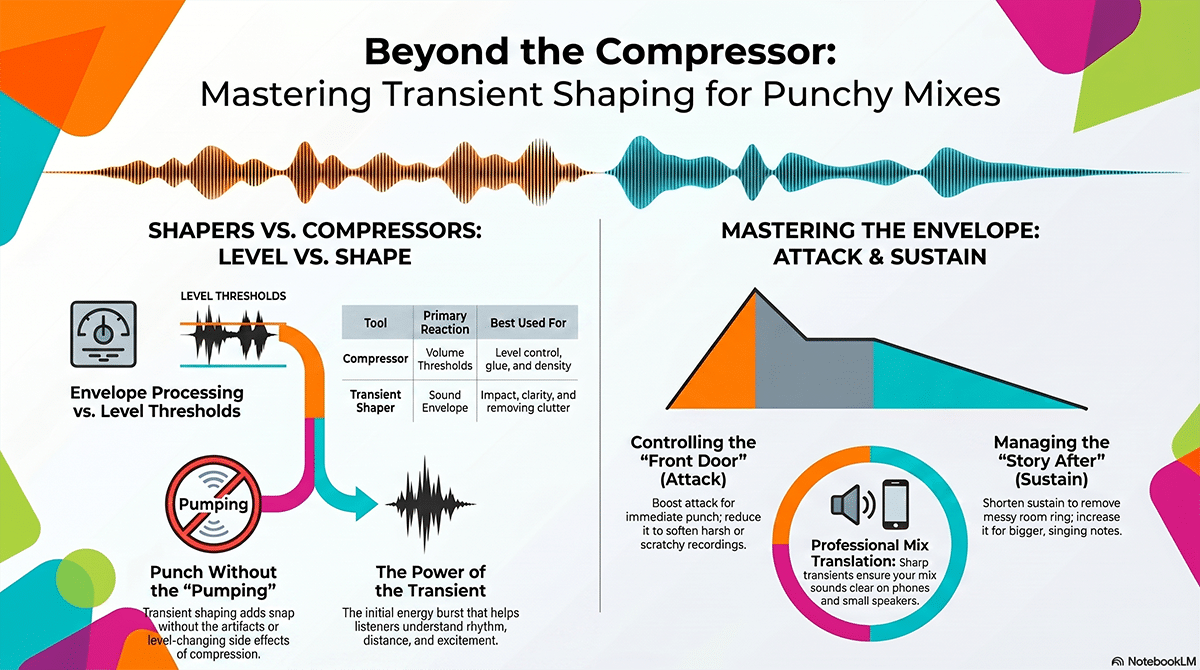
Why Transient Shaping Is Different From Compression
Compression and transient shaping both live in the world of dynamics, but they do not think the same way.
A compressor usually reacts to volume. You set a threshold, and when the sound gets louder than that threshold, the compressor turns it down according to the ratio you choose. The attack setting tells the compressor how quickly to react. The release setting tells it how quickly to let go. The makeup gain lets you bring the level back up after compression. This is powerful, but it is also easy to overdo.
A transient shaper is different because it focuses on the shape of the sound’s envelope. It is listening for the attack and sustain behavior of the sound, not simply waiting for the signal to cross a loudness threshold. That means it can often affect quieter and louder hits more evenly than a compressor. This is why a transient shaper can make a snare feel snappier without the pumping, grabbing, or level-changing side effects that sometimes come with compression.
Here is the beginner version.
A compressor says, “When this gets too loud, I will turn it down.”
A transient shaper says, “Let me reshape the front and back of this sound.”
That difference is huge.
Compression can make drums punchy, but it often does that by letting the transient through and then pulling down the body of the sound. Or it may clamp down on the transient and make the body feel louder. Or it may add density and attitude by changing the way the sound moves over time. Compression is wonderful when you want control, glue, thickness, energy, or movement.
Transient shaping is wonderful when the problem is more direct. If the kick needs more beater click, add attack. If the snare has too much ring, reduce sustain. If the acoustic guitar pick is too sharp, reduce attack. If the electric guitar feels too short and choked, increase sustain. If the drum room is washing out the groove, shorten the sustain. If a loop feels lifeless, add attack to bring the rhythm forward.
They intersect because both tools affect dynamics and feel. They are different because compression is usually level-based and transient shaping is usually envelope-based.
A lot of beginner mixes go wrong because the artist uses compression for every dynamics problem. That is like using a hammer for every repair in the house. Sometimes you need the hammer. Sometimes you need a screwdriver. Sometimes you need sandpaper. Sometimes you need a tiny adjustment that solves the problem without destroying the furniture.
Transient shaping is often that tiny adjustment.
Attack Is the Front Door of the Sound
Attack is the first impression. It tells the listener where the rhythm is. It tells the ear what is close and what is far away. It can make a part feel aggressive, confident, delicate, soft, nervous, relaxed, or explosive.
On drums, attack is obvious. The kick beater gives the kick its point. The snare crack gives the backbeat its authority. The stick on the tom tells the ear where the fill begins. The attack of a hi-hat or ride cymbal can make the groove feel tight or annoying, depending on how much is there.
On guitar, attack is just as important, but many home recordists miss it. The pick attack of an acoustic guitar can help the instrument cut through a dense mix. Too much pick attack, however, can make the guitar sound scratchy, cheap, or distracting. On electric guitar, attack can help riffs feel tight and rhythmic. But too much attack on distorted guitars can make the track feel fizzy or harsh. Not enough attack can make the guitar feel like a flat wall of noise instead of a performance.
On bass, attack can help the bass translate on smaller speakers. The low end may not fully show up on a phone, laptop, or small Bluetooth speaker, but the front edge of the bass note can still tell the listener what the bass is doing. That is a big deal for indie artists because fans do not always hear music on perfect studio monitors. They hear it in cars, earbuds, kitchens, bars, and little speakers that have no mercy.
On vocals, attack is more subtle. A transient shaper is not usually the first tool you grab for a vocal, but it can sometimes help with clarity. Consonants like T, K, P, and B have transient energy. Increasing that front edge can make a vocal feel more present. Reducing it can make a vocal feel smoother. This must be done carefully because vocals are personal. If you over-shape a vocal, it can start to feel unnatural very quickly.
Attack is not just loudness. It is the way a sound enters the room.
Sustain Is the Story After the Hit
Sustain is what happens after the attack. It is the ring, bloom, room, body, tail, decay, resonance, or wash that follows the first hit.
On a snare drum, sustain might be the ring of the shell, the buzz of the wires, the sound of the room, or the cymbal bleed hanging around after the hit. On a kick drum, sustain might be the low-end boom after the beater strike. On a tom, sustain might be the deep round note of the drum. On an acoustic guitar, sustain might be the body resonance after the pick hits the strings. On electric guitar, sustain is often the singing length of the chord or note.
Sustain can make things feel bigger. It can also make things feel messy.
This is where transient shaping can save a home studio mix. Many small rooms create problems with sustain because the room itself gets into the recording. A drum recording may have too much garage-like ring. An acoustic guitar may have a boxy tail. A percussion loop may have a room sound that fights the groove. A guitar amp recorded in a reflective room may have extra wash that makes the track feel less focused.
Compression often makes this worse. When you compress a track and then add makeup gain, you may bring up the quiet tail of the sound. That can make room noise, bleed, amp hiss, string squeaks, and unwanted resonance louder. Sometimes that is great. Sometimes it is exactly the wrong move.
A transient shaper gives you a different option. You can reduce sustain without crushing the attack. That means the drum can still hit, but the messy tail gets shorter. The guitar can still speak, but the extra room gets quieter. The loop can still groove, but the wash gets controlled.
This is why transient shaping is not just about adding punch. It is also about removing clutter.
The Fender Studio Pro 8 Workflow
In Fender Studio Pro 8, the basic workflow is simple, and the same idea applies to almost any DAW. You insert the transient shaper on the track or bus you want to shape, listen in context, make small adjustments, match the output level, and bypass often. The last part matters more than people think. Louder almost always tricks the ear into thinking something is better. Transient shaping should improve the feel, not just fool you with extra volume.
Start with a drum track, guitar track, bass track, loop, or bus. In the mixer, insert your transient shaper in the effects slot. Put it before heavy compression if you want the compressor to react to the newly shaped sound. Put it after compression if you want to restore some edge or tighten the tail after the compressor has done its job. There is no permanent rule here. The right order is the one that serves the song.
Loop the part of the song where the instrument matters most. Do not shape a snare in solo for ten minutes and then wonder why it takes your head off when the full mix comes back in. Use solo for diagnosis, but make decisions in the mix. Punch only matters in relationship to the other instruments.
Turn the attack up slowly. Listen for the moment where the sound becomes clearer, more rhythmic, or more exciting. Then keep going until it becomes too much. Once you hear too much, back it off. This teaches your ear where the edge is. Do the same with sustain. Turn it up until the sound gets bigger, then keep going until it gets messy. Turn it down until the sound gets tighter, then keep going until it gets thin or fake. Back off to the useful zone.
After that, level-match the output. This is the grown-up move. If the processed track is louder than the original, you may love it for the wrong reason. Pull the output down so the bypassed and processed versions are close in volume. Then ask the real question: does the shaped version make the song better?
That question is the whole game.
Using Transient Shaping on Drums
Drums are the obvious home for transient shaping because drums are built from impact and decay. A kick drum is attack plus low-end body. A snare is crack plus tone. A tom is stick hit plus resonant note. Even cymbals have a transient at the front, though you must be careful with them because too much cymbal attack can get painful fast.
On kick drum, transient shaping can help you find the beater without over-compressing the low end. If the kick is big but blurry, add a little attack. This can help the kick speak on smaller speakers and cut through bass-heavy arrangements. If the kick has too much boom after the hit, reduce sustain. This can make room for the bass and clean up the low end without needing extreme EQ.
This is where transient shaping becomes a money tool. Low end is one of the first things that separates amateur mixes from professional ones. If the kick and bass are fighting, the whole track feels smaller. A tighter low end helps the song translate in more listening environments. Better translation means the song has a better chance of working in playlists, videos, licensing pitches, live playback, and fan-shared clips.
On snare, transient shaping can bring back crack without adding too much top-end EQ. Many beginners try to fix a dull snare by boosting high frequencies. Sometimes that works. Other times it just brings up cymbal bleed, hiss, and harshness. A transient shaper can increase the front edge instead. That can make the snare feel more alive without making the whole track brighter.
If the snare rings too long, reduce sustain. This is especially useful in home recordings where the snare was not tuned perfectly or the room added an ugly tail. You can also use a transient shaper on a snare reverb send. Shorten the attack going into the reverb if the reverb splashes too hard, or reduce the sustain of the dry snare while letting the reverb create the space. This gives you control over size without mud.
On toms, transient shaping can be a cleanup tool. Toms often have great tone but too much ring, especially if the drums were recorded in a small room. Add a little attack for stick definition and reduce sustain to keep fills from washing over the vocal or guitars. If the toms sound too short and lifeless, do the opposite. Add sustain to bring out the note of the drum.
On drum bus, be careful. A transient shaper across the whole drum bus can be powerful, but it can also exaggerate cymbals, hats, and room problems. Use small moves. A little attack can make the groove feel more awake. A little sustain reduction can tighten the kit. A little sustain increase can make the kit feel bigger. But big moves on a full drum bus can turn a natural performance into a cartoon.
That cartoon effect can still be useful. Sometimes you want a drum break to sound exaggerated, sampled, smashed, or unreal. Transient shaping can help with that too. The point is to know when you are mixing and when you are creating an effect.
Using Transient Shaping on Guitars
Guitars are where transient shaping becomes more interesting than people expect.
On acoustic guitar, the attack is often the pick or fingernail hitting the string. If the acoustic guitar is getting lost in the mix, a little added attack can help the rhythm read clearly without turning the whole guitar up. This is useful when the vocal is the main focus and the acoustic guitar needs to support the groove without crowding the midrange.
But acoustic guitar can also have too much attack. Many home recordings place the mic too close to the picking hand or aim it in a way that captures too much pick noise. The result is a scratchy, clicky acoustic guitar that sounds busy even when the part is simple. Reducing attack can soften that pick edge while leaving the body of the guitar intact. That can make the guitar feel warmer and more expensive without reaching for heavy EQ.
Sustain control is just as useful. If the acoustic guitar has too much room, boom, or body resonance, reduce sustain. This can make strumming tighter and keep the guitar from masking the vocal. If a fingerpicked part feels too dry or small, increase sustain slightly to bring out the body and tail of the notes.
On electric guitar, transient shaping depends on the tone and the role. Clean funk-style parts often need attack because the rhythm is the hook. Add attack carefully and the part can jump forward without needing more volume. Edge-of-breakup rhythm guitar may need a little attack to keep the groove alive. Heavy distorted guitars often need the opposite. Distortion already compresses the signal and creates a dense wall of sustain. If you add too much attack, the guitars can get fizzy, spitty, or small. Sometimes reducing attack makes distorted guitars feel smoother and more powerful.
Sustain on electric guitar can be a creative tool. Increasing sustain can make single-note lines feel longer and more emotional. Reducing sustain can tighten palm-muted parts and stop rhythm guitars from smearing over the drums. On doubled guitars, reducing sustain slightly on each side can create more space in the center for vocal, kick, snare, and bass.
This is an overlooked professional trick: sometimes the guitar sounds bigger when each guitar track is a little smaller. A massive wall of guitar can eat the whole mix. Tightening the sustain lets the guitars hit hard and then get out of the way. That makes the song feel bigger because the listener can actually hear everything.
For indie artists, that matters because clarity sells the song. Fans may not know why a chorus feels strong, but they know when it does. Music supervisors may not care what plugin you used, but they care if the vocal, groove, and emotion are clear. Reviewers may not analyze your transient envelope, but they react to impact.
Transient Shaping as a Creative Tool
The normal use of transient shaping is to add punch or control sustain. That is useful. But the more exciting use is treating transient shaping as a creative production tool.
One creative move is to use transient shaping to change the apparent distance of an instrument. Sounds with strong attack often feel closer. Sounds with softer attack often feel farther away. That means you can use attack control almost like depth control. Instead of reaching for reverb to push something back, try reducing attack. Instead of turning something up to bring it forward, try adding attack. This can create front-to-back depth without filling the mix with extra reverb.
Another creative move is to shape the groove of a loop. Many loops are already compressed, limited, or processed. If you compress them more, they may fall apart. A transient shaper can wake up the rhythm without adding more squeeze. Add attack to make the loop more urgent. Reduce sustain to make it tighter. Increase sustain to make it dirtier, roomier, or more hypnotic. This works on live loops, electronic loops, percussion loops, handclap loops, found sounds, and even chopped samples.
You can also automate transient shaping. This is where the tool becomes part of the arrangement. In Fender Studio Pro 8, you can automate plugin parameters just like volume, pan, or effects sends. Add more attack to the snare in the final chorus. Reduce sustain in the verse to make the groove tight, then increase sustain in the bridge to make the room bloom. Add attack to acoustic guitar only in the chorus so it drives harder without turning up the fader. Pull attack down in the second verse to make the vocal feel more intimate.
That kind of automation makes a mix feel alive. It also keeps the listener engaged without obvious tricks. The average fan may never say, “Nice transient automation.” But they might say the song feels like it builds. That is the point.
Another outside-the-box move is to use transient shaping before delay or reverb. If a vocal delay is spitting consonants too hard, soften the attack before the delay send. If a snare reverb is exploding too much on the first hit, reduce attack feeding the reverb. If an ambient guitar delay is too blurry, increase attack before the delay so each repeat has more definition. If a reverb tail is making the track cloudy, reduce sustain before the reverb so the effect blooms without dragging mud behind it.
You can also use transient shaping after reverb or delay. Put a transient shaper on an effects return and shape the effect itself. Add attack to a rhythmic delay to make repeats feel more percussive. Reduce attack on a reverb return to make it softer and more cloud-like. Reduce sustain on a room reverb to fake a tighter space. Increase sustain on a special effect return to make a moment feel larger than life.
This is where transient shaping stops being a correction tool and becomes a paintbrush.
Tonal and Transient Splitting
Some modern tools go beyond basic attack and sustain controls. They split a sound into transient material and tonal material so you can process each part differently.
Eventide Physion Mk II is built around this idea. Instead of simply turning attack and sustain up or down, it separates the transient portion of a sound from the tonal portion, then lets you treat them differently with effects. That opens creative doors that normal compression cannot touch.
For example, imagine an electric guitar part where you want the pick attack to stay dry and clear, but you want the sustained part of the chord to swim in chorus or reverb. With a tonal/transient tool, you can leave the transient cleaner and process the tonal body more heavily. The listener still feels the rhythm, but the sound blooms into something bigger after the hit.
Or imagine a snare where you want the crack to stay tight, but the body to get darker, wider, or more effected. Or a vocal where you want the consonants clear but the vowel sustain more spacious. Or a bass where the front of the note remains solid while the tail gets movement.
This can get weird in a good way. You can reverse only the tonal part of a sound, smear only the sustain, distort only the attack, widen only the tail, or filter the body while keeping the hit. That is not just mixing. That is sound design.
For independent artists, this matters because unique sound is part of identity. You do not need to sound like a copy of whoever is trending this month. You can build a recognizable sonic fingerprint using tools that are already available in the home studio. That fingerprint can become part of your brand, your live tracks, your merch-table recordings, your exclusive fan content, and your sync catalog.
The old industry sold artists polish. The new artist needs polish plus identity.
Free and Budget Tools Worth Knowing
You do not need to spend a fortune to start learning transient shaping.
Flux BitterSweet is a classic free transient tool with a simple approach. It lets you push the sound toward more transient bite or toward a softer shape. This is a good beginner tool because it does not bury you in controls. You turn the knob, listen, and learn what transient shaping feels like.
Auburn Sounds Couture is another useful option with a free version and paid upgrade path. It can control transients and also move into distortion and tone shaping. For an indie artist, that makes it interesting because it can be both corrective and creative. You can tighten a sound, sharpen it, soften it, or use it as part of a more colored production chain.
Kilohearts Transient Shaper is part of the Kilohearts ecosystem and can be used as a regular plugin or inside their modular hosts. That makes it useful for both simple mixing and more experimental sound design. If you are the kind of artist who likes building custom chains, rhythmic effects, or layered textures, the Kilohearts world is worth exploring.
MeldaProduction MTransient is another budget-friendly tool that can bring transients up or down and includes Melda’s deeper feature set. Melda plugins can sometimes look intimidating to beginners because they offer a lot under the hood, but the basic concept is still simple. Turn the attack up or down and listen.
The best tool is not always the most expensive one. The best tool is the one you understand well enough to use quickly while the creative idea is still hot. A free transient shaper used with taste will beat an expensive plugin used with confusion every time.
Paid Pro Tools Worth Knowing
There are also paid tools that go deeper or offer a particular sound.
SPL Transient Designer Plus is based on the famous SPL transient design concept and is one of the names people often associate with this whole category. It is direct, fast, and musical. It is the kind of tool that can live on drums, rooms, guitars, percussion, and buses without needing a long explanation.
Native Instruments Transient Master is another simple and popular option. Its strength is that it keeps the idea clear. Attack, sustain, gain. That is the type of interface that helps beginners learn because the ear stays in charge.
oeksound Spiff is a more advanced adaptive transient processor. It can cut or boost transients in a more detailed way and gives you frequency-specific control. This can be powerful when you do not want to shape the whole sound equally. Maybe the pick attack in the upper mids is too sharp, but the body of the guitar is fine. Maybe the snare needs attack in one range but not another. Tools like Spiff are useful when basic transient shaping is too broad.
iZotope Neutron includes transient shaping as part of a larger mixing suite. This can be attractive for indie artists who want one ecosystem for EQ, compression, saturation, transient control, masking help, and mix assistance. The danger with any large suite is that you can let the software make decisions before your ear understands the problem. Use the help, but do not surrender your taste.
Softube Transient Shaper offers split-band operation, which means you can shape low and high parts of the sound differently. That is useful when only part of the sound needs help. You might want more low-end sustain from a kick but less click, or more high-end attack from an acoustic guitar without adding boom.
Sonnox Oxford Envolution is a deeper envelope shaping tool with detailed control over attack and sustain behavior. It is the kind of plugin that can work for surgical drum shaping, sound design, and advanced mix control. For beginners, it may be more than you need on day one. For serious home studio owners, it can become a powerful problem solver.
Eventide Physion Mk II belongs in its own creative category because it is not just about punch. It is about separating transient and tonal information and treating them differently. That makes it a strong tool for artists who want to create sounds, not just fix them.
How Transient Shaping and Compression Work Together
Transient shaping does not replace compression. It gives you another option. Often, the best result comes from using both, but in a smarter order.
If a snare lacks crack, try transient shaping before compression. Add a little attack first, then use the compressor to control the overall body. The compressor now receives a snare that already has the shape you want, so it does not have to work as hard.
If a drum bus is too spiky, try compression first and transient shaping after. The compressor can control the big dynamic jumps, and the transient shaper can restore a little snap if the compressor softened the drums too much.
If an acoustic guitar is too pokey, reduce attack before compression. This stops the compressor from overreacting to pick spikes. The compressor can then smooth the performance more naturally.
If a bass is inconsistent, compression may be the better first move because bass problems are often about note-to-note level differences. After the compressor controls the performance, transient shaping can add definition to the front of each note.
If a vocal is uneven, compression is usually more important than transient shaping. But a tiny amount of attack shaping can sometimes help a vocal sit forward without adding a harsh EQ boost. Again, tiny is the word. Vocals punish heavy-handed processing.
The main idea is simple. Use transient shaping for shape. Use compression for level control, density, glue, and movement. When you use each tool for its own strength, the mix gets easier.
Common Mistakes
The first mistake is using too much attack. This is very common because extra attack is exciting at first. The snare jumps out. The kick clicks. The guitar speaks. Everything feels more detailed. Then, after ten minutes, the mix feels sharp, small, and exhausting. If everything has extra attack, nothing feels special. The listener gets poked in the forehead for three minutes.
The second mistake is killing too much sustain. Reducing sustain can clean up a mix fast, but it can also remove emotion. A drum kit with no sustain can feel fake. An acoustic guitar with no body can feel thin. A vocal with too little tail can feel disconnected from the track. Tight is good. Dead is not always good.
The third mistake is shaping in solo. Solo is useful for hearing what the plugin is doing, but it lies about what the song needs. A snare that sounds ridiculous in solo may be perfect in the mix. A guitar that sounds huge alone may be too big when the vocal comes in. Always return to the full mix before deciding.
The fourth mistake is not level-matching. If your transient shaper adds volume, you may think it sounds better when it is only louder. Match the output and compare again.
The fifth mistake is using transient shaping to avoid fixing the source. If the guitar part is played badly, if the drum is tuned poorly, if the mic is in the wrong place, or if the arrangement is overcrowded, a plugin can only help so much. The best transient shaping starts with a good performance and a good recording.
That may sound old-school, but it is actually independent power. The more you fix at the source, the less you depend on expensive rescue tools later.
The Income Connection
Here is where this becomes more than a mixing lesson.
An independent artist does not make money from plugins. An independent artist makes money from songs, shows, merch, licensing, fan support, direct sales, memberships, production work, teaching, session work, and the relationship they build with listeners. Plugins are tools that help the work become strong enough to travel.
A punchy mix can help a song feel better on streaming platforms, but streaming alone is not the destination. Streaming is a doorway. Social media is a doorway. Short-form video is a doorway. The goal is to bring people into the artist’s own world, where the artist can sell tickets, offer merch, build an email list, create a Fan Passport relationship, sell exclusive recordings, pitch music for sync, and turn casual listeners into real supporters.
Transient shaping helps because it improves translation and emotional impact. A tight kick and bass can make a track feel more professional. A clear snare can make the groove easier to understand. A controlled acoustic guitar can leave more room for the vocal story. A guitar riff with the right attack can make a chorus more memorable. A drum loop with shaped sustain can feel cleaner on a phone. A mix with better depth can keep listeners engaged longer.
That does not mean every track needs to be loud, aggressive, or polished into plastic. Genre neutral does not mean emotion neutral. A folk track, jazz track, blues track, punk track, hip-hop track, country track, electronic track, soul track, rock track, gospel track, or experimental track can all use transient shaping differently. The point is not to chase one sound. The point is to control the sound you meant to create.
Control is the new artist advantage.
When an artist can record at home, mix with intention, release consistently, and keep ownership of the fan relationship, they are no longer waiting for a label to decide whether their music is worth developing. They are developing themselves. That is the Making a Scene philosophy in practical form. Own the music. Own the data. Own the relationship. Learn the tools. Build the middle class the old industry forgot to build.
A Practical Starting Recipe
Start with one song that already has a decent rough mix. Do not begin with your most broken recording. Pick something that is close but missing impact.
Open the session in Fender Studio Pro 8. Choose the kick, snare, drum bus, acoustic guitar, or main rhythm guitar. Insert a simple transient shaper such as Flux BitterSweet, Auburn Sounds Couture, Kilohearts Transient Shaper, Native Instruments Transient Master, or SPL Transient Designer Plus. Loop the chorus or the most important groove section.
On kick, add a little attack until the beater becomes clearer. Reduce sustain if the low end rings too long. Stop before it sounds clicky or small.
On snare, add attack until the backbeat speaks. Reduce sustain if the ring crowds the vocal. Stop before the snare sounds fake or papery.
On acoustic guitar, reduce attack if the pick is scratchy. Add attack if the rhythm is disappearing. Reduce sustain if the guitar muddies the vocal. Add sustain if the performance feels too small.
On electric guitar, reduce sustain for tight rhythm parts that smear. Add sustain for lines that need to sing. Reduce attack if the guitar is fizzy or harsh. Add attack only when the rhythm needs more definition.
Then bypass the plugin. Listen to the full mix. Turn the plugin back on. Ask whether the song feels better, not whether the track sounds cooler by itself. If the answer is yes, keep it. If the answer is no, remove it. There is no shame in deleting a plugin. The mute button and the bypass button are signs of maturity.
Once you understand the basic move, try it on a bus. Put a transient shaper on the drum bus and make a tiny adjustment. Then try it on a parallel drum bus. Blend the shaped version under the original. This can give you punch without making the main drum sound unnatural.
After that, try automation. Add a little more attack in the final chorus. Tighten sustain in the verse. Let the bridge bloom. Make the song move.
This is where mixing becomes arrangement.
Final Thoughts
Transient shaping is not a replacement for good recording, good playing, good arrangement, good EQ, or good compression. It is a way to control the life of a sound at the moment where the listener feels it first.
Compression controls energy over time. Transient shaping controls the shape of impact and decay. Compression can glue, thicken, level, pump, smooth, or excite. Transient shaping can sharpen, soften, tighten, lengthen, focus, or exaggerate. They are cousins, not twins.
For the beginner, transient shaping is one of the fastest ways to hear what attack and sustain really mean. For the advanced home studio owner, it becomes a precision tool. For the creative artist, it becomes a sound design instrument. For the independent artist building a real career, it becomes one more way to make recordings that stand up in the real world.
That real world is not just the studio. It is the venue. It is the merch table. It is the fan’s car. It is the licensing pitch. It is the video edit. It is the playlist submission. It is the direct download. It is the email list. It is the Fan Passport. It is the moment someone hears your track and decides whether to keep listening.
Punch is not about being loud. Punch is about being understood.
Transient shaping helps your music speak clearly without always reaching for compression. Used with taste, it can make drums hit harder, guitars sit better, loops move smarter, vocals feel closer, and arrangements breathe with more intention.
That is not just a mixing trick. That is independence in action.
 |  Spotify |  Deezer |  Breaker |
 Pocket Cast |  Radio Public |  Stitcher |  TuneIn |
 IHeart Radio |  Mixcloud |  PlayerFM |  Amazon |
 Jiosaavn |  Gaana |  Vurbl |  Audius |
 Reason.Fm | |||
Find our Podcasts on these outlets

Subscribe to Our Newsletter
Discover more from Making A Scene!
Subscribe to get the latest posts sent to your email.


