
The Attention Harvest: Using AI to Capture Fans Before the Algorithm Takes Them Away




Listen to the Podcast Discussion
Making a Scene Presents – The Attention Harvest: Using AI to Capture Fans Before the Algorithm Takes Them Away
Most Artists Celebrate Views. Smart Artists Capture Relationships.
There is a moment that happens every day in the life of an independent artist. A song clip starts moving. A short video gets more views than usual. A live performance reel catches fire. A comment section wakes up. A stranger writes, “Where can I hear more?” Another one says, “Come to my city.” Somebody shares the post. Somebody else saves it. The artist sees the number climb and feels that little rush we all understand. The views are going up. The algorithm is smiling. For a few hours, it feels like the door finally cracked open.
Then the feed moves on.
That is the part most artists do not want to talk about. Attention comes fast, but it also disappears fast. The modern music business trains artists to celebrate the wrong thing. It teaches them to cheer for reach, impressions, plays, followers, likes, and saves as if those numbers are the final prize. They are not. Those numbers are signals. They are smoke from a fire. They tell you something is happening, but they are not the thing you own.
A view is not a fan. A stream is not a customer. A follower is not a relationship. A playlist add is not a career. These things can help, but only if the artist uses them as the beginning of a direct connection. The problem is that most artists treat attention like the finish line when it is really the opening bell.
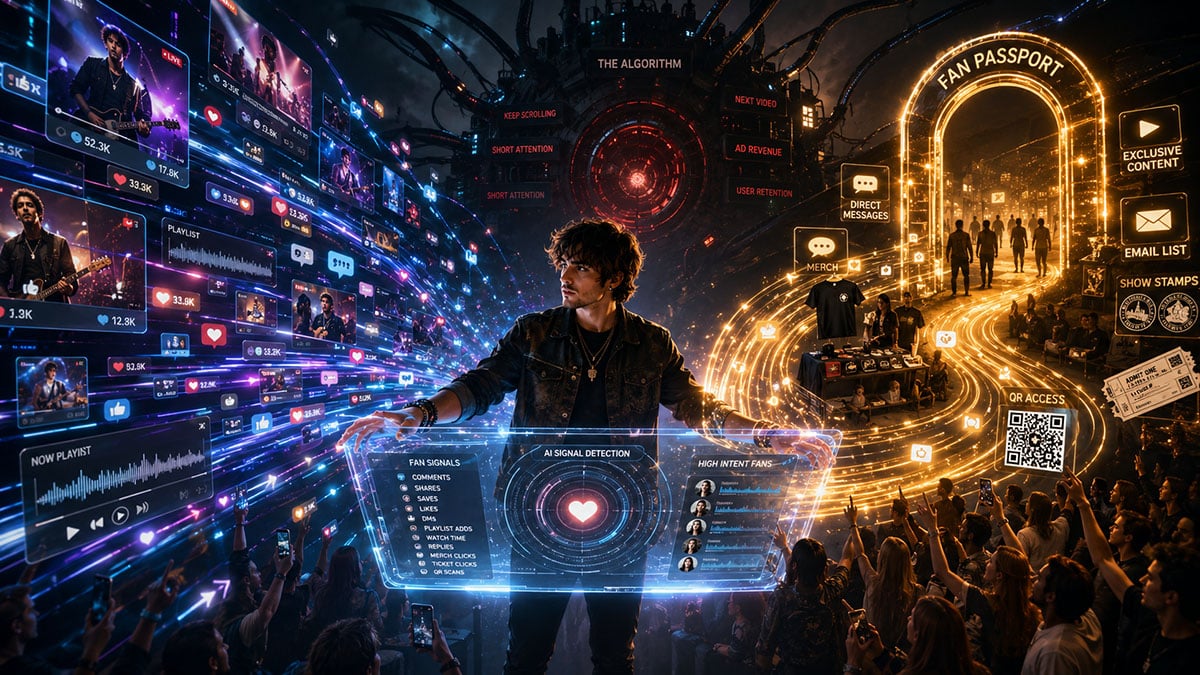
The platforms know this. TikTok, Instagram, Facebook, YouTube, Spotify, and every other attention machine on the internet are built to keep people moving inside their world. Their business model is not designed around making sure the independent artist builds a stable middle-class career. Their business model is built around keeping users engaged, collecting behavior data, selling advertising, selling subscriptions, and controlling the path between the creator and the audience.
That does not mean these platforms are useless. That would be silly. They are powerful. They can put a song in front of people who never would have heard it otherwise. They can help an artist test content, find markets, launch releases, sell tickets, build awareness, and start conversations. But here is the trick. Social media and streaming should be doors, not destinations. The goal is not to live inside the feed forever. The goal is to use the feed to find the people who care, then bring those people into an artist-owned ecosystem before the algorithm takes them away.
That is where AI changes the game.
AI is not just a toy for writing captions or making fake album art. Used correctly, AI becomes the artist’s radar system. It can help spot high-intent fans, read engagement patterns, organize fan behavior, trigger follow-up messages, and help move people from passive attention into active relationships. It can help the artist stop guessing and start responding at the exact moment a fan is most interested.
That is the Attention Harvest.
It is the process of finding fan interest while it is still hot, capturing that interest with permission, and turning rented attention into owned relationships. It is not about tricking people. It is not about spamming people. It is not about using AI to replace human connection. It is about using AI to notice the moments that matter, so the artist can build real relationships before the platforms bury that moment under the next dance trend, outrage clip, cooking hack, or cat video.
The stream listener is a passive resource. The engaged fan is the customer.
That one sentence should be printed on a sign and hung in every home studio, rehearsal room, merch booth, and artist dashboard in the world.
The Platform Does Not Forget. The Artist Usually Does.
The strange thing about social platforms is that they remember everything. They know what people watch, skip, click, pause, save, share, and buy. They know what city people are in, what content they return to, what ads they respond to, what videos they finish, and what creators keep them engaged. That data is the real gold mine.
The artist, on the other hand, often sees only the surface. They see the like count. They see the follower count. They see the number of streams. They see comments flying by. But unless they have a system, they do not really know who is moving from casual listener to real fan. The platform sees the pattern. The artist sees the applause.
That is backwards.
Independent artists have been trained to perform for platforms instead of building for themselves. They post on Instagram and hope people follow. They post on TikTok and hope the clip travels. They upload to Spotify and hope the playlist gods smile. They upload to YouTube and hope the video gets recommended. Then they wonder why all that activity does not always turn into ticket sales, merch sales, email subscribers, licensing opportunities, fan club members, or direct support.
The answer is brutal but simple. The artist is creating attention, but the platform is harvesting the relationship.
Every time a fan watches your video but never enters your world, the platform wins more than you do. Every time a listener streams your song but you have no way to reach them again, the platform controls the next step. Every time somebody comments “love this” and you do not have a way to invite them deeper, that fan slips back into the river. You may see them again. You may not. The algorithm decides.
This is not an accident. This is the system working exactly as designed.
The big platforms are not charities for artists. They are data companies, advertising companies, commerce companies, subscription companies, and attention companies. They reward content that keeps users active. They do not exist to hand over fan relationships to creators out of the kindness of their little Silicon Valley hearts. That is not bitterness. That is business.
So the independent artist needs a different business model.
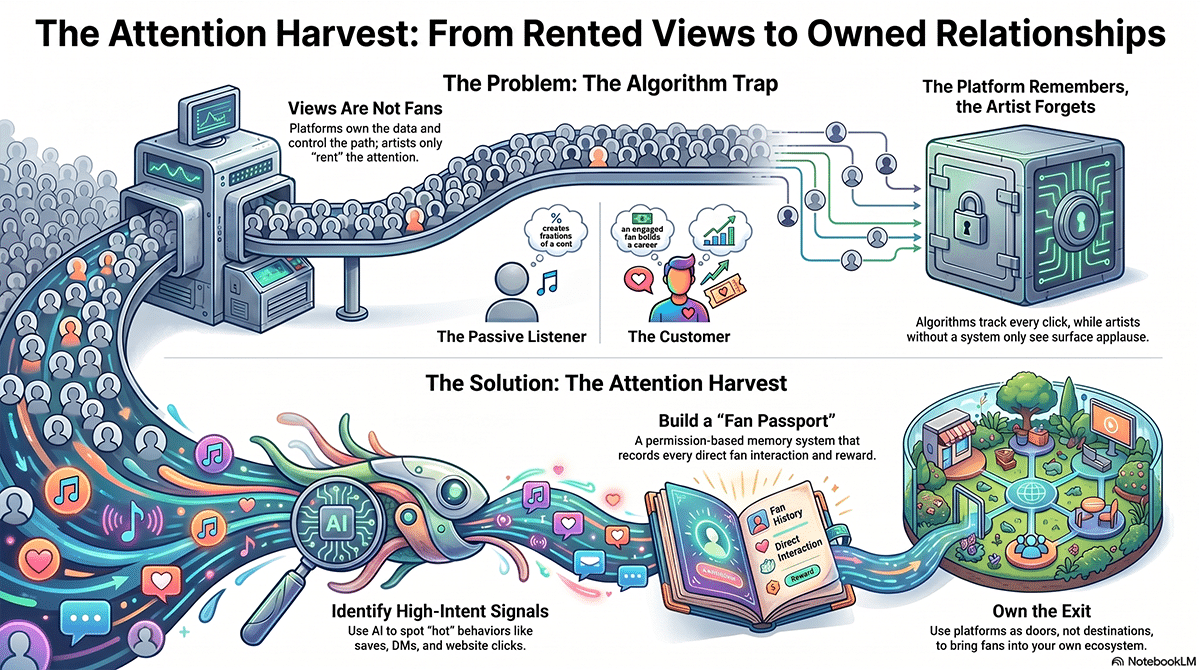
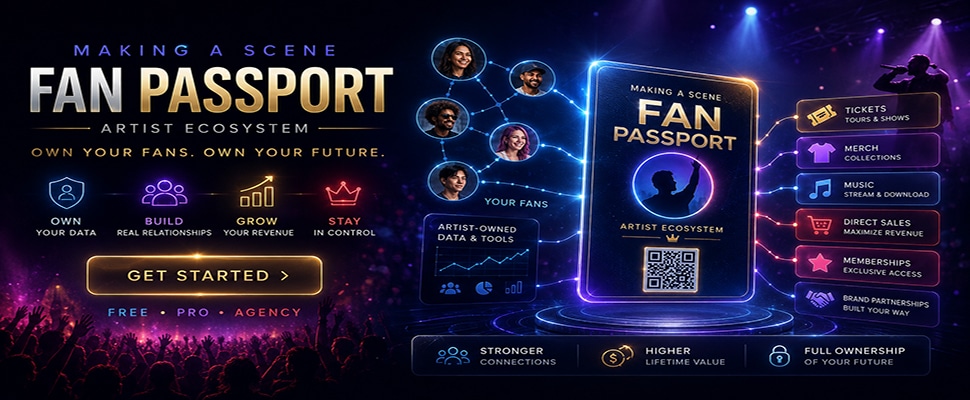
The new model is simple. Use the platforms for discovery. Use AI for signal detection. Use an artist-owned system for capture. Use the Fan Passport for relationship memory. Use direct channels to create revenue.
That is how an artist stops being a content supplier and starts becoming the owner of a fan ecosystem.
Attention Is Not the Same as Intention
One of the biggest mistakes artists make is treating all attention the same. A person who watches three seconds of a clip is not the same as a person who comments, shares, clicks the link, watches another video, joins the mailing list, and asks about the next show. Both may show up as “engagement,” but they are not equal.
Attention is when somebody notices you. Intention is when they take an action that suggests they may want more.
That difference matters because artists have limited time. Most indie artists are already doing too much. They are writing songs, booking shows, making content, recording, mixing, designing merch, managing websites, dealing with distributors, answering emails, learning social media, loading gear, driving vans, and trying to have something that resembles a life. They cannot chase every random view. They need to know where the real heat is.
AI can help with that.
A tool like ChatGPT can help an artist review comments, fan messages, email replies, survey answers, and social captions to identify patterns in fan language. A tool like Claude can help summarize long comment threads, organize fan feedback, and turn scattered conversations into useful insights. A tool like Perplexity can help research local markets, venue scenes, music trends, and content ideas with current information. A tool like Google Analytics can show what people are doing once they land on the artist’s website. A tool like Meta Pixel can track website actions for artists who use Meta advertising or retargeting. A tool like Zapier or Make can connect forms, email platforms, spreadsheets, fan systems, and automations without needing to hire a full-time developer.
These tools do not magically create a career. They are not fairy dust. They are tools. A hammer can build a house or smash a thumb. AI is the same way. The value is not in having the tool. The value is in the system you build with it.
The system starts by asking a better question.
Most artists ask, “How do I get more views?”
Smart artists ask, “Which viewers are showing signs that they want a relationship?”
That is the shift.
A passive listener may hear a song and keep scrolling. A high-intent fan might comment twice, watch multiple videos, click the link in bio, visit the tour page, scan a QR code at a show, save the song, reply to an email, buy a shirt, join a fan club, or ask a real question. AI can help identify these signals faster than a tired artist scrolling through notifications at midnight.
And that matters because timing is everything.
The Fan Is Hottest Right After the Moment of Discovery
There is a small window of time when a person is most likely to move from attention into action. It usually happens right after they feel something. They watched the video and got chills. They heard the lyric and thought, “That’s me.” They saw the live clip and thought, “I need to see this band.” They found a song that fits their mood. They heard a guitar tone, drum groove, vocal line, beat, or story that pulled them in.
That moment is gold.
But most artists waste it.
They post the content, collect the likes, maybe say thanks in the comments, and then move on to the next post. There is no capture path. No invitation. No fan-owned memory. No direct connection. No reason for the person to step out of the feed and into the artist’s world.
This is where the Fan Passport becomes powerful.
A Fan Passport is more than an email list. It is a relationship layer. It is a memory system. It gives the artist a way to know who showed up, what they engaged with, what city they are in, what they care about, what shows they attended, what merch they bought, what songs they responded to, and what permissions they gave. It turns scattered attention into organized fan identity.
This does not mean stalking fans. Let’s shut that nonsense down right now. The future of fan data has to be permission-based, transparent, and respectful. The artist should not be secretly grabbing personal information and creeping around like some discount data vampire. The fan should know what they are joining, why it benefits them, and how the artist will use the connection.
Done right, the Fan Passport is a fair exchange.
The fan gets access, recognition, rewards, show stamps, early announcements, exclusive content, community, and a deeper connection to the artist. The artist gets permission to communicate directly and build a real relationship. Everybody wins, except the gatekeepers who prefer artists stay trapped inside rented platforms forever. Tiny violin for them.
The important point is that the capture has to happen while the fan is still emotionally connected. A fan who just watched a powerful live clip is more likely to join than a fan who gets a generic “sign up for my newsletter” message three weeks later. A fan who just scanned a QR code at the merch table is more likely to accept a Fan Passport invitation than someone who sees a cold link buried in a profile. A fan who just commented “I need this song” is more likely to click than someone who is casually scrolling past hundreds of posts.
AI helps the artist recognize that moment and trigger the right invitation.
High-Intent Fan Signals: What Artists Should Watch For
A high-intent fan signal is any action that suggests a person is moving from casual attention toward real support. It is not always a sale. Sometimes it is a question. Sometimes it is a share. Sometimes it is a repeat visit. Sometimes it is a DM that says, “Are you playing near Chicago?” Sometimes it is a person who watches every video but never comments, then suddenly clicks the merch link.
The point is not to treat people like numbers. The point is to notice interest and respond like a human.
Repeat comments are one of the clearest signals. If the same person comments on multiple posts, they are no longer random traffic. They are raising their hand. AI can help track names, handles, themes, and repeated language so the artist knows who is showing up often.
Saves are another powerful signal. On platforms like Instagram and TikTok, a save often means the content had enough value that someone wanted to return to it. A person may save a performance clip, lyric breakdown, tour announcement, gear video, or story post because it mattered to them. That is not the same as a lazy like.
Shares matter because they show the fan is willing to attach their own name to the artist’s content. When someone sends a song clip to a friend or reposts a video, they are doing free marketing. That person should not be ignored. They may be a future street team member, local show booster, merch buyer, or community leader.
DMs are high-intent because they require more effort. A fan who sends a message is stepping out of public reaction and into direct communication. That is the perfect time to invite them into a Fan Passport system, as long as the message feels natural and not like a robot wearing a fake mustache.
Link clicks are where attention starts to become measurable behavior. If a person clicks from TikTok, Instagram, YouTube, or Facebook to the artist’s website, that is a major step. This is why the artist’s website must not be a dead brochure from 2014. It must be a living fan conversion hub. The first screen should make it clear what the fan can do next: listen, join, buy, watch, attend, support, or unlock something.
Website visits reveal even more. A fan who visits the tour page is different from a fan who only visits the bio page. A fan who visits the merch page twice is different from a fan who reads one blog post and leaves. A fan who checks the lyrics page, watches a live video, and then opens the email signup form is giving the artist a trail of intent.
QR scans are extremely valuable because they usually happen in a real-world moment. A QR code at a show, merch table, poster, sticker, vinyl insert, livestream, or house concert can connect physical attention to digital identity. When that scan leads to a Fan Passport invitation, the artist captures the fan at the point of strongest connection.
Email replies are gold. Do not sleep on them. A fan who replies to an email is telling you that the relationship is not just broadcast. It is two-way. AI can help summarize email replies and identify themes, cities, questions, and emotional reactions.
Ticket clicks are obvious high-intent signals. A person who clicks a ticket link should be invited into a local show segment, even if they do not buy right away. They may need a reminder. They may be waiting for payday. They may need to know set time, parking, age restrictions, or whether merch will be available. AI can help build the follow-up sequence.
Merch views and cart activity matter because merch is not just product. It is identity. A fan wearing a shirt is not just buying cotton. They are joining the story. A tool like Shopify can power the store, while email and automation tools can follow up with people who show interest. For artists who sell direct music and merch, Bandcamp is also important because it is built around fans directly supporting artists, not just passively consuming tracks.
Fan club joins, membership clicks, Patreon interest, and paid community actions are the strongest signals because they show a person is moving from audience to supporter. Tools like Patreon, Substack, Kit, and Klaviyo can all play a role, depending on the artist’s business model.
The artist does not need to chase every signal manually. That is where AI and automation can protect the artist’s time.
The New Artist Funnel Is Not a Funnel. It Is a Relationship Path.
The old marketing world loves the word funnel. It sounds neat and clean. Put people in the top, squeeze them through the middle, collect money at the bottom. Lovely little factory metaphor. Very charming. Also, for music, kind of cold.
Fans are not toothpaste. They are people.
A better way to think about this is a relationship path. The fan discovers the artist, feels something, takes a small action, receives an invitation, gives permission, gets remembered, gets value, and is offered ways to support. That support may be a ticket, shirt, vinyl, digital download, membership, livestream pass, house concert, lesson, sample pack, signed poster, sync license lead, crowdfunding campaign, or direct donation.
The key is that each step should make sense.
A person who watches one video should not immediately get hammered with “buy my deluxe vinyl box set.” Calm down, Captain Desperate. That is like asking someone to move in because they smiled at you in line at the grocery store. But a person who watches three videos, comments twice, clicks the tour page, and scans a QR code at a show is ready for a deeper invitation.
AI can help score that difference.
This does not have to be complicated. An artist can create a simple fan intent score based on behavior. A comment might be one point. A save might be two. A DM might be three. A website visit might be three. A merch page visit might be five. A ticket click might be six. A QR scan at a live event might be eight. An email reply might be ten. A purchase might be fifteen. The exact numbers are not sacred. The point is to stop treating all engagement as equal.
Once a fan crosses a certain level of intent, the system can trigger a next step. That next step may be a personal reply, a Fan Passport invitation, a welcome email, a local show alert, a merch discount, a behind-the-scenes video, a street team invite, or a survey that helps the artist learn more.
Tools like Zapier and Make can connect these actions. A form submission can add a fan to Mailchimp, Kit, HubSpot, or Klaviyo. A new email subscriber can trigger a welcome sequence. A QR scan can create a tag. A merch purchase can trigger a thank-you message. A ticket buyer can be added to a city segment. A Fan Passport stamp can mark a show attended.
The artist can also use Manychat for social DM automation on platforms like Instagram, Facebook Messenger, WhatsApp, and TikTok, especially when a fan comments a keyword or asks for a link. The trick is to use it with taste. The goal is not to make the artist sound like a vending machine. The goal is to remove friction at the moment of interest.
For music-specific link tracking, Linkfire can help create smart links for releases, tickets, podcasts, and campaigns. Hypeddit offers music promotion tools aimed at independent artists, including fan tracking and campaign tools. These platforms can be useful, but artists should always ask one important question: does this tool bring fans closer to my owned ecosystem, or does it just send them back to another rented platform?
That question is everything.
Why “Listen on Spotify” Should Not Be the Final Call to Action
Spotify is useful. Apple Music is useful. YouTube is useful. TikTok is useful. Instagram is useful. Nobody serious is saying artists should ignore them. But there is a major difference between using a platform and building your business on top of one.
When an artist sends every interested fan to Spotify, they may gain a stream, but they usually do not gain a relationship. They do not get the fan’s email. They do not get permission to follow up. They do not know if that listener wants to buy a ticket. They do not know if the listener is in a city where the artist could draw. They do not know if the listener would buy vinyl, join a fan club, support a crowdfunding campaign, or host a house concert.
The stream is useful, but it is incomplete.
That is why the stream listener is a passive resource. The engaged fan is the customer.
A stream listener may create a fraction of a cent. An engaged fan may buy a ticket, bring three friends, buy a shirt, join a membership, purchase a download, support a campaign, subscribe to a newsletter, share a release, license a song, book a show, or become part of the artist’s long-term community.
This does not mean every fan has to spend money right away. That is not the point. The point is that a real fan relationship creates options. Passive listening creates dependency. The artist is dependent on the platform to show the song again, recommend the next track, include the artist in a playlist, or let the audience know when something new happens.
An artist-owned system changes that.
When the fan joins the Fan Passport, the artist has a direct line. The artist can say, “We are coming to your city.” “Here is the story behind the song you liked.” “You earned a show stamp.” “You unlocked early access.” “We just released a limited shirt.” “We need help choosing the next single.” “Here is a private livestream.” “Here is a discount because you came to the last show.” “Here is a street team mission.” “Here is a house concert request form.”
That is not just marketing. That is relationship building.
And relationship building is where the money is.
The Fan Passport as the Artist’s Memory System
Every artist has fans who slip through the cracks. Somebody came to three shows, bought a shirt, and brought friends, but the artist has no idea who they are. Somebody comments on every post, but the artist never tags them as a top supporter. Somebody bought vinyl online, then came to a show, then replied to an email, but those actions live in three different systems that do not talk to each other.
That is crazy.
In any other serious business, this would be seen as broken. If a local coffee shop knew a customer came in every week, bought the same drink, brought friends, and posted about the place online, the owner would want to know that person. Music should be no different.
The Fan Passport solves this by becoming the artist’s memory.
A Fan Passport can record relationship moments. A new fan stamp. A show stamp. A merch stamp. A VIP stamp. A street team stamp. A reward stamp. A city stamp. A livestream stamp. A supporter stamp. Each stamp tells part of the story. Over time, the artist is no longer looking at a faceless crowd. They are seeing a living map of support.
This is especially important for touring.
Imagine an artist planning a run through the Southeast, Midwest, West Coast, or Northeast. Instead of guessing where to play based only on Spotify city data or social followers, the artist can look at Fan Passport activity. Who scanned QR codes? Who bought merch? Who joined from which city? Who clicked ticket links? Who opened show emails? Who invited friends? Who asked about house concerts? Who has attended before?
That is not fantasy. That is basic data discipline.
AI can help make sense of it. It can identify markets where engagement is rising. It can summarize fan comments by city. It can help write different messages for casual fans, active supporters, and superfans. It can suggest which fans should receive a local show alert, which ones might respond to a merch offer, and which ones might be ready for deeper community involvement.
But the artist should remain in control. Always.
AI should not become the new gatekeeper. The whole point is to free the artist from gatekeepers, not create a shinier robot version. AI should assist the artist, not replace the artist’s judgment. It should help organize the signals, not fake the relationship. It should help the artist see clearly, not turn fans into cold data points.
The artist’s voice still matters. The artist’s values still matter. The artist’s story still matters. AI just helps make sure the right people hear from the artist at the right time.
Predicting Fan Behavior Without Becoming Creepy
Prediction sounds like something out of a science fiction movie, but in this context it is simple. It means using past behavior to make a better guess about what a fan may want next.
If a fan clicks on tour dates twice, they may want show updates. If a fan watches every behind-the-scenes recording clip, they may want studio content. If a fan buys vinyl, they may care about physical releases. If a fan scans a merch table QR code, they may respond to limited drops. If a fan opens every email about songwriting, they may enjoy a lyric breakdown. If a fan attends a show in Atlanta, they should probably hear first when the artist returns to Georgia.
This is not creepy when it is permission-based and useful. It becomes creepy when it is hidden, manipulative, or invasive.
The artist should be clear. “Join the Fan Passport to get show alerts, rewards, exclusive content, and updates based on what you choose to share.” That is honest. That is fair. That is better than letting a giant platform quietly track everything while giving the artist almost nothing.
AI can help predict behavior by grouping fans into simple segments. New fans need a welcome. Local fans need show alerts. Merch buyers need product updates and thank-yous. Superfans need early access and deeper involvement. Quiet fans may need a simple check-in. Fans who clicked but did not buy may need more information or a reminder.
Tools like HubSpot, Mailchimp, Kit, and Klaviyo can help organize these segments and send different messages based on behavior. A creator-focused artist might prefer Kit. A merch-heavy artist might like Klaviyo. An artist building a larger CRM may look at HubSpot. A simpler newsletter-driven artist may use Mailchimp. The right tool depends on the artist’s real workflow, budget, and comfort level.
Do not buy complexity just because some marketing bro on YouTube said the word “scale” forty-seven times while standing in front of a rented sports car. Start simple. Capture permission. Tag fans correctly. Send useful messages. Track what works. Improve over time.
That is already more advanced than what most artists are doing.
The Roadmap: How Artists Can Apply This Today
The first step is to define the artist-owned destination. This should usually be the artist’s own website or artist ecosystem, not just a link-in-bio page that sends people in ten random directions. The destination should be clear, fast, mobile-friendly, and built around action. It should invite people to join the Fan Passport, hear the music, watch key videos, see upcoming shows, buy merch, and support the artist directly.
The second step is to place capture points everywhere attention happens. Every social bio should point to the artist-owned hub. Every video caption should have a reason to leave the feed. Every livestream should mention the Fan Passport. Every merch table should have a QR code. Every poster should have a QR code. Every release page should offer more than “stream now.” Every email should invite the fan to take the next step.
The third step is to define high-intent signals. The artist should decide what matters most. For one artist, the strongest signal may be local show interest. For another, it may be merch clicks. For another, it may be email replies, fan club joins, or house concert requests. Do not copy someone else’s system blindly. Build around the revenue paths that actually fit the artist.
The fourth step is to connect the tools. A simple setup might use the artist website, a Fan Passport signup form, Google Analytics, an email platform like Mailchimp or Kit, and an automation tool like Zapier or Make. A more advanced setup might add Manychat for DM capture, Linkfire or Hypeddit for campaign tracking, Shopify for merch, Bandcamp for direct music sales, and HubSpot or Klaviyo for deeper CRM behavior.
The fifth step is to build the welcome path. When a fan joins, do not just send one cold confirmation email and vanish like a mysterious raccoon. Welcome them. Tell them what they joined. Give them a reason to care. Offer a first reward. Ask one simple question. Invite them to identify their city. Let them choose what they want to hear about: shows, releases, merch, behind-the-scenes content, fan club, street team, or all of it.
The sixth step is to use AI to read the signals. Once a week, the artist can export comments, email replies, website behavior, fan signups, merch clicks, ticket clicks, and QR scans, then ask AI to summarize what is happening. What cities are appearing? What songs are getting the strongest response? What content is causing people to click? What questions keep coming up? What fans seem most engaged? What offer should be tested next?
The seventh step is to create automated invitations. When someone comments a keyword, they can receive a DM with a Fan Passport link. When someone scans a show QR code, they can get a show stamp and a welcome message. When someone visits the merch page but does not buy, they can receive a later email if they are already subscribed. When someone clicks a ticket link, they can receive a reminder before the show. When someone joins from a certain city, they can be added to that city’s show alert list.
The eighth step is to keep the human touch. Automation should open the door, not replace the artist. The more valuable the fan, the more personal the response should feel. A superfan does not need to be treated like a number in a spreadsheet. They need recognition. A quick personal thank-you can mean more than a complicated funnel. AI can help identify who deserves that personal touch.
The ninth step is to connect the system to income. Every artist should be able to answer this question: how does this relationship path create revenue? If the path does not lead to tickets, merch, direct sales, fan support, licensing leads, crowdfunding, memberships, lessons, private events, house concerts, or some other real income stream, then it may just be another vanity machine.
The tenth step is to improve monthly. The system does not need to be perfect on day one. It needs to get smarter. Look at what content creates Fan Passport signups. Look at what emails get replies. Look at what cities are growing. Look at what merch people click. Look at which calls to action work. Then adjust.
That is the AI feedback loop in action.
What This Looks Like in the Real World
Imagine an indie artist posts a short live clip from a packed club. The video starts moving on Instagram and TikTok. The old way is to celebrate the views, reply to a few comments, and hope the algorithm keeps pushing. The new way is different.
The caption says, “Want the full live track and show alerts? Join the Fan Passport.” The link leads to the artist’s own site, not just Spotify. Fans who comment “live” receive an automated DM through Manychat with a friendly invitation. Fans who click the link land on a page that offers the live track, show alerts, and a first Fan Passport stamp. Google Analytics tracks the page visit. The Fan Passport records the signup. Mailchimp or Kit sends a welcome email. Zapier or Make tags the fan based on the source. If the fan selects a city, they get added to the right local segment.
Now the artist has more than views.
The artist knows which platform drove the most signups. They know which cities appeared. They know which fans clicked for shows. They know which fans wanted the live track. They know which people replied to the welcome email. They know which names showed up again later.
That is a business asset.
Now imagine the artist plays a show. At the merch table, a sign says, “Scan to get tonight’s show stamp.” The fan scans the QR code. If they are new, they are invited to join the Fan Passport. If they already joined, they receive the show stamp. The system tags that fan as someone who attended. The next day, the artist sends a thank-you message with a live photo, a merch link, and a note about the next nearby show.
That is not spam. That is good follow-up.
Now imagine a fan buys a shirt. The system records that support. Later, when the artist releases a limited hoodie, that fan hears first. When the artist returns to their city, that fan gets early notice. When the artist launches a crowdfunding campaign, that fan is not treated like a stranger.
This is how artists build a middle class. Not by begging the algorithm for mercy. Not by chasing fake virality. Not by waiting for a label. Not by pretending a million empty views are better than a thousand real relationships.
A thousand real relationships can build a career.
The Artist-Owned Ecosystem Is the Real Machine
The artist-owned ecosystem is where all this comes together. It is the website, email list, Fan Passport, merch store, direct music sales, show calendar, content library, fan club, ticketing path, community space, and data dashboard working as one connected system.
This is what the old industry does not want artists to fully understand. The label model worked because labels controlled access, distribution, promotion, capital, and data. The platform model works because platforms control attention, recommendation, advertising, and user behavior. The next independent model works when artists control identity, permission, community, and direct revenue.
That is the fight.
Not every artist needs to become a tech wizard. Most artists do not want to spend their life building dashboards. They want to make music and get paid enough to keep making music. Fair. That is exactly why AI and automation matter. They can reduce the workload. They can organize chaos. They can help the artist act like a serious business without needing a corporate staff.
But the artist must own the center.
The center cannot be TikTok. It cannot be Instagram. It cannot be Spotify. It cannot be YouTube. It cannot even be Bandcamp, Patreon, Substack, or Shopify, as useful as those tools can be. The center has to be the artist’s own ecosystem, because that is where the relationship lives.
Every outside platform should feed the center.
TikTok should feed the center. Instagram should feed the center. YouTube should feed the center. Spotify should feed the center. Facebook should feed the center. Bandcamp should feed the center. Patreon should feed the center. Live shows should feed the center. QR codes should feed the center. Press should feed the center. Podcasts should feed the center. Every piece of attention should have a path back to the artist-owned relationship.
That is the Attention Harvest.
The Rebellion Is Not Leaving the Platforms. The Rebellion Is Owning the Exit.
Some people hear this argument and think it means artists should abandon social media and streaming. That misses the point. The rebellion is not leaving the platforms. The rebellion is refusing to be trapped by them.
Use the platforms. Use them hard. Post the clips. Upload the songs. Build the YouTube channel. Share the reels. Run the livestreams. Pitch the playlists. Use the discovery tools. Let the machines open doors. But do not confuse the door with the house.
The house is yours.
The house is where fans are remembered. The house is where the artist can speak without begging an algorithm. The house is where fans can buy directly. The house is where the artist can test ideas, launch releases, sell tickets, invite support, and build community. The house is where the music business middle class is built.
AI gives artists the power to watch the doors more intelligently. It can tell the artist which doors are working. It can show which fans are stepping through. It can help greet them when they arrive. It can help remember what they care about. It can help invite them back.
But the artist has to build the house.
That is the real work.
The New Rule: Never Let Attention End at the Platform
Every artist should adopt one simple rule. Never let attention end at the platform.
If a post gets views, there should be a next step. If a video gets comments, there should be an invitation. If a song gets streams, there should be a direct path. If a show creates energy, there should be a QR capture. If a fan buys merch, there should be a thank-you and future connection. If someone shares your music, there should be recognition. If someone joins the Fan Passport, there should be a welcome.
This is how an artist turns scattered moments into a durable business.
The old system told artists to chase exposure. Exposure was always a slippery word. It usually meant somebody else got the value while the artist got the hope. Hope is not a strategy. Exposure does not pay the van repair bill. Exposure does not pay for mastering. Exposure does not buy strings, sticks, gas, insurance, studio time, or groceries.
Relationships do.
A relationship can lead to a ticket. A relationship can lead to a shirt. A relationship can lead to a house concert. A relationship can lead to a sync opportunity. A relationship can lead to a crowdfunding pledge. A relationship can lead to a fan bringing five friends. A relationship can last longer than a trend.
That is why the stream listener is not the customer.
The engaged fan is.
Final Word: Harvest the Attention Before Someone Else Does
The music industry has always been a battle over control. Who controls the recording? Who controls the publishing? Who controls the audience? Who controls the money? Who controls the data? In the old days, the gatekeepers controlled most of it. In the platform age, the control shifted, but it did not disappear. It just got a nicer app interface and a better recommendation engine.
Now independent artists have a chance to shift it again.
AI, Fan Passport systems, direct-to-fan tools, automation, websites, email, SMS, QR codes, merch stores, fan clubs, and community platforms can help artists build something stronger than rented attention. They can build memory. They can build permission. They can build trust. They can build income.
But only if artists stop celebrating empty numbers as if they are the whole game.
Views are nice. Streams are useful. Likes feel good. Followers can help. But none of that means much if the artist cannot reach the fan again.
The real question is not, “How many people saw it?”
The real question is, “How many people cared enough to step into your world?”
That is the future of independent music marketing. Not shouting louder. Not posting more junk. Not feeding the machine until you burn out. The future is building intelligent systems that capture real interest, respect the fan, and turn moments of attention into long-term artist-owned relationships.
The algorithm will always try to take them away.
Your job is to invite them home before it does.
 |  Spotify |  Deezer |  Breaker |
 Pocket Cast |  Radio Public |  Stitcher |  TuneIn |
 IHeart Radio |  Mixcloud |  PlayerFM |  Amazon |
 Jiosaavn |  Gaana |  Vurbl |  Audius |
 Reason.Fm | |||
Find our Podcasts on these outlets
Subscribe to Our Newsletter
Discover more from Making A Scene!
Subscribe to get the latest posts sent to your email.


