Stop Chasing Virality and Start Building a Sustainable Micro-Label Ecosystem Today





Making a Scene Presents – Stop Chasing Virality and Start Building a Sustainable Micro-Label Ecosystem Today
Listen to the Podcast Discussion to Gain More Insight into Building your own MicroLable System!
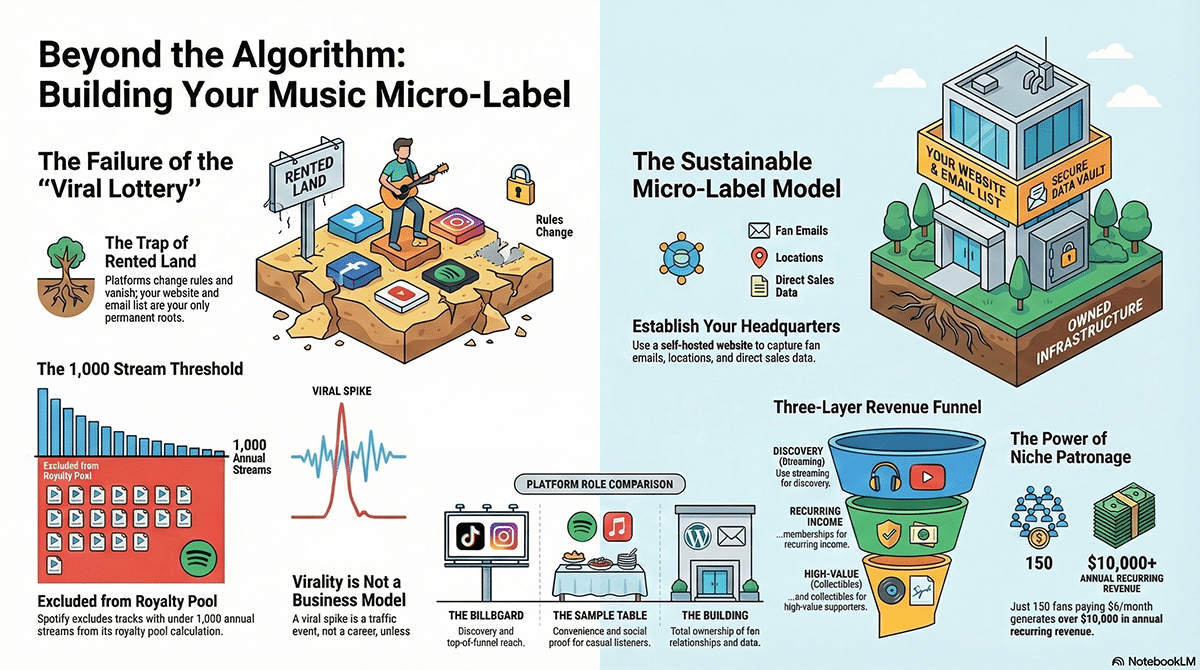
There is a scene happening in bedrooms, garages, basements, back rooms, and half-finished home studios all over America right now. An artist finishes a song, posts a clip, refreshes the numbers, waits for the spike, gets a little bump, and then starts over again. The song is real. The work is real. The hope is real. But the business model is still a slot machine. In 2026, the biggest platforms openly frame discovery as something you can campaign for inside their system, with tools like Spotify Discovery Mode, Marquee, and Showcase. At the same time, Spotify’s current royalty rules say tracks below 1,000 streams in the previous 12 months are not included in the recorded music royalty pool calculation. Streaming is enormous at the industry level, but the structure still rewards scale, leverage, and platform dependency more than artist ownership.
That is why more independent artists need to stop thinking like content suppliers and start thinking like micro-label owners. A micro-label does not have to mean a fancy office, a payroll department, or a team of lawyers on retainer. It can be one artist, one duo, one band, or a tiny roster of aligned acts with a shared sound and shared values. The real shift is not legal first. It is structural first. A micro-label ecosystem is a closed-loop system where your songs, your stories, your fans, your data, your offers, and your money flows live closer to you than to the platform. It is the difference between renting attention and owning relationships.
That shift matters because rented platforms change fast. Sound.xyz, which mattered a lot in the music collectible conversation, went offline on January 16, 2026. Zora also changed direction hard enough that its own help center now says NFTs are no longer supported on Zora applications, while the platform has shifted toward coins and post-based trading. That does not mean Web3 is dead. It means the same rule applies on chain and offchain: never build your whole house on someone else’s land. Your website, your list, and your direct sales infrastructure have to be the roots. Everything else is a branch.
The Myth of the Viral Lottery
Virality feels attractive because it looks like escape velocity. One clip hits. One chorus catches. One influencer uses your sound. One algorithmic wave lifts you for a week. For a minute, that looks like a career. But most artists already know the ugly truth. Virality is not a business model. It is a traffic event. If you do not own what happens after that traffic shows up, the moment passes and the value leaks out.
The platforms themselves tell the story if you listen closely. Spotify is not pretending that discovery is pure magic anymore. It offers campaign products and optimization tools inside the platform. That is not evil. It is just a reminder that distribution is not neutral. It is engineered space. If your entire plan depends on being noticed by a system designed to keep users inside someone else’s walls, then your career will always be at the mercy of a machine that has different goals than you do.
Meanwhile, the streaming economy can be huge in aggregate and still feel tiny at the artist level. Spotify says it paid out $11 billion to the music industry in 2025, and its Loud & Clear site highlights major songwriter and artist payout growth. But that does not erase the structural reality facing small independent acts. Large pools of money do not automatically become stable income for niche artists, especially when the game is still built around scale, retention, and algorithmic preference. That is why chasing “more reach” without building owned revenue rails is such a trap. You can be visible and still be broke.
The psychological cost is brutal too. When artists organize their whole creative life around the next spike, they stop building a body of work and start building bait. The hook becomes more important than the song. The clip becomes more important than the catalog. The trend becomes more important than the voice. That is backwards. A sustainable career comes from identity, trust, and repeat behavior. A fan who buys from you three times a year is worth more than a stranger who watches a clip once and scrolls away.
The old gatekeepers told artists to wait to be chosen. The new gatekeepers tell artists to post harder and hope the machine smiles on them. Same dependency. Different outfit. The contrarian move is not to quit promotion. It is to stop confusing promotion with infrastructure.
What a Sustainable Micro-Label Actually Is
A real micro-label ecosystem is a living system, not a logo. It has a headquarters, a contact database, a catalog, a membership layer, a premium layer, a fulfillment plan, and a way to split money fairly. It can work for one artist. It can work for a band. It can work for three friends releasing music under a shared banner. The point is not size. The point is control.
Think of it this way. Social platforms are your billboards. Streaming is your sampling table. But your website, email list, SMS list, subscriber area, merch store, and collectible layer are your actual building. That is where fans move from “I heard a song” to “I know who this artist is” to “I buy from this artist” to “I fund this artist.” That is the path from passive listening to recurring patronage.
This is also where the phrase “micro-label” gets really useful. When you think like a label, you stop asking, “How do I get one song to pop?” and start asking, “How do I create a system that can release singles, sell deluxe editions, segment fans, reward early supporters, recoup project costs, and grow long-term equity?” That is a bigger question, but it leads to real money.
Build the Headquarters First
Your first job is to create a home base that you control. WordPress remains one of the strongest options for this because WordPress.org is the official self-hosted version, it is open source, and self-hosting means you can install the software on your own server, use your own domain, and control your own plugins and design choices. That matters because freedom in the music business is not just artistic freedom. It is infrastructure freedom.
For most indie artists, that means building a site with a simple front door. Not a cluttered homepage with twenty menu items and old gig posters. Not a digital junk drawer. A front door. When a fan lands there, they should understand three things fast: what you sound like, why they should care, and what they get when they join your world. That page should collect an email address, first name, and ideally city and state. If you tour, location matters. If you sell merch, location matters. If you want to route weekend runs, location matters even more.
Then you connect that site to an email engine. If you want the email stack inside WordPress, MailPoet lets you create, send, manage, and grow email campaigns from inside WordPress, while FluentCRM is built around self-hosted CRM and automation inside the dashboard. If you want an external creator-first email platform, Kit offers no-code landing pages, opt-in forms, and visual automations, while MailerLite offers signup forms, automation, custom fields, landing pages, and WordPress integration, if you are looking for a simple single purpose splash page that allows you to collect emails and automatically send out 4 emails to send a free gift and establish trust Making a Scene Fan Funnel WordPress Plugin may be the perfect FREE Tool. The big idea is simple: the list must be yours, the signup path must be easy, and the sequence after signup must run without you having to manually babysit every lead.
There is one practical warning here that too many artists learn late. Collecting emails is easy. Getting emails delivered is harder. MailPoet explicitly warns that sending newsletters through your host is not a good idea because of sending limits and spam problems, which is why it offers a dedicated sending service. That same lesson applies no matter what stack you use. A mailing list is not real infrastructure unless it actually lands in inboxes. Deliverability is not glamorous, but it is part of owning the road instead of hitchhiking on it.
The Mailing List Is Not Old School. It Is Your Core Asset
Email is still one of the cleanest ways to turn attention into owned relationships because it does not vanish when a feed changes. It does not disappear because a clip underperformed. It does not get buried because the platform wants more ad inventory. When a fan gives you an email address, they are not just giving you permission to market. They are giving you a way back into their world.
That is why the list should not be a random pile of addresses. It should be segmented. Kit says its automation system can tag and segment subscribers based on what they care about. MailerLite lets you use custom fields and automation steps. In plain English, that means you can separate local fans from out-of-state fans, vinyl buyers from ticket buyers, demo collectors from casual listeners, house concert hosts from streaming-only listeners, and super-supporters from first-timers. That is where AI becomes useful too. Tools like ChatGPT are strong for drafting welcome sequences, rewriting subject lines, testing tone, and helping you think through segment logic before you build it. The machine should help you sort and communicate. It should not replace your voice.
The welcome sequence is where the micro-label really begins. The first email should deliver something of value fast. Maybe that is a free song, an unreleased demo, a live track, a lyric sheet, or a small discount code. The second should tell your story better than social ever could. The third should ask a simple question that helps you segment the fan. Where do you live? How did you find me? What kind of content do you want more of? Then the next emails can invite them toward the right offer instead of shouting the same thing at everyone.
That is the difference between audience and community. Audience watches. Community replies.
Add the Middle Layer: Membership and Recurring Patronage
Once the headquarters and list are working, you need a middle layer between casual fans and high-ticket supporters. This is where most artists leave money on the table. They try to jump from “stream my song” straight to “buy my deluxe bundle.” That is too big a leap for most listeners. A recurring layer solves that.
Bandcamp remains useful here because it is still one of the clearest direct-to-fan commerce platforms in music. Bandcamp says fans have paid artists $1.68 billion on the platform. It also supports artist subscriptions, subscriber-only messages, and community posts that can go to followers and subscribers through email and the Bandcamp app. In 2026, Bandcamp Fridays are continuing on multiple dates, which still makes the platform a strong public-facing sales layer for artists who want periodic buying moments that fans already understand.
There are practical details to know. Bandcamp subscriptions require Stripe, and subscribers are charged when they join and then monthly or annually after that, with the artist paid on that same schedule. That means subscriptions can create a real rhythm of income, but they are still best used as one layer of a wider system, not the whole system by themselves.
Patreon is another viable middle layer. Patreon describes itself as a place to build community with your biggest fans, offer memberships, newsletters, chats, DMs, and exportable email lists. Patreon is free to start, but its pricing page says creators pay 10% of income earned on Patreon, plus processing, currency conversion, payout fees, and applicable taxes. So it can work well, but you need to understand that convenience has a price. That is exactly why your email list still has to be yours, even if Patreon is part of your system.
Vault.fm is also worth watching because it is music-native and built around direct artist-fan connection. Vault says artists can drop music, demos, tickets, merch, and exclusive content, and that artists own the fan data while reaching fans directly by text or email. For some artists, that is a cleaner fit than trying to force music culture into a generic creator platform. The bigger lesson is not that every artist should use Vault. It is that recurring patronage gets stronger when the content feels like an ongoing world, not a once-a-month donation jar.
Digital Collectibles Need a Job
Now we get to the part that gets overhyped and misunderstood. Digital collectibles are not the business. They are a tool inside the business. If you treat them like lottery tickets, they will fail. If you treat them like membership keys, limited artifacts, proof of support, access passes, or collectible receipts tied to a real fan experience, they become powerful.
The smartest move in 2026 is not to pretend there is one magic “music NFT standard” that solves everything. There is not. The practical stack is still more modular than that. ERC-721 remains the standard for unique non-fungible tokens. ERC-1155 remains the flexible standard for handling both fungible and non-fungible token types in one contract family. ERC-2981 exists to standardize royalty payment information for NFTs. And if you want real membership behavior like expirations, renewals, recurring payments, or walletless onboarding, protocols like Unlock are built specifically for that use case.
That matters because the collectible should match the job. A one-of-one handwritten lyric page scan with a custom mix note might make sense as a unique ERC-721 item. A run of 250 supporter passes for an album cycle might make more sense as an edition-style ERC-1155 drop. A renewable backstage club, season pass, or monthly private-song membership may fit better inside Unlock’s membership model because Unlock explicitly supports expirations, renewals, recurring payments, and even familiar onboarding methods like email-based memberships and Apple or Google Wallet integrations.
For artists who want easy creation tools, Manifold describes itself as building tools to create, sell, and distribute digital goods on Ethereum. Thirdweb offers guided creation flows for ERC-20, ERC-721, and ERC-1155 tokens, plus token-gated content and embedded components that can connect to a website you already own. In other words, you do not have to build the whole machine from scratch anymore. The pieces are there. The hard part is not the code. The hard part is designing an offer fans actually want.
And that offer should be grounded in music culture, not crypto theater. A good collectible can unlock demos, stems, alternate mixes, annotated lyric sheets, early ticket access, a private livestream, a Q&A archive, a city-specific pre-sale, a supporter wall, or first shot at a limited merch run. It can also be a simple proof-of-support object. Not every token needs resale fantasy. Sometimes the most powerful job a digital collectible can do is say, “I was there early, and I helped build this.”
Intentional Scarcity Beats Fake Urgency
Scarcity gets a bad reputation because people use it like a gimmick. Ten copies left. Forty-eight hours only. Last chance. Final call. Half the time it is fake, and fans can smell that. But real scarcity is not manipulation. Real scarcity is honest limitation around things that are naturally limited: your time, your access, your signed items, your private material, your first-press objects, your small-room experiences, your inner-circle offers.
That is where the micro-label model gets elegant. You keep the music broadly accessible at the surface. The public single still goes out. The regular merch still exists. The general email signup still stays open. But the inner layers get narrower and more valuable. Maybe the song is public, but the commentary track is for members. Maybe the album is available everywhere, but the demo notebook, alternate mix, and private listening room are for 100 supporters. Maybe the tour dates are public, but the advance acoustic room show invite goes first to local subscribers and collectible holders.
Serenade is a good example of how this can bridge physical and digital without turning into nonsense. Serenade says its Smart Formats are collectible physical items that unlock digital music and bonus content with a simple phone tap, and that they can be sold online, at shows, or through a store. That is the kind of practical thinking artists need more of. Not abstract promises. Actual objects tied to actual fan behavior.
Scarcity should create belonging, not panic. The fan should feel invited into a closer circle, not tricked into a rushed checkout.
The Money Gets Better When the Relationship Gets Shorter
The shortest distance between artist and fan is almost always the healthiest margin. That does not mean you abandon streaming. Streaming is still discovery, convenience, and social proof. It matters. But it should be the top of the funnel, not the whole funnel.
Here is the math that too many artists avoid because it feels less glamorous than stream counts. If 150 fans pay you $6 a month for a real membership experience, that is $10,800 a year before fees. If 75 of those same fans also buy one $40 limited bundle each year, that adds another $3,000. If 20 supporters buy a $125 premium collectible or season pass, that is another $2,500. Without pretending every fan will do every thing, you can see how a small, known group starts to matter more than a giant, anonymous maybe.
That is the whole point of niche resonance. You do not need everybody. You need enough of the right people, reached directly enough, often enough, with offers that fit your art and their level of commitment. That is a micro-label mindset. It is also how you stop begging the algorithm to make payroll.
Bandcamp, Patreon, and Vault each offer different versions of this direct relationship. Bandcamp leans hard into music commerce and subscriptions. Patreon leans into membership business and community tooling. Vault leans into direct music-native drops, messaging, and fan data. None of them are perfect. All of them are more useful when they connect back to your own site and your own list.
If You Have Collaborators, Build the Split Before the Money Hits
This is where a lot of indie projects get messy. The artist thinks like a creator. The project starts making money. Then the admin chaos begins. Who gets what from the collectible drop? Who recoups the video budget first? How are the producer points handled? What about the designer? The featured vocalist? The person who fronted the mastering bill?
That is why a micro-label ecosystem needs payment logic before it needs hype. Splits is worth attention here because it is built around onchain revenue management. Its docs describe composable smart contracts for onchain revenue, and its Waterfall contract is specifically designed for situations where one recipient gets paid a set amount before the next one gets paid. That is useful for recoup arrangements, collaborator splits, and small-label accounting logic.
Again, the important thing is not that every indie artist needs to become a protocol expert. The important thing is that the new tools finally make it possible to encode fair behavior into the system instead of trying to remember it six months later when the money arrives unevenly. That is one of the real benefits of Web3 when it is used like infrastructure instead of marketing glitter.
A 90-Day Roadmap That Actually Gets Built
In the first 30 days, build the headquarters. Buy the domain. Launch the WordPress site. Put one clear signup offer at the center. Connect MailPoet, FluentCRM, Kit, or MailerLite. Write a four-email welcome sequence. Add fields for first name, email, and location. Set up one public offer and one subscriber-only offer. The goal in month one is not scale. It is plumbing.
In days 31 through 60, build the recurring layer. Choose whether your middle ring lives best on Bandcamp subscriptions, Patreon, Vault, or a direct membership flow on your own site. Start with one promise you can keep every month. One new demo. One commentary post. One acoustic version. One private livestream. One early merch window. One member Q&A. The biggest mistake artists make here is launching too many perks and turning their own system into a second full-time job. Keep it lean and repeatable.
In days 61 through 90, add the premium layer. Design one limited collectible or supporter artifact with a real job. Maybe it is a 100-pass album circle. Maybe it is a 25-copy annotated demo bundle. Maybe it is a city pass that unlocks pre-sale tickets and a private acoustic set for holders in that market. Build the release page. Decide the cap. Write the story. Then set up the split logic if collaborators are involved. Do not launch it as “crypto.” Launch it as belonging with receipts.
The Real Win Is Creative Freedom
The old music business sold the dream of being discovered. The platform era sold the dream of being boosted. Neither one is real freedom if you still do not own the fan relationship, the data, the offer path, or the money flow. A sustainable micro-label ecosystem flips that logic.
You do not wake up asking whether the algorithm likes you today. You wake up asking what your catalog is doing, what your members need, which city is warming up, what your collectors are buying, and what your next release window should unlock. That is a totally different career. It is calmer. It is more honest. It is more profitable at the level where working artists actually live.
The best part is that this model scales without losing your soul. A solo songwriter can run it. A house-concert folk duo can run it. A regional roots band can run it. A tiny label of three allied artists can run it. The system is modular. The principle is the same. Own the home. Build the list. Create the rhythm. Reward the inner circle. Keep the public door open. Use scarcity with integrity. Let automation do the boring work. Let music do the emotional work.
Stop chasing virality like it is salvation. It is not. Build the machine that still pays you after the post is forgotten. That is how indie artists stop feeding the algorithm’s lottery and start building a music industry middle class of their own.
 |  Spotify |  Deezer |  Breaker |
 Pocket Cast |  Radio Public |  Stitcher |  TuneIn |
 IHeart Radio |  Mixcloud |  PlayerFM |  Amazon |
 Jiosaavn |  Gaana |  Vurbl |  Audius |
 Reason.Fm | |||
Find our Podcasts on these outlets
Buy Us a Cup of Coffee!
Join the movement in supporting Making a Scene, the premier independent resource for both emerging musicians and the dedicated fans who champion them.
We showcase this vibrant community that celebrates the raw talent and creative spirit driving the music industry forward. From insightful articles and in-depth interviews to exclusive content and insider tips, Making a Scene empowers artists to thrive and fans to discover their next favorite sound.
Together, let’s amplify the voices of independent musicians and forge unforgettable connections through the power of music
Make a one-time donation
Make a monthly donation
Make a yearly donation
Buy us a cup of Coffee!
Or enter a custom amount
Your contribution is appreciated.
Your contribution is appreciated.
Your contribution is appreciated.
DonateDonate monthlyDonate yearlyYou can donate directly through Paypal!
Subscribe to Our Newsletter
Order the New Book From Making a Scene
Breaking Chains – Navigating the Decentralized Music Industry
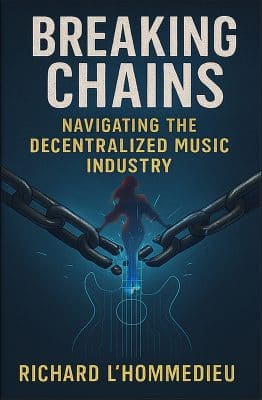
Breaking Chains is a groundbreaking guide for independent musicians ready to take control of their careers in the rapidly evolving world of decentralized music. From blockchain-powered royalties to NFTs, DAOs, and smart contracts, this book breaks down complex Web3 concepts into practical strategies that help artists earn more, connect directly with fans, and retain creative freedom. With real-world examples, platform recommendations, and step-by-step guidance, it empowers musicians to bypass traditional gatekeepers and build sustainable careers on their own terms.
More than just a tech manual, Breaking Chains explores the bigger picture—how decentralization can rebuild the music industry’s middle class, strengthen local economies, and transform fans into stakeholders in an artist’s journey. Whether you’re an emerging musician, a veteran indie artist, or a curious fan of the next music revolution, this book is your roadmap to the future of fair, transparent, and community-driven music.
Get your Limited Edition Signed and Numbered (Only 50 copies Available) Free Shipping Included
Discover more from Making A Scene!
Subscribe to get the latest posts sent to your email.


