

Reference Levels and LUFS: What Loudness Really Means Today




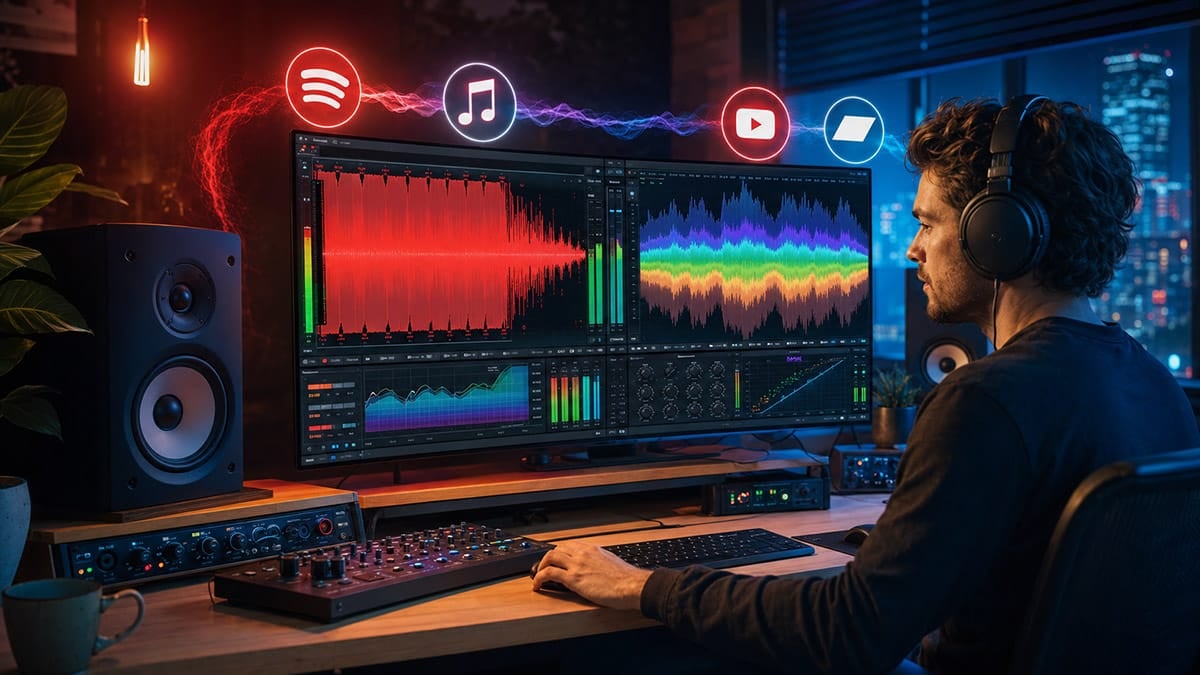
Reference Levels and LUFS: What Loudness Really Means Today
Listen to the Podcast Discussion
There was a time when the loudest record in the room felt like the winner. If your track jumped out of the speakers harder than the next artist’s track, you thought you had the advantage. Louder meant stronger. Louder meant more professional. Louder meant you could survive radio, clubs, cars, and cheap earbuds.
That world is mostly gone.
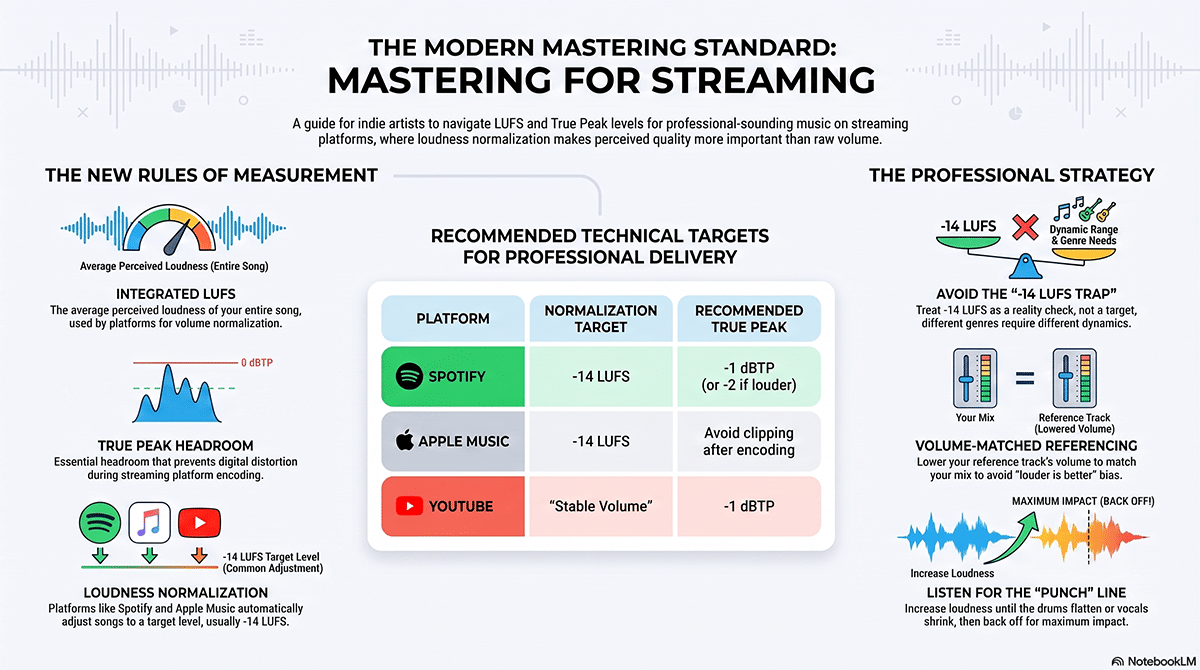
Today, your song is not only competing with other songs. It is being handled by streaming platforms that measure loudness, turn songs up or down during playback, and try to keep listeners from grabbing the volume knob every three minutes. Spotify says it uses loudness normalization to balance soft and loud songs, and its normal setting adjusts playback around -14 dB LUFS while recommending true peak headroom to avoid distortion during encoding (Spotify loudness normalization). Apple Music has Sound Check, which Apple describes as a feature that adjusts loudness between songs so they play at a more even volume (Apple Support). YouTube also says it may apply audio enhancements, including automatic volume adjustments and “Stable volume,” to make playback more comfortable (YouTube Help).
That does not mean you should master every song to the same number. That is where a lot of indie artists get trapped. They hear “Spotify is -14 LUFS” and think the job is to make every master hit -14 LUFS exactly. Then they wonder why their track sounds smaller than commercial releases. The truth is simpler and more useful. LUFS is a measuring tool. It is not a creative boss. It tells you how loud your music feels over time, but it does not tell you if the vocal is exciting, if the drums punch, if the bass is eating the mix, or if the song still has life after the limiter has done its work.
What LUFS Actually Means
LUFS stands for Loudness Units Full Scale. That sounds like something invented to scare musicians away from finishing songs, but the idea is not that hard. A normal peak meter tells you how close your signal gets to digital clipping. LUFS tries to tell you how loud the music feels to a human ear.
That matters because our ears do not hear all frequencies the same way. A bass-heavy mix can use a lot of energy without sounding as loud as a bright vocal or snare. A song with sharp upper mids may feel loud even if the meters are not screaming. A soft acoustic track can have big peaks but still feel quiet. LUFS looks at loudness in a way that is closer to how people experience sound, especially over time.
Most loudness meters show a few LUFS readings. Momentary loudness is the quick snapshot. Short-term loudness usually looks at a few seconds. Integrated loudness is the big one for streaming because it measures the whole song or a selected section. Youlean explains integrated loudness as the average loudness over the full duration, while true peak shows the maximum peak level that could occur between digital samples (Youlean measurements). In plain English, integrated LUFS is the “how loud did the whole song feel?” number. True peak is the “will this distort after conversion?” warning light.
The Peak Meter Is Not Enough
Most home studio artists learn peak meters first. Red is bad. Stay under zero. Do not clip the master bus. That is still true, but it is not enough anymore.
A song can peak at -1 dB and still feel quiet. Another song can peak at -1 dB and feel huge. The difference is density. Compression, limiting, arrangement, saturation, EQ, and low-end control all affect how loud the music feels. LUFS helps you see that difference.
This is why two songs can both peak near the same level but hit completely differently. One has a tight kick, controlled bass, clear vocal, and a limiter taking off just a couple of dB. The other has muddy low end, wild snare hits, and a limiter fighting for its life. The second song may show a loud number, but it will feel smaller because the mix is not working with the mastering chain.
That is the first mastering basic every indie artist needs to understand. Loudness is not created only at the end. Loudness starts in the mix. If the bass is too big, the limiter will react to the bass instead of the song. If the vocal has harsh peaks, the limiter will clamp down every time the singer leans into a word. If the snare jumps out 6 dB louder than everything else, the whole master gets held back. You cannot fix all of that by dragging one limiter threshold down and hoping the song becomes competitive.
Reference Level Means More Than One Thing
When engineers talk about reference levels, they may mean a few different things. They may mean the volume level of the speakers in the room. They may mean reference tracks used for comparison. They may mean loudness targets for streaming. All three matter, but they are not the same thing.
Your listening level is the first reference. If you mix quietly one day, loudly the next day, and painfully loud at midnight because you are trying to feel something, your ears will lie to you. Louder usually sounds better for a moment. It makes bass feel bigger and excitement feel easier. That is why a fixed, comfortable monitoring level is so important. You want your ears to learn the room. You want your decisions to come from balance, not from volume hype.
Your second reference is commercial music that lives in the same world as your song. If you are making a raw Americana track, do not compare it to a crushed EDM master and panic. If you are mixing a modern rock single, do not compare it only to a soft 1970s folk record. Pull in a few reference tracks that match your genre, arrangement, and emotional target. Turn them down so they play at the same perceived level as your mix. That last part is everything. If the reference is louder, you will think it is better even when it is only louder.
Your third reference is platform behavior. Spotify, Apple Music, YouTube, Amazon Music, Tidal, and other services do not all behave in exactly the same way across every device, setting, subscription tier, and playback context. Even Spotify notes that its web player and some third-party devices do not use normalization in the same way (Spotify loudness normalization). So the goal is not to master for one robot. The goal is to make a strong master that survives many playback systems.
The Trap of Chasing Minus Fourteen
The -14 LUFS number has become one of the most misunderstood numbers in modern music production. It is useful, but it is not a law. Spotify uses that number for its normal playback target, but that does not mean every song should be mastered to exactly -14 LUFS. Many commercial releases are louder than that. Streaming platforms may turn them down, but they can still sound powerful because their mixes are controlled, punchy, and balanced.
This is where indie artists get hurt. They read a quick post online and master everything to -14 LUFS because they think that is the professional streaming target. Then they compare their release to other tracks in a playlist and feel like their song is weaker. The problem is not that -14 LUFS is wrong. The problem is treating it like the finish line.
A delicate acoustic song may sound beautiful around -14 LUFS or even quieter if the dynamics are part of the emotion. A dense rock track may feel better around -10 or -9 LUFS if the mix can handle it. A hard pop, hip-hop, or electronic track may go louder if the sound calls for it. But if you push a weak mix to -8 LUFS, you do not get a hit record. You get a tired master with less punch, less space, and more distortion.
The smart move is to use -14 LUFS as a playback reality check, not a creative prison. Ask what happens when your song is turned down. Does it still punch? Does the vocal still feel close? Does the chorus still lift? Does the low end still speak? If the answer is yes, you are in good shape. If the answer is no, the issue may be arrangement, EQ, compression, or mix balance, not the final LUFS number.
True Peak Is the Quiet Detail That Saves You
True peak is one of those boring-looking settings that can save your master from sounding cheap. A regular digital peak meter looks at the sample points in the file. True peak estimates what can happen between those sample points when the audio is converted, encoded, or played back. That matters because a file can look like it is under zero on a sample peak meter and still create inter-sample peaks that clip after conversion.
Spotify recommends keeping true peak below -1 dBTP if the master is around -14 LUFS, and below -2 dBTP if the master is louder than -14 LUFS, because louder tracks are more likely to suffer extra distortion when encoded for streaming (Spotify loudness normalization). Apple’s Digital Masters guidance also tells engineers to audition encoded files and set levels so the encode does not show clipping; Apple warns that audible clipping from excessive encoder levels can affect whether a track qualifies for the Apple Digital Masters badge (Apple Video and Audio Asset Guide).
That is the real-world reason for true peak headroom. It is not about being timid. It is about keeping your music clean after the platform does what platforms do. Your WAV file is not the end of the trip. It may be encoded, decoded, streamed, played through Bluetooth, squeezed into earbuds, blasted in a car, or dropped under a video. Leaving a little true peak headroom is not weakness. It is professional delivery.
How Loud Should an Indie Artist Master?
Here is the honest answer: loud enough to feel finished, not so loud that the song loses its reason to exist.
For many indie artists, a good practical range is often somewhere between -14 and -9 LUFS integrated, depending on genre, arrangement, and taste. Softer folk, jazz, roots, acoustic, and singer-songwriter material can live beautifully around the more open end of that range. Rock, pop, country, soul, blues, indie, and modern band productions often land louder. Heavy electronic, hip-hop, hard rock, and aggressive pop may push louder still, but only if the mix is built for it.
The better question is not “What LUFS should I hit?” The better question is “How far can I push this before it stops getting better?” Put a loudness meter after your limiter. Lower the limiter threshold slowly. Listen to the kick. Listen to the snare. Listen to the vocal. Listen to the width. Listen to the chorus. At first, the master may feel more exciting. Then, at some point, the punch starts to flatten. The vocal gets smaller. Cymbals smear. Bass gets cloudy. The chorus no longer jumps because the whole song is pinned to the ceiling. That is the line. Back off.
This is the heart of mastering basics. You are not trying to win a meter. You are trying to finish the record.
The Simple Mastering Chain
A beginner mastering chain does not need to look like a spaceship control panel. In a DAW like Fender Studio Pro, Logic Pro, Pro Tools, Cubase, Ableton Live, Reaper, FL Studio, or Studio One-based workflows, the basic idea is the same. You place processing on the stereo mix or mastering session, make small moves, compare often, and keep level changes honest.
A simple chain might start with gentle EQ to clean low-end buildup or soften harshness. Then a compressor may add a little glue if the mix needs it. A saturation tool may add weight or tone. A clipper may shave fast peaks before the limiter if the style calls for it. The limiter usually comes near the end, setting final loudness and ceiling. After that, a loudness meter tells you integrated LUFS, short-term LUFS, true peak, and sometimes loudness range.
You can do this with free and paid tools. Youlean Loudness Meter is a popular free option for reading LUFS and true peak. FabFilter Pro-L 2 includes loudness metering and true peak features built into a professional limiter. iZotope Ozone is a full mastering suite with assistant features, reference tools, limiters, EQ, and modern mastering modules. Waves limiters, Klanghelm tools, Sonnox, T-RackS, DMG Audio, and many stock DAW plugins can also do serious work when used with care.
The tool is not the secret. The secret is knowing what you are asking the tool to do.
Volume-Matched Referencing Is the Cheat Code
If you want to learn loudness fast, stop comparing songs at different playback levels. That one mistake causes endless bad decisions.
Bring a reference track into your DAW. Route it so it does not run through your mastering chain. Turn it down until it feels about the same loudness as your mix. Now compare. Does your low end feel too big or too small? Is your vocal too sharp? Is the snare too far forward? Does your chorus feel smaller even at the same volume? That is useful information.
When the reference is louder, it will almost always seem better. That is not wisdom. That is biology. Our ears often prefer louder in short bursts. Streaming platforms know this, which is why normalization became part of the listener experience. Your job is to remove that trick from your own process.
This is also why artists should check their master at several listening levels. Listen quietly. Listen at a normal level. Listen in the car. Listen on earbuds. Listen on a small speaker. Do not keep changing the master every time one system sounds different. Look for patterns. If the vocal is buried everywhere, fix it. If the bass only disappears on a phone, that may be normal. If the master sounds exciting loud but dull quiet, the midrange may need work. If it sounds huge in your studio and messy everywhere else, the room may be lying to you.
Why Over-Limiting Costs You Money
This is not just a nerd argument about meters. This affects real career outcomes.
A crushed master can make people skip faster because it feels tiring. It can make a music supervisor pass because the track does not have enough space for picture. It can make a live video feel harsh on YouTube. It can make your song smaller after streaming normalization turns it down. Worst of all, it can hide the very thing fans came for: the human performance.
Indie artists do not have the luxury of wasting emotional impact. You need the vocal to connect. You need the groove to move. You need the chorus to lift. You need the listener to stay long enough to follow you, buy a ticket, join your email list, scan the QR code at the merch table, grab the vinyl, support the next release, or show up again. Loudness should help that relationship. It should not sand the life off the record before the fan even gets to know you.
This is where Making a Scene always comes back to ownership and direct connection. Your master is part of your business. It is the sound of your store window. It is the first handshake. It is the thing that travels through Spotify, Apple Music, YouTube, Bandcamp, your website, your EPK, your live show promo, your sync pitch, and your direct-to-fan ecosystem. Treat it like an asset, not an afterthought.
A Practical Way to Finish
When your mix is ready, export a clean 24-bit WAV with headroom and no clipping on the stereo bus. Open a new mastering session so you are not tempted to keep rewriting the mix while mastering. Add your reference tracks. Add your mastering chain. Add your loudness meter last.
Start by making the song sound better before making it louder. Fix broad tonal problems. Control only what needs control. Then bring in the limiter. Set your true peak ceiling around -1 dBTP as a starting point, or lower if you are pushing a loud master. Raise the loudness slowly. Watch the integrated LUFS, but listen harder than you look. When the song begins to lose punch, back off. Check the loudest chorus. Check the quiet intro. Check the ending. Then listen from top to bottom, because integrated LUFS only makes sense when the whole song plays.
After that, test the master against references at matched volume. Then test it in normal life. Earbuds. Car. Laptop. Phone speaker. Studio monitors. If it works in the places your fans actually listen, you are closer to done than any number can tell you.
The Real Meaning of Loud Today
Loudness today is not about brute force. It is about translation. It is about making a song feel strong after streaming normalization, after codec conversion, after earbuds, after the car stereo, after the fan hears it inside a playlist full of major label releases.
LUFS helps you understand that world. True peak helps you survive it cleanly. Reference levels keep your ears honest. Reference tracks keep your taste grounded. Mastering basics keep you from turning a good mix into a loud mistake.
So yes, learn the numbers. Know what -14 LUFS means. Know why -1 dBTP matters. Know how Spotify, Apple Music, and YouTube can change playback level. Use tools like Youlean, FabFilter, Ozone, and your DAW meters. But do not hand your song over to a number and call that mastering.
The goal is not to be the loudest file uploaded this week. The goal is to make a record that feels alive when the platform turns the volume knob for the listener. That is the modern game. Not louder at any cost. Louder only when it still sounds like music.
 |  Spotify |  Deezer |  Breaker |
 Pocket Cast |  Radio Public |  Stitcher |  TuneIn |
 IHeart Radio |  Mixcloud |  PlayerFM |  Amazon |
 Jiosaavn |  Gaana |  Vurbl |  Audius |
 Reason.Fm | |||
Find our Podcasts on these outlets

Subscribe to Our Newsletter
Share this:
- Share on Pinterest (Opens in new window) Pinterest
- Email a link to a friend (Opens in new window) Email
- Share on X (Opens in new window) X
- Share on LinkedIn (Opens in new window) LinkedIn
- Share on Facebook (Opens in new window) Facebook
- Share on Tumblr (Opens in new window) Tumblr
- Share on Reddit (Opens in new window) Reddit
- Share on Telegram (Opens in new window) Telegram
- Print (Opens in new window) Print
- Share on WhatsApp (Opens in new window) WhatsApp
- Share on Mastodon (Opens in new window) Mastodon
Related
Discover more from Making A Scene!
Subscribe to get the latest posts sent to your email.


