

Great Performances Beat Great Equipment





Making a Scene Presents – Great Performances Beat Great Equipment
Listen to the Podcast Discussion
Spend enough time around recording musicians and you eventually witness a familiar little ceremony. Someone finishes a take, listens to the playback, makes a face normally associated with discovering something unpleasant in the refrigerator, and decides the studio needs an upgrade. Perhaps the microphone is not expensive enough. Maybe the preamp lacks whatever invisible magic lives inside transformers made during the Eisenhower administration. There could be something wrong with the converters, the monitors, the cables, or the plug-in collection, which already contains enough virtual compressors to control the dynamics of a small country. Whatever the culprit may be, it is remarkably comforting to believe that the disappointing thing coming out of the speakers can be corrected by something arriving from a delivery truck on Thursday.
Sometimes it can. Equipment matters, and pretending otherwise would be silly. A noisy microphone can make a quiet vocal difficult to record, an untreated room can turn a beautiful acoustic guitar into something that sounds as though it was tracked in a tiled bus station, and poor monitoring can fool an engineer into making decisions that collapse everywhere except inside the room where the mix was created. Good tools remove obstacles, and the history of recorded music is full of musicians and engineers using technology creatively enough to change what records could sound like.
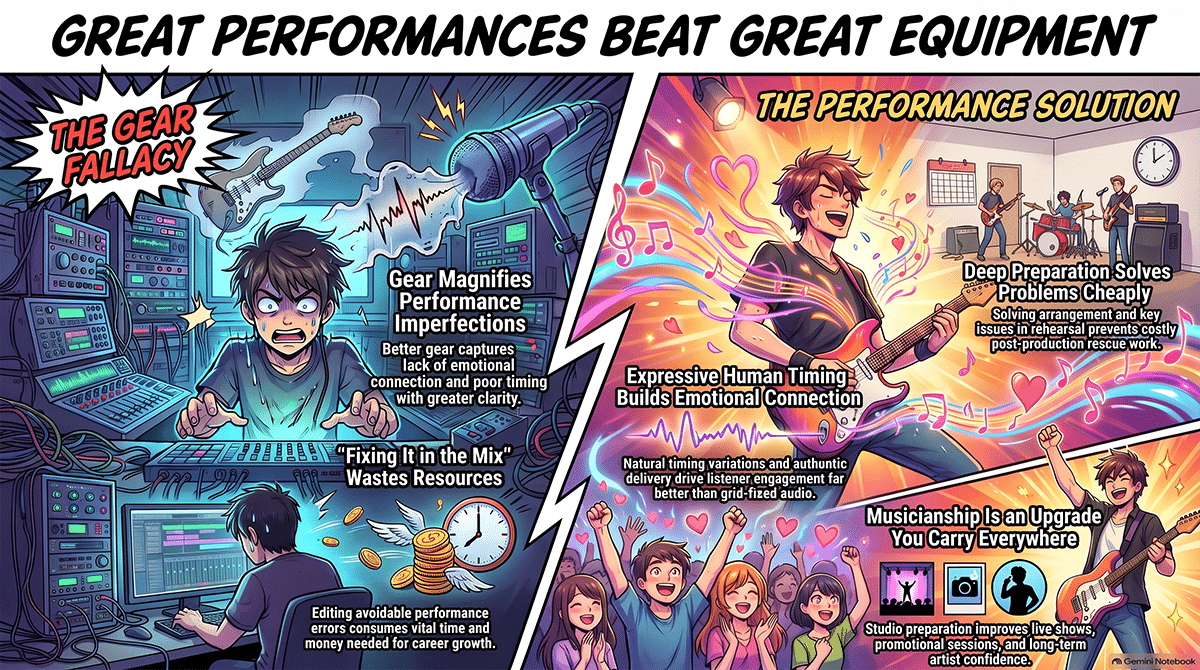
The trouble begins when we ask equipment to solve a problem that occurred before the sound ever reached the microphone. If the singer does not connect with the lyric, a more expensive microphone will capture that lack of connection with greater detail. If the drummer cannot settle into the groove, another set of converters will preserve the wandering time with exceptional accuracy. If the guitar player knows the intro, mostly knows the verse, and is hoping divine intervention will handle the bridge, the finest recording console in the world has no knob labeled “make the musician remember the arrangement.”
This is where recording culture can become a little backwards. We talk endlessly about the equipment that captures a performance while paying far less attention to the performance being captured. You can spend an entire evening online comparing microphone frequency-response charts without once asking whether the singer is ready to sing the song. You can debate the sonic personality of six different preamps while the bass player is still figuring out exactly where the chorus begins. None of this means musicians should stop enjoying gear. Gear is fun, and anyone who has ever opened a box containing a new microphone understands that rational economic behavior occasionally takes the evening off. But if the goal is to make better records, there comes a point where the next meaningful upgrade is not sitting in a shopping cart.
It is standing in front of the microphone.
For independent artists, this matters far beyond the sound of one recording. Every hour spent fixing something that could have been performed correctly is an hour taken from the rest of the artist’s business, and every dollar spent chasing equipment that does not solve the real problem is a dollar unavailable for the work that happens after the record is finished. A better performance can reduce recording time, simplify editing, make mixing easier, strengthen the live show, and leave the artist with more resources to promote the release and build direct relationships with the people who care about it. When you are trying to create a sustainable career without a corporation paying the bills, the difference between improving the musician and merely expanding the studio can become surprisingly important.
The Studio Does Not Create the Performance
One reason musicians become obsessed with recording equipment is that a studio surrounds the creative process with machinery. The moment we walk into a recording room, music suddenly becomes visible as numbers, levels, waveforms, meters, tracks, and little glowing buttons that suggest somebody somewhere knows exactly what all of this means. Once the recording begins, the musician can easily start thinking like the technology instead of thinking like the musician. The singer watches the screen. The guitarist worries about the click. The drummer becomes fascinated with whether the snare transient appears exactly where the vertical line says civilization intended it to appear.
Yet the important information reaching the microphone was created before any of those displays became involved. A singer shapes a phrase according to what the words mean. A drummer decides, consciously or instinctively, how hard the chorus should push compared with the verse. A bass player chooses how long a note should live before allowing space back into the arrangement. The technology receives those decisions after the musician has already made them, and the recording either contains the result or reveals that the decision was never really made.
Research into musical performance has spent decades examining these small human choices because expressive playing is not simply a matter of producing the correct notes. Studies of performance routinely identify changes in timing, dynamics, articulation, timbre, attack, and other characteristics as part of the way musicians communicate interpretation and emotion. A large review of expressive performance research describes these variables as fundamental tools performers use to shape musical character, while other studies have found that listeners respond differently when natural human fluctuations in timing and intensity are present.
This helps explain something musicians have known without needing a laboratory to tell them. Two people can play the same notes on the same instrument through the same recording chain and produce performances that feel completely different. One player makes the melody sound as though it has somewhere to go, while another delivers all the correct information but never convinces you that the trip was necessary. The difference may live inside timing too small to notice consciously, or in the way a note begins and ends, or in a change in intensity that would barely register on a meter. Those details are difficult to buy because they belong to the performer.
Recording magnifies them. A live audience experiences sound along with the physical energy of a room, the movement of the musicians, the volume of the PA, and the shared excitement of everyone standing together. A record removes much of that environment and leaves the performance exposed in a way that can be wonderfully revealing or mildly terrifying. The singer who always loses support at the end of a line hears it repeatedly. The guitarist whose picking becomes harder whenever a difficult section approaches discovers that the tone changes with it. The drummer who believed the tempo was solid may learn that the band accelerates every time excitement rises.
This can feel brutal when you first begin recording yourself, but the microphone is not being cruel. It is simply an unusually honest witness. Once you treat playback as information instead of judgment, the studio becomes one of the best teachers a musician can have.
Emotion Begins With Believing the Song
The easiest way to understand emotion in recording is to imagine a singer performing a lyric about the most painful moment of their life while concentrating primarily on whether the waveform looks impressive. Nobody needs a research grant to predict how that session is going to go. The singer may hit every note and still leave the listener outside the song because emotional communication depends on more than technical correctness.
This does not mean technique is unimportant. In fact, technique matters precisely because emotion becomes difficult to communicate when the performer is fighting the mechanics of the performance. A singer who is running out of breath cannot make a meaningful choice about the end of the phrase because survival has become the more immediate concern. A guitarist who barely knows the chord change does not have much attention left for dynamics. A drummer who is struggling to maintain the tempo cannot relax enough to shape the groove.
Good technique creates room for expression because it removes some of those emergencies. Once the performer knows how to execute the material, attention can move beyond execution toward meaning. The singer can begin thinking about why one word deserves more weight than another, and the guitarist can respond to the vocal instead of simply arriving at the next chord before everyone notices the panic. The musician starts hearing the song as a conversation rather than a series of instructions.
Researchers studying expressive performance have found that the human qualities musicians introduce into timing and loudness can influence emotional response in listeners. In one study comparing expressive and mechanically rendered performances, the expressive version produced stronger emotional responses, while changes in timing were related to reported emotional arousal. This does not mean there is some mathematical formula where delaying a note by a particular number of milliseconds automatically creates heartbreak. Human expression is thankfully more complicated than that. What it does reinforce is the idea that the performance itself carries emotional information that exists beyond the written notes.
A singer learns this by living inside the lyric rather than decorating it. When you understand what the song is saying, phrasing begins to change naturally because language already contains musical movement. People do not speak every sentence with identical emphasis, volume, speed, and tone. We hesitate when we are unsure, rush when we are excited, soften when something becomes intimate, and lean harder on words we need another person to understand. A believable vocal borrows from the same instincts.
This is where a home studio can become an advantage rather than a compromise. You may not have the microphone locker of a major commercial facility, but you can give the singer another evening to live with the song. You can change the key after discovering that the emotional center of the vocal is buried underneath the effort required to reach the highest note. You can try singing from the beginning without interrupting every thirty seconds to repair something. The absence of a large hourly studio bill can create the space needed for a performance to become more natural, provided you do not use that freedom to record seventy-two mediocre takes and promise yourself that somebody will eventually assemble a personality from the pieces.
For independent artists, emotional connection also has a very practical business value. A listener does not become a fan because the recording passed a technical inspection. Something in the music has to matter enough for that person to stay, return, share the song, come to a show, buy something, or join the artist’s community. The performance is often the first place where that relationship begins. Production can make the invitation sound beautiful, but somebody still has to make the listener want to come inside.

Timing Is Not the Same Thing as Obeying the Grid
The modern digital studio has given musicians the ability to see timing with a degree of precision that previous generations never had. This is useful until the eyes begin overruling the ears. A waveform appears slightly ahead of the grid, so somebody moves it. Another transient looks a little late, so it gets dragged into place. After enough corrections, the session resembles a neighborhood where an overly enthusiastic homeowners association has required every shrub to be exactly the same height.
The problem is that expressive timing is part of music. Experienced performers do not necessarily produce identical microscopic timing on every pass, even when the overall musical interpretation remains stable. Research on repeated performances has shown that accomplished players can preserve a recognizable interpretation while allowing flexibility in the exact timing of expressive gestures. The performance remains controlled without becoming mechanically identical.
Popular musicians understand this idea through feel. A drummer can sit a little deeper in the pocket without losing the tempo. A bass player can interact with the kick drum in a way that makes the groove feel heavy without every attack occupying exactly the same mathematical location. A singer can float across a phrase while the rhythm section remains steady underneath. These things become powerful because the musicians control them rather than because they accidentally missed the beat in an artistically convenient direction.
That distinction is essential. Musicians sometimes hear discussions about playing behind the beat and use them as diplomatic cover for poor timing, which is a little like calling a wrong turn “experimental navigation.” Intentional flexibility comes from having a strong internal sense of time. When the player understands where the center is, they can choose how to relate to it. When the center itself is uncertain, every variation becomes a negotiation.
The best way to improve this in a home studio is to listen to complete performances instead of immediately opening the editing tools. A song may reveal that the groove feels confident through most of the verse but tightens awkwardly whenever the chorus begins. That change could come from the drummer getting excited, the guitarist attacking harder, the singer pushing the first phrase, or some combination of all three. If you immediately repair the waveform, you can hide the symptom without understanding the musical behavior that created it.
Once you hear the pattern, rehearsal becomes much more productive. The band can work on the transition until the chorus arrives with energy without arriving early. The guitarist can practice increasing intensity without increasing speed. The singer can learn to approach the opening line without dragging the rhythm section forward. These are musical solutions, and the beautiful part is that they still work when the computer is not in the room.
This is where the economic argument becomes hard to ignore. Editing one timing problem takes moments, but weak timing rarely arrives as one polite little problem waiting to be corrected. It spreads across tracks and sections until the engineer is nudging bass notes, moving guitars, repairing drums, and wondering when exactly a recording session turned into administrative work. If the artist is paying an engineer, those hours have a price attached to them. If the artist is doing the work personally, the invoice is invisible, but the lost time is just as real.
Better timing therefore makes recording cheaper without requiring the music to become sterile. It also improves the live show because the musician carries the skill out of the studio. A tighter band usually feels more confident on stage, and confidence allows everyone to pay more attention to the audience instead of wondering whether the bridge is about to arrive three beats earlier than scheduled. Fans may never describe the difference in technical language, but they know when a band feels settled inside its own music.
Consistency Is What Makes Freedom Possible
Consistency sounds less glamorous than emotion because nobody has ever sold many concert tickets by advertising an evening of dependable note lengths. In the studio, however, consistency is one of the quiet characteristics that separates a musician who occasionally produces a wonderful moment from one who can build an entire recording around those moments.
The key is understanding that consistency does not mean identical. An expressive performer should not sound like a photocopy machine. What matters is having enough control over the fundamentals that variation happens for musical reasons. A singer who maintains a reasonably stable relationship to the microphone can still become louder and softer, but those changes belong to the performance rather than being caused by wandering six inches backward during one phrase and attempting to climb inside the microphone during the next.
Even microphone manufacturers acknowledge how much the performer affects the recording before processing begins. Shure’s recording guidance emphasizes maintaining reasonably consistent distance because changes in microphone position alter level and tone, and it stresses that successful vocal recording depends heavily on capturing a prepared performance before mixing begins. That advice is useful precisely because it comes from a company whose business involves selling microphones. Even the people making the equipment are telling you that the singer still has a job.
Instrumental performances reveal the same principle. A bass player who has control over attack and note length gives the song a dependable foundation without needing every note to sound identical. A guitarist who can repeat a part at a similar intensity makes double-tracking easier because the layers cooperate rather than wrestling for control. A drummer who understands their own dynamics creates a kit that already has musical balance before compression begins doing any work.
The producer benefits because dependable performances create options. If three vocal takes share the same basic tone and intention, the producer can choose moments from each without making the finished vocal sound as though three different singers wandered into the building. When every take changes dramatically because the musician is still discovering how to perform the part, editing becomes less like choosing between good possibilities and more like trying to assemble furniture from three unrelated instruction manuals.
Consistency also gives the performer freedom to experiment. This seems contradictory until you experience it. When the musician knows what a stable version of the part feels like, changes become meaningful because there is something to compare them with. The singer can pull back the second verse because the first verse established a reference point. The drummer can open up the chorus because the groove underneath remains trustworthy. The guitarist can leave space instead of filling every opening with another part, which is difficult at first but becomes easier once somebody reassures the guitarist that the instrument will still exist when the next section arrives.
What sounds spontaneous on a great record is often supported by enormous preparation. Skilled performers develop reliable movements and musical relationships deeply enough that they can stop thinking about basic execution. Research on repeated performances suggests that preparation can increase stability while still allowing expressive flexibility, which helps explain why experienced musicians can sound both controlled and alive.
That combination should be the target. Consistency is not the enemy of human feeling. It is what allows the musician to keep the emotional decisions while reducing the accidental ones.
Preparation Is Where the Expensive Problems Become Cheap
Many musicians think recording begins when the red light comes on. Producers tend to know better. The recording often succeeds or fails during the less glamorous period when nobody is taking photographs because the band is sitting in a rehearsal room arguing about whether the second chorus should be half as long.
Preparation is where expensive studio problems can still be solved cheaply. An arrangement that drags can be shortened before anyone records twenty tracks around it. A vocal key that forces the singer into a strained part of the range can be changed before the entire instrumentation becomes attached to the original key. A guitar part that competes with the vocal can be simplified before an engineer spends an afternoon attempting to make two things occupy the same musical space through equalization and prayer.
This is what preproduction is really for. It does not require polished demos or elaborate equipment. A phone recording can tell you whether the song loses energy halfway through. A simple rehearsal capture can reveal whether the chorus actually grows or merely becomes louder. Listening a day later often exposes arrangement problems that nobody noticed while playing because musicians are understandably busy participating in the event.
The distance created by playback is incredibly useful. When you are playing the song, your attention is divided between your own part, the other musicians, the physical act of performing, and whatever anxiety is currently occupying the remaining space in your head. When you listen afterward, you can experience the arrangement more like an audience member. A four-minute song that felt exciting while playing may suddenly contain a thirty-second instrumental section where absolutely nothing interesting happens except the guitar player enjoying themselves.
That discovery costs nothing.
The expensive version happens when you discover it after tracking, overdubbing, editing, mixing, and beginning to master the record.
Preparation also changes the psychological experience of recording. Musicians who know the material deeply can enter a session with attention available for interaction. The drummer hears the singer. The bass player responds to the drummer. The guitarist notices when the arrangement needs less instead of automatically assuming it requires another layer. The singer can inhabit the lyric because the next chord change is no longer demanding emergency attention.
This is one reason rehearsal should not be treated as merely learning how the song goes. Knowing the sequence of chords is only the beginning. A recording-ready band understands how the sections relate emotionally, where the arrangement expands, where it pulls back, and how the energy moves from the first note to the last. Those decisions do not need to become rigid rules, but they should exist strongly enough that the musicians are telling the same story.
The financial benefit for independent artists is substantial because preparation reduces the amount of rescue work required later. Studio time becomes more productive, editing becomes more selective, and mixing can focus on presenting the record rather than repairing its foundation. If you are working in your own studio, the savings appear as time rather than cash, but time is often the scarcer resource. Every weekend spent fixing an avoidable performance problem is a weekend unavailable for finishing another song, booking shows, developing merchandise, communicating with fans, or doing the thousand other jobs an independent artist discovers were apparently included in the career without anyone mentioning them during childhood music lessons.
The Red Light Should Not Become the Main Character
Even well-prepared musicians can change when recording begins. A rehearsal take feels wonderful, everyone relaxes, and then somebody announces that the next pass is going to be the real take. Suddenly the drummer discovers that sticks are difficult to hold, the guitarist becomes intensely interested in finger placement, and the singer remembers every voice teacher they ever had simultaneously.
The recording light creates pressure because it suggests permanence. Musicians begin judging themselves while they are still performing, and that internal critic is not especially useful when it is sitting in the control room of your brain shouting instructions halfway through the second verse. The performer starts thinking about whether the previous phrase was good instead of experiencing the current one. By the time the bridge arrives, half the musician’s attention is performing and the other half is conducting an unauthorized performance review.
Preparation reduces some of that pressure because deeply learned material does not require constant conscious supervision. The musician has landmarks inside the song and can recover from a small error without feeling as though the entire structure has collapsed. This is another place where the home studio offers enormous potential. Recording can become ordinary rather than ceremonial.
If musicians record rehearsals frequently, the microphone stops feeling like an examiner. If the singer is allowed to perform several complete passes without somebody interrupting every small imperfection, the emotional arc has time to develop. Sometimes the strongest moment happens precisely because everyone temporarily forgets that the equipment is there.
A good producer learns to protect those moments. This can require resisting the temptation to correct every flaw immediately. There are technical issues that need attention, of course, but repeatedly stopping an emotionally engaged singer to discuss tiny noises can slowly train the performer to care more about avoiding mistakes than communicating the song. The technically cleaner take may arrive afterward, but the reason anyone wanted to record the song in the first place can disappear somewhere between Take Nine and a lengthy conversation about consonants.
The engineer’s job is therefore not merely to capture clean audio. It is to create conditions in which the musicians can perform. That may involve microphone placement and headphone balances, but it also involves understanding when the artist needs information and when they need enough silence to remain inside the song.
Editing Works Best When It Has Less Work to Do
Digital editing is one of the great gifts of modern recording. It has rescued brilliant performances containing small technical flaws, saved sessions after unexpected noises, and allowed producers to combine the strongest moments from multiple takes in ways that once required literal razor blades and considerably more courage. Nobody needs to become nostalgic for a time when moving a note involved sharp objects.
The problem appears when musicians start treating editing as the first stage of performance rather than the final stage of refinement. If everyone assumes timing will be corrected, pitch will be repaired, dynamics will be automated, and every rough edge will be removed afterward, the standard for what happens during recording gradually falls. The session stops being an attempt to capture a compelling performance and becomes an attempt to collect enough raw material for somebody to manufacture one later.
A finished record can certainly be assembled that way, and sometimes the production style intentionally depends on heavy editing. There is nothing morally superior about refusing digital tools. The more useful question is whether the editing serves the performance or whether the editing has become responsible for creating a performance that never existed.
That distinction affects the sound in ways that are difficult to measure because musicians interact across time. A singer’s second phrase responds emotionally to the first. A drummer changes intensity because of something the guitarist just played. The bass player leaves space because the vocal expanded into it. When every moment is treated as an independent object to be perfected, some of those relationships can disappear even while the recording becomes technically cleaner.
This is why a strong complete take can sometimes feel better than a flawless composite. The performance has an internal conversation. Small variations make sense because they developed together rather than being selected individually from a menu of technically perfect moments.
The smartest approach is not to reject editing but to make it earn its keep. Capture the best performance possible, then use technology to protect and enhance what was already there. A small correction can preserve an otherwise extraordinary take, and thoughtful comping can bring together performances that share the same emotional character. In that role, technology becomes an ally rather than an emergency medical service.
Better Performances Make Better Business
The connection between musicianship and business becomes clearer when you follow what happens after recording. A weak performance creates work at every stage that follows it. The engineer edits more heavily, the mix requires more automation, and revisions multiply because something still feels wrong even though nobody can quite explain why. Time and money continue flowing into the record long after the original session because the production is trying to create confidence that should have existed before tracking.
A strong performance changes the entire path. The mixer receives tracks whose dynamics already make musical sense. Effects can create depth rather than hide uncertainty. The mastering engineer works with a mix built around a confident musical center. The artist gets to the release stage sooner, with fewer resources consumed repairing things the audience will never know were broken.
Those resources can then move toward the parts of the career that actually create relationships and revenue. An independent artist can use money that did not disappear into unnecessary studio repair to support promotion, live shows, physical products, direct sales, licensing preparation, or fan experiences. The exact destination will differ from artist to artist, but the underlying idea is the same: efficiency in the studio creates possibilities outside the studio.
The performance itself also becomes a more useful asset because the same qualities that strengthen the recording strengthen almost every other way the music can earn. A singer with greater control gives better live performances. A band with stronger timing creates better concert videos because the footage does not need heroic editing to become usable. Musicians who can perform consistently are more dependable on sessions, livestreams, radio appearances, and promotional recordings.
This is where Making a Scene’s larger philosophy about building a music-industry middle class becomes relevant. Independent artists rarely survive because one revenue source suddenly becomes enormous. Sustainable careers tend to grow from several parts of the artist’s world supporting one another. The recording introduces the music, the live show deepens the relationship, direct sales and merchandise allow fans to support the artist more meaningfully, and ownership keeps more of the resulting value under the artist’s control.
The quality of the performance sits quietly underneath that entire system. If people do not care about the music, there is not much business architecture capable of rescuing the situation.
Gear Becomes Valuable When You Know Why You Need It
None of this should send musicians into the opposite mistake of believing equipment never matters. There are moments when a technical limitation is genuinely holding the artist back, and that is exactly when buying something becomes sensible. The important difference is that the purchase now has a reason.
A singer working in a noisy environment may eventually need a microphone better suited to rejecting the room. A band trying to record drums with an interface that has only two inputs may need more channels because the existing system simply cannot accommodate the job. An engineer working in an untreated room may benefit far more from controlling the acoustics than from purchasing another microphone whose greatest achievement will be capturing the same bad room with improved fidelity.
The decision becomes clearer when the artist begins by identifying what is actually preventing the desired result. Instead of asking which microphone everybody on the internet currently loves, you ask what problem exists in your recording and whether a different microphone would solve it. Sometimes the answer really is equipment, and when that happens the purchase can produce value for years.
Other times the investigation leads somewhere less exciting. The vocal sounds thin because the singer is backing away whenever the note becomes difficult. The acoustic guitar sounds harsh because the player is attacking harder than the arrangement needs. The groove feels weak because the bass line contains too much activity for the drum pattern. These problems do not become easier simply because they lack price tags.
In fact, they can be harder because buying something feels productive immediately. Practicing does not provide tracking information from a shipping company. You do not get a confirmation email telling you that better phrasing will arrive between noon and four. Progress happens gradually, often while you are doing the mildly uncomfortable work of listening closely enough to recognize your own habits.
The reward is that musicianship does something equipment cannot do. It follows you out of the studio.

The Upgrade You Carry Everywhere
A microphone stays in the microphone locker when you leave for a gig. A compressor remains in the rack. The beautiful preamp that made the vocal sound wonderful last Tuesday will not be standing beside you when the venue hands you whatever microphone survived the previous weekend.
Musicianship travels.
The singer who learned to control the emotional shape of a verse still has that ability on stage. The drummer who developed stronger internal time brings it to every rehearsal. The bass player who learned how note length changes the groove can use that awareness whether recording through an expensive signal chain or plugging into a questionable club amplifier that appears to have participated in several regional conflicts.
The same preparation that makes a recording session easier also makes a band more dependable live. Musicians stop spending mental energy trying to remember what happens next and begin interacting with the room. They can notice the audience, recover when something unexpected happens, and allow the music to stretch without losing its identity. Those qualities are difficult to quantify on an equipment specification sheet, but they are exactly the things that turn a competent show into an experience people want to repeat.
This is why improving the performer can deliver such an unusually good return for an independent artist. You are not purchasing an improvement that applies to one studio task. You are developing an ability that strengthens the recording, the concert, the content created around the music, and often the artist’s confidence while doing all of it.
Technology can multiply that value when it is used intelligently. Modern recording tools can help artists hear problems more clearly, experiment cheaply, and produce professional work without needing access to the kind of studio budgets that once separated independent musicians from the major-label world. AI-assisted tools will continue making editing, restoration, organization, and analysis easier, which can reduce costs and remove tedious work from production.
That should give artists more room to be artists, not an excuse to become less prepared.
As technical polish becomes easier to obtain, human character becomes more important rather than less. If almost everyone can produce audio that is reasonably clean, clean audio stops being the great separator. The artist who has something recognizable to say and knows how to perform it still possesses something that cannot be reduced to a preset.
What the Microphone Is Really Waiting For
The recording industry has spent decades building extraordinary tools, and musicians should take full advantage of them. We have access to recording power in ordinary homes that would have looked absurdly futuristic to engineers only a few generations ago. An independent artist can create, edit, mix, distribute, promote, and sell music from the same room, which represents an enormous transfer of capability away from the traditional gatekeepers who once controlled access to professional production.
That freedom becomes much more valuable when we remember what all the equipment is waiting to receive.
The microphone is waiting for a musician who has something to communicate and enough control to communicate it. The recording system is waiting for a band that has spent enough time with the song to stop merely navigating it. The editing tools are waiting for a performance worth preserving rather than a pile of parts desperately hoping to become one.
Emotion, timing, consistency, and preparation are not separate studio tricks that musicians can master one at a time and file away. They overlap constantly. Preparation makes consistency possible because the performer knows the material deeply enough to repeat what matters. Consistency gives the musician confidence, and confidence creates room for expressive timing and emotional decisions. Those decisions make the performance feel human rather than merely correct.
Once that performance exists, the equipment finally gets to show what it can do.
A good microphone can reveal the texture in the singer’s voice instead of merely documenting uncertainty. A great preamp can preserve the impact of a performance rather than dressing up something that never developed any impact of its own. The mixer can work with dynamics that already tell a story, shaping and enhancing them instead of building emotional movement from scratch.
At that point, great equipment really is wonderful, because the technology is amplifying something worthwhile rather than trying to substitute for it.
That is the relationship independent artists should be looking for. The goal is not to reject new technology or romanticize some imaginary era when everyone recorded masterpieces with three microphones and a roll of tape. The goal is to put the priorities back in the right order, so the money and technology serve the music instead of convincing the musician that another purchase is always standing between them and a professional record.
A sustainable artist career is ultimately built around work people care about. Those listeners may discover the artist through a streaming service, a recommendation system, a short video, a live show, a friend, or whatever new technology arrives next month claiming to have reinvented human attention. If the connection becomes meaningful, however, it will still come back to the same basic event that has powered music for a very long time: somebody performs something in a way that another human being believes.
The studio can make that moment louder, clearer, wider, warmer, cleaner, and easier to distribute around the world. It can preserve it so the artist owns an asset that can continue generating revenue through recordings, licensing, direct sales, physical products, fan experiences, and future uses that have not yet been invented. That is an extraordinary amount of power for an independent musician to hold.
But the technology still needs the moment first.
Spend money where equipment is truly limiting the work, and enjoy good gear without feeling guilty about it. Just remember that some of the biggest improvements available in a studio will never arrive in a cardboard box. They arrive when musicians know the songs deeply enough to stop thinking about them, listen closely enough to respond to one another, and perform with enough control that emotion has somewhere to live.
When that happens, even modest equipment suddenly begins sounding much more expensive than it did yesterday.
 |  Spotify |  Deezer |  Breaker |
 Pocket Cast |  Radio Public |  Stitcher |  TuneIn |
 IHeart Radio |  Mixcloud |  PlayerFM |  Amazon |
 Jiosaavn |  Gaana |  Vurbl |  Audius |
 Reason.Fm | |||
Find our Podcasts on these outlets

Subscribe to Our Newsletter
Discover more from Making A Scene!
Subscribe to get the latest posts sent to your email.


