

EQ-Based Gating: The Smart Way to Leave Space in a Mix Without Killing the Music





Making a Scene Presents – EQ-Based Gating: The Smart Way to Leave Space in a Mix Without Killing the Music
Listen to the Podcast Discussion
There is a point in almost every mix where the fight starts. The vocal wants the center. The guitars want width. The bass wants weight. The kick wants authority. The toms want to sound huge for three moments in the song and then politely disappear before they turn the whole bottom end into a muddy parking lot. This is the part where a lot of home studio mixers either over-EQ everything until the track sounds skinny, or they give up and let the arrangement stay crowded. EQ-based gating is the move that lives in between those two bad decisions.
And that is why it matters to indie artists.
When you are working in your own room, on your own budget, trying to make records that can stand next to major releases without paying a studio bill the size of a used car, you do not have time for tools that only look smart. You need moves that solve problems fast and leave the song feeling alive. EQ-based gating is one of those moves. It does not just remove junk. It decides what kind of junk matters, when it matters, and what deserves to stay. That is a very different mindset from old-school blunt-force gating, where the gate opens because something got loud and closes because it got soft. A modern mix needs more judgment than that.
What EQ-Based Gating Actually Means
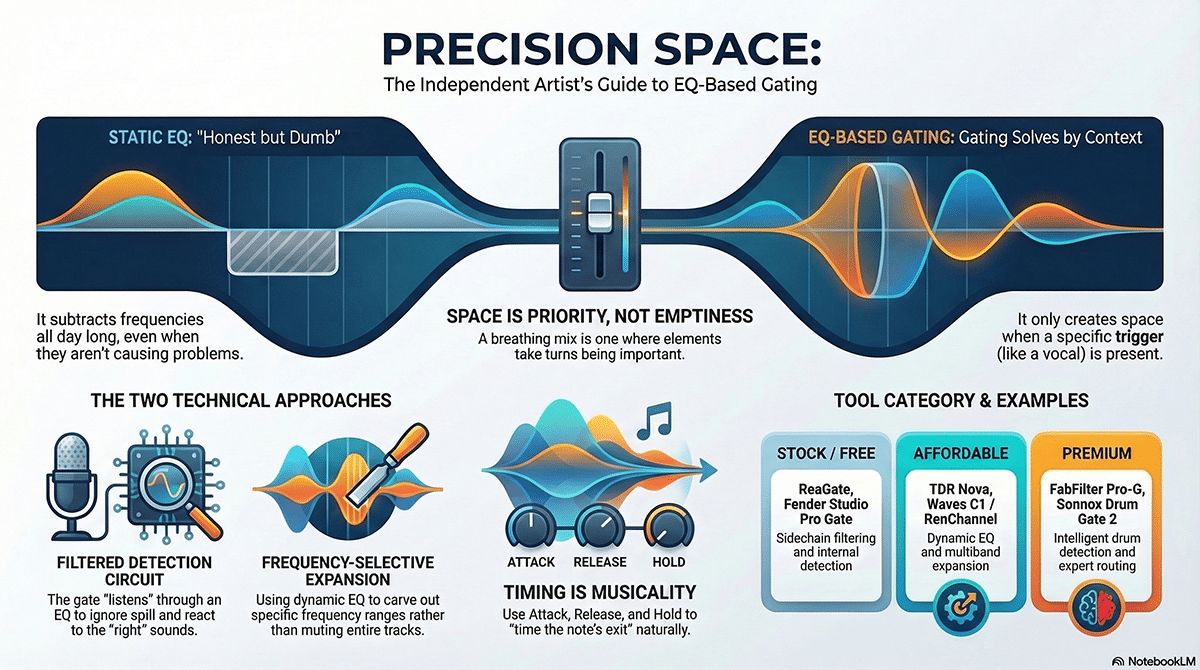
The phrase “EQ-based gating” gets used a few different ways, and that is worth clearing up before we get practical. Sometimes it means a regular gate with a filtered detection circuit. In plain English, that means the gate is listening through an EQ before it decides whether to open. The audio itself is not necessarily being EQ’d on the way out. The detector is being EQ’d so the gate can ignore the wrong stuff and react to the right stuff. That is the classic kick-and-toms use case. A gate on a tom track can be told to care about the tom’s body and attack, while ignoring cymbal splash and snare spill. FabFilter Pro-G, REAPER’s ReaGate, Waves C1, Waves Renaissance Channel, Neutron’s Gate, and the stock gate in Fender Studio Pro all live somewhere in this lane.
The other version of EQ-based gating is more modern and more surgical. That is where a dynamic EQ or multiband expander behaves like a frequency-selective gate. Instead of shutting an entire track on or off, it only clamps down on a chosen frequency range when the trigger condition is met. FabFilter Pro-Q 4 can run dynamic EQ with optional side-chain filtering and external triggering. FabFilter Pro-MB can work in expansion mode and even let you define a free trigger range anywhere in the spectrum. TDR Nova is a dynamic EQ, and the paid TDR Nova GE expands that into upward and downward expansion, including gating. This is where “leave space” gets really interesting, because now you are not just muting a track between hits. You are carving openings in specific ranges while keeping the rest of the performance intact.
Why This Matters More Than Static EQ
Static EQ is honest but dumb. It cuts 300 Hz all the time, even when 300 Hz is only a problem during the chorus. It scoops top end from a guitar even when that guitar only clashes with the vocal on certain lines. It strips low-mid weight out of tom tracks even though the toms only become a mess when the cymbals are washing over them between fills. Static EQ solves by subtraction, but it subtracts all day long.
EQ-based gating solves by context. It says, “When the vocal is present, I only need the guitars to back off in this band.” Or, “When the tom is not actually being played, I do not need its microphone contributing kick bleed, snare crack, cymbal spill, and HVAC rumble to the low end.” That is not just cleaner. It is more musical. And for indie artists working fast, musical problem-solving is business problem-solving. The faster you can get to a clear, release-ready mix without wrecking the emotion, the more songs you finish, the fewer revisions you burn, and the more competitive your masters become for streaming, licensing, direct sales, and client work.
The Big Lie About Gates
The big lie is that gates are just for cleaning noise. That is beginner language. Useful language, but still beginner language.
In a real mix, a gate is a timing device. It is a space-management device. It is a way of shaping density. That is why good gates have hold controls, attack and release controls, hysteresis, lookahead, and sometimes sidechain filtering or external triggering. Those features exist because the point is not simply to mute silence. The point is to decide when the door opens, how fast it opens, how long it stays open, and what kind of sound is allowed to be the key. iZotope’s gate documentation highlights separate open and close behavior and hold control, while FabFilter and REAPER both emphasize sidechain routing and filtered triggering as central parts of a serious gate workflow.
Once you understand that, the gate stops being a cleanup checkbox and starts becoming arrangement control. That is where EQ-based gating earns its keep. Instead of hacking away at tracks with a machete, you are teaching the mix what to respond to. That feels more like producing than repairing, and that is exactly the attitude an indie artist should have in a home studio. You are not trying to imitate somebody else’s expensive room. You are trying to build decision-making that makes your room stronger.
Leaving Space in a Full Mix
Let’s get out of the drum room for a second, because this trick is bigger than drums.
Say you have a dense verse. Acoustic guitar, electric pad, keys, lead vocal, harmony throw, bass, kick, snare, room mics, maybe even a little tambourine if you woke up feeling dangerous. The old move is to grab EQ on everything and start carving. Guitar loses some 2 kHz. Keys lose some 3 kHz. Vocal gets boosted around 4 kHz. Then you spend the next hour wondering why the mix sounds thinner but still not clearer.
A frequency-selective gate or dynamic EQ can do a better job because it only moves when it needs to. Put a dynamic EQ or expanding band on the guitars keyed from the vocal, and only that vocal-sensitive range ducks when the singer is actually singing. The rest of the guitar tone stays intact. Use the same idea on keys against snare crack or on bass against kick attack. FabFilter Pro-Q 4 supports dynamic EQ on every band with external triggering and side-chain filtering, while Pro-MB lets you set expansion per band with freely chosen trigger ranges. That means you can create little moving doorways in the mix instead of permanently demolishing frequency neighborhoods.
This is the part a lot of artists miss: space is not emptiness. Space is priority. A mix that breathes is a mix where things take turns being important. EQ-based gating is one of the cleanest ways to enforce that without sounding like you enforced anything. When it is dialed in, nobody hears the trick. They just hear a mix that feels expensive.
Why Drums Expose Bad Gates Fast
A drum kit is where lazy gating goes to get embarrassed.
Toms are the obvious example. A tom mic spends most of a song not hearing tom. It hears hi-hat, snare, cymbal wash, kick bleed, maybe some guitar amp in the room, and whatever chaos the drummer’s body is producing. Then, for one glorious fill, the tom actually matters. If you leave that mic wide open all song, your low end gets foggy and your cymbals start multiplying like a bad idea. If you gate it badly, the fill sounds chopped, fake, or like the shell got cut off with scissors.
That is exactly why filtered gates and intelligent drum gates exist. Sonnox says Oxford Drum Gate 2 was built specifically to solve inconsistent hits, phase issues, and uncontrolled spill in multi-mic drum sessions. Their description makes a sharp distinction between ordinary threshold gates and a drum-specific detection engine that classifies hits by drum type, preserves quiet intended hits, and uses adaptive decay so the drums stay natural instead of stiff. That is a big deal on toms, where the decay is the whole emotional payoff.
Kick drum has a different problem. The kick mic usually has less cymbal bleed than a tom mic, but it can still collect stage rumble, pedal squeak, shell resonance, snare sympathetic buzz, and the sort of vague low-end haze that makes a mix feel big for ten seconds and then exhausting for three minutes. A simple gate can help, but an EQ-aware detector helps more because it can be taught to react to the punch and body of the kick while ignoring subsonic garbage and upper spill. Waves’ gating examples specifically describe using internal sidechain filtering on kick, while REAPER, FabFilter, and Waves C1 all support filtered detection or related sidechain control.
The Tom Trick: Teach the Gate What a Tom Sounds Like
Here is the core move on toms. You do not want the gate listening full-range, because full-range listening is how cymbals trick the detector. You want the detector tuned toward the tom’s identity. That usually means giving it access to the body and the stick attack of the tom while rolling off a lot of bright spill that would otherwise open it at the wrong times.
In practice, that means using the sidechain filter inside the gate. Start with the threshold low enough that real tom hits open reliably. Then narrow the detector so it pays attention to the tom rather than the whole world. Listen to the sidechain if your plugin offers audition. FabFilter Pro-G lets you audition the sidechain and meter it in real time, which is exactly the kind of feature that speeds this work up. On a rack tom, you might bias the detector toward the low-mid punch and initial attack. On a floor tom, you may allow more low information but still stop the gate from reacting to broad cymbal wash. The exact frequencies depend on the drum, the player, the mics, the tuning, and whether the song wants tight rock control or natural control or natural roots bloom. The principle stays the same: do not ask the gate to be psychic when you can just tell it what drum it is supposed to care about.
Then comes the part that separates musical gating from amateur cleanup: release and hold. Too fast, and the tom sounds like it got strangled. Too slow, and you might as well not have gated it. The right setting lets the shell speak and then gets out of the way before the next bar’s cymbal wash turns your mix into soup. Sonnox’s Drum Gate 2 leans hard into adaptive decay for exactly this reason, because decay is the emotional tail of the drum. Even if you are using a standard gate, think the same way. You are not closing a door on noise. You are timing the note’s exit.
The Kick Trick: Clean Without Making It Clicky and Dead
Kick gating is where people often get overconfident. They hear that classic tight rock kick in their head and decide the answer is to slam a fast gate on the close mic. Then the low end disappears, the beater becomes a typewriter, and the whole drum starts sounding like a sample from a bad 2004 forum post.
A better approach is to make the kick gate smarter before you make it harder. Filter the detector so the gate reacts to the part of the kick that actually defines the hit. You may want the detector to ignore extreme sub junk that shakes the meter but does not represent a real, musical kick event. You may also want it less sensitive to top-end spill from snare and cymbals. This is exactly the kind of filtered detection that tools like Waves C1, REAPER’s ReaGate, FabFilter Pro-G, Neutron’s Gate, and Fender Studio Pro’s noise gate are built to handle.
From there, think about what the song wants. If it is a tight modern track, you can let the gate close sooner and use the release to define punch. If it is blues, Americana, roots rock, or any style where the kick is part of a living kit rather than a separate weapon, you probably want more decay and less obvious action. The gate should make the kick feel more confident, not more synthetic. In a Making a Scene world, that matters because we are not chasing some platform-fed plastic sound. We are trying to make records that carry human weight and still translate on speakers normal people actually own. EQ-based gating helps you keep that weight while trimming the junk that would bury it.
When a Gate Should Become an Expander
One of the smartest decisions you can make in a drum mix is admitting that not every cleanup job wants a full gate. Sometimes you do not need the mic to disappear. You just need it to back off.
That is expansion.
FabFilter Pro-G is marketed as a gate and expander, and that distinction matters. So does Pro-MB’s ability to expand per band. TDR Nova GE adds downward expansion and gating at the band level. These tools let you reduce spill and clutter without the obvious “open/close” effect of a hard gate. On toms in particular, a gentle expansion curve can keep the mic quieter during non-hit moments while preserving enough ambience and resonance that the drums still feel attached to the kit. On bass guitar, an expanding low-mid band can keep finger noise and room buildup from stepping on the kick between notes. On guitars, an expanding presence band can stop fizzy hash from stacking up when the player is not actually making a statement.
This is where a lot of indie mixers level up. They stop treating every problem like it needs an on/off switch. A musical mix is usually built out of gradients, not binary choices. Gates are powerful, but expanders are often more honest. When you are trying to leave space while keeping life, honesty wins.
Dynamic EQ: The Grown-Up Version of “Get Out of the Way”
If filtered gating is the bouncer at the club door, dynamic EQ is the smart stage manager. It does not remove a whole source from the room. It just tells a specific frequency range when to calm down.
FabFilter Pro-Q 4 is one of the clearest examples of this approach right now. Every dynamic EQ band can use sidechain filtering and external triggering, and the trigger itself can be band-based or freely filtered. That means you can set a guitar band around the vocal’s intelligibility zone and let it step back only when the singer is active. You can set a low-mid band on bass to ease off when the kick arrives. You can even control ugly ring on toms only when the ring crosses a threshold, instead of hacking away with static cuts that thin the drum all the time.
TDR Nova gives a lower-cost and even free entry into that idea, and TDR Nova GE goes further into expansion and gating behavior. If your budget is tight, that matters. A lot. Because one of the dirty secrets of modern mixing is that the clever move is often not buying the most famous plugin. It is understanding the move deeply enough to use whatever you already have. If you understand EQ-based gating as a concept, the gear list becomes flexible. The thinking stays valuable.
Intelligent Drum Gates: When the Plugin Really Is Doing Something Extra
There are moments when old-school filtered gates are enough. Then there are sessions where the bleed is ugly, the drummer is dynamic, the ghost notes matter, and you are one snare spill away from swearing at your monitors.
That is where a purpose-built tool like Sonnox Oxford Drum Gate 2 starts earning its money. Sonnox says it is not a normal threshold gate at all, but a drum detection engine that classifies hits by drum type, keeps intended hits, uses adaptive decay, and can align time, polarity, and phase across the whole kit. It also supports external sidechain or MIDI triggering, and the company is explicit that its latency makes it a mixing tool rather than a tracking insert. In other words, this is not a gate you casually throw on while cutting drums. It is a post-recording precision tool for making a messy multi-mic kit behave like it belongs on a record.
That matters to the indie artist because editing time is money even when you are the one doing the editing. If a tool lets you spend less time drawing fades, cleaning tom tracks, checking phase, and rebuilding a kick channel from scraps, that time goes back into songwriting, release planning, merch design, outreach, or just keeping your sanity long enough to finish the project. The middle class in music is not built only on revenue. It is built on margin. Time margin counts.
Stock and Budget-Friendly Tools That Can Absolutely Do the Job
You do not need a luxury plugin folder to start using this technique. REAPER’s free ReaPlugs bundle includes ReaGate, and Cockos lists sidechain filters and sidechain input right on the product page. That means you can do classic filtered kick and tom gating with a free tool if your DAW supports it.
If you are working in Fender Studio Pro, Fender’s own product page describes the included noise gate as having sidechain capability with a sidechain filter. That makes it a legit starting point for EQ-based gating inside a home-studio workflow that many indie artists already know.
If you want a very affordable channel-strip way into the idea, Waves Renaissance Channel combines compression, expansion, gating, sidechaining, and four bands of EQ in one plugin, and Waves’ C1 includes compression, expansion, gating, sidechain, and equalization as well. Those URLs are and . Either one can get you into filtered detector territory without building a complicated chain.
On the dynamic side, TDR Nova and TDR Nova GE. Nova is a dynamic EQ, and the GE version extends that concept into full band-level expansion and gating behavior. That is a serious amount of control for mixers who would rather learn technique than endlessly shop for somebody else’s preset pack.
Premium Tools Worth the Money If This Becomes Part of Your Sound
FabFilter Pro-G is one of the cleanest “learn the discipline properly” gates out there. FabFilter highlights customizable sidechain control, external sidechain support, expert routing, multiple gate and expander styles, MIDI triggering, and a workflow built around clear metering and sidechain audition. If you want a gate that teaches you what it is doing while you use it, this is one of the best choices.
FabFilter Pro-Q 4 and Pro-MB are where the concept gets more surgical. Pro-Q 4 handles dynamic EQ with sidechain filtering and external triggering. Pro-MB handles expansion and compression per band and lets you define a free trigger range anywhere in the spectrum. That combination is devastatingly effective when you want to leave space without making your mix sound obviously processed.
iZotope Neutron 5 is another strong modern option, with a dedicated Gate module. iZotope describes its gate as having improved multiband functionality, and the company’s own educational material points to a detection circuit filter in Neutron’s dynamics tools for shaping what the processing responds to. That is exactly the kind of “make it listen smarter” thinking behind EQ-based gating.
And if drums are the heart of your production style, Sonnox Oxford Drum Gate 2 is one of those rare specialty tools that really is aimed at a real pain point rather than invented marketing pain. If your sessions regularly involve live kits, this is not fluff. It is a time-and-clarity machine.
A Practical Drum Workflow That Actually Works
Here is the workflow I recommend in a real session.
Start with the overheads and room mics, not the close tom tracks. Get the picture of the kit feeling good first. Then bring in kick and snare. Only after that should you start cleaning toms. If you gate the toms before you understand how they interact with overheads, you will almost always overdo it.
When you do reach for the tom gate, start with detector filtering before threshold. That sounds backward, but it saves time. Make the gate hear something closer to “tom” and less like “the whole drum room,” then set threshold. Use enough attack that the transient is not blunted, enough hold that the note feels intentional, and enough release that the drum finishes its sentence. If the plugin has sidechain audition, use it. If it has expansion instead of full gating, try expansion first. If the part is complex and the bleed is nasty, that is when a smarter tool like Oxford Drum Gate 2 starts to make sense.
On kick, do the same thing, but think less about silencing the mic and more about clarifying the pulse. Let the detector focus on the kick identity. Then use range and release to determine whether the result sounds natural or plastic. If the gate is drawing attention to itself, the problem is usually not that you need more gate. The problem is that the detector is listening to the wrong information, or the timing controls are fighting the song.
Where People Mess This Up
The most common mistake is setting threshold first and filter second. That turns the process into a wrestling match. The second mistake is making the release too short because the muted gaps feel satisfying in solo. Solo is a liar. A gate that sounds “tight” in solo often sounds silly in the mix. The third mistake is using a full gate when gentle expansion would have kept the life. The fourth is forgetting that overheads and rooms already contain the kit’s natural glue, so the close mics do not have to carry all the ambience themselves.
Another big one is trying to solve arrangement problems with drum cleanup alone. If the low end is still a war zone after your kick and toms are cleaner, the issue might be bass guitar masking, room resonance, or simply too much low-frequency information piling up across the production. That is where the dynamic EQ and multiband side of EQ-based gating comes back in. Sometimes the clean tom track is not the final solution. Sometimes the final solution is a bass band that steps back only when the kick speaks, or a low-mid guitar band that stops piling onto the tom fill. Space is a system, not a plugin preset.
The Bigger Point
This is not just about technical neatness. It is about independence.
The old gatekeeper model trained artists to believe that great mixes required giant studios, big budgets, and some mystery class of engineer with magic ears behind a locked door. The truth is less romantic and a lot more useful. Great mixes come from better decisions. Better listening. Better prioritizing. Better use of tools that are already on the screen. EQ-based gating is a perfect example. It is not glamorous. It is not some algorithm-bait buzzword. It is just a smarter way to keep important things important.
And that matters because cleaner, more intentional mixes help indie artists compete without begging for access. Better mixes hold listeners. Better mixes travel across streaming, sync briefs, live recordings, direct-to-fan releases, and catalog products. Better mixes mean fewer expensive fixes later. Better mixes mean the song gets a fair shot in the world. That is the kind of technical discipline that supports a music industry middle class: not hype, not dependency, not waiting for approval. Just knowing how to make the work hit harder with the tools you control.
The Final Take
If you remember one thing, remember this: EQ-based gating is not really about muting. It is about listening with intent.
On a drum kit, it keeps kick and tom mics from dragging the rest of the mix into the mud. On a full production, it opens little lanes for the vocal, the bass, the snare, the guitars, or whatever actually deserves the front seat in that moment. Sometimes that means a classic filtered gate. Sometimes it means a multiband expander. Sometimes it means dynamic EQ. The common thread is simple: stop treating every signal equally all the time.
That is how you leave space without draining the blood out of the track. That is how you make a home studio mix sound less like a compromise and more like a decision. And that is the kind of move that keeps indie artists in control of their records, their time, and their income instead of handing all three to somebody else.
 |  Spotify |  Deezer |  Breaker |
 Pocket Cast |  Radio Public |  Stitcher |  TuneIn |
 IHeart Radio |  Mixcloud |  PlayerFM |  Amazon |
 Jiosaavn |  Gaana |  Vurbl |  Audius |
 Reason.Fm | |||
Find our Podcasts on these outlets

Subscribe to Our Newsletter
Discover more from Making A Scene!
Subscribe to get the latest posts sent to your email.


