

Diane Coll Strangely in Tune




 Diane Coll
Strangely in Tune
Happy Fish
For the past few years, we can count on a release from Atlanta-based singer-songwriter Diane Coll during the first week of January. Strangely in Tune is her fifth solo release and the third consecutive one that we’ve covered on these pages. Known for her intimate, theme-centered folk music, this effort is more musically eclectic, to the point where Coll and producer/guitarist Jonny Daly rock on a couple of tunes. Coll says, “Being my fifth album, I felt the need to artistically shake things up sonically. Since five is the number of change and adventure, it was only fitting to explore new musical terrain.” What she doesn’t mention is equally important. Although Daly has played on past albums, Daly succeeds producer, multi-instrumentalist Daniel Groover, who produced her prior two albums. Daly also recorded and mixed the session.
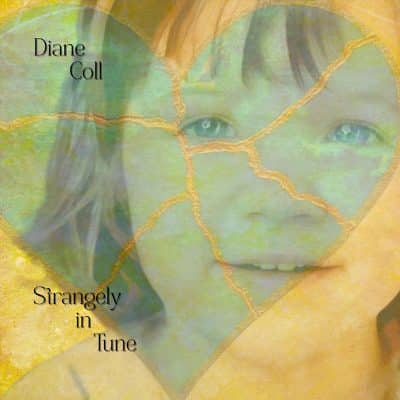
Strangely in Tune celebrates the indelible moments that occur between life and death as Coll paints thoughts about human resilience through her unique lens as a mental health therapist in her ‘day job.’ The songs emerged from sadness but found their way to embrace polarities – grief and joy, frustration and acceptance, the heavy and the light. Coll drew her inspiration from the Japanese art form, Kintsugi, an example of the alchemy that creates new form and resilience after things fall apart. Simply put, these are songs about ‘the big in-between.’
The exuberantly strummed opener, “Better Fly Me Right,” depicts the unbridled joy and freedom of the soul descending to earth. A steady stomping underpins “In and Out Of Time,” representing a grounding in a world of chaos and uncertainty. It has a dizzying effect, but finds resolution in the last lines, “Soothe this sour mind/In the sweet spot unlined, in between time.” The swirling sonics of “Carolina Wren” are meant to emulate the sweetness of nature, capped off by the bird song at the end. Coll was in the mountains in a sad state of mind when the Carolina wren’s singing shook her out of her reverie. So, it’s a reminder that nature can rescue us from the depths of despair.
Just three tracks in, one cannot help but notice the major shift in sound compared to Coll’s last two albums. Aside from Daly (guitars, bass, banjo, jaw harp, percussion) and cellist Erica Holloway, the other musicians are newcomers. They are Robin Vincent (harmonica, bass), John Speaks (drums), and Greg Wright (bass). Coll handles all vocals as well as guitars, keys, and percussion.
The pop-infused, slightly psychedelic “Disappear” has few lyrics. That’s likely intentional to drive home the point that some individuals become visible and invisible within a relationship. Here, the heroine chooses to disappear for good. The lliting “The Dream of You” celebrates the rarely heard positivity of singlehood. “Porcupine” is the epitome of the aforementioned Kintsugi. Even the instrumentation is filled with broken chords glued together by a recurring melodic figure. Coll toasts resilience – “Fear not, my porcupine/We’ll get through one breath at a time.”
Upon first listen, “Double Feature” jolted me with its half-punk, half-Pretenders hard rock. The lyrics express the frustration that occurs when a new start takes longer than expected. Coll uses the analogy of sitting in a movie theater staring at a blank screen, waiting endlessly for the damn movie to start. The ethereal soundscape, offset by the acoustic guitar, as heard in “Tell Jupiter, Hi,” is what we typically associate with Coll, a sharp contrast to the previous track. She sings of grief, pain, and endurance, paide off in the lines – “Here’s to why how long I cried/Couldn’t have it otherwise when grace is the prize.” Yet, Coll turns lighthearted in the infectious “Half Along the Way,” replete with its “wooh, hoo” sing-along chorus.
There’s a spacey, droning quality to “Othering,” a plea for inclusiveness, while the muscular strummed title track celebrates both resilience and the reassurance that it’s okay to be slightly askew and non-conforming. The disorienting, shoegaze-like sonics exude a sadness that is at odds with the song title, “Happiness.” That’s Coll’s way of stating that both emotions can coexist, in essence, the crucible of this album’s theme. That would have been the perfect closer, but instead the piano-driven “Dream Away” captures loss, as a kindred spirit enters a new realm.
Strangely in Tune is a richly woven album, compelling and provocative as you’d expect lyrically, but surprising in its musical twists and turns. Coll stakes new ground. You’ll need multiple listens to fully absorb it.
– Jim Hynes

Subscribe to Our Newsletter
Discover more from Making A Scene!
Subscribe to get the latest posts sent to your email.


