

Mary Gauthier Reckoning




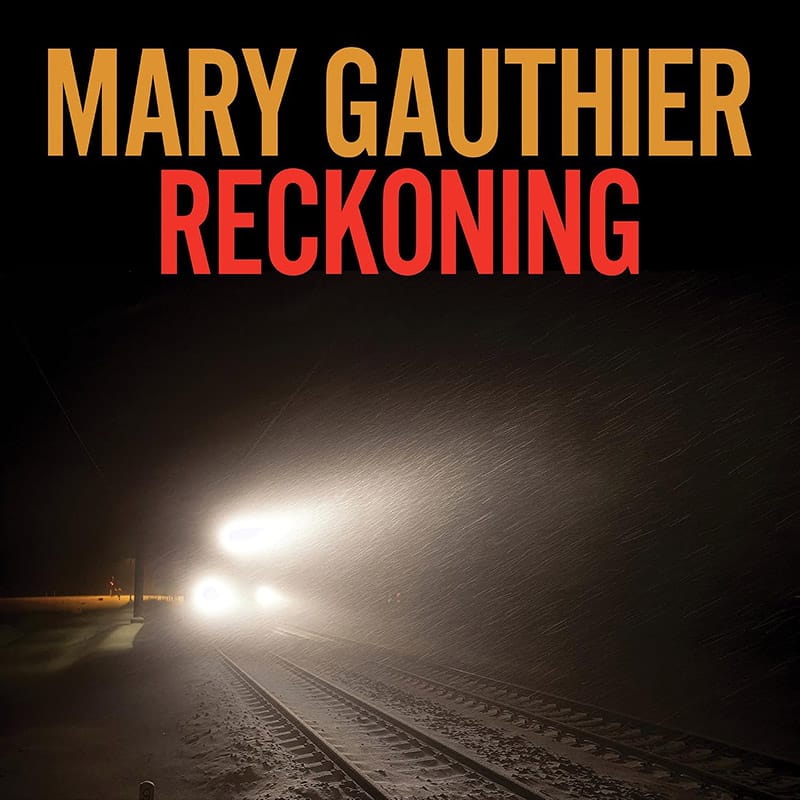
Mary Gauthier
Reckoning
In The Black Records
Mary Gauthier was born in 1962 in New Orleans, to a mother who gave her up for adoption. She was adopted by an Italian Catholic couple from Thibodaux, Louisiana. Her father was an alcoholic. Struggling with a variety of issues, Gauthier had drunk herself unconscious on sloe gin by the time she was twelve. She left home at age fifteen and abused drugs and alcohol.
Gauthier recalls, “I was a gay kid, back then. Gay kids were often beat up and abused, some taking their own lives.” She spent the next several years in drug rehab, in halfway houses, and living with friends, and spent her 18th birthday in a jail cell. These experiences provided fodder for her songwriting later on.
Spurred on by friends, Gauthier enrolled at LSU as a philosophy major, dropping out in her senior year. After attending the Cambridge School of Culinary Arts and working in an upmarket restaurant, she opened her own Cajun restaurant, Dixie Kitchen, in Boston’s Back Bay neighborhood. On opening night, July 12, 1990, she was arrested for drunk driving. She has been sober ever since; she was twenty-seven years old. Gauthier continued to manage and cook at the restaurant but was increasingly driven to dedicate herself to songwriting.
Having recorded her debut album, Dixie Kitchen, Gauthier sold her share in the restaurant to finance her second album, 1998’s Drag Queens in Limousines. Winning accolades, it led to appearances at eleven major folk festivals, including Newport. In 2001, she secured a publishing deal with Harlan Howard Songs, followed by her third album, Filth and Fire.
Two years later, Gauthier landed a record deal with Lost Highway, a division of Universal Music, and released two albums there. Mercy Now and 2007’s Between Daylight and Dark won widespread acclaim, making the Top Ten Albums list in many publications. 2010’s The Foundling was released on Razor & Tie Records. 2013’s Live at Blue Rock, her first live album, on In the Black Records, was recorded at a ranch outside of Austin. Her eighth studio album, 2014’s Trouble and Love, demonstrated her now familiar “brutal honesty balanced by rough-hewn tenderness.” In 2015, she appeared on Eight 30 Records’ Cold and Bitter Tears: The Songs of Ted Hawkins, contributing her take on Hawkins’ signature song “Sorry You’re Sick.”
Gauthier’s next record, 2018’s Rifles & Rosary Beads, was co-written with U.S. veterans and their families, out of her involvement with the Songwriting With Soldiers program. The album secured Gauthier her first Grammy Award nomination.
Overall, Gauthier’s recordings have won numerous awards. Her songs have been recorded by artists including Jimmy Buffett, Tim McGraw, Boy George, Candi Staton, Amy Helm, Kathy Mattea, Mike Farris, and Bettye LaVette. Gauthier also wrote a book in 2021, Saved by a Song. She is a regular on the Grand Ole Opry and currently resides in Nashville. Gauthier sings all lead vocals, plays guitar and harmonica, and contributes backing vocals. Most of the album was produced, mixed, and mastered (magic dust) at Skinny Elephant Recording Studio in Nashville.
The album opens with “Alcohol and Adderall,” a co-write by Gauthier, Ben Roberts, and Jaimee Harris, as Gauthier sings, “I used to love a girl who danced for money, she’s come up to my room when she was high, count her cash at the kitchen table, and I’d try to bridge the distance in her eyes, she’d stare out the window at the highway, as the early morning truckers chased the dawn, she’d let her cigarette burn in the ashtray, sink into herself and she’d be gone. Alcohol and Adderall the pride that comes before the fall, emptiness and all the damage done. Matches and gasoline, tripwire, broken things, wars that can’t be won, let me tell you something hon, like a bullet from a gun, some things can’t be outrun.”
On “Heaven,” co-written by Gauthier and Lori McKenna, Gauthier chimes, “A candle burns next to the bed, White curtains pulled back with lace, his slippers slowly shuffle up the stairs, dry toast, a cup of tea, China plates from Italy. Every step in her direction is a prayer, and he’ll be alright, cause he believes, he believes in heaven. He’ll be alright, cause he believes, he believes in heaven.”
“Judgement Day” was written by Gauthier and Susan Gibson, with Cole Hubbard on harmonica, as Gauthier chants, “The bishop from the pulpit spoke, words of fire that rose like smoke. Brothers, love has no walls or borders, with our bodies, we must take a stand, for the law of God, not of man. Now it’s time to get our affairs in order…I’ll trust in what Jesus will say on Judgement Day.”
On the title track, “The Reckoning,” co-written with Aaron Lee Tasjan, Gauthier moans, “There’s a fault beneath the surface, a seam about to split, there’s smoke on the horizon, a fire has been lit, there’s trembling in the distance, trains a rolling down the track, ain’t no ticket you can buy now, ain’t no way to turn it back, A reckoning is beckoning and the old world is fading into black,” with Gauthier on both guitar and harmonica.
“Soldier of Fortune,” a co-write from Gauthier and Eliza Gilkyson, features Gauthier as she groans, “You were the Roman soldier, you hid behind the helmet and the sword, you were only following orders when you nailed his hands to the board, you mocked him. ‘Hail, King of the Jews!’. You gambled for his clothes, you heard his mother crying out and said. ‘Hey, that’s just how it goes’…You drove the trucks full of innocents, the Gestapo overseeing the trains. That carried them off to concentration camps, and they were never heard from again. You terrorized in the dead of night, you wore the white sheet and the hood, quoting the bible, burning the crosses, and you’d string ’em up again, if you could. Soldier of fortune, your nothing new, we know about you, you do it in every age. You’re a soldier of fortune, you do it for the money and laughs.”
On the topical “Some Times,” co-written by Gauthier and Vince Gill, Gauthier wails, “I worked the Orange Blossom Special, from ’48 till ’54. Manhattan to Miami, I worked in the dining car, till Eisenhower built the intersates, and jet liners sailed the skies, and luxury trains were shuttered and the railroads up and died. Some times, some times, I have seen some times. They shot JFK and Bobby, and Martin Luther King, these days guns are everywhere, Lord, they’re shooting everything. I saw my first black president, made me so proud I cried. I saw the insurrection, I can’t say I was surprised. Some times, some times, I have seen some times,” with some fine viola from Michele Gazich.
“Black Ice,” written by Gauthier and Beth Nielsen Chapman, features Gauthier on harmonica, as she howls, “Freezing Rain, falling light, asphalt gleams like glass tonight. Two lane road, headlights shake, tires go loose, tap the brake, spinning out, ’round and ’round, hard to tell up from down. No warning sign, no flashing light, black ice, black ice.”
On “Gone,” a second song from Gauthier and Chapman, Gauthier declares, “You always come to meet me in the morning, you change with the angle of the light, you slip into my dreams without warning, in the middle of the night. Without permission, without guidance, you sanctify the darkness before dawn. You rise like a prayer out of the silence, it’s a year now, since you’ve been gone.”
The closer, “I Thought I Heard a Train,” was produced by Mark Hallman and written by Tom Mason and Billy Alcorn — the only song not co-written by Gauthier. She blows harp as she croons, “A candle casts a lonesome shadow by the bed, like the curtains in the window, I’m just hanging by a thread. Outside the wind is moaning a sad and soft refrain, and off somewhere in the distance I thought I heard a train…and off somewhere in the night, I thought I heard a train…to an unknown destination, I thought I heard a train.”
A reckoning can be personal, political, or spiritual, and these songs inhabit all three realms at once. When the truth finally arrives, it carries consequences. These songs live in the aftermath of that moment. With The Reckoning, Gauthier adds another defining chapter to her celebrated career. Intimate, courageous, and deeply resonant, the album finds one of our finest songwriters meeting a turbulent moment with clarity, compassion, and unwavering faith in the power of storytelling.
Richard Ludmerer

Subscribe to Our Newsletter
Discover more from Making A Scene!
Subscribe to get the latest posts sent to your email.


