
You Built Your Own Artist Website. Does Facebook Think It Can Use What’s On It?




Making a Scene Presents – You Built Your Own Artist Website. Does Facebook Think It Can Use What’s On It?
Listen to the Podcast Discussion
Meta’s proposed business terms have sparked a fight over website scraping, artificial intelligence, and copyright. For independent musicians, the bigger question is whether using social media to promote your music should give a technology company new permissions over the creative work you own.
You Own the Music. You Built the Website. Now Read the Fine Print.
Imagine spending years building your career as an independent musician. You have written the songs, paid for the recording sessions, hired the photographer, designed the album covers, built your website, and spent countless nights convincing strangers in noisy bars that your music deserves their attention. You have done everything the modern music business tells independent artists they should do. You have built a business around something you actually own.
Then one morning, you discover that the company you use to promote your next gig may be asking for permission to collect and use material from that website.
Not just the photographs you posted on Facebook. Not just the video you uploaded to Instagram. We are talking about content on your own website, the place you built specifically because you wanted to stop depending on somebody else’s platform.
Welcome to another exciting chapter in the relationship between independent musicians and Silicon Valley, where the terms of service are longer than your last recording contract and considerably less entertaining.
This time, the company at the center of the controversy is Meta, the parent of Facebook, Instagram, Messenger, Threads, and WhatsApp. In October 2026, Meta proposed changes to the commercial terms governing businesses that use its services. Those changes raised a disturbing question about whether a social media company could obtain broad permission to collect material from websites associated with its business customers and use that material to develop its own products, potentially including artificial intelligence.
Before anybody starts deleting their Facebook account, throwing their phone into a lake, or putting aluminum foil around the studio computer, there is an important distinction to make. These proposed terms have not been established as giving Meta unlimited rights to artists’ recordings, photographs, lyrics, or websites. Meta disputes that interpretation, and the company has paused implementation while it consults with industry groups.
But the concern is serious enough that copyright organizations, publishers, lawyers, and government regulators are now asking questions. And those questions reach directly into the future of independent music.
For years, Making a Scene has argued that musicians must own their masters, publishing rights, fan relationships, and digital businesses. Social media can introduce people to your music, but your website should be where those relationships become something lasting and financially valuable. Meta’s proposed terms show why that distinction matters more than ever.
The October Surprise Hidden in Meta’s Business Terms
The controversy began when Meta announced changes to the terms governing commercial use of its platforms. Those rules affect businesses that use services such as Facebook Pages, Instagram business accounts, advertising tools, and other commercial features to reach customers.
For a working musician, that description probably sounds familiar. If you promote shows through a Facebook Page, advertise a new album, or manage marketing through Meta Business Suite, you may be using Meta’s products for commercial purposes. You do not need to own a record label or operate a large merchandise company to fall into that category.
The proposed changes initially were expected to take effect on October 30, 2026. Meta subsequently moved the date to November 20 following criticism from publishers and other businesses. On October 28, Meta indicated that consultation with industry groups could continue beyond that date and that implementation would be delayed accordingly.
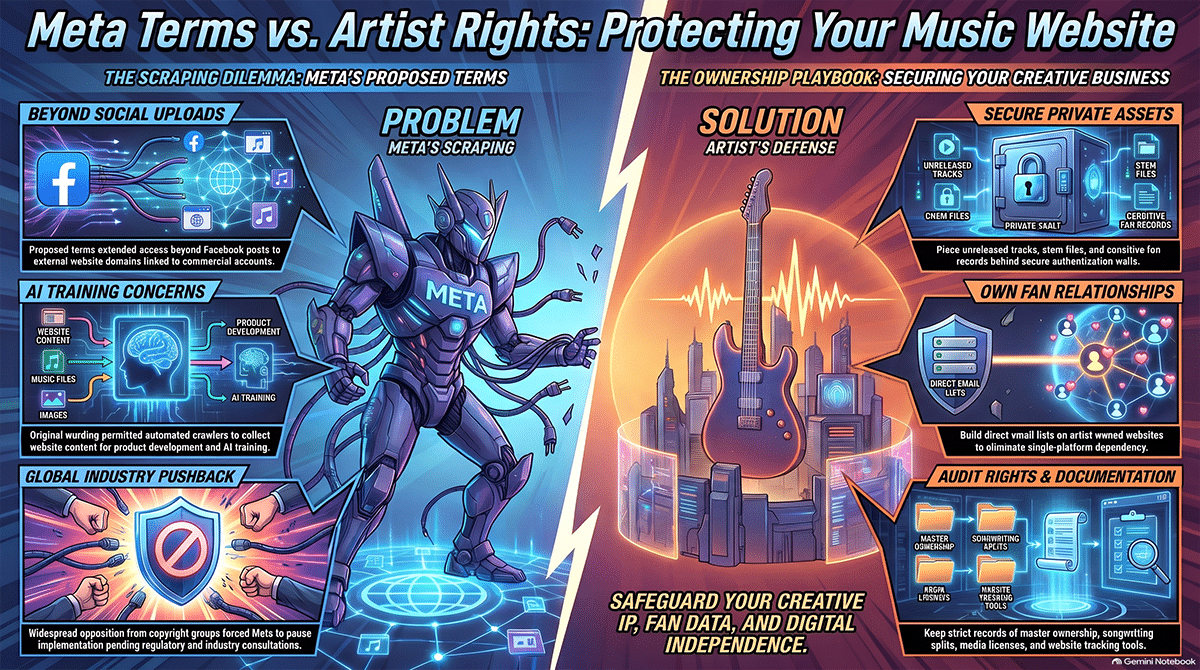
The controversy centered on wording that would authorize Meta, or parties working on its behalf, to use automated software to access and collect information from websites associated with business accounts. The language referred to web scrapers, bots, crawlers, and other software capable of visiting websites and collecting their contents.
The original proposal went further by explicitly including training among the purposes for which collected material could be used. That language immediately attracted attention because training is one of the processes used to develop artificial intelligence systems.
On October 27, the Copyright Alliance, an organization representing creators and copyright-related businesses, issued a strong objection. Its chief executive, Keith Kupferschmid, warned that the proposed changes could expose copyrighted material on business websites to broader collection and use by Meta.
The organization was particularly concerned about the absence of a practical way for commercial account holders to refuse the proposed permissions while continuing to use Meta’s business services. In the Copyright Alliance’s interpretation, businesses could face a choice between accepting the conditions and abandoning important marketing channels.
For a major publisher with an expensive legal department, that is a serious business problem. For an independent musician whose Facebook Page helps sell enough tickets to pay the drummer, it creates a rather unpleasant dilemma.
What the Proposed Language Actually Says
The first thing to understand is that Meta was proposing permission to use automated technology to visit websites connected to commercial accounts. That is different from simply having permission to display something an artist uploaded to Facebook.
A web crawler is a computer program that visits web pages and gathers information. Search engines use crawlers to discover websites. Businesses use them to check prices, update product listings, and collect other publicly available information. Artificial intelligence developers may also use collected material to support training, search, retrieval, and other functions.
There is nothing automatically improper about using a web crawler. The legal questions depend on what is collected, how access is obtained, what agreements apply, and what happens to the material afterward.
The controversial Meta language covered domains, webpages, and internet addresses associated with a business’s products or services. It also included permission to create test credentials to access material. The initial version allowed collected content to be used for a broad range of purposes connected to developing and improving Meta products.
Nieman Journalism Lab examined the language with legal experts and reported that it could be interpreted as permitting the collection of website material for AI training. The lawyers also acknowledged that whether such contractual language would ultimately be enforceable was a separate question.
Consider what this could mean for a musician. Your Facebook Page might contain a link to your official artist website, where visitors can read lyrics, purchase recordings, view professional photographs, and watch videos. Under a broad interpretation of the proposed terms, that connection could become part of the argument for allowing automated collection of content beyond Facebook itself.
That does not establish that Meta has collected an artist’s entire website or obtained valid permission to exploit everything on it. It establishes why the proposed wording was controversial. The difference matters, because a legitimate copyright investigation must distinguish between what a contract appears to permit and what a company has actually done.
The mention of test credentials also deserves attention. Such credentials can be used for legitimate testing and verification, but their inclusion prompted questions about the limits of automated access. The proposal did not establish that Meta could lawfully bypass paywalls, private membership restrictions, or other access controls, and those questions should not be treated as settled.
Still, musicians should recognize the importance of a company asking for this kind of permission in the first place. If the purpose is merely to understand which T-shirts a band sells, why should the agreement need language broad enough to raise concerns about collecting and developing products from copyrighted material?
That is a fair question, and artists deserve an understandable answer.
Meta Says the Critics Have Misunderstood Its Intentions
It would be irresponsible to examine this controversy without giving Meta’s explanation the same serious attention.
Meta has maintained that the changes were intended to support advertising and business-related services, including obtaining accurate information from external websites about products and services being promoted on its platforms. The company has disputed the suggestion that the revised terms provide unrestricted permission to use copyrighted website material to train its artificial intelligence systems.
That explanation has a practical basis. Imagine an artist advertising a new vinyl record through Instagram. The record’s price, availability, and shipping details may change on the artist’s website. Meta has a legitimate commercial interest in keeping advertising and product recommendations accurate when those recommendations direct customers to external websites.
Meta also revised its proposed language after complaints. The revised version removed the explicit reference to training and described the relevant uses in terms of advertising and business products. That is a meaningful change to the wording, although critics argue that developing or improving business products could still encompass AI-related activity.
Meta has said that website owners can use the robots.txt system to communicate their preferences about automated crawling. The company also stated that the update was not intended to change its existing crawling practices.
On October 28, Meta communications executive Andy Stone said the company would consult with industry groups before implementing changes. According to reporting by Nieman Journalism Lab, Meta indicated that its existing terms would remain in force during that process.
That is important. As of November 2, the controversial changes have been paused rather than established as an active grant of the sweeping permissions feared by critics.
But there is an uncomfortable business lesson hiding inside that reassurance. If one of the largest technology companies in the world can propose language that creates substantial uncertainty about the rights of its customers, the customers should not have to depend solely on a public statement explaining what the company meant.
The written agreement should make the limits clear.

Posting a Picture Is Not the Same as Licensing Your Entire Business
To understand why musicians should pay attention, we need to talk about one of the least glamorous but most important subjects in the music industry: licensing.
A license is permission to use something under particular conditions. Those conditions might specify where the material can be used, for what purpose, for how long, and whether the person receiving permission can pass it along to somebody else.
When you upload a concert photograph to Instagram, the platform needs certain permissions to store, process, display, and distribute that photograph through its service. Otherwise, it could not show the picture to your followers or deliver it across different devices.
That is an understandable part of operating a social media platform. A website cannot display copyrighted material on behalf of its users without some legal basis for doing so.
But permission to display a photograph in a social media post is not automatically the same as permission to collect every photograph on the artist’s separate website and use them to develop a new commercial product.
The same distinction applies to music. Giving a platform permission to stream a promotional video does not automatically settle whether it may use the underlying recording, composition, lyrics, or isolated vocals for unrelated purposes. Those rights can involve different owners and separate agreements.
This is where contract language becomes incredibly important. A license can be limited to a particular service, or it can be written broadly enough to support uses that the creator never seriously considered.
It is also important to distinguish licensing from ownership. Under American copyright law, an artist can grant a nonexclusive license without transferring ownership of the copyright. A musician can therefore remain the copyright owner while another company gains permission for certain uses.
The U.S. Copyright Office explains that copyright owners generally control several important uses of their protected works, subject to legal exceptions and limitations. Those rights can be licensed separately, which is why the exact scope of an agreement matters.
A broad license may leave your name on the ownership paperwork while still reducing your ability to control certain commercial uses. That is one reason copyright ownership alone is not enough to protect an independent music business. Artists must understand what permissions they are granting after they acquire those rights.
Your Artist Website Contains More Than a Few Pictures
An independent artist’s website is much more than a digital business card. It can hold years of creative work, professional investment, and business history.
A typical musician’s website might contain studio recordings, concert videos, promotional photographs, cover artwork, biographies, song lyrics, downloadable press materials, interviews, merchandise catalogs, and information about upcoming performances. Some artists also offer exclusive recordings, instructional material, fan memberships, or private experiences.
Each of these materials can represent a different kind of intellectual property.
A photograph may belong to the photographer unless the artist has obtained the necessary rights. A song involves rights in the musical composition, while a particular studio recording involves a separate sound-recording copyright. A concert video may contain additional rights involving the filmmakers, performers, music, and other contributions.
Even an artist who owns the website may not own every element appearing on it.
This creates another problem with broadly worded platform permissions. A business account holder may not have the legal authority to grant extensive rights over every work displayed on the associated website.
Suppose a blues guitarist hires a professional photographer for an album shoot. The agreement allows the guitarist to use the images on an official website, in advertisements, and on merchandise. It does not necessarily permit the guitarist to authorize an unrelated company to reuse those images in developing commercial AI products.
If a platform agreement appears to seek broader rights than the musician can grant, the result is a contractual problem waiting to happen. Whether any particular provision creates liability would depend on the agreements and applicable law, but the potential conflict is real enough to deserve attention.
The same is true of cover songs, licensed artwork, guest performances, and recordings involving other rights holders. An independent artist can be both a copyright owner and a licensee, depending on the material involved.
This is why keeping accurate records of ownership, permissions, licenses, contributors, and restrictions is not just an administrative chore. Those records help determine what an artist can legally authorize and what rights must remain with somebody else.
AI Training Is Not the Same Thing as AI Finding Information
One reason this controversy became so confusing is that the phrase artificial intelligence covers several different technologies.
AI training is the process of using data to develop or improve a model. A system may examine enormous quantities of text, photographs, recordings, or other information to learn statistical patterns. That process can involve making copies of copyrighted works, which creates important legal questions.
Another technique, often called retrieval or grounding, works differently. An AI system may search for information or retrieve stored material to help answer a question. Instead of relying only on patterns learned during training, it can consult external information when generating a response.
Imagine a fan asking an AI assistant when a particular independent blues band is performing in Atlanta. The system might retrieve the concert date from the band’s official website and provide a useful answer. If it clearly directs the fan back to the band’s ticket page, that could help the artist sell tickets.
Now imagine a different arrangement in which a platform collects an artist’s original instructional videos, photographs, biographies, and lyrics, then develops a commercial service that uses that material while providing little recognition, traffic, or compensation to the creator.
Those are very different business outcomes.
Using AI to help fans discover accurate concert information is not the same commercial activity as using copyrighted creative material to develop new products. Neither situation can be judged solely by the fact that software collected information from a website.
Meta’s original proposed wording expressly raised AI-training concerns. Although the company removed that reference, the Copyright Alliance remained concerned that the revised language might still allow broader AI uses, including grounding.
The legal status of AI training itself is also unsettled in important respects. In its 2025 report on generative AI training, the U.S. Copyright Office examined questions involving copyright, licensing, and fair use. The analysis did not establish a universal rule that all AI training requires permission or that all AI training qualifies as fair use.
That uncertainty is exactly why contractual permissions matter. If a technology company can obtain a valid license for a particular use, that license may change the legal arguments surrounding the activity. Whether a proposed agreement actually grants such a license, and whether it is enforceable, remain separate questions.
For independent musicians, this also affects future opportunities. Authorized AI uses of recordings, compositions, lyrics, and other creative assets may develop into additional licensing markets. But those opportunities only benefit artists when they have meaningful control over what is licensed, what it is used for, and what compensation is negotiated.
Giving away uncertain rights today could affect what an artist can negotiate tomorrow.
The Social Media Bargain Is Changing
The original promise of social media was fairly simple. Artists could reach people without buying expensive advertising from newspapers, radio stations, or television networks. Musicians could post videos, announce shows, share new songs, and develop relationships with fans who might never have discovered them otherwise.
It was a remarkable opportunity, especially for independent artists. A musician with a decent song, a smartphone, and some personality could suddenly reach audiences far beyond the local bar circuit.
But there was a catch. The platform controlled the distribution.
Over time, artists learned that gathering followers was not the same as building an audience they could independently contact. A musician could spend years developing a following, only to discover that reaching those same people through the platform was increasingly difficult or required paid promotion.
The exact mechanics vary between platforms and over time, but the basic business problem remains. The musician creates the value, while the platform controls much of the access to that value.
That arrangement encouraged artists to promote their own websites, build email lists, offer direct sales, and develop relationships that would survive changes in social media algorithms.
Now Meta’s proposed terms have raised a new concern. Could the commercial relationship with a social platform affect permissions involving material on the artist’s independent website?
The answer is not legally settled by this controversy. But the fact that artists and publishers must ask the question shows how far the relationship between creators and platforms has evolved.
Social media began as a place where musicians shared content to reach potential fans. Today, those platforms operate advertising systems, recommendation engines, online marketplaces, data services, and artificial intelligence products.
The tools have become more sophisticated. The agreements governing them have become more complicated. And the artist is still being asked to click the button that says everything is fine.
The Website Was Supposed to Be the Safe Place
Making a Scene has spent years encouraging musicians to build artist-owned websites for a simple reason. When you control the destination, you have a better chance of controlling the customer relationship.
A fan who discovers you on Instagram might watch a video and move on. A fan who visits your website can purchase a recording, join your mailing list, buy merchandise, explore your catalog, or sign up for a fan membership.
That relationship creates business value beyond a single social media interaction.
Your website can also carry information that helps you develop your career. When fans voluntarily provide their email addresses and give permission to receive updates, you can notify them about future shows and releases without depending entirely on a third party’s recommendation system.
A fan who buys your album today might purchase a concert ticket next month, a T-shirt next summer, and an anniversary vinyl edition three years later. Those purchases are not guaranteed, but maintaining the relationship gives the artist opportunities that a fleeting social media view cannot provide.
The artist’s website is where that relationship can grow.
However, we need to be honest about what website ownership actually means. Having your own domain does not make everything published there invisible to technology companies. Public webpages are generally accessible to visitors and may be collected or indexed by automated systems.
The important distinction is that public availability does not automatically establish unlimited permission for every possible commercial use.
That is why artists need both a business strategy and a rights strategy. Owning a domain is valuable, but an artist also needs clear content permissions, sensible access controls, accurate ownership records, and an understanding of the outside services connected to the website.
Independence is not simply having your logo at the top of the page. It is having practical control over how your creative business operates.
The Trouble With Robots.txt
One of the more technical disagreements in this controversy involves a small website file called robots.txt.
The name sounds like something a science-fiction writer invented after drinking too much coffee, but the idea is straightforward. A robots.txt file communicates instructions to automated crawlers about which parts of a website they should or should not visit.
A website owner might use it to discourage certain automated systems from collecting particular pages. Search engines and other responsible crawlers often use these instructions when deciding what to access.
Meta has pointed to this system as a way for website owners to signal their preferences about crawling.
Unfortunately, there is a difference between asking an automated system not to collect something and physically preventing it from doing so.
The Mozilla Developer Network’s explanation of robots.txt makes clear that these instructions are not a security mechanism. They communicate preferences, but they do not necessarily stop software that ignores them.
The Copyright Alliance also raised a contractual concern. If a business agreement appears to authorize crawling, critics worry that Meta could argue the contractual permission takes precedence over a website owner’s robots.txt instructions.
That interpretation has not been established as a legal outcome. But it exposes a weakness in treating robots.txt as a complete answer to questions about content ownership and AI use.
For artists, the practical lesson is simple. A website’s crawling preferences may help communicate limits to automated visitors, but genuinely private content needs real access restrictions.
Unreleased songs, confidential contracts, private financial records, and exclusive fan materials should not be placed on openly accessible webpages merely because those pages are missing from a menu. They should be protected through proper accounts, permissions, authentication, and secure storage.
The same principle applies to a membership website. A paying fan should receive access to the content included in the membership, while a public visitor or automated crawler should not automatically receive that access.
Those technical controls do not answer every legal question, but they are an important part of operating a responsible digital music business.
The Fan Data Question Is Even Bigger
Creative assets are only one part of an independent musician’s business. The other is the relationship with the audience.
Consider an artist who uses Facebook advertising to promote a concert. The advertisement sends interested people to the musician’s own website, where they can buy tickets or sign up for show announcements.
That can be an excellent marketing strategy. The artist is using social media to introduce potential fans to a business the artist controls.
But musicians should understand the different kinds of data involved in that process.
A public webpage containing the date of a concert is not the same thing as a private customer record containing a fan’s name, email address, purchase history, or membership information. The fact that both pieces of information exist within the same website does not mean they should have the same access rules.
The Meta controversy primarily concerns the proposed collection and use of website content associated with commercial accounts. It should not be confused with a proven claim that the proposed terms would automatically give Meta access to every private customer database or fan record.
However, the debate is a useful reminder that artists must understand what information they share through advertising tools, website integrations, and other third-party services.
A musician might own the website and collect email addresses directly, but still use outside technology to measure advertising results or customer activity. Those connections may involve their own contractual and privacy obligations, separate from the disputed commercial terms.
Fan information is also personal information belonging to real people. An artist’s ability to maintain a direct relationship with a fan does not create unlimited permission to sell, expose, or exploit that fan’s data.
The Federal Trade Commission advises businesses to limit unnecessary personal-data collection and protect the information they retain.
That principle fits perfectly with the Making a Scene philosophy. Artists should have reliable access to the relationships they earn, while fans should understand what they are signing up for and how their information will be used.
A fan mailing list built through clear consent is a valuable business asset. It is not an excuse to treat somebody’s privacy like the free buffet at a record-company party.
What Happens to the Money?
Whenever a new technology raises questions about copyright and permissions, musicians should eventually ask the most practical question in the room.
How does this affect the money?
Suppose an independent musician has spent several thousand dollars recording an album. The artist owns the master recordings and controls the songwriting rights. Those assets can potentially generate income through direct sales, streaming, physical releases, licensing, performances, and other legitimate uses.
The artist might also license a recording for a film, television program, advertisement, or game. Those transactions can create revenue because a customer needs permission to use something valuable.
Artificial intelligence could eventually create additional markets for authorized uses of music and related creative material. A company might seek a negotiated license for recordings, lyrics, musical compositions, or other content. The artist would then have an opportunity to evaluate the proposed use and negotiate compensation.
That opportunity depends on the rights involved and the demand for the material. There is no guarantee that every recording will have an AI licensing market, or that every use will require payment under the law.
Still, an artist who controls the necessary rights is in a better position to pursue a legitimate licensing opportunity than one who has granted broad permissions without understanding their value.
Now imagine the artist has already accepted contractual terms that another business argues allow it to collect and use certain materials without negotiating a separate payment. Even if ownership remains unchanged, the earlier agreement could complicate the artist’s ability to control those uses.
The result would depend on the contract and the law. But the financial concern is understandable.
Independent musicians have already experienced this problem in other forms. Artists have signed away publishing, granted excessive recording rights, or accepted deals that appeared harmless until their work became more valuable.
Technology does not eliminate the need to understand contracts. It simply creates new ways for those contracts to affect future income.
AI rights should therefore be considered alongside traditional music rights. An artist needs to understand what has been authorized, which uses remain available for negotiation, and whether future uses require separate consent.
The business model should be built around informed agreements, not accidental permission.
Copyright Protection Is Not Automatic Business Protection
American copyright law gives creators important rights, but those rights do not automatically resolve every dispute involving technology and licensing.
Copyright generally protects original creative expression once it is fixed in a qualifying form. A musician does not have to upload a song to a social platform to receive copyright protection, and placing a recording on a publicly accessible website does not automatically place it in the public domain.
However, copyright protection is not the same as proof that every use of a work is unlawful.
Some uses may be authorized by a contract. Other uses may fall within statutory exceptions or limitations, including fair use. Questions about contract interpretation, ownership, access, and infringement often depend on specific facts.
This is especially important with artificial intelligence. Different AI systems use different technologies, and the copyright questions surrounding their development are still being tested through litigation and policy discussions.
It is also important to remember that music contains multiple layers of rights. Owning a sound recording does not necessarily mean owning the underlying composition, and publishing rights may be divided among several songwriters or publishers.
That makes organized documentation essential.
An artist who cannot identify the owner of a master recording, verify songwriting splits, or locate a signed photography agreement may struggle to negotiate licensing opportunities or respond to a disputed use.
The solution is not to panic every time a technology company changes its terms. The solution is to build a business in which ownership, permissions, contracts, and creative assets are documented clearly enough that the artist knows what can be licensed.
That is what real control looks like.
Europe Is Asking Whether the Bargain Is Fair
The controversy has already moved beyond statements from copyright organizations.
On October 30, 2026, the United Kingdom’s Competition and Markets Authority announced an investigation into whether Meta’s commercial terms could impose unfair conditions on publishers, advertisers, and other businesses.
The investigation focuses on the possibility that businesses relying on Meta’s platforms could be required to accept broad permissions involving their websites without meaningful control over how the collected material is used.
This is an important distinction. A copyright dispute may ask whether a particular use of creative work is authorized or infringes someone’s rights. A competition investigation can examine whether a powerful company is using its market position to impose unfair business conditions.
Both questions matter to independent musicians.
If an artist depends on Facebook and Instagram to promote shows and merchandise, walking away from those services may carry a real financial cost. The musician may not have the advertising budget, staff, or alternative audience channels available to a major corporation.
That dependence can affect how freely the artist can negotiate.
In Norway, media companies also challenged the proposed terms, and a court issued a temporary injunction while their legality was considered. The court action did not resolve every copyright or contract question, but it demonstrated that the objections had moved into formal legal proceedings.
The UK investigation is likewise not a finding that Meta has broken the law. The regulator has stated that it must examine the evidence before reaching a conclusion.
Still, these developments reveal a larger issue. When a business relies on a dominant digital platform to reach customers, the platform’s contractual terms may become difficult to refuse in practice.
That is not unique to musicians, but independent artists are particularly vulnerable because they often lack bargaining power and cannot afford lengthy legal disputes.
An artist who cannot negotiate the terms individually needs clear protections, fair defaults, and meaningful choices about the use of creative material.
What Working Musicians Should Do Right Now
The first thing artists should do is resist the temptation to treat every alarming headline as a reason to shut down their marketing.
Facebook and Instagram remain useful promotional channels for many musicians. If a platform helps an artist find concertgoers, sell merchandise, or introduce people to new music, abandoning it without considering the financial consequences may create more problems than it solves.
The immediate response should be to understand which business services the artist uses and pay attention to notices about their terms.
An artist who manages a business Page, runs advertisements, or uses Meta’s commercial tools should review relevant agreements and watch for any final changes. The proposed terms are paused, and nobody should assume the controversial language has already taken effect exactly as originally written.
Artists should also examine the material published on their websites. There is nothing wrong with offering public biographies, promotional photographs, music samples, and concert information. Those materials help people discover and support the artist.
However, material intended for private customers, paying members, licensing partners, or internal business use should have suitable access restrictions. Valuable unreleased recordings, private stems, confidential agreements, and customer records should not be left openly accessible when they do not need to be.
The next step is to review ownership and licensing records. If an artist uses photographs supplied by a professional photographer, the agreement should explain what uses are permitted. The same applies to artwork, videos, guest performances, and other material involving outside contributors.
Artists should also understand the advertising and analytics services connected to their websites. Data shared through those connections may be governed by agreements separate from the proposed Meta commercial terms.
For those who maintain their own websites, it is reasonable to ask a knowledgeable developer about crawler policies and access controls. But artists should remember that technical restrictions cannot replace legal rights, and robots.txt alone cannot secure private information.
Most importantly, musicians should continue building direct relationships with fans. Every social media post can provide a reason to visit the artist’s own website, subscribe to updates, purchase something directly, or become part of a fan community.
That strategy does not guarantee protection from every technology-policy change. It does reduce the business damage that can occur when one outside platform changes its rules.
Why This Matters to the MAS Artist Ecosystem
The Meta controversy illustrates exactly why the MAS Cloud Artist Ecosystem has been developed around artist ownership, portable information, and direct fan relationships.
The objective is not to eliminate Facebook, Instagram, or other promotional platforms. Those services can be valuable tools for discovery. The objective is to make sure discovery leads toward a business relationship the musician can maintain independently.
The distinction becomes particularly important when creative assets and personal information are involved.
An artist needs a reliable Source of Truth for recordings, compositions, ownership details, contributors, songwriting splits, artwork, licensing information, and related records. Those documents help establish what the artist owns, what the artist has permission to use, and which rights may require additional approval.
The system should also distinguish between public material intended to attract fans and protected material intended for specific uses.
A promotional photograph may be appropriate for public distribution. An unreleased recording might be available only to selected collaborators. A premium membership video may be accessible only to paying fans. A private contract or royalty statement should remain confidential.
Those differences should be part of how the artist’s business operates, not something the musician has to remember every time a new technology agreement arrives.
The Fan Passport concept adds another important dimension. Artists should be able to maintain records of their direct fan relationships, including appropriately consented contact information, purchases, rewards, memberships, and attendance activity.
Those records can support legitimate business opportunities, such as announcing a new concert to people who attended a previous show or offering an exclusive release to fans who have chosen to join a membership program.
At the same time, sensitive fan information should remain protected and should not become part of a publicly crawlable website simply because it lives within the same digital business.
This controversy also points toward an important future capability for an artist operating system: a clearer way to understand and record permissions for artificial intelligence and other third-party uses.
Such a system could help musicians distinguish between allowing public promotion, authorizing a specific commercial license, and granting permission for AI-related purposes. It could preserve documentation showing what the artist agreed to, which materials were involved, and whether compensation or other restrictions applied.
These are design priorities and potential extensions of the ecosystem, not claims that every feature is already available or that software can guarantee a particular legal outcome.
The central idea is much simpler. Independent musicians should not need to become lawyers, database administrators, and cybersecurity specialists just to understand which parts of their creative business are public and which parts they still control.
Technology should make that distinction easier.
AI Should Help Build the Music Industry Middle Class
There is a danger that controversies like this will push musicians into believing artificial intelligence is automatically the enemy.
That would be a mistake.
AI can help independent artists research markets, develop promotional campaigns, organize business information, produce marketing materials, analyze properly collected customer data, and make complicated work more manageable.
It can also create opportunities for music production, sound design, licensing, education, and other services that working musicians may be able to sell.
A small independent artist operation often has to accomplish the work of several employees with limited money and time. Useful technology can reduce that burden and leave more hours for writing songs, recording, rehearsing, and performing.
But there is an enormous difference between using technology to improve an artist’s business and allowing a technology company to obtain sweeping permissions over the artist’s creative assets.
The first can make independent music businesses stronger. The second may weaken their ability to control and license what they produce.
That distinction should guide the development of future AI services.
Artists should be able to understand when their work is being used, what rights are being requested, and whether a particular use involves compensation. The details will depend on the technology and applicable law, but transparency and meaningful consent should be basic business expectations.
There is no contradiction between supporting AI innovation and demanding fair treatment for creators.
In fact, responsible licensing can create business opportunities for both technology companies and musicians. Developers obtain authorized access to useful material, while artists gain a chance to negotiate terms that reflect the value of their contributions.
That is a much healthier foundation for a creative economy than expecting working artists to provide valuable material through agreements they barely understand.
The Real Value of a Fan Relationship
The music industry has a long history of confusing attention with income.
A million views may look impressive, but the number alone does not tell an artist how many records were sold, how many tickets were purchased, or how many people are likely to return for another show.
A smaller audience that actively supports an artist can sometimes create a more sustainable business than a much larger audience that produces very little direct revenue.
That is why ownership of the fan relationship matters.
Consider an independent band developing a regional touring audience. After each show, the band encourages interested listeners to visit its website and sign up for concert announcements. Fans receive useful information and, when offered, access to music or experiences that make joining worthwhile.
Over time, the band may learn which cities have enough interested fans to support another performance. It can make informed choices about where to tour, what merchandise to offer, and when to release new material.
The band can still advertise on social media. But it is no longer depending entirely on one platform to maintain contact with the people who have already shown interest.
That difference can affect transportation expenses, hotel costs, merchandise planning, ticket sales, and the number of shows a regional artist can realistically sustain.
The connection between ownership and income is not philosophical. It appears in the everyday decisions that determine whether a musician finishes a tour with money in the bank or another exciting collection of gas receipts.
The same principle applies to creative assets. A musician who maintains clear ownership and licensing records is in a better position to evaluate opportunities involving recordings, compositions, merchandise designs, and other intellectual property.
These are the practical building blocks of a music industry middle class.
A Platform Should Be a Doorway, Not Your Landlord
There is a reason so many independent musicians find technology agreements frustrating. Artists are constantly being told to become entrepreneurs, build personal brands, develop websites, collect fans, understand copyrights, and diversify revenue.
Then, after doing all that work, they are expected to accept increasingly complicated terms from the companies that control important marketing channels.
The imbalance is difficult to ignore.
A musician may spend years building a catalog, creating promotional material, and cultivating a recognizable identity. The platform provides useful technology and access to an audience, but the creative investment belongs to the musician and everyone who helped produce the work.
That should be the starting point for a fair commercial relationship.
Meta is entitled to explain what information it needs to operate advertising and business services. Artists and publishers are equally entitled to question permissions that appear broader than necessary for those purposes.
The dispute should be resolved through clear contractual boundaries, not a guessing game about whether a phrase buried in a business agreement might authorize uses nobody discussed.
Ideally, a platform agreement would distinguish routine advertising operations from other commercial uses of website content. It would also identify meaningful ways for rights holders to control the collection and use of material when those activities extend beyond the services they originally requested.
Whether Meta ultimately adopts such distinctions remains to be seen.
For now, the pause in implementation gives the company and affected businesses an opportunity to address the concerns before new terms take effect.
Independent musicians should pay attention to what comes out of that process because the result may influence how other platforms approach website content and AI permissions.
The Music Business Has Seen This Movie Before
There is something painfully familiar about the argument surrounding Meta’s proposed commercial terms.
For decades, musicians signed agreements they did not fully understand because they needed access to recording studios, distributors, radio stations, retailers, or promotional channels. Sometimes those contracts worked out. Sometimes the artist discovered, years later, that valuable rights had been granted under conditions that no longer seemed reasonable.
The technology has changed, but the bargaining problem has not disappeared.
Today, a musician can record an album in a home studio, distribute it internationally, sell merchandise directly, and build an audience without the permission of a traditional record label.
That independence represents enormous progress.
But artists now face agreements from digital platforms whose services may be just as important to their businesses as distributors and radio stations once were. The companies are different, the terminology is more technical, and the paperwork usually arrives as a button on a screen.
The underlying question remains whether artists have meaningful control over the value they create.
This is why the movement toward artist ownership cannot stop at obtaining master recordings and publishing rights. Musicians must also pay attention to the licenses they grant, the data they share, the systems they depend on, and the agreements governing their digital businesses.
No amount of technological progress changes the importance of understanding who controls what.
The Final Word: Your Website Is Your Business
Meta’s proposed commercial terms have not been shown to grant the company unlimited rights over every artist website. The company has revised its language, disputed the broadest interpretations, and paused implementation while it consults with affected businesses. Regulators are investigating important questions, but the legal and commercial outcome remains unresolved.
Those facts matter, and independent musicians deserve reporting that respects them.
At the same time, the controversy exposes a real weakness in the modern creator economy. Artists increasingly rely on digital platforms whose contractual rules can change in ways that create uncertainty about copyright, website content, and future commercial uses of creative work.
For working musicians, the lesson is not to abandon technology. It is to use technology with a clearer understanding of what belongs to the artist and what permissions are being granted.
Keep promoting your shows on Facebook. Share your music on Instagram. Use social media to introduce new listeners to what you create. Those tools can contribute to a successful independent music business.
But continue building your own website, your own fan relationships, your own catalog records, and your own direct revenue opportunities. Protect material that should remain private, understand the agreements connected to your business, and pay attention when a platform asks for new rights.
Most importantly, remember that a technology company’s ability to deliver your work to an audience does not make that company the creator of the work.
You wrote the songs. You recorded the music. You developed the audience. You invested the money, time, and creative effort that made the business worth promoting.
A fair digital economy should recognize the difference between helping an artist reach customers and obtaining broad permission to exploit the assets that artist created.
The future of independent music will depend partly on how successfully musicians make that distinction.
And if Silicon Valley genuinely wants to help artists build sustainable businesses, there is a fairly simple place to start: make the agreements understandable, give creators meaningful choices, and let musicians negotiate the value of their work.
After all, the band already has enough trouble getting the bass player to arrive on time. It should not need a team of copyright attorneys just to announce Friday night’s gig.
Making a Scene believes that the future of the music industry belongs to independent artists who control their creative work, understand their rights, own their fan relationships, and build businesses that create sustainable income. Social media should help musicians find their audience. It should never become a substitute for owning the business that audience supports.
 |  Spotify |  Deezer |  Breaker |
 Pocket Cast |  Radio Public |  Stitcher |  TuneIn |
 IHeart Radio |  Mixcloud |  PlayerFM |  Amazon |
 Jiosaavn |  Gaana |  Vurbl |  Audius |
 Reason.Fm | |||
Find our Podcasts on these outlets
Subscribe to Our Newsletter
Discover more from Making A Scene!
Subscribe to get the latest posts sent to your email.


