
Stop Selling Things to Your Fans. Start Building Things With Them.




Making a Scene Presents – Stop Selling Things to Your Fans. Start Building Things With Them.
Listen to the Podcast Discussion
How fan-created merchandise, shared ownership, AI-powered creativity, and a new approach to artist-approved businesses could turn an independent musician’s audience into a community of entrepreneurs.
What If Your Next Great Merchandise Idea Comes From Your Audience?
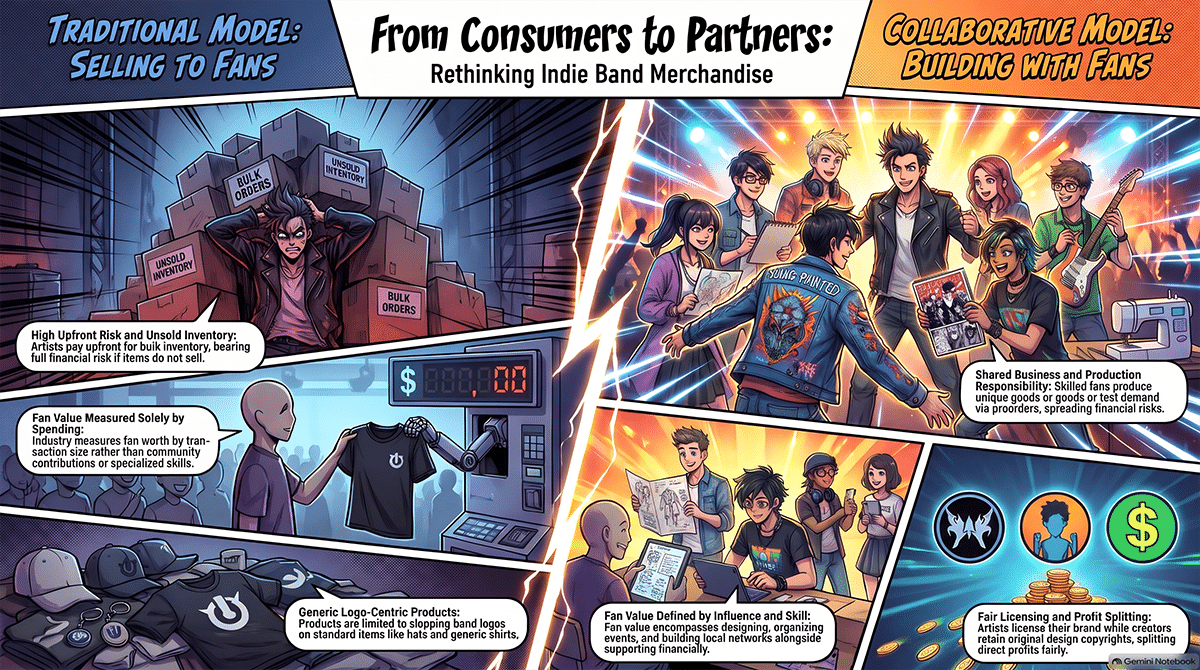
Somewhere in America, an independent musician is sitting in a room filled with cardboard boxes containing 200 T-shirts that seemed like a brilliant idea six months ago. The artwork looked terrific on the computer screen, the printing company offered a discount for ordering in bulk, and everybody in the band agreed the shirts would sell like crazy. Unfortunately, the audience appears to have missed that particular meeting. Now the shirts are taking up space next to the spare microphone stands, the band still owes money on the printing bill, and the drummer has suggested giving them away at Christmas.
Meanwhile, one of that band’s fans has been making beautiful handmade jewelry inspired by the band’s songs. Another fan is a graphic designer who has been creating artwork for the band’s social media community. Somebody else has organized a group of music lovers who attend the band’s shows together and bring new people every time. These fans understand the music, they understand the community, and they have skills that could become the foundation of something much bigger than another box of unsold T-shirts.
Yet nobody has thought to invite them into the business.
This is the strange contradiction at the heart of today’s music industry. Record companies, streaming platforms, and marketing consultants spend enormous amounts of time discussing how much money they can extract from superfans, while some of those same fans are already creating products, organizing events, and building communities without being asked. The industry is studying their spending habits while overlooking their abilities. It is rather like owning a restaurant, discovering that half your regular customers are excellent chefs, and deciding the best business strategy is to charge them more for appetizers.
For independent musicians, that misunderstanding represents a remarkable opportunity. The future of merchandise may not belong exclusively to artists who can afford better manufacturing, bigger warehouses, or more expensive advertising. It may belong to musicians who recognize that their fans can become creative partners, business collaborators, and even independent entrepreneurs operating within a shared musical community.
The important word here is partners. This is not an invitation to convince enthusiastic fans to work for nothing while somebody else collects the profits. It is an opportunity to build relationships where creative contributions are respected, ownership is understood, and the financial benefits are shared fairly.
A Different Way of Looking at the Superfan
On October 21, 2026, Music Business Worldwide published an interview with Jacquelle Amankonah Horton, founder of Fave, a company developing tools for fan-created merchandise, fan-organized events, and commerce connected to entertainment communities. Horton previously worked at Google and YouTube, giving her an unusually informed view of how online audiences participate in the businesses surrounding the people they follow.
Her argument challenges a popular assumption that has become almost sacred in the modern music business. The industry generally describes a superfan as somebody willing to spend more money than an ordinary listener. The bigger the purchase, the more valuable the fan appears to be. That thinking has produced an endless parade of premium merchandise, expensive VIP experiences, collectible editions, and subscription packages designed to encourage another transaction.
Horton sees something important missing from that picture. In her interview, she argues that influence, creation, organization, and action can reveal more about a fan’s lasting value than purchasing behavior alone. Somebody who organizes hundreds of people for an event may contribute more to a musical community than somebody who purchases the most expensive collectible in the store. A fan who designs something that other fans love may create an entirely new product category the artist’s management never considered.
According to the interview, Fave reported that its beta app had attracted just under 200,000 users and that fan creators working with the company had reached more than two million people. Horton also described fan-led events and campaigns that generated significant sales and participation. Those figures are company-reported results, not independent guarantees of what another artist or fan creator can earn, but they illustrate why this conversation deserves attention beyond the usual discussion of fan engagement.
Fave’s website describes a developing marketplace where fans can create products, organize events, request licenses to use official artist material, and establish identities within their communities. As of this article, its public website still advertises forthcoming marketplace capabilities and a waitlist. Independent musicians should therefore distinguish the company’s vision and reported pilot activities from features that are broadly available for everyday use.
What matters most is not whether any single company becomes the dominant platform for fan commerce. It is the change in thinking behind the idea. Instead of assuming the artist creates everything and the fan purchases whatever appears in the store, imagine a music business where the artist and the audience can both contribute creative ideas, resources, and expertise.
That is a much more interesting economic relationship, particularly for musicians who have spent years building dedicated audiences without ever having access to the machinery of a major record company.
Your Fans May Already Be Your Most Valuable Creative Department
Consider an independent blues artist with 2,000 genuinely interested fans. That is not a stadium audience, and nobody is suggesting that all 2,000 people are waiting with credit cards in their hands. Some attend shows regularly, others purchase recordings, and many simply enjoy the music when life gives them enough breathing room. Within that audience, however, there may be graphic designers, photographers, woodworkers, jewelry makers, clothing designers, teachers, photographers, event organizers, software developers, and small-business owners.
The traditional music business looks at those people primarily as potential customers. The artist sends them announcements, offers them merchandise, and hopes enough of them respond to cover the costs of the next recording or tour. A collaborative merchandise business asks a different question. What could those people help create if the musician gave them a legitimate opportunity to participate?
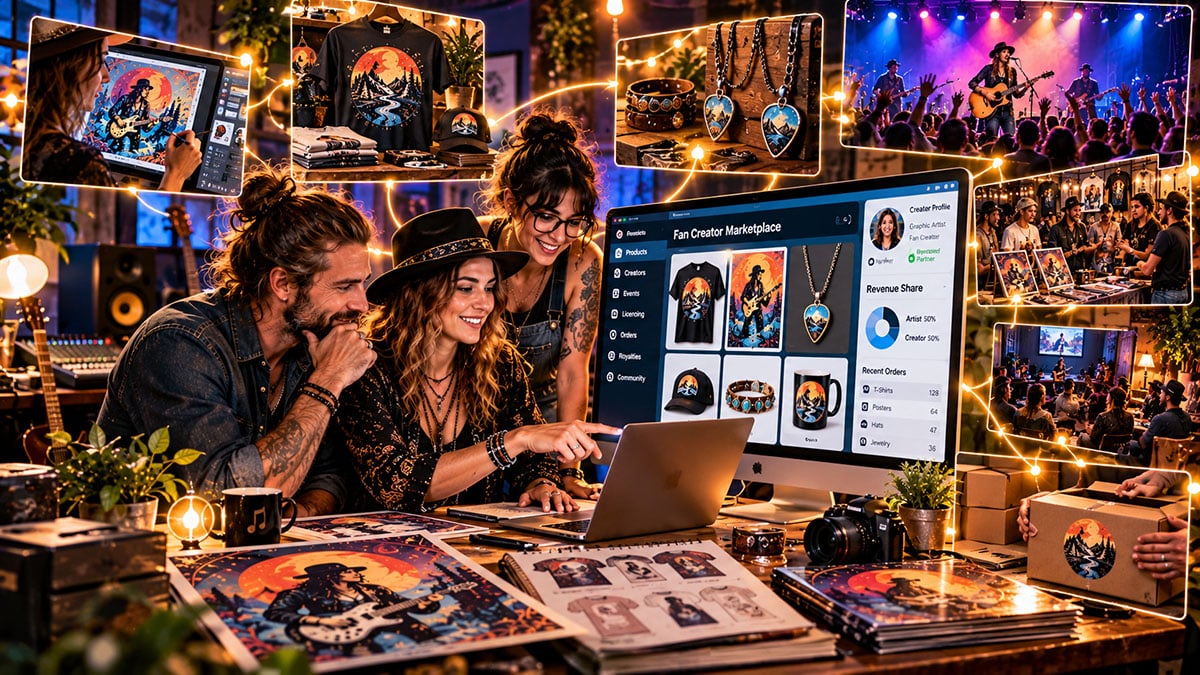
Perhaps a fan who works with leather designs a custom guitar-pick holder featuring artwork licensed by the musician. Another fan creates illustrated prints inspired by stories behind the songs. A local craftsperson makes a small collection of handcrafted accessories available during regional shows. An experienced event organizer develops a listening party where fans purchase admission, meet one another, and receive a special recording or keepsake.
These ideas do not require the artist to personally develop every product. The musician provides the creative identity, the connection to the music, and whatever permissions are appropriate. The participating fans provide their own skills, labor, and imagination. Together, they can develop something neither party would have created alone.
There is also an important financial difference between this arrangement and ordinary merchandise manufacturing. An artist who purchases 200 shirts carries the risk of selling those shirts. A fan who produces a small batch of handcrafted products may assume some of the manufacturing responsibility under an agreed business arrangement. Alternatively, the artist and fan can test demand through advance orders before either commits significant money.
Of course, distributing the work does not magically eliminate business expenses. Somebody still has to purchase materials, collect payments, arrange shipping, address returns, and handle unhappy customers. But those responsibilities can be divided among people who are actually equipped to manage them, rather than automatically landing on an already overworked musician who would prefer to spend Wednesday afternoon practicing guitar instead of arguing with a shipping company.
The larger opportunity is to recognize that a fan community contains practical economic abilities as well as enthusiasm. When those abilities are organized fairly, merchandise becomes less about selling identical products to thousands of people and more about creating distinctive things that belong to the culture surrounding the music.
Merchandise That Actually Means Something to the Fans
One of the reasons traditional artist merchandise becomes repetitive is that so much of it begins with the same question: Where can we put the band logo? Shirts, hats, mugs, stickers, and tote bags all have their place, and many musicians earn valuable income selling them. There is nothing wrong with a good T-shirt, especially when it helps pay for gasoline between shows. The problem begins when every merchandise decision is reduced to choosing another object that can carry the same artwork.
Fans often experience music differently from the people who make it. A songwriter may remember the exhausting studio sessions behind an album, while a listener remembers hearing one of its songs during a difficult year. The musician may consider a particular lyric a minor detail, while an entire group of fans has turned it into a shared expression. Those emotional connections can inspire products that a conventional merchandise catalog would never suggest.
Imagine a blues community creating a collection of illustrated postcards based on towns mentioned in an artist’s songs. A fan who enjoys local history could research the locations, while another creates the artwork and the artist contributes personal stories about performing in those places. The finished collection becomes part merchandise, part musical storytelling, and part invitation for fans to explore places connected to the recordings.
A folk musician might collaborate with fans who make quilts, handmade journals, or illustrated songbooks. A roots-rock band could work with a fan who restores vintage clothing, creating limited pieces connected to an album’s visual identity. A jazz musician might partner with a photographer to sell signed concert prints accompanied by notes about the musicians and the performances. A blues artist with a strong community of guitar players could work with an independent craftsperson on pick holders, instrument straps, or other accessories that combine useful objects with the culture surrounding the music.
These examples are potential business concepts, not claims that particular artists are already generating revenue from them. Their value lies in showing how much broader merchandise can become when the creative process includes people who understand the community from inside it.
The best products would not necessarily be the most expensive or elaborate. A beautifully designed five-dollar item that fans actually want can be more valuable than a complicated premium package that requires substantial investment and leaves the artist waiting for customers. Low-cost objects can also introduce new listeners to the community, while more specialized items can serve people who want a deeper connection.
What makes these products powerful is the story behind them. A fan-created design can carry a personal history, an explanation of the inspiration, and recognition of the person who made it. Customers are no longer purchasing only a physical object. They are supporting the work of another member of a community they value.
That connection can be especially meaningful in blues, roots, Americana, jazz, and other independent music scenes where audiences often know the performers personally. A merchandise table can become a place where musicians, craftspeople, and listeners meet one another instead of merely exchanging cash for objects.
The Merchandise Table Could Become a Small Business Marketplace
Think about the merchandise table at a typical independent concert. It usually sits near the entrance, beside the soundboard, or in a corner where the lighting was apparently designed to discourage commerce. Somebody from the band, a spouse, or a generous friend tries to sell recordings and shirts while simultaneously watching the performance and keeping track of which customer asked for an extra-large shirt.
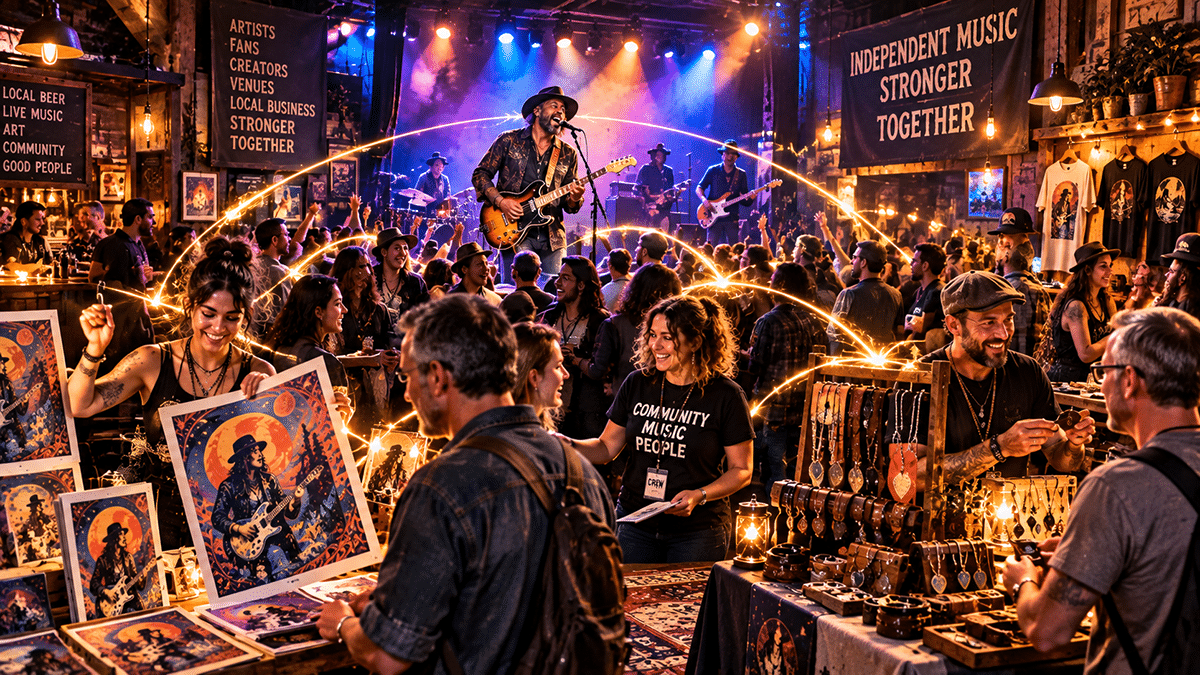
Now imagine that same space operating as a small marketplace connected to the artist’s music. The band’s official merchandise remains available, but nearby are products developed by approved fan creators. Each item has a clear price, an explanation of who made it, and a simple way to purchase or order it. Some products are available immediately, while others are displayed as samples and ordered for later delivery.
A musician might work with a local artist to design a limited poster for a particular concert. A fan who makes jewelry could offer a small selection of approved pieces inspired by an album’s imagery. Another person might create handmade notebooks featuring original illustrations related to the music. The band benefits when the arrangement includes an agreed licensing fee or revenue share, while the creators earn money from their own work.
This arrangement has a practical advantage for touring musicians. Instead of transporting every product across several states, an artist could work with approved makers in particular regions. Products could be created or delivered locally, reducing some travel and storage costs. However, the band would still need clear arrangements regarding product quality, pricing, unsold inventory, responsibility for sales taxes, and what happens when a concert is canceled.
Regional fan collaborations could also help artists form deeper relationships with local creative communities. An independent musician touring through Georgia, Tennessee, and the Carolinas might develop different approved products with creators in each area. Fans attending those concerts would discover items connected to their particular music scene, giving the shows a local identity that cannot be duplicated simply by ordering another thousand generic shirts.
The important distinction is that these partnerships should be genuine businesses, not arrangements where fans donate hours of skilled labor in exchange for exposure. A musician who cannot afford fair compensation should begin with smaller projects or clear revenue-sharing agreements that everyone understands. Enthusiasm is wonderful, but it does not pay a graphic designer’s electric bill any more reliably than it pays the guitarist’s.
Imagine a Merchandise Collection Designed by the Fans
An interesting experiment for an independent band would be to invite its audience to propose a new merchandise collection around an upcoming album. Rather than asking everyone to submit finished designs for free, the band could begin with an open conversation about what kinds of products fans would actually enjoy owning.
That discussion might reveal a surprising preference for illustrated posters, handmade accessories, unique clothing, or items connected to the album’s stories. The artist could then invite interested creators to submit brief proposals, with clear information about the available budget, potential compensation, ownership of the final work, and how successful products would be sold.
A designer who proposes an original piece of artwork could receive a development fee, a share of sales, or both, depending on the agreement. A craftsperson who manufactures their own products might negotiate a wholesale arrangement or a license to sell approved goods independently. The musician would have the opportunity to review ideas before authorizing commercial use of the band’s identity.
Before investing in a full collection, the artist could display mockups and invite fans to express interest. Actual paid preorders, with honest delivery dates and clear refund terms, would provide stronger evidence of demand than social media likes alone. If the response is promising, production could begin with a limited quantity or a preorder-based run.
This process would make merchandise development more responsive to real customers while giving talented fans access to opportunities that ordinarily would not exist. It might also produce unexpected ideas. A design that seems unusual to the band could make perfect sense to the audience because it reflects a moment, joke, lyric, or shared experience the musicians did not realize had become important.
The artist should maintain reasonable creative and quality standards, but collaboration requires some willingness to let another person bring something new into the picture. If every fan proposal is forced to look exactly like the official merchandise already in the store, the project will have succeeded mainly in creating a more complicated way to produce the same old merchandise.
Fan-Organized Events Could Become Merchandise Businesses of Their Own
The opportunity becomes even more interesting when merchandise is connected to experiences rather than only physical objects. Fans have been organizing listening parties, concert meetups, travel groups, and celebrations of favorite artists for years. Much of that activity happens without formal coordination, even when it produces obvious benefits for the musicians involved.
An independent artist could develop an approved program allowing experienced fans to organize local gatherings under agreed conditions. A fan in one city might arrange an album listening party at a record store. Another could coordinate a gathering before a regional concert. A third might organize a community event centered on the stories behind an album, with a special video appearance or prerecorded message from the musician.
These events could create several kinds of income when the economics justify them. Organizers might earn ticket revenue or an agreed event-management fee, while the artist receives a licensing payment, a share of event proceeds, or revenue from recordings and merchandise sold to participants. Local venues and shops could benefit from increased traffic, and fans would gain something more meaningful than another automated advertisement asking them to stream the newest single.
Suppose a fan organizer arranges a listening party for 40 people at a small venue. Tickets sell for $15, producing $600 in gross ticket revenue. If the room costs $150, event staffing and equipment cost $75, payment processing costs $25, and the artist receives an agreed $100 fee, the remaining $250 is available to compensate the organizer and cover any other expenses. That is an illustration of how the numbers might work, not a forecast, and the real event could require additional costs for insurance, licensing, permits, marketing, accessibility, or other obligations.
The business only becomes sustainable if the organizer is compensated for the time required to make it happen. Someone who spends twenty hours planning an event has done real work, even if everyone involved loves the music. If the financial arrangement leaves that person earning less than the cost of the gasoline needed to reach the venue, the plan may need to change.
The same concept could support fan-created merchandise specifically designed for the gathering. A local artist might produce a limited poster, while another supplies small souvenirs or keepsakes. The event becomes a community experience with several participating creators, each operating under a defined agreement rather than a vague expectation that everyone should be grateful for the opportunity.
The Fan Creator Should Own Something, Too
Here is where the music industry’s history offers a useful warning. Musicians know what happens when creative people sign agreements without understanding what they are giving away. Entire careers have been built around contracts that left the performers creating the value while other people controlled the rights. It would be rather embarrassing for independent artists to escape that arrangement only to recreate a smaller version of it with their own fans.
A fan who creates an original illustration generally begins with copyright ownership in the original expression, subject to applicable law and any existing contractual arrangements. The musician may own the band’s trademark, original photographs, album artwork, compositions, or recordings, but that does not automatically give the musician ownership of an unrelated original design created by a fan.
The United States Copyright Office explains that copyright normally begins with the creator of an original work. The rules can differ for employment, qualifying works made for hire, and written transfers of rights. Simply paying someone to create artwork does not automatically mean that the buyer owns every copyright associated with it.
This creates an important opportunity for a more equitable merchandise model. Rather than demanding ownership of every fan-created design, the musician could license the artwork for specified uses while allowing the creator to retain copyright. The artist might receive an exclusive license for a particular merchandise collection or a nonexclusive license allowing both parties to use the work under agreed conditions.
At the same time, the fan creator would need permission to use any protected material belonging to the musician or other rights holders. A fan cannot assume that admiration for an artist creates permission to commercially reproduce album covers, official photographs, logos, or song lyrics. Even the artist may need to obtain additional permission when a record company, photographer, publisher, or designer controls particular material.
A good agreement should explain what each party owns, what each is licensing, which products are authorized, where those products can be sold, how long the permission lasts, and whether either party may sell the design elsewhere. It should also explain how payments are calculated, who handles product quality and customer problems, and what happens to remaining merchandise when the agreement ends.
These details may sound less exciting than imagining new products, but clear ownership is what makes long-term cooperation possible. An agreement that works for 50 handmade items may become painfully inadequate if the design unexpectedly sells 5,000 units. Both parties should understand in advance how a successful product will be managed and whether there are opportunities to renegotiate expanded rights.
Independent musicians have spent enough time fighting for ownership of their own work. A fan-created marketplace should respect the same principle for the people who contribute new ideas.
Sharing Revenue Without Playing Accounting Games
There are several reasonable ways for artists and fan creators to divide the income from collaborative merchandise. The best arrangement depends on who provides the original design, who owns the protected material, who pays for manufacturing, who processes transactions, and who handles fulfillment.
For a simple example, imagine a fan creates an original design that the band approves for a $30 shirt. Manufacturing costs $12 per shirt, while transaction fees, packaging, and other direct expenses total another $3. That leaves $15 before creator compensation, artist income, overhead, taxes, and any additional costs.
If the parties agree to divide that $15 equally, the fan creator receives $7.50 and the artist receives $7.50 per shirt. Selling 100 shirts would therefore generate $750 for each participant under those assumptions. The numbers are deliberately simple, and they do not include every possible expense, such as advertising, refunds, defective items, unsold inventory, or income taxes.
The exact percentages are less important than defining the calculation clearly. Some agreements may work better with a royalty based on gross sales, meaning the selling price before deductions. Others may use a percentage of a specifically defined amount after permitted direct expenses. Problems arise when the contract promises a share of profits without explaining what qualifies as an expense, leaving one party to discover that the other has a rather imaginative definition of accounting.
A fan who pays for materials and handles manufacturing should not automatically receive the same deal as someone who supplies artwork while the artist finances everything. Similarly, an artist providing valuable licensed material, customer access, marketing, and customer service may reasonably receive compensation for those contributions. The goal is not to make every arrangement identical. It is to make every arrangement understandable and fair.
Artists could also experiment with advance payments against future royalties, guaranteed minimum compensation, or wholesale purchasing arrangements. A creator who makes jewelry might sell finished items to the band at an agreed wholesale price, allowing the band to handle retail sales. Another creator might sell directly to customers and pay the musician a defined licensing royalty for authorized branding.
Whichever approach is chosen, both parties should have access to understandable sales records and payment statements. An artist who demands transparency from streaming services should not expect fan creators to accept mysterious calculations from the merchandise table.
What Happens When a Fan-Created Product Becomes a Hit?
Small collaborations are relatively easy to manage while everyone knows one another and the orders fit inside a shoebox. The real test arrives when a fan-created design becomes popular enough to require professional manufacturing, expanded distribution, or licensing to other businesses.
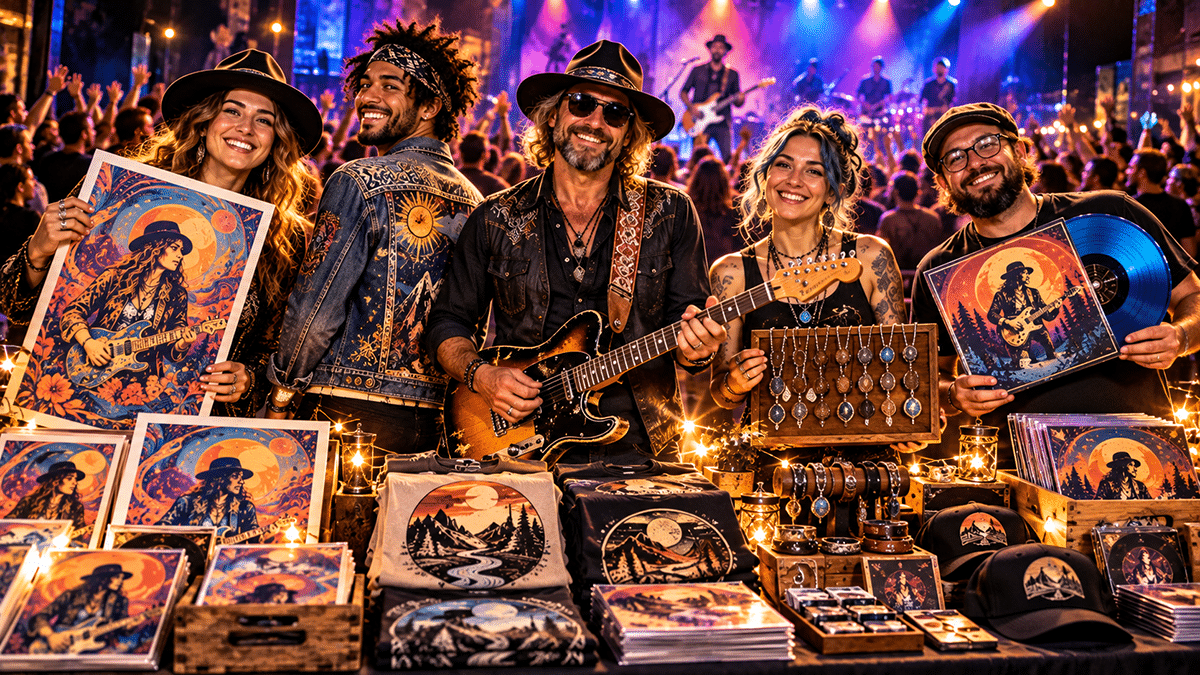
Imagine an independent artist approves 100 handmade items from a fan creator, and the first collection sells out almost immediately. The artist now wants to produce 2,000 units through a larger manufacturer. The original creator may be excited about the opportunity, but the new arrangement introduces questions that were not part of the first experiment.
Does the creator retain ownership of the original design? Can the artist authorize a different manufacturer to reproduce it? Does the creator continue to receive the same royalty? Who pays for changes required by the manufacturing process? Can the artist expand the product into other categories, and does that require additional permission?
The answers should come from the agreement rather than from whichever person happens to have the loudest lawyer. A sensible collaboration can allow a small product to grow while protecting the interests of the person whose idea made it possible.
It is also worth remembering that a successful product can create problems unrelated to intellectual property. Customers may demand faster shipping, larger sizes, replacement items, or international delivery. The artist and creator may suddenly need a customer-support process, a reliable manufacturer, and accurate inventory records. The charm of a handmade product can disappear quickly when nobody can explain why an order placed in July has not arrived by October.
Before expanding production, both parties should review the actual costs and responsibilities. A successful creative concept deserves a business structure capable of supporting it, particularly when a growing audience begins depending on promises made by the artist’s official merchandise operation.
AI Could Help Fans Create Better Products Without Replacing the Fans
Artificial intelligence introduces another fascinating possibility because many independent musicians already have access to fans with great ideas but limited technical experience. A person may know exactly what kind of merchandise would appeal to the community without knowing how to prepare professional artwork, build an online store, write product descriptions, or estimate production costs.
AI tools can help bridge some of those gaps. A fan with an original concept could use AI-assisted software to explore colors, develop presentation mockups, draft marketing copy, or organize a production plan. A musician could use AI to compare product costs, review customer feedback, prepare sales reports, and identify ideas worth testing before committing substantial money.
The real benefit is not replacing a skilled designer with a machine that produces endless pictures. It is making the business side of creativity more accessible to people who would otherwise struggle to turn an idea into a product.
Consider a fan who makes handcrafted leather accessories. That person may be excellent at working with leather but uncomfortable writing online product descriptions or building a catalog. AI could help develop clear descriptions from information the creator supplies, estimate materials needed for different order quantities, and draft customer-service responses for review. The technology reduces administrative friction while leaving the human creator responsible for the actual work and product quality.
AI could also help artists analyze proposals and identify practical concerns. If a proposed item requires expensive materials, unusual shipping arrangements, or a large minimum manufacturing order, an AI-assisted planning process might help reveal those issues before money is spent. The musician and creator would still need to verify supplier quotes, costs, licensing requirements, and other important facts rather than trusting an automated estimate.
There are legal questions that cannot be ignored. The U.S. Copyright Office’s January 2025 report on copyright and artificial intelligence explains that copyright protection depends on sufficient human authorship. Using AI as an assistant does not automatically eliminate protection for human-created work, but material generated entirely by AI may not qualify for copyright protection. Prompting a system by itself does not necessarily establish ownership of the resulting expression.
Artists should also avoid encouraging fans to feed protected images, recordings, or other material into outside AI services without understanding the service’s terms and having the necessary rights. A fan-created merchandise program needs clear rules about unauthorized use of celebrity likenesses, existing artwork, copyrighted characters, and other people’s creative material.
A responsible program could ask creators to disclose meaningful AI use and identify any third-party materials incorporated into their designs. That information would help the musician evaluate potential rights issues and avoid promising buyers that a work is entirely handmade when it is not.
Used carefully, AI can make it easier for talented fans to participate in small businesses. Used carelessly, it can turn a charming creative partnership into an expensive argument about who copied whose artwork.
What About Web3 and Digital Collectibles?
The idea of fan-created merchandise naturally leads to questions about digital ownership, limited editions, and whether blockchain technology could make collaboration easier. Web3, broadly speaking, describes approaches that use decentralized systems and digital ownership tools rather than depending entirely on one company’s database.
A fan-created collectible could potentially include a digital certificate, a record of its creator, or a connection to future community experiences. A musician and fan artist might jointly release an illustrated collectible that includes original artwork, a licensed recording, and access to a private listening session. The physical item would remain useful and meaningful, while the digital layer could document its origin or provide additional benefits.
Blockchain-based systems might be useful in certain arrangements for recording provenance, managing transfers, or automating some payments. Smart contracts can perform programmed actions when defined conditions are met, but they cannot independently confirm every real-world fact. If a product is returned, a shipment is lost, or a licensing dispute occurs, human processes and legally enforceable agreements are still necessary.
The artist should also consider transaction costs, wallet complexity, security, privacy, and whether buyers can access the experience without becoming technology experts. An audience that loves blues music should not need a weekend seminar on cryptocurrency just to purchase a commemorative guitar pick.
There is a more useful lesson here than simply attaching a token to every physical object. Independent artists should favor portable records of ownership and participation, clear rights agreements, and systems that allow fans to retain access to their purchases. When technology makes those things easier, it deserves consideration. When it adds confusion and expense without improving the experience, the conventional database and a straightforward sales receipt may be the better choice.
For most working musicians, the sensible starting point is a functional merchandise business with transparent digital records. More advanced ownership tools can be considered when there is a specific need and a clear benefit to the participating creators.
An Artist-Owned Fan Passport Could Connect the Pieces
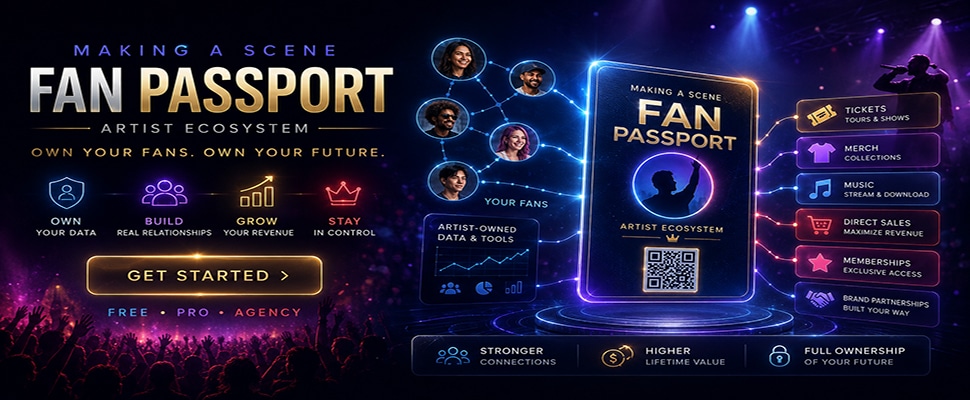
This brings us to an opportunity that fits naturally into the Making a Scene Artist Ecosystem and its Fan Passport approach. Instead of treating a fan relationship as a collection of ticket purchases, merchandise orders, and email addresses, Fan Passport is designed around a more complete understanding of how people participate in an artist’s community.
That distinction matters because the fan who purchases the most merchandise is not necessarily the person who creates the most value for the community. Somebody who introduces twenty friends to a band, organizes listening parties, or helps produce an approved product may contribute meaningfully without spending much money personally.
An artist-controlled fan system could eventually recognize those contributions with the permission of the participants. A fan who wants to become a creator could choose to establish a profile showing the skills they wish to share, their location or service area, and whether they are interested in paid collaboration. Another person might identify themselves as a local event organizer. A designer might upload examples of work and request consideration for merchandise projects.
The critical point is that this should be a voluntary business relationship, not a system that secretly profiles everybody who enjoys the music. People should decide whether they want to participate and what information they are comfortable sharing. Their purchase records and attendance history should not automatically become a public résumé, and joining an ordinary fan rewards program should never mean agreeing to work for the artist.
A future Fan Creator Marketplace within the Artist Ecosystem could allow musicians to review proposals, authorize specific uses of artwork, document licensing terms, and monitor sales. Fan creators could maintain their own project records and see the payments associated with approved products. The artist could keep important records connected to the broader Source of Truth system without pretending that every piece of fan-created intellectual property belongs to the musician.
These would be proposed additions to the ecosystem, not a claim that a complete fan-commerce marketplace already exists. The strongest development approach would build upon the existing ideas behind Fan Passport, consent-based fan relationships, rewards, and artist-owned records rather than introducing a separate platform that divides the community into yet another collection of accounts.
This approach also offers something especially valuable for independent musicians: continuity. If an artist changes a merchandise supplier, website provider, or payment service, the records of approved collaborations, fan permissions, and business relationships should remain available through secure, portable exports. A creator should not lose evidence of their work simply because a storefront closes.
The larger vision is a community where the musician controls the artist’s own business records, participating fans retain appropriate ownership of their contributions, and both parties can understand the value they are creating together.
Fan Memory Should Recognize Contribution, Not Just Consumption
Most music marketing systems are designed to answer familiar questions. How many people opened an email? How many purchased a shirt? Who attended a concert? Which customers spent the most money?
Those questions are useful, but they reveal only part of the relationship between an artist and an audience. They do not necessarily identify the person who helped organize a successful concert meetup, designed an outstanding poster, or introduced the artist to a local venue.
A more thoughtful Fan Passport system could allow those activities to become part of an opt-in record of community participation. When a fan hosts an approved event, the system could record the event and recognize the organizer. When a fan-created product goes on sale, the creator could receive visible credit and appropriate compensation. When a collaboration generates meaningful results, both participants could see the outcome.
This information might help an independent musician understand where genuine community-building is occurring. If several fans in a particular town repeatedly organize activities, that could provide useful evidence of local interest. An artist planning a regional tour might decide to investigate venues in that area rather than relying exclusively on streaming statistics that offer little information about whether anybody will actually purchase a concert ticket.
There is an important limit, however. A fan’s contribution should not automatically become commercial property that the artist can sell or expose to unrelated companies. Participation data should be collected for clear purposes, with suitable consent, privacy settings, security controls, and reasonable options for correction or deletion.
Fans should also be able to participate without competing for points or public rankings. Turning every helpful action into another loyalty contest could undermine the very community spirit the project is supposed to encourage.
A fan relationship has value partly because it is human. Technology should help musicians recognize and support that relationship, not turn friendship into a scoreboard.
Rewarding Creators Without Turning Everyone Into an Unpaid Street Team
Fan rewards can become a meaningful part of this model, provided the system understands the difference between recognition and payment. A musician might offer participating creators early access to recordings, invitations to special gatherings, or recognition on the artist’s website. Those benefits can strengthen the relationship, but they should not be treated as automatic substitutes for compensation when a fan performs work that creates commercial value.
A fan who volunteers to help carry equipment because they enjoy the band is participating in an informal act of support. A designer who spends twenty hours developing a product the artist plans to sell is providing a professional service. The musician should recognize the difference before deciding that a handful of reward points will somehow settle the matter.
This is particularly important because independent artists are familiar with the unpleasant phrase “great exposure.” Many musicians have been offered unpaid performances with promises that important people might attend. The industry has never quite explained why the important people cannot purchase tickets like everybody else.
A fair fan-created business should avoid repeating that behavior. Participation can be voluntary, and rewards can be meaningful, but paid commercial work deserves a transparent financial arrangement.
If the artist cannot afford upfront compensation, a clearly negotiated royalty arrangement may be possible. But the creator should understand the risks, the expected expenses, and whether they have any guaranteed payment. The musician should also avoid collecting large amounts of speculative work from multiple fans when only one design will be used.
When fan creators become genuine business partners, the result can extend beyond merchandise income. The experience may help them build portfolios, develop professional relationships, and establish businesses of their own. That outcome fits the larger goal of creating a sustainable middle class around independent music rather than concentrating every dollar in the hands of a platform or intermediary.
The Legal Details Are Boring Right Up Until They Become Expensive
An artist-approved merchandise business needs a practical system for permissions and agreements. Music-related products can involve multiple kinds of intellectual property, and those rights do not always belong to the same person.
The band may own its name or logo, while a photographer owns the copyright in a promotional photograph. The songwriter may control the composition, while a publishing company administers certain rights. The person who designed an album cover may retain copyright in the artwork unless the applicable agreement says otherwise. Merchandise that combines these materials may therefore require permission from more than one party.
A license can define which protected material may be used, the approved products, the territory, the term, and the permitted sales channels. When trademarks are involved, the owner also needs appropriate oversight of the quality and use of the mark. A licensing agreement should explain how designs are reviewed and what happens if products fail to meet agreed standards.
Artists should be especially careful with products that include lyrics, samples, photographs, or recognizable images of people. These uses can raise copyright, trademark, publicity, or other rights questions depending on the circumstances. Independent musicians should not assume that controlling the master recording automatically grants every permission needed to reproduce associated artwork or written material on merchandise.
There are practical commercial responsibilities as well. A seller may need to collect and remit applicable sales taxes, comply with consumer protection requirements, provide accurate product descriptions, and follow relevant safety rules. Products intended for children, cosmetics, food, and certain accessories may introduce additional regulations that make them poor choices for an inexperienced merchandise operation.
When fan creators promote items from which they receive commissions or other benefits, advertising disclosures may be required. The Federal Trade Commission advises that material relationships between endorsers and sellers should be disclosed clearly when those relationships could affect how audiences evaluate a recommendation.
None of this means an independent musician needs to employ a team of attorneys before selling a small collaborative poster. It does mean that written agreements, appropriate rights checks, honest marketing, and reliable records should be part of the project from the beginning. As sales grow or arrangements become more complex, professional legal and accounting advice becomes increasingly valuable.
A fair arrangement protects the artist, the creator, and the customer. It also prevents the kind of dispute that can destroy years of goodwill over a product that originally seemed like a harmless idea.
The Hidden Costs of Letting Everybody Create Merchandise
Collaborative commerce can lower some expenses, but it can also create new ones. Managing five independent fan creators may be more complicated than ordering shirts from a single printer, especially when each person uses different production methods, shipping procedures, and customer-service practices.
An artist should decide whether fan-made products will be sold through the musician’s official store, through creator-operated shops, or through a shared marketplace. Each arrangement creates a different set of responsibilities.
When the official artist store handles the payment, customers will usually expect the artist’s business to address problems, even if the product was manufactured by somebody else. The artist may therefore need clear agreements requiring creators to meet production deadlines, provide accurate shipping information, and cooperate on refunds or replacements.
When creators sell through their own shops, they may handle more of those responsibilities directly, but the artist has less control over the customer experience. The licensing agreement should make responsibilities clear, and the artist should avoid presenting a creator-operated business as an official store unless that relationship is accurately described.
Print-on-demand production can reduce inventory risk for some kinds of merchandise, but it does not eliminate manufacturing costs, quality concerns, shipping charges, or customer-service obligations. Handmade production offers originality and personal value but may become difficult to scale. A product made by one person over several hours cannot always be expanded to thousands of units without changing the production method and possibly the character of the item itself.
The artist should also consider the time required to review proposals and maintain relationships. A musician with a full touring schedule may be better served by working with two reliable creators than launching an open marketplace with dozens of participants. The system should grow in response to demonstrated demand rather than an assumption that more products automatically mean more income.
A smaller operation that consistently pays people, ships products properly, and treats customers well is far more valuable than an impressive online catalog filled with merchandise nobody can deliver.
Start With One Artist, One Creator, and One Product
The most practical way for an independent musician to explore this business model is through a small experiment. There is no reason to build an entire marketplace before learning whether the audience actually wants fan-created merchandise.
An artist could begin by talking with familiar fans about their creative interests and skills. Perhaps somebody already makes artwork, clothing, jewelry, or other products. The musician might select one potential collaboration that fits the band’s identity and can be developed without a large financial commitment.
The artist and creator would agree on the proposed product, rights, costs, responsibilities, and compensation before production begins. They could then develop a sample, photograph it properly, and show it to fans through the musician’s own website and permission-based mailing list.
A short preorder campaign could help determine whether the product deserves a production run, provided customers receive clear information about fulfillment and refunds. If enough orders arrive to support the project, the creator can produce the merchandise under the agreed arrangement. If demand is weak, both parties have learned something useful without committing to a warehouse full of unsold inventory.
The artist should evaluate more than gross sales. What did production cost? How much time did each person spend? Were customers satisfied? Did the collaboration introduce new fans to the music? Did the creator receive worthwhile compensation, and would both parties willingly repeat the experience?
Those questions help distinguish a sustainable business from a charming one-time project that quietly loses money. A successful experiment might justify developing a second product, introducing another creator, or organizing a small fan-led event.
Growth should come from evidence rather than excitement alone. Independent musicians have already been sold enough expensive systems based on promises that everything will work beautifully once a large enough audience arrives.
The Artist’s Website Should Remain the Home Base
One of the greatest risks in fan commerce is replacing one dependency with another. An artist who spends years building a community through a social media platform may eventually discover that the platform controls access to the audience. Launching an entire fan-created merchandise business inside another closed marketplace could create the same problem with additional financial relationships attached.
Independent musicians should carefully consider where their customers, transaction records, product information, and permission-based fan relationships are maintained. A marketplace can help with discovery, manufacturing, payment processing, or administration, but the artist should seek arrangements that preserve reasonable access to their own records and relationships.
The musician’s website can serve as the central destination where fans learn about official collaborations, discover creators, purchase available products, and join the artist’s community. Outside platforms can still provide valuable services, but the artist should avoid making any single provider the only place the business can function.
For the Making a Scene Artist Ecosystem, this means a future creator marketplace should support artist-controlled commerce and portable records rather than demand that every fan relationship occur inside a new closed environment. The Fan Passport identity and community features could connect relevant activity, while ordinary website visitors would still be able to browse merchandise without unnecessary barriers.
Customers should not be forced to register for a complicated loyalty program merely to purchase a handmade poster. Participation features should add convenience and value for people who want them, rather than becoming another obstacle between a music fan and a simple transaction.
The artist also needs to protect creators from the same platform dependency. A fan who builds a successful merchandise business should be able to retain their own business records, original files, and permitted customer relationships, subject to privacy and contractual requirements. Cooperation works better when neither party becomes trapped.
Fan-Created Merchandise Could Strengthen Regional Touring
There is another opportunity that deserves more attention, especially for working musicians who earn much of their income on the road. Fan-created businesses could become part of a regional touring strategy, helping artists build stronger local communities while creating opportunities for small creative businesses in the towns they visit.
Imagine an independent blues band developing a network of approved creators across several neighboring states. When the band books a show in a particular town, a local fan designer might create a limited poster for that performance. Another fan could organize a small gathering before the concert, while a nearby record store offers a listening session connected to the band’s newest release.
The musician would not need to build every event from scratch. Instead, the artist could work with people who already understand the local music community and have the skills to organize activities. Those collaborations could help reach potential concertgoers who might never respond to a generic advertisement.
There is an economic advantage when fans help create local reasons to attend. A concert becomes more than another date on a tour calendar. It becomes an opportunity to meet familiar people, discover locally made products, and participate in a community that exists beyond the performance itself.
The musician still needs to be careful about assigning responsibilities and compensating organizers. Fan participation should support professional touring rather than become an excuse to replace experienced staff with unpaid volunteers. A good local organizer creates value and should receive appropriate recognition and payment when operating a commercial event.
The artist can also learn from these collaborations. Which towns have active communities? Which products sell locally? Which events introduce new customers? Which partnerships are financially worthwhile? Over time, these observations could help shape more effective touring decisions than simply examining listener counts on a streaming dashboard.
For independent musicians trying to build a dependable regional audience before attempting expensive national tours, this model could connect merchandise, live performance, and community development into one practical strategy.
What a Fan Creator Marketplace Might Eventually Become
If the model proves useful, an artist-owned Fan Creator Marketplace could develop into a broader business system without abandoning the principles that made it attractive in the first place.
Imagine an independent musician opening a dashboard where interested fans have voluntarily registered as designers, makers, or organizers. The artist could publish a paid creative opportunity for an upcoming album, review proposals, and invite a creator to develop a product. Once both parties agree on terms, the system could store the licensing record, approved artwork, compensation arrangement, and authorized sales channels.
The finished product could appear in the artist’s existing merchandise storefront. Orders would be tracked through the commerce system, and both participants could review their respective sales records. If the collaboration included royalty payments, the system could calculate amounts owed according to the defined agreement while maintaining a clear record of adjustments, refunds, and expenses.
Creators could receive credit on product pages, while fans who purchase merchandise could learn about the people who made it. A creator might develop a recognizable body of work across several participating artists, creating the beginnings of an independent business serving the wider music community.
A fan who organizes events could have a different kind of profile, showing approved events, relevant experience, and the services they offer. Musicians could invite organizers to propose gatherings in specific locations, with financial responsibilities and permissions documented in advance.
AI assistance could help prepare proposals, summarize terms, estimate expenses, or flag incomplete information, but important approvals should remain with the artist and creator. The system should not automatically grant rights simply because a proposal passes an automated check. Human ownership and authorization remain essential.
The marketplace should also accommodate creators who want to operate through their own independent businesses rather than becoming permanent subcontractors. Some collaborations might involve wholesale purchases, others licensing royalties, and others shared projects. A flexible system would recognize those differences instead of forcing every relationship into one commission structure.
These are potential future capabilities, and each would require thoughtful development, reliable accounting, security, and legal review. The value of the concept lies in creating infrastructure that makes legitimate collaboration easier without taking ownership away from the people whose work gives the marketplace meaning.
The Biggest Opportunity May Be Creating More Small Music Businesses
The traditional music industry tends to measure success by concentrating attention and money around a relatively small number of stars. Platforms compete for millions of users, record companies pursue enormous catalogs, and marketing firms celebrate campaigns that reach audiences most working musicians can barely imagine.
Independent music operates differently. Many artists build careers through modest but dedicated communities, regional touring, direct sales, teaching, production work, licensing, and a collection of smaller revenue sources that support one another. The goal is not necessarily to become a global celebrity. It is to make enough money from music to continue creating it without surrendering control of everything along the way.
Fan-created commerce fits naturally into that economic picture because it can support more than the musician. A fan who becomes a successful merchandise designer may eventually serve several independent bands. Someone who learns to organize profitable listening events could build a local event business. A photographer who begins creating approved concert merchandise might develop a reputation that leads to other professional assignments.
Those opportunities are not guaranteed, and not every fan wants to become an entrepreneur. Many people simply want to enjoy the music, attend concerts, and spend time with friends. That is perfectly fine. A healthy community should welcome people who contribute in different ways and never treat those who spend or produce less as inferior supporters.
For those who do want to participate commercially, however, the musician’s community could become a place where small businesses begin and grow. Instead of only moving money from fans toward the artist, the community could create opportunities for money to circulate among musicians, creators, venues, manufacturers, and other independent businesses.
This is how the idea connects to the larger mission of building a music industry middle class. Independent artists do not need to become miniature record companies trying to extract every possible dollar from their audiences. They can become the centers of creative networks where ownership and opportunity extend to other people who help make the music culture possible.
The business model should still generate meaningful revenue for the artist. Music is the reason the community exists, and the person creating and performing it needs sustainable income. But a stronger network of fan creators and local partners could make that income more durable by expanding the kinds of products, experiences, and relationships the community can support.
The Future of Fan Commerce Is Not Another Expensive VIP Package
There will always be a market for premium merchandise, exclusive experiences, and special editions. Fans who can afford those products often enjoy supporting their favorite musicians, and artists deserve to earn money from the work they create. The problem is not that superfans purchase expensive things. It is that the industry has increasingly treated their spending capacity as the most important thing about them.
The emerging conversation around Fave challenges that assumption by asking what fans already create and organize for themselves. That perspective does not eliminate conventional merchandise, nor does it require every artist to launch a collaborative marketplace. It simply reveals that an audience may contain far more creative and economic potential than a customer database can measure.
For an independent musician, the most useful starting point may be a conversation with someone who has supported the band for years. Perhaps that person has a skill the artist never knew about. Perhaps they have an idea for a product, an event, or a local collaboration that could become a worthwhile business. The artist can explore that possibility without surrendering ownership of the music or asking anybody to work without fair terms.
Some of those conversations will lead nowhere, and that is part of building a business. Other ideas may become modest collaborations that earn a few hundred dollars while making the community more interesting. Occasionally, a product or event may develop into something larger, creating meaningful income for both the artist and the fan who helped make it possible.
The important thing is to build the relationship on trust, clear agreements, appropriate permissions, and respect for the creative work involved. Those principles matter far more than the technology used to process an order or record a reward.
Independent musicians have spent decades dealing with companies that wanted control over their recordings, publishing, audiences, and careers. As new fan-commerce models develop, artists have an opportunity to build something different rather than simply becoming another set of gatekeepers themselves.
That requires recognizing that the person standing at the merchandise table may be more than a customer. They might be the designer of next year’s most popular product, the organizer of a successful regional event, or the beginning of a small creative business that contributes to the local music economy.
The musician’s opportunity is to make room for that creativity while building a business where everybody understands what they own, what they contribute, and how they get paid. If independent artists can do that well, their merchandise operation may become more than a source of income between sets. It could become a gathering place for the people who are helping build an independent music economy, one original idea and one genuine partnership at a time.
Editorial note: Merchandise collaborations, financial illustrations, and proposed Fan Creator Marketplace capabilities described in this article are examples or recommendations unless specifically attributed to an existing service or reported activity. They are not promises of earnings or claims that proposed Artist Ecosystem features are currently available. Copyright, licensing, advertising, tax, and other legal requirements depend on the facts and jurisdiction involved.
 |  Spotify |  Deezer |  Breaker |
 Pocket Cast |  Radio Public |  Stitcher |  TuneIn |
 IHeart Radio |  Mixcloud |  PlayerFM |  Amazon |
 Jiosaavn |  Gaana |  Vurbl |  Audius |
 Reason.Fm | |||
Find our Podcasts on these outlets
Subscribe to Our Newsletter
Discover more from Making A Scene!
Subscribe to get the latest posts sent to your email.


