

When the Recording Carries the License: AI, Audio Provenance and the Future of Artist-Owned Rights




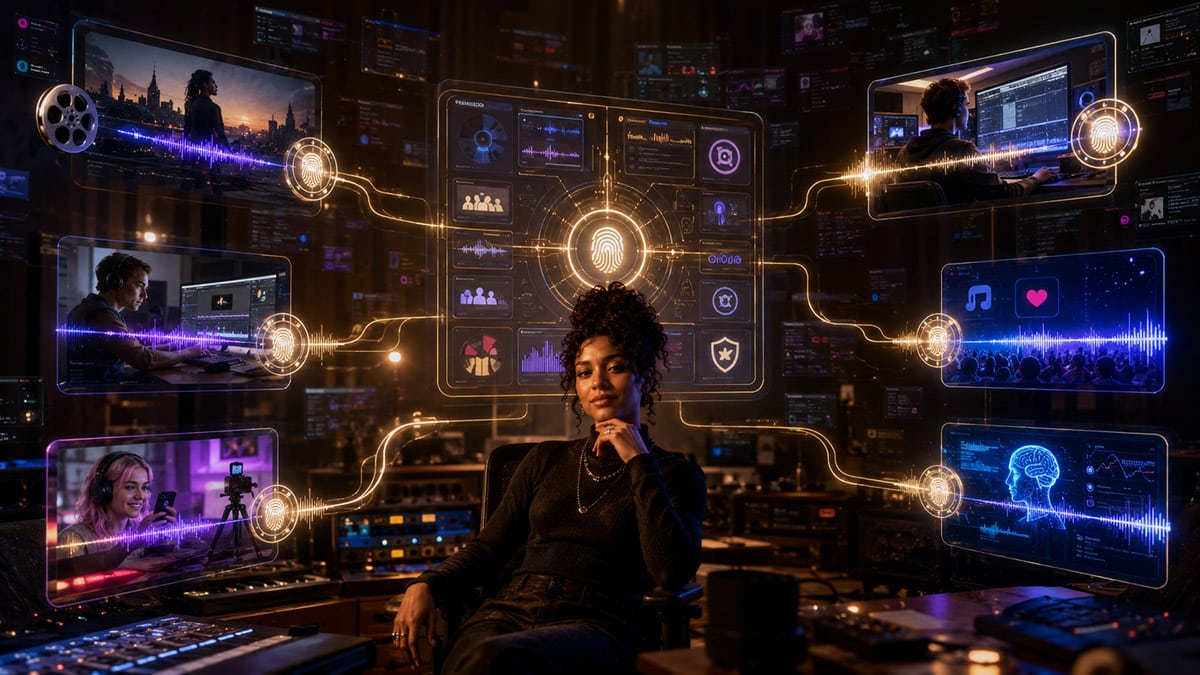
Making a Scene Presents -When the Recording Carries the License: AI, Audio Provenance and the Future of Artist-Owned Rights
Listen to the Podcast Discussion
An A2IM spotlight on SonicOrigin points toward a future where a recording can carry a persistent connection to its ownership and AI-licensing terms even after ordinary metadata disappears. Making a Scene is moving in the same direction with the MAS Audio Fingerprint system, connecting both Sync and AI licensing to the artist-controlled Fan Passport source of truth. Together, these ideas suggest that the next generation of music files may do something recordings have historically been terrible at doing: explain who owns them, what they can be used for and where somebody can go to legally spend money.
Your Recording Has Always Been Terrible at Introducing Itself
A modern recording can travel around the world faster than most musicians can find a clean pair of socks for the gig. You can finish a master in Georgia, send it to somebody in Los Angeles, have it dropped into a video project in London and discover it playing from somebody’s phone in Berlin before you have finished arguing about whether the vocal should have been half a decibel louder.
What generally does not travel nearly as well is everything that explains what that recording actually is as a business asset.
The WAV file may contain the music, but the master ownership information could be sitting in a database. The songwriter splits might be in a PDF. Publishing information may be in somebody else’s system. A Sync licensing policy could be sitting on a website. Contributor permissions may exist in contracts buried inside a folder creatively named “IMPORTANT MUSIC STUFF.” AI-training terms, assuming the artist has even established them, might live in yet another document.
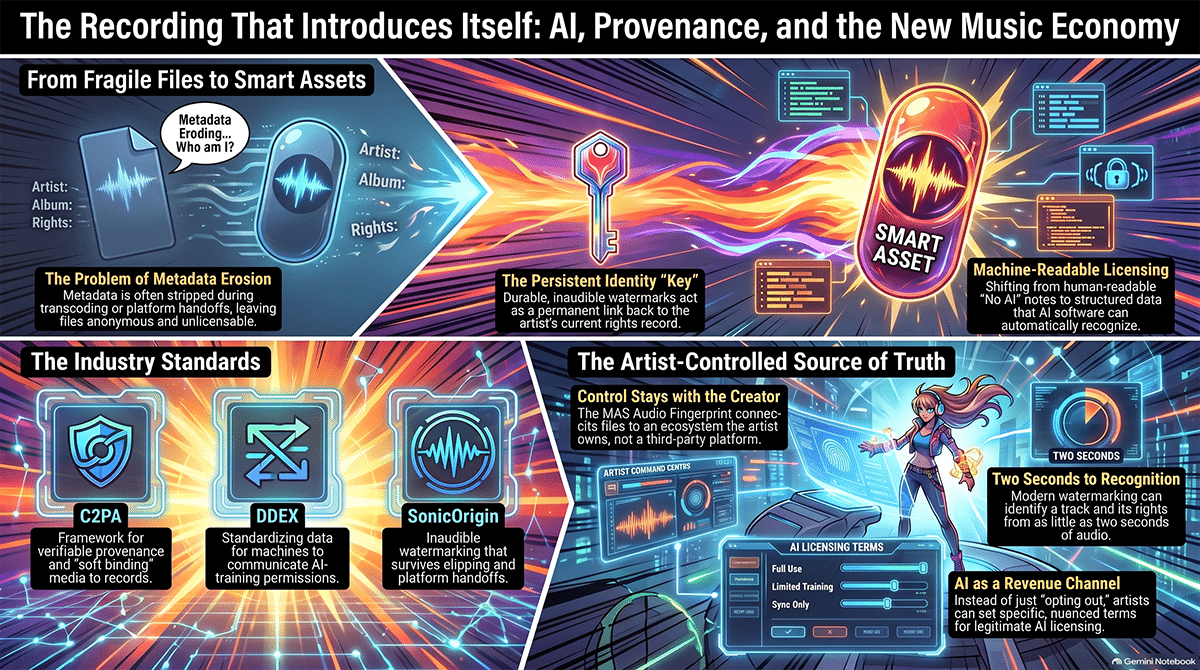
Once the audio leaves the artist’s hands, some of those connections can become surprisingly fragile. Files get transcoded, renamed, copied, clipped, converted and separated from the emails and documents that originally traveled with them. Ordinary metadata can be stripped or lost as content moves between different tools and platforms. C2PA, the Coalition for Content Provenance and Authenticity specifically addresses this problem in its current technical guidance, explaining that provenance credentials can become separated from the media and that durable identifiers such as invisible watermarks or fingerprints can be used to rediscover the associated record.
That is why an August 3, 2026, member spotlight published by the American Association of Independent Music, or A2IM, deserves more attention than the usual technology announcement. A2IM featured SonicOrigin, and its approach to placing an inaudible watermark directly into recorded audio. According to the description published by A2IM, the company says that watermark can carry ownership information, a declaration of origin and machine-readable AI-training terms while remaining recoverable after transcoding, platform handoffs and clipping. SonicOrigin also claims the mark can be recovered from as little as two seconds of audio.
Those are substantial claims, and they need to be treated as the company’s claims rather than universal facts about every file and every possible audio transformation. Still, the basic idea is important even before we start debating how many times somebody can mangle an MP3 before the watermark begins wondering what it did wrong in a previous life.
The really interesting part is not that the song can be identified.
The interesting part is that the song may be able to carry a persistent path back to the rules for doing business with it.
From “Do Not Train” to “Here Is Who Can License This”
Most of the public argument about AI and music has been framed as a fight over permission. Artists ask whether their recordings or compositions were used to train models. AI companies argue about fair use, licensing, access to data and what copyright law allows. Legislators and courts are being asked to untangle questions that did not exist in anything like their current form when much of modern copyright law was written.
SonicOrigin introduces a slightly different way of looking at the problem.
According to A2IM‘s description, SonicOrigin‘s system is not presented simply as a giant electronic “NO AI” sticker. The company describes a machine-readable assertion that can effectively communicate that a particular use requires a license and identify the party authorized to discuss that license. In other words, the recording could potentially tell a compliant system, “You do not have permission to simply assume this is free training material, but there is somebody you can talk to if you want to use it.”
That difference matters enormously.
An independent artist does not build a sustainable business simply by preventing everybody from doing things. The more useful position is having enough control over your music to decide when the answer is no, when the answer is yes and when the answer is, “Yes, but there is a license involved, and funny enough, licenses usually contain money.”
That is where persistent AI terms begin looking less like a protection device and more like part of an artist’s revenue infrastructure.
A recording could potentially identify itself, point toward the rights holder, communicate that AI training is not automatically permitted and provide a path toward an authorized transaction. If licensing markets for AI training continue developing, the difference between an anonymous audio file and an audio file that carries a persistent licensing identity could become economically important.
That does not guarantee that every AI company will recognize those signals. It certainly does not mean a watermark can rewrite copyright law. What it does is begin solving one of the practical problems that sits underneath almost every legitimate licensing system: identifying the work and finding the person who actually has authority to make a deal.
A2IM Is Highlighting Something Bigger Than One Startup
It would be easy to dismiss the SonicOrigin story as one company’s technology pitch if the rest of the standards world were moving in a completely different direction. It isn’t.
DDEX, the Digital Data Exchange organization develops many of the data standards used throughout the digital music business. DDEX says its Electronic Release Notification standard has already been updated so record companies and distributors can communicate whether a sound recording or music video may be used to train AI technology. DDEX is also continuing work on the terms and transaction flows that may be needed as AI-related use cases develop.
That is significant because DDEX is not talking about a vague philosophical preference buried somewhere on an artist’s biography page. It is talking about structured information that machines participating in the music supply chain can exchange.
The distinction is important. Human-readable policies are useful when humans are doing the reading. Machine-readable policies become much more important when software is making decisions at enormous scale.
If an artist writes “Do not use my recordings to train AI without permission” at the bottom of a website, that statement may be perfectly clear to a person who visits the site. An automated process that encounters only an audio file may never see it.
The next generation of rights infrastructure needs to close that gap.
DDEX provides one piece of that puzzle by creating standardized ways for music businesses to communicate information through their data systems. SonicOrigin is approaching the problem from another direction by placing a durable identifier into the audio itself. C2PA provides a broader technical framework for connecting media with verifiable provenance information even when normal embedded metadata has been lost.
None of these systems is identical, and it would be misleading to pretend they have somehow merged into one universal global music-license machine. What matters is the direction they are traveling.
The music industry is beginning to take seriously the idea that rights information should become more machine-readable, more persistent and easier to recover.
For independent artists, that could be a very big deal.
C2PA Shows Why the Idea Is Technically Plausible
C2PA gives us a useful way to understand how this kind of architecture can work without pretending the entire rights contract has to be shoved inside the audio waveform.
C2PA’s Content Credentials framework can associate a piece of digital media with a cryptographically signed provenance record. Its current implementation guidance explains the idea of a “soft binding,” which can be either a fingerprint computed from the content or an invisible watermark embedded into the content. That binding can be used to locate an external manifest containing the richer provenance information even if the manifest itself is no longer embedded in the file.
That is an important distinction.
The watermark does not necessarily need to carry a complete rights database inside the recording. It can carry a persistent identifier that acts like a key. The key allows an authorized system to find the current record stored somewhere else.
This is exactly the architecture that becomes useful when rights information changes over time.
An artist may change publishers. A songwriter may appoint a new administrator. A previously uncleared track may become fully cleared. A licensing contact may change. An artist may decide that a catalog is available for one form of AI training but not another.
A static block of information permanently embedded into a recording could become outdated.
A durable identity that leads back to a controlled and updateable source of truth is much more useful.
C2PA’s current approved soft-binding algorithm list makes the SonicOrigin connection particularly interesting. SonicOrigin‘s watermarking engine is actually listed there as a C2PA soft-binding algorithm for audio and video, with an entry dating to August 2025. That does not prove every performance claim SonicOrigin makes, but it does mean the technology is not merely waving at the standards world from across the parking lot. Its watermarking engine is represented in the C2PA soft-binding registry.
At the same time, there is an important technical nuance worth getting right. Earlier versions of C2PA contained their own Training and Data Mining assertion, but the current specification removed that native assertion. Current C2PA AI guidance instead points to an external training-and-data-mining assertion mechanism for communicating whether assets are allowed, constrained or not allowed for certain AI or data-mining uses. C2PA itself has previously clarified that its current technical specification should not be casually described as containing a standard C2PA TDM assertion.
That may sound like standards-committee trivia, but it matters because this field is moving quickly. If we are going to tell independent artists that machine-readable AI licensing is becoming real, we should also be precise about where those instructions actually live.
Making a Scene Is Building the Same Principle Around Artist Control
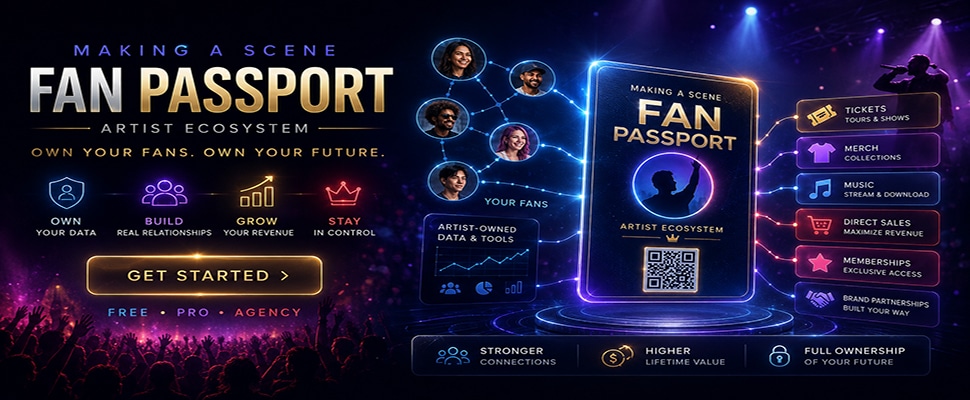
This emerging model also lines up with work being added to the Making a Scene Fan Passport Artist Ecosystem.
The MAS Audio Fingerprint system is being developed to give an artist’s audio a persistent connection to both Sync clearance and AI-licensing information. The important part is not simply that Making a Scene can recognize a recording. The larger goal is for that identity to connect back to the Artist Ecosystem’s artist-controlled source of truth so that the rights and licensing information remain under the artist’s control.
That makes the MAS approach complementary to the larger provenance movement rather than a replacement for it.
SonicOrigin is showing how an audio-level watermark can carry a durable connection to ownership, provenance and AI terms. DDEX is developing standardized ways for AI-related rights information to move through the traditional digital music supply chain. C2PA demonstrates how watermarks and fingerprints can reconnect media with richer provenance records after ordinary metadata disappears.
The MAS Audio Fingerprint system applies the same basic principle to the practical business world of an independent artist.
The recording carries a persistent identity. That identity connects back to the Fan Passport Artist Ecosystem. The Artist Ecosystem remains the source of truth for the artist’s rights information, licensing authority, Sync clearance and AI-use policy. The artist remains in control of the underlying resources rather than handing the permanent business identity of the catalog to yet another platform.
That last part is not a small philosophical detail.
It is the whole point.
The Source of Truth Matters More Than the Fingerprint
There is a danger whenever we talk about technology like this. The shiny piece gets all the attention.
Watermarks are interesting. Fingerprints are interesting. Cryptographic signatures are interesting. AI reading licensing instructions from a recording sounds like something we should probably illustrate with glowing blue waveforms and at least one person staring thoughtfully at a hologram.
The boring database behind all of it is more important. A fingerprint connected to incorrect rights information simply makes the wrong answer easier to retrieve.
If an artist says they control one hundred percent of the master but they actually signed half of it away, a persistent fingerprint does not fix the problem. If the composition has three writers and only one has approved the use, a machine-readable “SYNC CLEARED” declaration does not summon the other two signatures from the digital ether.
Technology can preserve a statement. It cannot make a false statement true. That is why the source-of-truth concept inside the Artist Ecosystem matters so much. The rights record should establish what the artist actually controls before the system attempts to communicate anything about licensing.
Master ownership needs to be known. Composition ownership needs to be known. Songwriter shares need to be documented. Publishers and administrators need to be identified. Samples and interpolations need to be accounted for. Contributor permissions need to be stored where appropriate.
Only then does persistent identification become powerful. When the underlying business record is clean, the fingerprint can become a road sign leading back to something reliable.
This Could Solve One of Sync Licensing’s Most Annoying Problems
Anyone who has spent time around Sync knows that finding the right song is only part of the job. A music supervisor may hear a perfect track and immediately want to know whether it can actually be licensed. Who owns the master? Who controls the composition? Are all the writers represented? Is the publishing one-stop? Are there samples? Is there an instrumental? Is there a clean version? Who has authority to sign the license?
The answers may be wonderfully organized. They may also live in six emails, two Dropbox folders, an old publisher spreadsheet and the memory of somebody who is currently on tour and does not answer texts before noon. The smaller the production and the tighter the deadline, the more dangerous that friction becomes.
A supervisor working on a television episode, advertisement, game or independent film may not have three days to reconstruct the chain of ownership. If another track sounds almost as good but can be cleared in twenty minutes, the second track may get the placement. That is why persistent clearance information can become a revenue tool.
The MAS Audio Fingerprint system is intended to allow a track prepared through the Fan Passport Artist Ecosystem to retain a persistent connection back to its Sync clearance information. If the filename changes or the normal metadata is stripped, the recording can still carry the identity needed for a compatible system to find the artist-controlled rights record.
The important phrase there is “artist-controlled.” Making a Scene is not building this around the idea that a centralized marketplace should become the permanent owner of the artist’s licensing identity. The artist’s ecosystem holds the authoritative information. The audio points back to it.
The Same Architecture Can Carry AI Licensing
Once that connection exists, Sync and AI licensing start to feel like two versions of the same underlying problem rather than separate worlds.
In both cases, someone is simply trying to understand an audio asset that has shown up in front of them. They want to know what the recording is, who controls it, what rights are attached to it, and what kind of use requires permission. They also need to know who is actually allowed to grant that permission and how a legitimate transaction begins.
Sync licensing tends to surface those questions when music is being considered for film, television, advertising, games, or any other visual media. AI licensing raises almost the same questions, just in a different context, where the goal might be training a model or working with stems, vocals, or compositions inside a dataset or development environment.
The use cases are different, but the rights problem starts in almost exactly the same place. That is why having a shared source of truth becomes so powerful.
With the Artist Ecosystem maintaining the authoritative rights record, the MAS Audio Fingerprint can act as the bridge that connects a traveling audio file back to that record. On the Sync side, that means quickly confirming clearance and identifying who can approve a placement. On the AI side, it means clearly communicating the artist’s licensing position and opening a path toward a proper negotiation when one is required.
What emerges is a single, durable business identity that can support multiple licensing markets at once. That is far more efficient than scattering the same information across disconnected AI opt-out forms on one side and Sync spreadsheets on the other.
AI Licensing Should Be More Than an Opt-Out Button
There is a bigger shift happening underneath all of this. For a long time, artists have been encouraged to think about AI mainly in defensive terms. The fear is that catalogs will be scraped, voices will be cloned, or styles will be imitated without permission. Those concerns are real, but they are not the whole picture.
For independent artists trying to build sustainable careers, the more interesting question is whether AI could also become a legitimate revenue channel when handled correctly. The answer will not be the same for everyone, and that is the point. Some artists will choose to keep their work completely out of AI training environments. They may decide that their vocals, compositions, or recordings should never be used for model development or digital replication. That is a valid and fully sovereign choice.
Others may take a more selective approach. A songwriter might allow catalog-level analysis while restricting generative use. A producer might license stems for very specific research or model training under tightly defined conditions. Another artist might explore carefully negotiated agreements for limited AI applications.
None of these paths is inherently right or wrong. What matters is that the artist has real control over the decision. That is where machine-readable licensing becomes important. Instead of reducing everything to a simple “yes” or “no,” the system can express nuance. It can indicate when permission is required, what types of use are allowed or restricted, and where an authorized party can be contacted to negotiate terms.
This is also what makes the SonicOrigin approach so interesting. It is not just about blocking access. It is about allowing the recording itself to guide legitimate users toward a licensing conversation when appropriate, rather than leaving them guessing or forcing them to hunt for rights information elsewhere.
The Law Still Gets a Vote
At the same time, it is important not to let the technology narrative outrun the legal reality.
A machine-readable statement that says “AI training requires a license” does not, by itself, create new legal rights in the United States. The U.S. Copyright Office continues to treat AI training as a fact-specific legal question, where outcomes depend on how fair use is applied in each case. Some uses may qualify as fair use, others may not, and courts ultimately decide based on the details of each situation.
What the Copyright Office has also emphasized is that licensing markets for AI-related uses are beginning to emerge and should be allowed to develop. That is a crucial point, because it shifts attention toward infrastructure rather than pure restriction.
A functioning licensing market depends on more than legal theory. It needs reliable ways to identify works, locate rights holders, communicate terms, and complete transactions. Persistent audio identity does not decide whether a use is fair or infringing, but it can make it much easier for legitimate users to find the correct path to licensing.
That distinction is important. This technology is not replacing copyright law. It is helping make copyright workable in a machine-driven environment.
Europe Is Moving Even More Directly Toward Machine-Readable Rights
Outside the United States, the direction of travel is even more explicit.
European copyright law already allows rights holders to reserve their works against certain text-and-data-mining uses, and it specifically anticipates that these reservations can be expressed in machine-readable form. As AI systems have become more central to content use, that idea has moved from theory into active policy development.
The European Commission has been exploring how general-purpose AI systems can recognize and comply with rights reservations at scale. Recent studies have even examined the possibility of centralized or standardized registries for opt-outs, including the use of identifiers, fingerprints, and metadata to help machines reliably detect rights signals.
All of this points to the same underlying challenge: how do you connect a piece of content encountered by a machine to a trustworthy, up-to-date rights declaration controlled by the actual rights holder?
Europe has not solved that problem yet, and no single watermark or registry will magically fix it. But the direction is clear. Machines are being expected to understand rights, which means artists and rights holders need better ways to express them in structured, durable forms.
A Recording Contains More Rights Than One Checkbox Can Handle
Music makes this problem especially complex because a single recording is rarely a single piece of ownership. The sound recording itself is one layer, while the underlying composition is another. Those rights may be split among multiple songwriters, publishers, and administrators. On top of that, there may be samples, featured performers, producers, and other contributors whose agreements affect how the work can be used.
AI adds yet another layer, because licensing a recording for training is not the same as allowing a digital replica of a voice or performance.
This is why a simple label attached to a file is not enough. A serious rights system has to understand what the asset actually is, which rights are involved, who controls them, and what authority exists for any given use.
That is also why the MAS Audio Fingerprint needs to connect back to a broader Artist Ecosystem. The fingerprint identifies the traveling audio, but the ecosystem holds the real rights structure behind it.
This Is Where Independent Artists May Have an Unexpected Advantage
For years, independent artists have often been seen as disadvantaged because they lack the infrastructure of major labels. But in a world of machine-readable rights, that assumption starts to shift. Large catalogs can be complicated. They often involve multiple layers of ownership, publishing splits, administration agreements, and territorial variations. Even finding the right person to approve a license can take time.
An independent artist who fully controls their master, clearly understands their composition rights, and keeps clean documentation of collaborators can actually present a much simpler and more attractive licensing profile. That simplicity has real value. A Sync supervisor benefits from one-stop clearance. An AI company looking for legitimate training material benefits from the same clarity.
When an artist can clearly say they control the master, control the publishing, and have documented permissions in place, they become significantly easier to work with than a fragmented catalog that requires multiple layers of approval just to begin a conversation. Independence alone is not the advantage. Clean, well-managed independence is.
The Artist Ecosystem Can Become the Business Layer Behind the Audio
This is where the Fan Passport Artist Ecosystem becomes more than just a supporting system. It functions as the underlying business layer that sits behind the music itself. Within that structure, the audio is connected to a single authoritative rights record. That record holds Sync clearance information, AI licensing policy, ownership details, and any alternate assets like instrumentals or clean versions. Everything related to the song lives in one controlled environment.
The MAS Audio Fingerprint then allows the audio file to remain connected to that system even as it moves through the world. The recording does not need to carry every detail inside itself. It only needs a reliable way to say, in effect, “this is who I am, and this is where my current rights information lives.” That separation is powerful. It allows the artist to update their business information without breaking the connection to the music itself, while still keeping full control over the underlying rights.
Artist Control Has to Survive the Platform
Anyone who has worked in music long enough has seen the same pattern repeat. A new platform appears, artists upload their work, and over time their entire business becomes tied to that system. Then something changes. Pricing shifts, terms are updated, companies are acquired, or features disappear, and suddenly the artist realizes that their “account” was never the same thing as their actual business.
The Making a Scene approach is designed to avoid that trap. Platforms, marketplaces, and AI services can all be useful, but none of them should become the sole place where an artist’s identity and rights live. The artist must retain control of the masters, contracts, metadata, licensing history, and core rights records.
The ecosystem should function as a source of truth that the artist owns, not a black box that defines them. The MAS Audio Fingerprint is valuable precisely because it connects external systems back to that artist-controlled foundation rather than replacing it.
The File Can Travel Without Taking the Business Away
In practice, a master might leave the Artist Ecosystem and travel through many different environments. It could be sent to a music supervisor, downloaded by an editor, passed through a distribution system, or shared in a production workflow. Along the way, filenames change, metadata gets stripped, and the original context can easily disappear.
What should not disappear is the connection back to the rights holder. A persistent fingerprint or watermark acts like a return address. Even if the file is separated from its original metadata, it can still point back to the current rights record maintained by the artist.
This is the same principle being explored by systems like SonicOrigin and the same direction Making a Scene is applying through MAS Audio Fingerprint. Different technologies, same goal: the identity of the recording should survive its journey.
Persistent Identity Could Change How Music Gets Discovered
Traditionally, licensing starts with outreach. Artists pitch supervisors, submit to libraries, or upload to marketplaces and hope the right person finds the track. That workflow is not going away, but it is no longer the only path.
With persistent identity, discovery can work in reverse. Someone might encounter a track in a video, a podcast, a game, or even a random file, and the audio itself can lead them back to the licensing source. Instead of forcing every discovery to begin inside a platform, the music itself becomes the entry point. The listener or creator finds the track first, and the rights information follows.
That shift creates a more open and decentralized licensing environment, where the music can circulate freely while still maintaining a clear path back to the artist.
The Same Thing Could Happen With AI Discovery
The same idea applies directly to AI systems. When a company is building a dataset, it may encounter a piece of audio that carries a persistent identifier. That identifier can resolve to a rights record that clearly states whether AI training is allowed, restricted, or requires a license.
From there, the process becomes structured rather than ambiguous. The system knows who to contact, what rights are available, and how to proceed with a legitimate agreement if one is possible. We are not yet in a world where every AI system behaves this way, but the direction is becoming clearer. Standards bodies, regulators, and industry groups are all moving toward machine-readable rights infrastructure.
A Watermark Is Not a Copyright Force Field
It is important to stay grounded about what this technology can and cannot do. A watermark or fingerprint does not prevent copying. It does not guarantee compliance. It does not force every system in the world to recognize or respect it. It also does not replace contracts, registration, or enforcement.
What it does provide is traceability. It helps connect content back to its source of truth and makes it harder for rights information to be completely lost as files move through different systems. That is useful, but it is not magic. It is infrastructure, not enforcement.
The Boring Paperwork Is Still Running the Show
For all the excitement around AI, provenance, and machine-readable licensing, the foundation still comes down to something very unglamorous: accurate rights information. Before any system can communicate licensing terms, those terms have to exist. Before a recording can declare who owns it, that ownership has to be properly documented. Before AI training or Sync licensing can be cleared, the underlying rights structure has to be correct.
Technology can make that information more durable and more accessible, but it cannot invent it. This is why good rights management is becoming one of the most important skills an independent artist can develop. It is not the most exciting part of the job, but it is the part everything else depends on.
The Master of the Future May Be Bigger Than the Audio File
Traditionally, a master has been thought of as the final recorded audio. In a modern licensing environment, that definition is expanding. The master increasingly includes not just the waveform, but also its identity, ownership record, provenance history, contributor information, licensing options, and available assets. It becomes a complete business object rather than just a sound file.
As AI systems, search tools, and licensing platforms become more automated, they will rely on structured information to make decisions. The artists who maintain that structure clearly and accurately will be in a much stronger position than those who rely on filenames and hope for recognition.
AI Should Become Part of the Revenue Stack, Not Another Tollbooth
From an artist’s perspective, AI licensing should not become another layer of gatekeeping. Instead, it should function as one more potential revenue stream within a broader direct-to-artist ecosystem. That might include licensing recordings, compositions, stems, or other approved materials under specific conditions. The terms can vary widely depending on the artist’s preferences and strategy.
The key point is control. The artist decides what is allowed, what is restricted, and what is off-limits entirely. Persistent licensing identity helps make that possible by ensuring that every use can be traced back to the decision maker rather than an anonymous database.
Sync and AI Licensing Belong in the Same Rights Conversation
Although Sync and AI licensing look very different on the surface, they both begin with the same foundation: ownership and control of rights. Both require clarity about who owns the master and the composition. Both depend on documented permissions. Both need a clear way to define what is available for use. And both ultimately rely on a system that connects usage back to the people who are authorized to approve it. That is why it makes sense for both to live within the same underlying rights infrastructure rather than separate, disconnected systems.
One Source of Truth Beats Six Dashboards
Independent artists already deal with fragmented data across streaming platforms, distributors, PROs, publishers, Sync libraries, and emerging AI services. Each one holds a partial version of the truth. The result is often a scattered system where no single place reflects the full reality of the artist’s business.
A unified source of truth changes that dynamic. Instead of multiple competing records, there is one authoritative system that everything else references. If one platform disappears or changes, the artist’s core business does not go with it. That stability is just as important for AI licensing as it is for traditional music distribution.
The Artist Should Be Able to Leave
A healthy system always has to answer a simple question: what happens if the platform disappears? If the answer is that the artist loses access to their licensing identity or business structure, then the system has failed at a fundamental level. The artist must retain the masters, the rights records, the contracts, and the licensing history. The fingerprint or identifier should be a connection, not a dependency.
That is what keeps the system artist-first rather than platform-first.
This Is What Decentralization Is Supposed to Look Like
It is easy to confuse decentralization with technology trends like blockchain or tokenization, but the real goal is much simpler. It is about preventing any single platform from becoming the sole gatekeeper of an artist’s identity and rights. Different technologies can support that goal, including cryptographic records, distributed systems, and provenance standards like C2PA. But none of them are valuable unless they actually solve the problem of artist control.
The point is not to decentralize for its own sake. The point is to ensure that control remains with the artist.
SonicOrigin and MAS Are Pointing Toward the Same Larger Opportunity
The significance of SonicOrigin’s A2IM spotlight is not that it represents a single solution, but that it reflects a broader direction across the industry. Standards bodies like DDEX are working on machine-readable rights signals. C2PA is building frameworks for durable provenance. Regulators in Europe are exploring structured opt-out systems for AI training. And systems like MAS Audio Fingerprint are connecting audio directly to artist-controlled rights infrastructure.
These are not competing ideas. They are different pieces of the same emerging ecosystem.
The Recording Starts Acting Like a Business Asset
In this emerging model, a recording is no longer just a file that gets licensed occasionally. It becomes a persistent business asset that can be recognized, understood, and transacted across multiple contexts. A music supervisor can find clearance information instantly. An AI system can identify licensing requirements automatically. And in both cases, the process begins with the recording itself leading back to the artist’s controlled rights record.
The same piece of audio can participate in multiple markets without losing its identity or creating conflicting versions of ownership. That is what makes persistent provenance so powerful.
It Also Makes the Artist Harder to Erase
Over time, music often becomes separated from its original context. Files are reposted, renamed, redistributed, and detached from their creators. Without a persistent identity, it becomes increasingly difficult to trace ownership or even recognize the original artist.
A system that maintains that connection helps prevent that erosion. It ensures that the artist remains visible wherever the music travels. In a world where machines increasingly determine what gets surfaced, licensed, or paid, that visibility becomes essential.
The Future Is Not “Protect the Song.” It Is “Empower the Song.”
The shift here is subtle but important. The goal is not to lock music away in order to protect it. The goal is to give it enough structured identity that it can move freely through the world while still remaining connected to its creator.
A recording that can identify itself, point to its owner, and guide users toward legitimate licensing is far more useful than one that is simply restricted or hidden.
And Yes, the Paperwork Still Wins
After all the discussion of AI systems, fingerprints, provenance, and machine-readable rights, everything still comes back to the same foundation: accurate, well-managed rights information.
Technology can support it, extend it, and make it more durable, but it cannot replace it. The systems being built today are not changing the importance of rights. They are making those rights more visible, more portable, and more usable in a machine-driven world.
The Music Industry May Finally Be Teaching Files to Know Who They Are
What is emerging is a music ecosystem where recordings are no longer disconnected objects drifting through platforms. Instead, they remain tied to a living rights structure that travels with them. For independent artists, the opportunity is not just to protect their work, but to build the infrastructure that allows their music to participate in new markets like AI and Sync without losing control.
SonicOrigin, DDEX, C2PA, and the MAS Audio Fingerprint are all pointing in that direction from different angles. The result is a future where the music carries not just sound, but identity, ownership, and a clear path back to the artist. And after decades of losing track of who owns what in the music industry
 |  Spotify |  Deezer |  Breaker |
 Pocket Cast |  Radio Public |  Stitcher |  TuneIn |
 IHeart Radio |  Mixcloud |  PlayerFM |  Amazon |
 Jiosaavn |  Gaana |  Vurbl |  Audius |
 Reason.Fm | |||
Find our Podcasts on these outlets
Subscribe to Our Newsletter
Discover more from Making A Scene!
Subscribe to get the latest posts sent to your email.


