
The New Music Search Engine Is a Conversation




Making a Scene Presents – The New Music Search Engine Is a Conversation
Listen the the Podcast Discussion
The Search Box Just Learned How to Talk
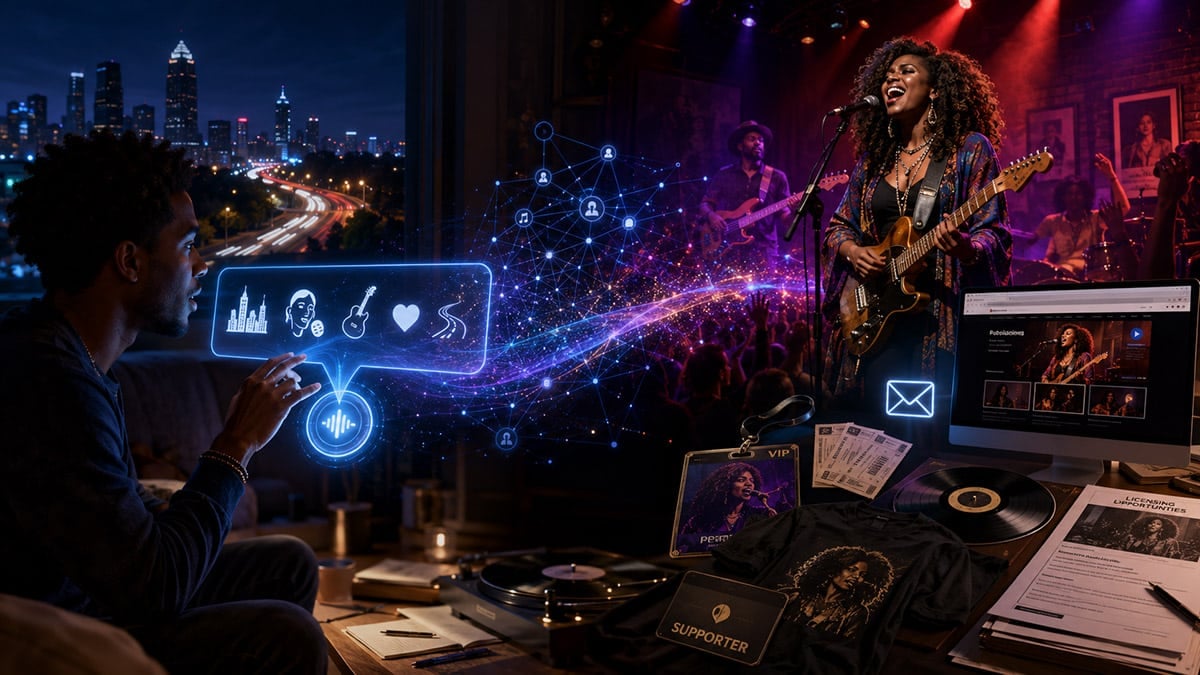
Picture a music fan driving home late at night. The road is empty, the dashboard is glowing, and the fan wants to hear something new. In the old days, this person might search for “blues rock,” open a playlist with a picture of a guitar on the cover, and begin skipping through songs that all seem to have been chosen by the same mysterious fellow wearing sunglasses indoors.
Now the fan may be able to ask a much better question.
“Find me a blues-rock artist from Atlanta with powerful female vocals, strong guitar work, and songs that sound good on a late-night drive.”
That is not a normal search. It is a description of a need. The listener is not naming an artist or requesting a song title. The listener is describing a sound, a place, a voice, a mood, and a moment.
This is where music discovery is heading.
On July 14, 2026, Spotify announced a conversational experience that lets eligible listeners speak or type requests, ask follow-up questions, learn more about what they are hearing, refine the music being played, explore their listening history, and perform actions such as adding a song to the queue or following an artist. Spotify calls the feature “Talk to Spotify,” and its official announcement can be found at https://newsroom.spotify.com/2026-07-14/talk-to-spotify-announcement-beta/.
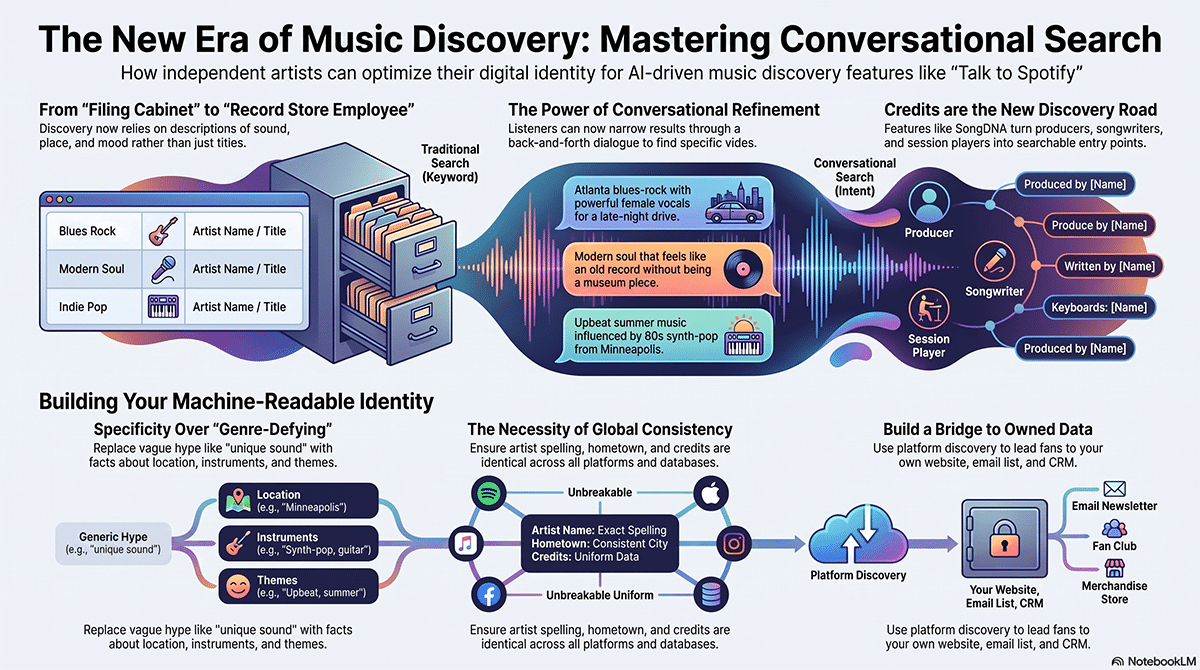
This means the music search box is beginning to act less like a filing cabinet and more like a knowledgeable record-store employee who has heard nearly everything, remembers what the customer played last Tuesday, and apparently never needs lunch.
That could be wonderful for independent artists.
It could also become another gate that artists must learn to pass through.
What Spotify Has Actually Announced
It is important to slow down here because new technology announcements tend to collect rumors the way black T-shirts collect cat hair.
At launch, Spotify said Talk to Spotify was rolling out gradually as a beta for Premium users who were at least 18 years old in the United States, Ireland, and Sweden. It was available in English on Spotify’s iOS and Android mobile apps. As of July 21, 2026, Spotify’s official support material still describes it as a beta feature for Premium listeners aged 18 and older. Spotify has not announced through those official pages that the conversational feature is available to everyone worldwide.
Listeners can begin a conversation from the Spotify Home screen or from the Now Playing view. They can type or use the microphone. The system can respond to broad listening requests, answer questions about music and other media, refine what is playing, explore parts of the user’s listening history, and carry out certain actions. Spotify’s examples include asking for upbeat summer music, requesting new releases from favorite artists, asking who influenced an artist, making the music more upbeat, finding out when a song was first played, adding something to the queue, or following an artist. Spotify’s support page is available at https://support.spotify.com/us/article/talk-to-spotify/.
Spotify also clearly warns that this is a work in progress. Its announcement says responses will not always be perfect. That matters. We are not dealing with an all-knowing musical oracle floating above the clouds. We are dealing with a beta feature inside a commercial streaming service. It may be useful. It may be clever. It may occasionally recommend something that makes a listener wonder whether the machine has been spending too much time alone.
The confirmed fact is that listeners can now have a more detailed back-and-forth conversation about what they want to hear.
The unconfirmed part is exactly how Spotify decides which artists fit those requests.
Spotify has not publicly said that an artist can improve conversational placement simply by changing a biography, adding a hometown, posting more interviews, or repeating a genre phrase seventeen times. There is no confirmed secret recipe for conversational search ranking.
Still, artists would be wise to prepare for a music-discovery world in which clear identity, useful context, complete credits, accurate locations, and consistent information may matter more than they did when search was mainly based on names, titles, playlists, and broad genres.
That is not a promise about an algorithm. It is basic business sense.
When fans begin asking better questions, artists need to provide better answers.
From Searching for Names to Describing Intent
Traditional music search usually begins with something the listener already knows. The fan types the name of an artist, a song, an album, or a genre. The platform then returns matching results.
That works nicely when the listener knows what to request.
It works less well when the listener knows only what they want to feel.
A fan might want a singer who sounds raw but not angry. The fan may want a modern soul artist whose recordings feel like an old record without sounding like a museum display. The listener may want a Southern female artist who plays small venues, writes about working-class life, and uses slide guitar without turning every song into a twelve-minute guitar solo that frightens nearby houseplants.
A normal keyword search struggles with that kind of request.
A conversational system can attempt to understand the full idea. The fan could begin by saying, “Play some modern soul.” After hearing the first few tracks, the fan might say, “Make it less polished.” Then the listener could add, “Focus on female artists from the South who tour smaller venues.”
The important change is not simply that the fan can talk instead of type. Voice control has existed for years.
The important change is that the request can develop through a conversation.
That turns music discovery into a process of refinement. The fan can explain what is wrong with the first answer and move closer to the desired result.
For an independent artist, this may open doors that traditional playlist categories kept closed. An artist who does not fit neatly into “blues,” “rock,” “Americana,” “soul,” or “country” may still match a detailed listener request extremely well.
The question is whether the system can understand who that artist is.
The Great Genre-Defying Identity Crisis
Independent artists have spent years being told to stand out. Naturally, many have responded by describing themselves as impossible to describe.
Their biographies say they are “genre-defying.” Their music is “a unique blend of influences.” Their sound “cannot be placed in a box.” Their live show is “an unforgettable journey.” Their new single is “unlike anything heard before.”
This language feels exciting, but it often contains almost no useful information.
A brilliant artist may indeed cross several genres. That does not mean the artist should become invisible behind a fog machine of promotional adjectives.
A listener asking for music through conversation may use real details. The fan may ask for an Atlanta blues-rock singer, a Navajo guitarist, a Minneapolis power-pop band, a jazz trio that uses electronic textures, or a songwriter whose lyrics deal with grief and recovery.
An artist described everywhere as “genre-defying” may not provide enough context to match those questions.
Being impossible to describe is not always a marketing superpower. Sometimes it is just bad directions.
The artist does not need to flatten the music into one boring label. The goal is not to choose a single box and live inside it forever. The goal is to describe the music truthfully enough that a fan, journalist, talent buyer, music supervisor, or discovery system can understand the artist’s place in the world.
A clearer description might say, “An Atlanta-based blues-rock singer and guitarist mixing Southern soul vocals, heavy slide guitar, and songs about working-class life.”
That sentence will not fit every artist. It is not automatically the perfect description. It does, however, contain useful information. It tells us the location, the broad style, the vocal influence, an important instrument, and the subject matter.
Compare that with, “An exciting genre-bending artist with a unique sound.”
The second description could refer to almost anyone from a teenage bedroom producer to a kazoo orchestra with a fog machine.
Building a Machine-Readable Artist Identity
“Machine-readable identity” sounds like something artists might need to have surgically installed at a technology conference.
It is much simpler than that.
A machine-readable artist identity is a clear and consistent set of facts that helps digital systems and human beings understand who the artist is.
It begins with the artist’s name. The spelling should remain consistent. If the group is called The Midnight Wanderers on Spotify, Midnight Wanderers Band on YouTube, and Midnight Wanderer Official on the website, fans and systems may have trouble deciding whether these are the same act.
The identity also includes genre and subgenre descriptions, hometown, current location, band members, songwriters, producers, engineers, featured artists, instruments, themes, influences, release dates, label information, publishing information, ownership information, official links, and contact details.
None of these items guarantees conversational discovery.
Together, however, they create a stronger public record.
That record can help a fan recognize the right artist. It can help a venue understand the live show. It can help a journalist prepare an interview. It can help a music supervisor determine whether the artist might fit a project. It can help a festival understand the artist’s relationship to a regional scene. It may also help future search and recommendation systems interpret the artist more accurately.
The key word is “accurately.”
Artists should not load biographies and profiles with every genre they can find. A folk singer does not become more discoverable by claiming to be folk, rock, jazz, hip-hop, metal, reggae, blues, classical, ambient, and dance-pop. That does not create a broad identity. It creates a musical yard sale.
Bad metadata is not marketing. It is like putting the wrong address on every package and then becoming angry at the mail carrier.
Your Biography Needs to Say Something
The artist biography may become one of the most important documents in the independent artist’s business.
Unfortunately, many biographies are built from large piles of adjectives and very few facts.
“A dynamic artist with a passion for music” does not tell the reader anything useful.
“Known for an unforgettable sound and electrifying stage presence” is not much better. Somewhere in the world, there may be an artist whose official biography reads, “Our sound is fairly forgettable and the stage show is mildly adequate,” but that person has yet to submit a press release.
A useful biography gives context.
It explains where the artist is based, where the artist came from, what kind of music is being made, which instruments shape the sound, which traditions or local scenes influenced the work, who is in the group, what the songs are about, and what listeners can expect from a live performance.
A strong biography can explain why the current release matters. It can describe how the record was made, who produced it, which musicians contributed, and what changed since the last album.
This does not mean the biography must sound like a police report. Personality still matters. A good biography should feel alive. It should contain story, emotion, struggle, humor, and point of view.
The difference is that the story should be built from facts rather than clouds of hype.
A conversational discovery system may or may not use an artist’s official biography directly. Spotify has not confirmed that biographies determine conversational recommendations. Still, a clear biography improves the wider digital identity surrounding the artist. It gives journalists, fans, venues, websites, and search tools reliable language with which to describe the work.
That matters even if no algorithm ever reads a word of it.
Credits Are Becoming Roads to Discovery
Credits used to live on album jackets, CD booklets, and liner notes. Fans could hold a record, read the names, and discover that the same producer, drummer, songwriter, or engineer appeared on several albums they loved.
Streaming often reduced that experience to a song title, a lead artist, and a small image.
Spotify has been expanding the credit information available inside the service. Its support page states that the credits shown on Spotify come from metadata supplied by labels and distributors. These credits can include producers, engineers, songwriters, and featured artists. Spotify also says that missing or incorrect credits generally must be corrected through the label or distributor, which then resends the metadata. The official information is available at https://support.spotify.com/us/artists/article/song-credits/.
This is important because credits are not decoration. They can lead to work.
A fan may discover a producer whose sound appears on several favorite records. A songwriter may gain attention because people can follow the songs they helped create. An engineer may be hired after an artist notices the person’s work across several releases. A session player may become visible instead of remaining buried in a spreadsheet on somebody’s laptop.
Credits also protect revenue.
When writers, publishers, master owners, featured performers, and other contributors are not properly documented, payments can be delayed, misdirected, disputed, or lost. A licensing opportunity can stall because nobody knows who has the authority to approve the composition or the recording.
The music business has a strange habit of treating paperwork as boring right up until someone is waiting for a check.
SongDNA Turns Credits Into a Map
Spotify’s SongDNA feature is another sign that discovery is expanding beyond the artist name and song title.
Spotify announced SongDNA on March 24, 2026. The company described it as an interactive feature inside the mobile Now Playing view that lets Premium listeners explore writers, producers, collaborators, samples, interpolations, and cover versions connected to supported tracks. The official announcement is available at https://newsroom.spotify.com/2026-03-24/songdna-announcement-beta/.
Spotify said SongDNA was rolling out globally to Premium users on iOS and Android and would become broadly available to Premium users during April 2026. Spotify’s current support page continues to describe SongDNA as an interactive discovery feature inside the mobile app. That page is available at https://support.spotify.com/us/artists/article/songdna/. The original announcement called the experience a beta, and Spotify’s support material continues to explain how artists and teams can manage parts of the SongDNA presentation through Spotify for Artists.
SongDNA does not promise perfect or complete information. Spotify says the connections are built from information supplied by artists and their teams, along with community-sourced data. Samples and certain song connections are tied to information from WhoSampled. Eligible artist and label teams can review and manage parts of the feature in Spotify for Artists, although Spotify notes that changing SongDNA does not change the separate credits displayed elsewhere in the app.
That detail matters. SongDNA should not be confused with a complete legal ownership database. It is a discovery experience.
Still, it shows where music listening may be heading. A song can become the entrance to a network of writers, musicians, producers, samples, covers, influences, and related catalogs.
For independent artists, accurate credits can create more roads leading into the music. They can also lead toward session work, production work, songwriting opportunities, publishing income, licensing relationships, and new collaborations.
A producer credit might cause another artist to ask about production services. A drummer credit might lead to a session request. A songwriter connection might create a co-writing opportunity. A cover-song link might introduce listeners to an older catalog.
The song is no longer only a product. It is also a map.
Location May Become a Business Tool Again
The internet encouraged artists to think globally. That opened wonderful possibilities, but it also caused many artists to hide the fact that they live somewhere.
Their social profile says they are based on “Planet Earth.” Their biography says the music comes “from the heart.” Their website has no city, state, region, or country.
This is poetically pleasant and commercially unhelpful.
Conversational discovery makes location more interesting because a fan can ask for something local or regional.
A listener may ask for a blues-rock artist from Atlanta. A traveler may want a New Orleans brass band. Someone in Chicago may ask for touring roots artists playing nearby. A fan may search for a Brooklyn punk band, a Memphis soul singer, or a folk group connected to Appalachia.
Location can connect discovery to action.
It can lead toward a show, a regional festival, a venue booking, a record-store appearance, a local radio interview, a community event, or a hometown partnership. Those are not abstract engagement numbers. Those are possible ticket sales, merchandise sales, performance fees, press opportunities, and new fan relationships.
Artists should keep their official website updated with current show information. Concert-discovery services such as Bandsintown at https://www.bandsintown.com/ and Songkick at https://www.songkick.com/ can also help fans track performances, but the artist-owned website should remain the final source the artist controls.
A profile that says “Earth” may feel delightfully mysterious. It does not help a fan discover that the band is playing twelve miles away on Friday.
A Song Is More Than an Audio File
Streaming trained the music business to think of a song as a file with a title, an artist name, some artwork, and a play button.
The listener often receives very little context.
Yet songs are full of context.
A song can have a story, a place, a cultural history, a recording method, a lyrical theme, a mood, a tempo, a set of instruments, a group of collaborators, and a reason it was written.
One recording may have been tracked live in a small room with the band playing together. Another may have been built from homemade samples. One song may be about grief. Another may be a fictional crime story. One track may feature a cigar-box guitar. Another may include a church choir, a vintage drum machine, or a horn section recorded in somebody’s kitchen because that was the only room available.
That context helps people understand the music.
It may also help conversational systems answer more detailed questions in the future. Again, Spotify has not said that all of this information directly determines recommendations. Artists should not pretend there is a confirmed ranking trick hidden inside a lyric page.
The larger point is that rich, accurate context makes an artist easier to understand across the whole digital world.
Artists can publish that context through an official website, release pages, lyric pages, electronic press kits, newsletters, videos, interviews, album notes, distributor metadata, and properly maintained rights records.
YouTube at https://www.youtube.com/ can host behind-the-song videos, studio footage, lyric videos, and live performances. The artist’s own website can gather those pieces into one reliable home. An email newsletter can carry the story directly to fans without hoping that a platform decides to deliver it.
The artist should not describe every track as happy, sad, energetic, relaxing, cinematic, workout-friendly, romantic, angry, peaceful, retro, futuristic, and perfect for both weddings and bank robberies.
Context needs to be honest to be useful.
Playlist Pitching Is Not Dead
Every time a new discovery tool appears, somebody announces the death of playlists.
The playlists usually ignore the announcement and continue operating.
Editorial playlists, listener playlists, algorithmic radio, social video, music journalism, live performance, recommendations from friends, traditional search, and conversational discovery can all exist at the same time.
The change is not that playlist pitching suddenly becomes useless.
The change is that being easy to place in a playlist may no longer be enough.
For years, artists have been encouraged to describe songs using playlist language. A release is called “perfect for chill playlists,” “ideal for workout playlists,” or “a great fit for indie discovery.” This can sometimes be practical, but it can also reduce a real piece of music to background wallpaper.
Conversational discovery may reward a more complete identity. A fan may not ask for “a song suitable for playlist placement.” A fan may ask for a female blues guitarist from Georgia with a rough voice, a small-band sound, and lyrics about surviving a difficult year.
That is not a playlist category. It is a human request.
Artists should continue pitching suitable playlists, but they should also develop language that explains what the music actually is.
“Indie,” “alternative,” “authentic,” and “genre-bending” are not useless words. They are simply too broad to carry the entire identity.
Specificity gives the listener something to grab.
Your Identity Should Not Change at Every Website
An artist’s information should remain reasonably consistent across the web.
The official website should not say the band formed in 2019 while the biography sent to journalists says 2021. The Spotify profile should not use a different artist spelling from the distributor. The electronic press kit should not list musicians who left three years ago. The show calendar should not advertise a concert that was canceled last month.
The artist’s Spotify profile, distributor records, website, press kit, Bandcamp page at https://bandcamp.com/, YouTube channel, social pages, Bandsintown listing, Songkick listing, publishing registrations, performance-rights records, and press coverage should agree on basic facts.
This does not mean all of those services send their information directly into Spotify. Spotify has not said that a Bandcamp biography, a newspaper review, or an artist website automatically feeds Talk to Spotify.
Consistency matters for a wider reason.
It creates a stronger and more trustworthy public identity. Fans can verify that they have found the right artist. Journalists are less likely to repeat old information. Venues can find current contact details. Music supervisors can identify the proper rights owner. Search tools may have an easier time connecting different references to the same artist.
Think of the artist’s digital identity as a trail of road signs. Every sign does not need to look identical, but they should not point toward different towns.
Conversation Does Not Mean Perfection
Conversational music search creates real possibilities, but it also creates new ways for things to go wrong.
The system may misunderstand a genre. It may confuse two artists with similar names. It may rely on incomplete information. It may favor artists with larger amounts of available data. It may struggle with regional scenes, languages, new subgenres, or music that has never been described clearly online.
Spotify admits that Talk to Spotify is a beta and that responses will not always be right.
Artists should also consider the problems caused by fraudulent uploads, incorrect artist-page assignments, synthetic music, missing credits, and outdated biographies. A conversational interface does not automatically clean up the messy parts of the digital music business.
It may simply speak confidently about the mess.
There is also a business question behind every recommendation. Spotify is a private platform. Its job is to serve listeners and operate its own service. The music it recommends may fit the listener’s request, but the overall system is also designed to keep the listener using Spotify.
That does not make the recommendation evil. It means the platform and the artist do not have identical goals.
Spotify wants a satisfied Spotify customer.
The artist needs a lasting artist customer.
Those goals can overlap, but they are not the same.
The Platform Knows the Listener
Spotify’s announcement says its conversational experience can draw on information such as favorite artists, playlists, repeat listens, and listening history. Its support material also shows that listeners can ask questions about their past listening behavior and request music based on those patterns.
Spotify for Artists gives artists useful analytics. Its official analytics page at https://artists.spotify.com/analytics describes information about streams, saves, listener engagement, demographics, playlists, and audience segments. That can help an artist understand growth and see where listening activity is happening.
What the artist does not receive is ownership of the individual listener relationship.
A person may discover an artist, play three songs, save an album, and follow the artist. The artist may see the results reflected in analytics. The artist does not automatically receive that listener’s email address, phone number, purchasing history, personal preferences, or permission to make direct contact.
The platform knows the customer.
The artist often receives the applause through a wall.
This is one of the biggest business problems in modern independent music. Artists can build large audiences on services they do not control while remaining unable to reach those people directly.
A million impressions are not the same as a million relationships.
Ten thousand followers are not the same as ten thousand customers.
A listener is valuable, but a listener who has voluntarily joined the artist’s world is far more valuable over time.
Fan Data Is the New Currency
Calling fan data a currency can sound cold. It can bring to mind giant companies quietly trading personal information while everybody clicks “Accept” because they are trying to make a pop-up box disappear.
That is not the Making a Scene approach.
Artist-owned fan data should be permission-based. It should be collected openly. Fans should know what they are joining and why. Artists should protect the information and use it to improve the fan relationship rather than treating supporters like laboratory mice with credit cards.
The value comes from memory.
An artist-owned system can remember that a fan lives near Atlanta, attended two shows, bought vinyl, prefers email over text messages, and joined a membership. That information can help the artist send more useful messages.
The Atlanta fan can receive news about an Atlanta show instead of sixteen reminders about a concert in Oregon. The vinyl buyer can hear about a signed pressing. The repeat concertgoer can receive early ticket access. The member can receive the promised private content without digging through six social feeds and a promotional email about mattress sales.
This is how data becomes revenue without becoming creepy.
It helps the artist serve the fan more accurately.
It can lead to ticket sales, merchandise, memberships, direct music sales, crowdfunding, special events, house concerts, lessons, workshops, and fan support.
The data does not replace the relationship.
It helps the artist remember the relationship.
Build a Bridge, Not an Escape Tunnel
Artists should not treat Spotify as an enemy that fans must flee.
That would make little sense. Fans enjoy streaming. Spotify can introduce people to music they might never have found otherwise. Conversational discovery could make those introductions more personal and more useful.
The problem begins when discovery has nowhere to go.
The artist needs to build a respectful bridge from Spotify into an artist-owned world.
That bridge might lead to an official website, an email signup, a text community, a direct store, a concert calendar, a membership, a free download, a fan club, a behind-the-song page, a private livestream, or a Fan Passport.
The goal is not to drag the listener away from Spotify before the first song ends. That would be like proposing marriage before the first chorus.
The goal is to offer the next sensible step.
A listener who wants show dates should find show dates. A fan who wants lyrics should find lyrics. A vinyl collector should find the vinyl. A musician who loves the guitar tone may want information about lessons, production services, or the studio where the record was made.
Every page should answer a real fan question.
The artist’s website should not be a dusty digital brochure that says “Welcome to my website” and then points everyone back to social media.
It should be the artist’s business headquarters.
The Fan Passport and the Memory of Fandom
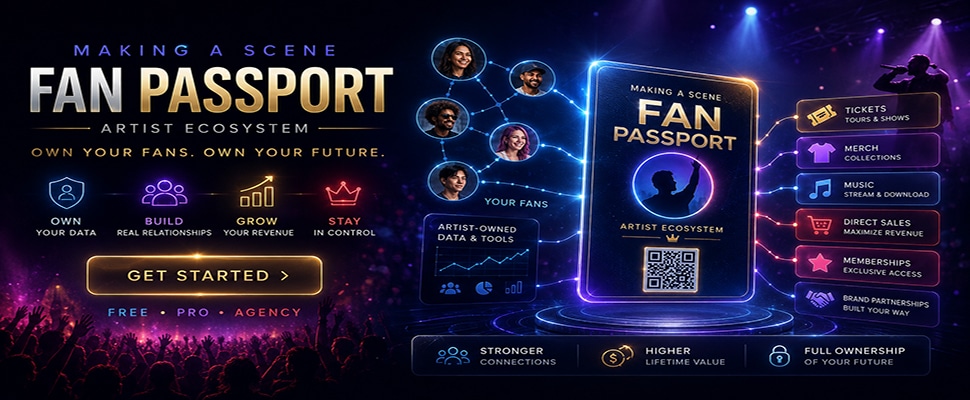
The Making a Scene Fan Passport offers one model for building that bridge. You can create your own free account at https://masfanpassport.app/ and your fans can download the Fan passport app on Iphone (Mas Fan Passport) and Soon to be released on android.
The basic idea is that a fan relationship can grow through a series of meaningful actions. A fan may discover an artist through streaming, visit the official website, join with permission, attend a concert, scan a QR code or tap an NFC point, receive a show stamp, buy an album, purchase merchandise, support a campaign, or join a membership.
The artist can then remember that journey inside an artist-controlled customer relationship system.
This is not about turning music into a supermarket loyalty card.
It is about recognizing that fandom develops over time.
The person who streamed one song yesterday should not receive the same message as the fan who has attended ten concerts and purchased every album. Both people matter, but they are at different points in the relationship.
A Fan Passport can help the artist recognize those differences without handing the full history to a social or streaming platform.
It can also make support more enjoyable. A fan may collect show stamps, unlock a reward, gain early access, receive a signed item, or be recognized as a longtime supporter.
The technology should remain in the background. The relationship should stay in the foreground.
Fans do not wake up excited about entering a CRM database.
They may become excited about being remembered.
How a Conversation Can Become a Revenue Stack
Imagine the listener from the beginning of this article.
She asks Spotify for a blues-rock artist from Atlanta with powerful female vocals and strong guitar work. Spotify recommends an independent artist who fits the request.
The fan listens to a song. Then another. She follows the artist.
Later, she visits the artist’s profile and finds a clear link to the official website. The website has current show dates, a strong biography, a store, a newsletter signup, and a page explaining the story behind the new album.
The fan joins the email list because the artist offers useful updates rather than promising “exclusive content” that turns out to be another photograph of a coffee cup.
Two weeks later, the artist announces a local show. Because the artist knows the fan’s city and has permission to send email, the fan receives the announcement.
She buys a ticket. She brings a friend. At the show, she buys a shirt and a signed record. She scans a Fan Passport code and receives a show stamp. A month later, she joins the artist’s supporter membership because she wants early access to live recordings.
One conversational recommendation has now touched streaming, email capture, ticket sales, merchandise, direct music sales, fan referral, membership income, and long-term customer data.
That path is not guaranteed.
Talk to Spotify is not a magic money faucet.
It is a possible entrance to a business funnel. The artist still needs good music, accurate information, a working website, current shows, useful communication, products worth buying, and a reason for the fan to return.
Discovery creates attention.
The artist’s business system must turn attention into a relationship.
The relationship can then support income.
Turning Discovery Into Ticket Sales
Live music is one of the clearest ways conversational discovery could become real revenue.
A listener may ask for artists connected to a city, region, venue, genre, festival, or scene. If the discovered artist has accurate and current show information, that interest can move toward a ticket.
The artist’s show page should include the date, venue, city, ticket link, performance time, supporting artists, and any reason the event is special.
“Friday at Joe’s Bar” is not enough if the fan does not know which Joe’s Bar, where it is, when the artist performs, or whether Joe has seventeen bars spread across three states.
Concert listings on Spotify, Bandsintown, Songkick, venue sites, ticket platforms, and social media can help with discovery. The artist’s own calendar should tie those pieces together.
Once fans join the artist’s email list or CRM with permission, location becomes valuable. The artist can send local show messages to local fans. A tour announcement can be divided by region. A last-minute ticket offer can reach people who can actually attend.
That is far more useful than yelling “Who’s coming?” at every follower on the internet.
Ticket sales can also create additional revenue. A concertgoer may buy merchandise, purchase music, tip the artist, join the mailing list, book a private event, or bring another person into the fan community.
The show is not only a performance.
It is a relationship-building event.
Merchandise and Direct Music Sales
A fan who asks detailed questions about an artist or album may be showing more interest than a person who passively hears a song in the background.
That does not mean the fan is ready to buy a deluxe box set after twelve seconds. It means the artist should make buying possible when the interest grows.
The artist’s website or direct store can offer vinyl, CDs, downloads, shirts, posters, lyric books, signed items, limited releases, bundles, live recordings, and other meaningful products.
Bandcamp at https://bandcamp.com/ remains one option for direct digital music and physical merchandise. Artists can also use their own commerce systems, provided the store is easy to use and the artist understands the costs, fees, customer records, fulfillment needs, and payment process.
Direct sales do more than create a larger payment from one transaction. They tell the artist something important.
A stream says someone listened.
A vinyl purchase says someone cared enough to own an object, pay shipping, wait for it, and possibly explain to a confused younger relative why a large plastic circle is now in the house.
That customer may be interested in future physical releases, signed editions, concerts, or memberships.
The artist should capture that relationship with permission and treat the buyer well.
Memberships Should Offer Real Belonging
Conversational discovery may lead some fans to want a deeper connection.
The fan may want demos, live recordings, studio updates, private streams, early tickets, songwriting discussions, online gatherings, unreleased tracks, or access to a community of other supporters.
That can become a membership or direct subscription.
The key is value.
Artists should not place every human interaction behind a monthly fee. A fan should not need a premium membership to learn whether the band still exists.
A strong membership gives supporters a reason to stay. It can create predictable monthly income while deepening the fan relationship.
For the artist, recurring support can help fund recording, touring, marketing, equipment, rehearsal space, video production, and staff.
For the fan, membership can offer a feeling of participation. The fan is not simply paying to unlock files. The fan is helping the artist continue working.
That is part of building a music industry middle class. The goal is not to find one wealthy sponsor or one magical viral moment. The goal is to build a wide base of people who support the artist in different ways over time.
Better Context Can Support Licensing
Conversational search is also part of a wider move toward natural-language music discovery in professional settings.
Music supervisors, filmmakers, advertisers, podcasters, game developers, and video creators often search for music based on detailed needs. They may want a dark Southern blues track with female vocals, no explicit lyrics, a slow build, and a clean ending. They may want joyful acoustic music that feels handmade. They may want a tense electronic track that does not sound like a robot trapped in a dishwasher.
Spotify has not said that Talk to Spotify is a professional sync-licensing search engine. Artists should not assume that a consumer listening feature will suddenly deliver film placements.
The larger trend still matters.
Detailed descriptions and clean ownership information make songs easier to evaluate for licensing.
An artist should know who owns the master recording, who controls the composition, how the writer splits are divided, which publisher is involved, and who can approve the use.
The artist should have accurate ISRCs for recordings and, where applicable, ISWCs for compositions. Instrumental versions, clean versions, lyric sheets, stems, and high-quality files should be organized when the artist is actively seeking licensing work.
A music supervisor who finds the perfect song but cannot identify the owner may move on to the second-perfect song whose owner answers the email.
That is not glamorous, but neither is losing income because the rights information is stored in a notebook under a broken guitar cable.
Publishing Data Must Be Ready When Opportunity Arrives
Publishing income depends on accurate ownership and registration.
Songwriters should document splits when songs are written, not six months later when everyone remembers the chorus but nobody remembers the percentages.
The composition should be registered with the appropriate performance-rights organization and publishing systems. The recording should have accurate ownership information. Contributor agreements should be clear. Contact records should be current.
Conversational discovery may create attention, but attention does not fix missing paperwork.
An artist can be discovered by a fan, a filmmaker, a producer, or another musician. If that discovery leads to a use, performance, cover, collaboration, or license, the rights information determines whether the opportunity can be completed and whether the proper people can be paid.
Ownership is not merely a legal issue.
It is part of the revenue system.
A song cannot reliably earn for an artist when nobody can determine who owns it, who controls it, or where the money should go.
AI Can Help Audit the Artist’s Identity
Artists do not need to become machine-learning engineers.
They can, however, use AI as an assistant to review their public identity.
An AI tool can compare several biographies and point out conflicting dates. It can help organize a credits sheet. It can turn a long interview into possible biography material. It can identify missing information in an electronic press kit. It can suggest clearer wording for genre, location, instrumentation, themes, and influences.
An artist can also ask an AI system to generate the kinds of questions a potential fan might use.
“What would somebody ask to find music like mine?”
“How would you describe this artist based on the biography?”
“Which important facts are missing?”
“Does this website clearly explain where the artist is based, what the music sounds like, and how to buy something?”
The artist must check every answer.
AI has a cheerful habit of filling empty spaces with confident nonsense. It may invent an award, add a famous collaborator, misidentify a hometown, or decide that the artist was deeply influenced by a musician the artist has never heard.
The artist owns the consequences even when the robot wrote the sentence.
AI should help organize truth, not manufacture credibility.
Learn to Answer the Most Important Question
Every independent artist should be able to answer one simple question.
“What kind of artist are you?”
That answer should be clear enough to be useful and flexible enough to remain human.
It might include the artist’s location, sound, instruments, themes, scene, influences, or live style.
A vague answer might say, “We make genre-bending music with an authentic and unforgettable sound.”
A clearer answer might say, “We are a Minneapolis power-pop band mixing bright guitars, three-part harmonies, and bittersweet songs about work, relationships, and starting over.”
Another might say, “I am a Navajo blues-rock guitarist combining heavy electric guitar, desert imagery, and songs about family, identity, and life on the road.”
Another might say, “We are a New Orleans brass group that mixes second-line rhythms with funk, hip-hop, and high-energy street performance.”
These descriptions do not reduce the art.
They give the listener a doorway.
Artists should ask fans and friends how they describe the music. The answers may reveal language that the artist has overlooked.
When several fans say “Southern soul with blues guitar,” but the official biography says only “eclectic contemporary artist,” the artist may have found a communication problem wearing a very fashionable scarf.
Independent Journalism Creates Context
Journalists, reviewers, radio hosts, bloggers, venue owners, photographers, scene organizations, and interviewers all help build the public story around an artist.
A thoughtful interview can explain influences, recording methods, career history, and business goals. An album review can identify instruments, themes, styles, and collaborators. A live review can describe what the artist actually does on stage. A regional publication can document an artist’s place inside a local scene.
There is no confirmed evidence that a Making a Scene article or another independent review automatically improves an artist’s Spotify conversational ranking.
That is not the point.
Credible coverage strengthens the public record. It gives fans more ways to understand an artist. It helps venues, writers, music supervisors, and other professionals confirm facts and hear the story behind the music.
This is why independent music journalism matters in a conversational discovery world.
Making a Scene at https://www.makingascene.org/ should do more than repeat press releases and announce that another song is “available on all major platforms.”
Its role is to document the people, scenes, studios, recordings, ideas, business systems, and creative connections that large platforms often flatten into a thumbnail and a play button.
When search engines begin answering questions, independent journalism helps provide better material from which the wider music world can understand the artist.
That can lead to discovery, interviews, airplay, shows, licensing conversations, collaborations, production work, teaching opportunities, and direct fan support.
Context creates value.
What an Artist Can Change in Thirty Days
An independent artist does not need to rebuild an entire career overnight.
A useful thirty-day project can begin with a simple review of the artist’s public identity.
During the first part of the month, the artist can examine the official website, Spotify profile, YouTube channel, Bandcamp page, social accounts, distributor information, electronic press kit, and concert listings. The artist can look for different spellings, outdated members, broken links, old biographies, missing cities, and canceled shows that refuse to leave the internet.
The artist can then gather the facts that should remain consistent. This includes the official name, current location, biography, band members, genres, instruments, influences, contact information, website, and current release details.
The next step is to gather credits. Songwriters, producers, engineers, performers, featured artists, publishers, labels, master owners, and other contributors should be documented. Missing Spotify credits should be addressed through the label or distributor, as Spotify instructs on its official credit-support page.
The artist can improve the website by adding clear release pages, lyrics, credits, show information, direct purchase options, and an email signup that explains what the fan will receive.
A CRM or Fan Passport system can then connect permission-based fan signups to future communication. The artist can begin organizing fans by location, purchase, show attendance, or level of support without turning the entire process into a surveillance project.
Before the month ends, the artist can test the public identity using natural-language questions. Friends can be asked how they would search for this kind of music. AI tools can review the biography for gaps. The artist can compare the language used by real fans with the language used in official materials.
This is not an attempt to trick Spotify.
It is an attempt to make the artist easier to understand and easier to support.
What Artists Should Not Do
The arrival of conversational discovery will probably attract people promising shortcuts.
They will offer secret keywords, guaranteed placement, magical biographies, hidden metadata, artificial fan conversations, and perhaps a revolutionary package involving cryptocurrency, moon phases, and an Excel file.
Artists should remain skeptical.
Keyword stuffing can make a biography unreadable. Misleading genre labels may attract the wrong listener. Copying famous artist names into every paragraph can damage credibility. Fake followers and fake coverage create numbers without a real business underneath them.
Publishing conflicting biographies makes the artist harder to verify. Leaving outdated shows online frustrates fans. Hiding contact information blocks legitimate opportunities. Giving every customer relationship to one platform leaves the artist vulnerable when the platform changes its rules.
The artist should not chase the machine at the expense of the human.
Conversational search is supposed to help listeners express what they want. The best preparation is to describe the music honestly, document the work properly, and create a useful next step for the interested fan.
The Gatekeeper Did Not Disappear
Conversational interfaces may feel less like gatekeepers because they are friendly.
They answer questions. They refine requests. They may help a listener find the perfect song without requiring hours of scrolling.
The gate is still there.
The artist is still operating inside a privately owned platform. The platform controls the interface, the data, the recommendation systems, the available actions, and the relationship with the subscriber.
The old gatekeeper may have been a label executive, radio programmer, editor, or playlist curator.
The new gatekeeper may speak in a warm voice and ask whether the listener wants something moodier.
Independent artists should use the opportunity without confusing access with ownership.
Spotify can begin the introduction.
It should not own the entire relationship that follows.
The Conversation Must Lead Somewhere
The new music search engine is becoming a conversation.
That conversation could help fans find artists who were difficult to discover through broad genres and generic playlists. It could help listeners explore influences, credits, scenes, moods, instruments, locations, and stories.
That is good news for independent artists with clear identities and distinctive music.
The artist still needs a destination beyond the streaming platform.
Discovery should lead toward the official website. The website should offer a reason to join. The email list or Fan Passport should remember the fan with permission. The CRM should help the artist communicate more usefully. The store should make direct support easy. The show calendar should turn local interest into attendance. The rights records should make licensing and publishing opportunities possible.
This is how conversational discovery can become part of a revenue stack.
A stream may lead to a follow. A follow may lead to a website visit. A website visit may lead to an email signup. The signup may lead to a ticket. The ticket may lead to merchandise. The concert may lead to a membership. The relationship may lead to years of direct support.
That is how a music industry middle class is built.
It is not built from one viral song, one playlist, one platform, or one miraculous algorithm.
It is built from many connected relationships and many connected forms of income.
Independent artists do not need to outspend major labels. They do not need to become experts in artificial intelligence. They need to be accurately described, properly credited, easy to find, easy to understand, easy to contact, and easy to support.
The future winner may not be the artist who shouts the loudest at the algorithm.
It may be the artist who provides the clearest answer when a fan asks, “Who makes the kind of music I have been looking for?”
The platform may begin that conversation.
The artist-owned website, email list, CRM, store, live show, membership, and Fan Passport must keep it going.
 |  Spotify |  Deezer |  Breaker |
 Pocket Cast |  Radio Public |  Stitcher |  TuneIn |
 IHeart Radio |  Mixcloud |  PlayerFM |  Amazon |
 Jiosaavn |  Gaana |  Vurbl |  Audius |
 Reason.Fm | |||
Find our Podcasts on these outlets
Subscribe to Our Newsletter
Discover more from Making A Scene!
Subscribe to get the latest posts sent to your email.


