The Music Industry Does Not Have a Fan Problem. It Has a Customer-Ownership Problem




Making a Scene Presents – The Music Industry Does Not Have a Fan Problem. It Has a Customer-Ownership Problem
Listen to the Podcast Discussion
An independent artist sits in front of a laptop, staring at numbers that should feel exciting. The new single has passed 100,000 streams. A video has collected thousands of views. The band’s social pages have picked up followers from several countries. Last month’s show sold well, and the ticketing company scanned hundreds of people through the door. By every visible measure, something seems to be happening.
Then the artist asks a question that makes the whole celebration go strangely quiet: Who are these people?
The artist does not mean their average age, their general location, or which playlist delivered the most streams. They want to know which people came to the show, bought the shirt, played the album more than once, or might buy a ticket when the band returns. They want to know who prefers vinyl, who might join a membership, who would attend a house concert, who needs a producer, who might book a private show, and who has already supported the music three or four times.
The artist usually does not know.
The streaming service knows part of the story. The social network knows another part. The ticketing company knows who bought admission. The merchandise store knows who ordered a shirt. The advertising platform knows who clicked the ad. The payment processor knows who completed the transaction. Every company has a small piece of the relationship, while the artist often receives a collection of reports that do not talk to one another.
The artist helped create the music, pay for the recording, make the video, promote the release, rehearse the show, drive the van, carry the gear, and attract the audience. Yet after all that work, everyone seems to know more about the audience than the artist does. It is a little like throwing a party, buying the food, hiring the band, and then being told that somebody else owns the guest list.
That is the real problem.
The music industry is not suffering from a shortage of people who enjoy music. People stream songs all day. They watch videos, attend concerts, buy shirts, share playlists, follow artists, join fan groups, and argue with complete strangers about whether analog tape sounds better than digital recording. Humanity appears to have plenty of time for music and even more time for arguing about it.
The music industry does not have a fan problem. It has a customer-ownership problem.
The Audience Is Huge, but the Relationship Is Missing
A June 3, 2026 analysis published by Music Business Worldwide argued that the industry has built a system that is very good at selling access to music but much weaker at helping artists and rightsholders understand the people who care about particular artists. Ironically Making a Scene has identified this issue over a year ago.
The analysis described a strange and expensive loop. Artists, labels, managers, and rightsholders spend money creating recordings, producing videos, running advertising, hiring publicists, posting content, and touring. That work helps bring people onto streaming services, social networks, ticketing sites, and other platforms. Those platforms then collect detailed information about what the audience watches, hears, clicks, saves, buys, and ignores.
Later, the artist may have to pay those same platforms for advertising or promotional tools to reach the people attracted by the artist’s work. In other words, the artist helped bring the guests into the room, but now has to buy a ticket to speak with them.
The complete Music Business Worldwide analysis can be found at https://www.musicbusinessworldwide.com/the-music-industry-doesnt-have-a-streaming-problem-it-has-a-customer-ownership-problem/.
None of this means streaming services are evil. Streaming helped rebuild the recorded music business after years of piracy and declining physical sales. It gave listeners easy access to enormous catalogs and allowed independent artists to distribute music around the world without persuading a record-store buyer to place three CDs on a dusty shelf near the restrooms.
Social media has also created real opportunity. An artist can record a performance in a bedroom, post it in the afternoon, and reach listeners in several countries before dinner. That kind of access would have sounded like science fiction to an independent artist twenty-five years ago.
The trouble begins when discovery becomes the final destination.
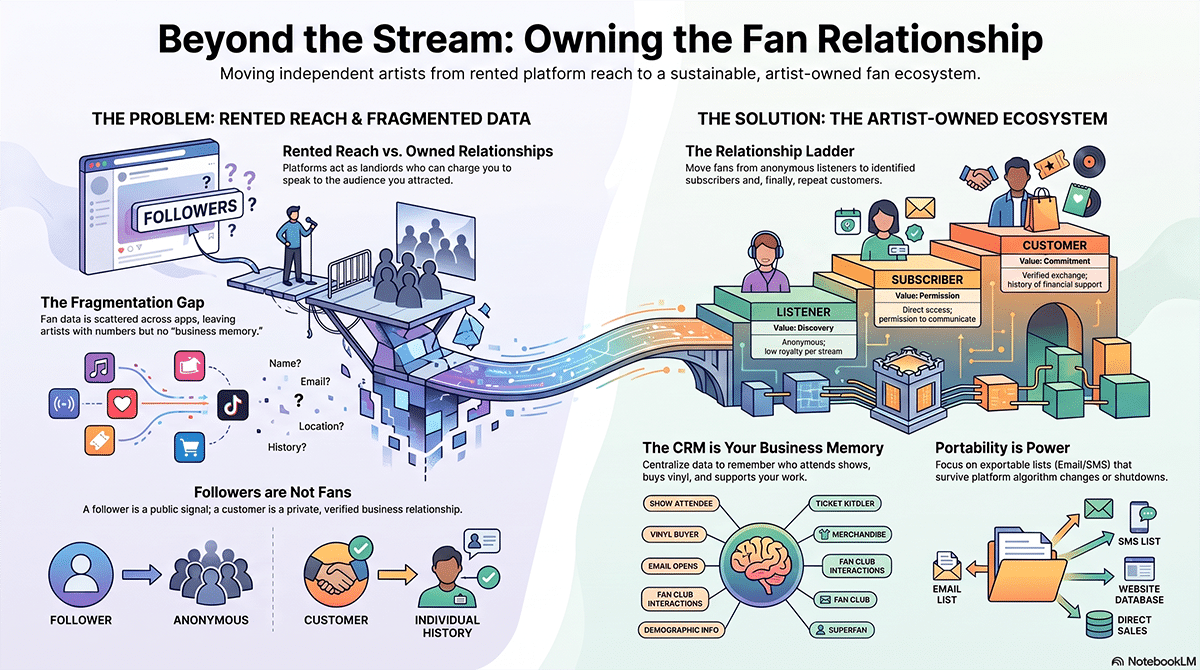
An artist may have thousands of listeners on Spotify , followers on TikTok, followers on Instagram, viewers on YouTube, and listeners on Apple Music. Those numbers can be useful. They may show that people are paying attention. But the artist may still have no reliable way to contact most of those people directly.
The artist has visibility, but no relationship.
The artist has activity, but no customers.
The artist has numbers, but no business system that can remember where those numbers came from.
Customer Ownership Does Not Mean Owning People
The phrase “customer ownership” needs to be handled carefully because it can sound as if artists are being encouraged to collect human beings and store them in a warehouse. Artists do not own fans. Labels do not own fans. Platforms do not own fans. Fans are people with their own choices, preferences, privacy rights, and ability to decide when they have heard enough from you about the new deluxe hoodie.
Customer ownership means controlling the business structure around a voluntary relationship. It means the artist controls the place where the relationship begins, keeps an exportable record of the people who gave permission to communicate, and can remember purchases, attendance, interests, and past support without depending entirely on one outside company.
It means the fan can say yes to email, text messages, show alerts, rewards, memberships, or other communication. It also means the fan can say no, change preferences, or leave without having to hire a private investigator to locate the unsubscribe link. A healthy artist-owned system gives fans control over what they share. It collects only information the artist has a real reason to use. It protects that information and does not secretly scrape personal details, buy questionable mailing lists, or sign ticket buyers up for unrelated marketing they never requested.
The artist owns the responsibility and the tools. The fan owns the choice.
Platform-controlled access says the artist may communicate while remaining inside the platform, following its rules, and accepting whatever reach the algorithm decides to provide. An artist-controlled relationship says that a particular person asked to hear from the artist and that the artist now has a responsibility to respect that permission.
One is rented attention. The other is earned trust.
The Artist Is the Brand Fans Actually Follow
A fan may discover a song through Spotify, but the fan is not usually falling deeply in love with Spotify. A fan may see a performance on TikTok, but they are probably not buying a concert ticket because of an emotional attachment to TikTok. A fan may watch an interview on YouTube, but they are not showing up at the venue wearing a YouTube shirt and begging the platform to play an encore.
The platform may make the introduction, but the artist creates the emotional value.
Fans connect with a voice, a song, an attitude, a story, or a live experience. They remember the music that played during a breakup, a road trip, a wedding, a bad job, a great summer, or a difficult year. They may feel that an artist somehow explained something they could not put into words themselves. That connection lives between the artist and the fan, yet the business machinery surrounding it often belongs to several other companies.
Artists spend years developing a recognizable identity and then routinely send people away from their own world. The artist’s website sends visitors to a social platform. The social platform sends them to a streaming service. The streaming service sends them to a ticketing company. The ticketing company sends them to a payment processor. The payment processor completes the sale and sends everybody a report.
Every company receives a piece of the journey. The artist may receive some money, a few statistics, and a sincere invitation to purchase more advertising.
What the artist may not receive is a complete memory of the fan.
A Follower Is Not Automatically a Fan
The modern music business uses words like follower, listener, subscriber, fan, and customer as if they are interchangeable. They are not.
A follower is someone who clicked a button on a platform. That action has value because it may increase the chance that the person sees another post or receives a platform notification. It is a small sign of interest, and small signs of interest are worth paying attention to.
The problem is that the artist does not control what happens next. The platform may change its feed. The follower may stop using the service. The artist’s account may be restricted or suspended. A post may reach only a small percentage of the people who followed, leaving the artist to buy an advertisement to reach people who already asked to see more.
That is a strange arrangement. Imagine a fan walking into a record store, asking the clerk to let them know when an artist releases a new album, and then the store charging the artist every time it considers passing along the message.
A follower is a useful signal, but it is not the same as a direct relationship.
A Listener May Remain Almost Completely Anonymous
A listener is someone who played a song, but the reasons behind that play can vary wildly. The person may have searched for the artist by name. They may also have heard the track because it appeared in a playlist, an autoplay queue, an algorithmic radio station, or a mix created for folding laundry.
Spotify for Artists provides useful information about streams, saves, playlists, engagement, listener locations, and different audience segments. These tools can help artists see where music is finding attention and whether listeners appear to be returning. Spotify explains its analytics tools at https://artists.spotify.com/analytics.
That information can help an artist make smarter decisions. If streams are growing in Atlanta, the artist might investigate whether a show there makes sense. If listeners are saving a particular song, the artist may decide to feature it more heavily in promotion or place it earlier in the live set.
Still, audience analytics are not the same as an exportable customer list. Knowing that 4,000 people listened in Atlanta does not tell the artist which of those people wants to attend a show in Atlanta.
It is a map that shows the city but not the people standing inside it.
A Subscriber Has Given Permission
A subscriber has taken a more meaningful step. They have provided an email address, phone number, app follow, or another direct contact method and agreed to receive communication. This does not mean the artist should immediately send twelve sales messages, three desperate reminders, and a blurry photo of a hat that may or may not exist. Permission is not an invitation to become unbearable.
It means the fan has opened a door.
The value is not simply the email address or phone number. The value is the permission attached to it. The subscriber has asked to receive something directly from the artist. That might include a release story, show announcement, ticket offer, private video, tour diary, thank-you message, or invitation to a listening event. The artist can communicate without crossing their fingers and hoping an algorithm decides the message deserves daylight.
The subscriber may never buy anything, and that is fine. Permission does not guarantee income. It creates the possibility of a continuing relationship, which is something an anonymous stream cannot provide by itself.
An Identified Fan Has a History
An identified fan is someone the artist can recognize through information that person shared willingly. The artist may know the fan’s city, communication preferences, show attendance, purchases, or interest in vinyl, livestreams, acoustic performances, or special events.
The artist does not need to know the fan’s entire life story. This is a music career, not a spy movie. The goal is to remember enough to serve the fan better. An identified fan in Nashville might receive a message when a Nashville show is announced. Someone who purchased vinyl may be interested in a limited pressing. A fan who attended an acoustic house concert may appreciate an invitation to another small-room performance.
Identification turns a broad message into useful communication. It also lets the artist recognize loyalty. A person who attended five shows, bought two records, and joined a membership should not always be treated exactly like someone who clicked a link five minutes ago.
Both people matter. They are simply at different points in the relationship and they require a different revenue stack.
A Customer Has Completed a Real Exchange
A customer is someone who spent money. They bought a ticket, shirt, record, download, membership, livestream, lesson, workshop, VIP experience, house concert, sample pack, tip package, or another offer. That purchase tells the artist something important. The person was willing to move beyond attention and complete an exchange.
A stream can show interest. A purchase shows commitment.
This does not mean the artist should look at every customer and see a wallet wearing shoes. The first sale is not permission to attack the person with daily offers until they escape through the spam folder. The sale should begin a better level of service. The artist can provide updates, say thank you, ask whether the customer enjoyed the purchase, offer something related when it makes sense, and remember the relationship when that person returns.
The goal is not to squeeze more money from one human being. The goal is to keep creating experiences and products that give that person a good reason to support the artist again.
A Million Streams and a Thousand Customers Are Not the Same Thing
One person may move through every stage of the relationship. They may hear a song in a playlist, follow the artist, visit the artist’s website, join the email list, attend a show, buy a shirt, purchase a record, and eventually become a member. That journey may take one afternoon or five years.
The mistake is assuming that every stream represents a fan, every follower represents a subscriber, or every subscriber represents a customer. These actions have different meanings. A million anonymous streams may look impressive on a graphic, but the artist may have no dependable way to invite those listeners to a show, sell them a record, or ask what they want next.
A much smaller group of identified supporters may buy tickets, merchandise, memberships, house concerts, lessons, direct downloads, livestreams, and special editions for years. Scale matters, but depth matters too. The modern music business has become very good at measuring scale because large public numbers look exciting in press releases. Independent artists must become better at building depth because depth is where repeat business lives.
Rented Reach and Owned Reach
Rented reach is any audience connection mainly controlled by another company. Social followers, playlist placement, platform recommendations, and paid advertising audiences are all forms of rented reach. The artist can benefit from every one of them. There is no reason to throw away useful discovery tools simply because the artist does not own them.
The artist should remember, however, that they do not control the building. The landlord can change the rent, close a doorway, redesign the rooms, limit who enters, or decide that posts containing the word “Tuesday” will now be shown only to left-handed accordion players in Wyoming. Owned reach works differently. It includes an artist-controlled website, an exportable CRM, a permission-based email list, a properly managed SMS list, customer records, and fan profiles that can be moved between compatible systems.
Even owned reach is not completely free from outside companies. Websites need hosting, email needs delivery services, payments need processors, and software occasionally decides to update itself ten minutes before showtime. The goal is not perfect independence from every company on Earth. That would require the artist to build a data center, create a telecommunications network, and possibly install a small power station behind the rehearsal room.
The goal is portability and control.
Can the artist export the contact list? Can the artist move to a different provider? Can the artist keep purchase history? Can subscribers be contacted without buying an advertisement? Can the fan change permissions or leave easily?
The answers reveal who really controls the relationship.
Why a Permission-Based Email Can Matter More Than Another Anonymous Stream
This does not mean that every email address has a fixed cash value. Some subscribers never open anything. Some use an address they last checked when compact discs were still considered modern. Some join for a free download and disappear into the digital mist. The difference is possibility.
An anonymous stream may create one small royalty event. The artist may learn the listener’s general location but may never be able to communicate with that person again. A permission-based email address creates the possibility of future communication. The artist can share a new release, explain a song’s story, announce a local show, sell tickets, offer merchandise, promote lessons, invite fans into a membership, or ask supporters what they want to hear next.
More important, the artist can build familiarity over time. Strong supporters rarely appear because they saw one sales message. They become supporters because the music matters, the artist communicates like a real person, and the fan receives meaningful ways to take part. Email can carry that relationship over time. It is not perfect. Email providers filter messages, and poor practices can damage delivery. Still, the artist can usually export a legitimate subscriber list and move it to another compatible service.
Try exporting the names and contact details of everyone who watched fifteen seconds of your last social video. That particular button remains unusually difficult to locate.
The Platforms Control the Customer Journey
Imagine a fan named Elena. She discovers a song through a TikTok video, watches the full performance on YouTube, streams the album on Spotify, sees a concert announcement on Instagram, buys a ticket through a ticketing company, orders a shirt from an online store, and eventually joins a membership through another service. Elena believes she has been supporting one artist. The business systems see six or seven unrelated accounts.
TikTok knows she watched the clip. YouTube knows she finished the video. Spotify knows she streamed the album. Instagram knows she clicked the event announcement. The ticket company knows she purchased admission. The store knows she bought a shirt. The membership service knows she signed up. The artist may never connect those actions to one person.
That fragmentation makes basic business questions difficult. The artist cannot easily see whether a video campaign sold tickets, whether shirt buyers return to shows, whether membership customers also purchase vinyl, or which fans have supported the band for several years. When every part of the relationship lives in a different dashboard, the artist is forced to guess. Guessing can lead to poorly routed tours, unwanted merchandise, wasted advertising, weak follow-up, and loyal fans who feel invisible even after supporting the artist several times.
Guessing is not a business strategy. It is what happens when the information needed to make a decision belongs to somebody else.
A CRM Is the Memory of the Artist’s Business
CRM stands for customer relationship management, which sounds like a phrase invented during a meeting where someone was being paid by the syllable. In simple language, a CRM is the memory of the business. It helps the artist remember who asked to stay connected, where they live, what they purchased, which shows they attended, which messages they requested, and how the relationship developed.
A small artist CRM does not need to begin as a giant corporate system with forty-seven dashboards and buttons that require a certification course. It can start with a secure record containing a name, contact method, city, permission status, signup source, purchase history, attendance, and a few useful notes. The important word is useful.
Artists should not collect information simply because another field can be added to a form. There is no need to request a birthday, street address, shoe size, blood type, and childhood nickname when all the artist needs is an email address and city. Every piece of data creates responsibility. The artist should collect what improves the fan experience, protect it, keep it accurate, and remove information that is no longer needed.
A good CRM should make the artist more human, not less. It should help the artist remember that Maria attended three shows and bought the last record. It should not reduce her to Contact Record 004783 and begin speaking to her like a malfunctioning vending machine.
The Revenue Stack Must Work Together
Independent artists are often told to create several revenue streams. That advice is correct, but it is incomplete. A pile of disconnected revenue streams can quickly turn into a pile of disconnected subscriptions, passwords, dashboards, reports, fees, and headaches. Nothing says artistic freedom quite like spending an entire morning trying to reset six passwords.
A real revenue stack becomes stronger when each part supports the others. The artist-controlled website serves as the center. It explains who the artist is and gives fans clear ways to listen, join, attend, buy, or support.
The CRM remembers permission, purchases, attendance, and engagement. Email carries stories, announcements, offers, and follow-up. SMS handles timely communication such as show reminders, ticket deadlines, location changes, or limited releases. Text messaging must be used carefully because a phone is a personal space, not a tiny electronic billboard hiding in someone’s pocket.
Direct commerce allows fans to buy music, merchandise, tickets, lessons, downloads, and experiences. Memberships create recurring support when the artist provides something worth joining. Ticket and door-list information helps the artist remember who attended. Shows generate ticket sales, merchandise revenue, tips, VIP opportunities, and fan connections.
Publishing, performance royalties, neighboring rights, and synchronization licensing create income from the music itself. Private events, house concerts, workshops, livestreams, production services, and lessons create additional ways for the artist’s skills to produce revenue.
Each activity should strengthen the next one. A show should help build the contact list. The contact list should help sell the next show. A merchandise purchase should become part of the customer history. That history should help the artist create a better offer. The offer should help fund the next recording. The recording should create new sales, touring, content, publishing, and licensing opportunities.
That is what a business ecosystem looks like. It is not one income stream. It is a group of connected activities that become more useful because they share a memory.
What an Artist-Owned Fan Journey Looks Like
Let us return to Elena.
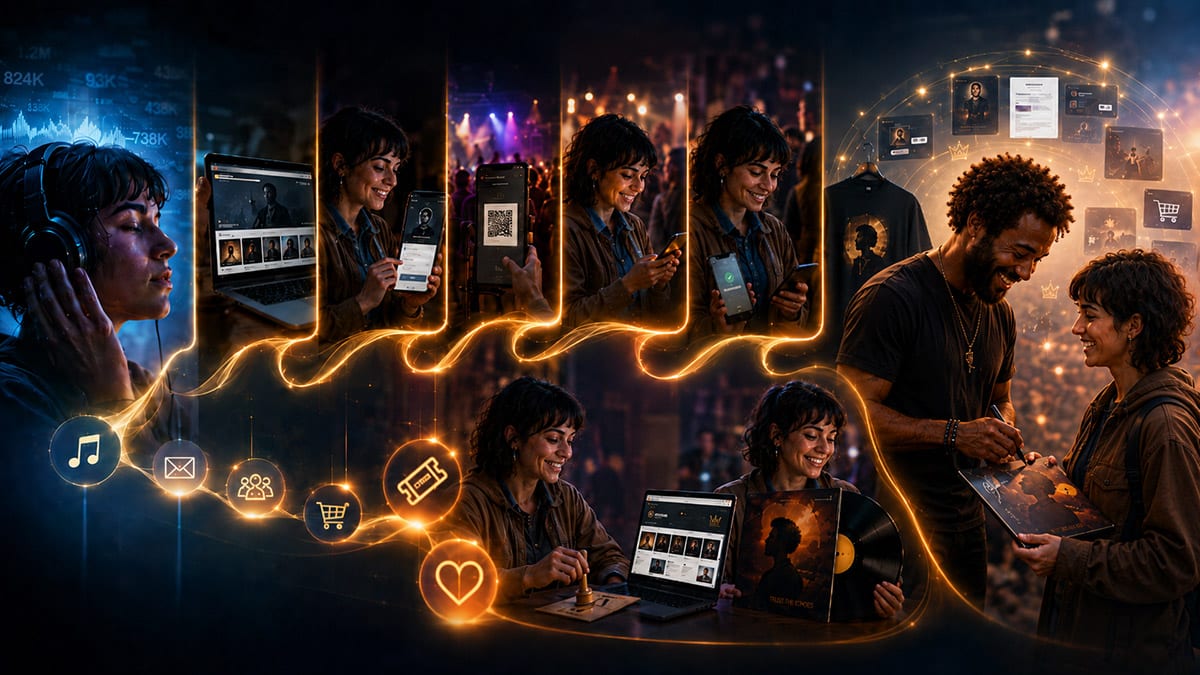
She hears a song on TikTok. This time, the artist does not simply ask her to follow another profile and hope for the best. The video directs her to the artist’s own website, where she can hear more music, learn the story, view upcoming shows, and join the artist’s email list or Fan Passport. Elena joins because the artist offers something useful, such as early ticket access, a live recording, a private song story, local show alerts, or a digital stamp from the concert.
The signup form explains what she will receive. There are no mysterious boxes, no preselected permission tricks, and no promise that joining will somehow unlock the secrets of the universe. Elena buys a ticket. At the show, she checks in through a QR code and receives a stamp or reward. Later, she buys a shirt.
The artist’s system can now remember that Elena joined voluntarily, lives near the venue, attended the show, and bought merchandise. The next morning, she receives a genuine thank-you message rather than an immediate attack involving three discounts and a countdown clock. Several weeks later, the artist announces another local event. Elena receives the message because she requested local show news. Later, she buys a vinyl release. Eventually, she joins a membership because the artist has repeatedly delivered music, stories, experiences, and offers she values.
Nobody forced Elena through a funnel. She was given a path. Each step created more value for her and more stability for the artist.
The Making a Scene Artist Fan Passport OS
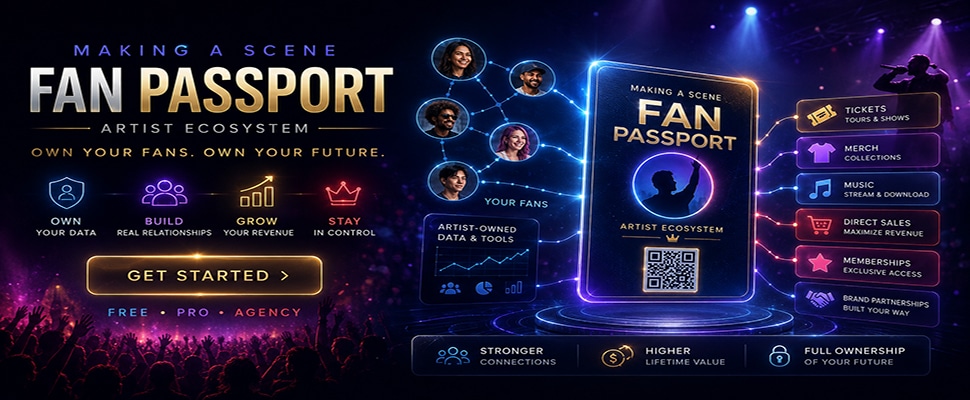
The Making a Scene Artist Fan Passport OS is one example of how these pieces can be connected around the artist instead of scattered across unrelated platforms. The system is designed to connect an artist-controlled website, fan profiles, QR codes, show activity, rewards, merchandise moments, communication permissions, and business workflows. On the fan side, the Fan Passport concept allows supporters to follow artists, collect stamps, take part in rewards, and control what information they share.
On the artist side, the goal is to remember engagement and turn isolated moments into longer relationships. A show scan can become a fan connection. That connection can lead to a thank-you message. A merchandise purchase can become part of the relationship history. A return visit can be recognized and rewarded.
The system should not be treated as a magical substitute for good music, strong shows, respectful communication, or hard work. Software cannot make people care about music that does not move them. What it can do is help the artist remember the people who already care.
A Making a Scene overview of the Artist Fan Passport OS is available at https://www.masfanpassport.com. The core system is free for artists and the App is free for all fans!
Direct Sales Reveal What Streaming Cannot
A stream tells the artist that a song was played. A direct purchase can tell the artist what someone chose to buy, when they bought it, and whether they returned later.
Bandcamp, is one example of a music-focused platform that gives artists access to sales history and communication tools. Its artist materials explain that artists can see who purchased music or merchandise and can target messages based on factors such as location or level of support. Fans can also choose to join artist mailing lists that may be exported.
Bandcamp remains a platform with its own rules, fees, ownership, and business decisions. The lesson is not that every artist should place the entire business in one Bandcamp basket and then sit beside it nervously. The lesson is that tools should be judged partly by the relationship they allow artists to keep.
Does the artist receive useful customer information with proper permission? Can the artist communicate directly? Can important records be exported? Can repeat purchases be understood? Can the artist move without losing the whole audience?
A service that helps create a portable relationship is more useful than one that provides only another pile of anonymous numbers.
The Fan Ownership Ladder Is Really a Relationship Journey
The journey often begins with anonymous attention. Someone hears a song, watches a clip, walks past a festival stage, or notices a friend wearing the artist’s shirt. The person may enjoy the moment and continue with their day. That is not failure. Most attention remains casual, and not every person who hears a song is waiting to become the president of the fan club.
The next stage is voluntary identification. The person visits the artist’s website, scans a QR code, joins the Fan Passport, enters an email address, or creates an account. There must be a clear reason for taking that step. “Join my list because I would like more data” is not an inspiring offer. Local show alerts, early tickets, live recordings, fan rewards, private videos, or meaningful access give the person a useful reason to join.
Permission comes next when the fan selects the kind of communication they want. Engagement grows as the person opens messages, watches content, replies, collects a show stamp, attends a livestream, or visits the website again. The first purchase changes the relationship because the fan has exchanged money for music, merchandise, access, or an experience. A repeat purchase goes further because it shows that the first exchange created enough value for the fan to return.
Membership adds recurring commitment. Advocacy appears when a fan recommends the artist, shares a release, brings friends to a show, or creates energy in a local community. A deeply involved supporter may eventually become a community leader by hosting a house concert, helping organize a street team, welcoming new supporters, or becoming the person who somehow arrives at every show with six additional people and a homemade sign.
The goal is not to force every listener through these stages. The goal is to make sure a path exists for the people who want to travel it.
How It Works for a Coffeehouse Artist
Consider a solo songwriter who performs in coffeehouses and small listening rooms. The artist plays for forty people on Friday night, and several of them say they loved the songs. In the traditional pattern, the artist says, “Follow me on social media.” Some people do, and most disappear into the feed before the artist gets home.
In an artist-owned pattern, a QR code on the merch table leads to a simple page offering local show announcements and a live recording from that evening. Twelve people join. Twelve may not look impressive beside a viral video. It will not cause the internet to gasp. But those twelve people stood in the room, heard the songs, and chose to stay connected.
When the artist returns three months later, those people receive a direct invitation. Some buy tickets. One books a house concert. Another purchases a songwriting lesson. Two buy the new album. One night has now created several connected forms of income.
That is how a modest career becomes a sustainable one. It happens one remembered relationship at a time.
How It Works for a Regional Touring Band
A regional band plays in six cities. Streaming analytics show listeners across the area, but the band does not know which listeners attend shows or purchase merchandise. The band begins treating the merch table as more than the location where the bass player struggles to make change. Fans can scan a code, join for local dates, collect a show stamp, and choose whether to receive email or text updates.
The band records the city, show, permission, and purchases in its CRM. After several tours, a pattern becomes clear. One city produces strong merchandise sales and repeat attendance. Another generates many streams but weak ticket sales. A third has a smaller audience but unusually strong membership support.
That information changes the tour plan. The band returns more often to the first city, tests a smaller room in the second, and creates a special member event in the third.
Streaming showed where listening occurred. Customer relationships showed where a business could grow.
How It Works for a Producer
A producer who sells sample packs, templates, mix consultations, or lessons may never step onto a traditional stage, but the same ownership lesson applies. Someone discovers a production video, visits the producer’s website, downloads a free sample, and gives permission to receive recording tips. Later, that person buys a sample pack, and the CRM remembers the purchase.
The producer can then offer something connected to that interest, such as a drum-arranging workshop, a mixing lesson, a preset collection, or an advanced sample pack. The message is useful because it is based on something the customer actually chose. AI can help the producer identify first-time buyers, repeat customers, lesson clients, and people who downloaded a free item but never purchased. That makes it possible to communicate with smaller groups in more relevant ways.
The producer is not chasing millions of random viewers. The producer is building a well-understood market around a useful skill.
How It Works for an Established Independent Artist
An established independent act may have millions of streams but very little direct fan information. The answer is not to drag every listener away from every streaming and social platform. That would be impossible, exhausting, and deeply irritating.
The artist should instead create clear bridges for the people who want a closer relationship. Streaming profiles, social pages, videos, shows, physical packaging, and interviews can all point toward an artist-controlled home.
Fans may be offered early access, special editions, local show alerts, memberships, archival recordings, private livestreams, or behind-the-song content. Even if only a small portion of the streaming audience chooses to build a direct connection, that group can support ticket sales, premium merchandise, direct music purchases, memberships, crowdfunding, and future releases.
The anonymous audience remains valuable for discovery. The identified audience becomes valuable for stability.
AI Should Help the Artist Remember, Not Spam Faster
An artist-controlled AI assistant can make a CRM much more useful. It can organize information fans shared voluntarily, group supporters by city, identify repeat customers, compare show activity, draft follow-up messages, and help the artist understand which actions produced revenue.
It may notice that vinyl buyers respond well to studio stories or that one city has many subscribers but very few ticket buyers. It can help turn one release into several weeks of emails, videos, fan questions, merchandise stories, show offers, and licensing outreach.
For a solo artist, this can provide some of the organizational help that once required a marketing assistant. The AI must remain an assistant. It should not pretend to be the artist in personal conversations, scrape private information, create fake intimacy, or send hundreds of messages simply because automation has made mass annoyance more efficient. The artist should approve the message, control the information, select the audience, and remain responsible for the relationship.
Good AI helps an artist become more thoughtful. Bad AI helps an artist become irritating at industrial speed.
Web3 Matters Only When It Solves Something
Web3 discussions have a habit of floating away from Earth in a cloud of tokens, jargon, and promises that everything will be revolutionized by Thursday. The useful part is much simpler.
A portable digital identity could allow fans to carry proof of attendance, membership, access, or support between compatible systems. A verifiable show stamp could confirm that a fan attended an event without depending on one social platform. A digital membership could provide access to music, rewards, events, or a community. A smart contract could automate a clearly defined payment or split.
These tools matter only when they improve control, portability, transparency, access, or direct revenue. Web3 does not automatically create fans. It does not improve weak music or rescue a confusing offer. The technology should disappear behind the experience.
A fan should not need to understand blockchains, wallets, gas fees, tokens, and digital mining simply to prove they were standing near the stage last Saturday.
The best Web3 tool may be the one the fan barely notices.
Trust Is the Most Valuable Thing in the System
Fan information can help an artist earn money, but trust determines whether that information remains useful.
Artists should explain what people are joining, what kinds of messages they will receive, how often communication may occur, and how they can leave. They should honor unsubscribe requests, protect customer records, and avoid buying lists or adding ticket buyers to unrelated marketing without permission or another valid legal basis.
In the United States, the Federal Trade Commission’s CAN-SPAM guidance explains requirements for commercial email, including accurate sender information, honest subject lines, a valid postal address, and a working opt-out process. The official guide is available at https://www.ftc.gov/business-guidance/resources/can-spam-act-compliance-guide-business.
The United States does not use one simple permission rule for every type of commercial email. That is a good reason for artists to adopt practices stronger than the lowest legal requirement. Clear permission produces better relationships and fewer complaints.
Text messaging needs extra care. The Federal Communications Commission provides guidance on unwanted calls and texts at https://www.fcc.gov/consumers/guides/stop-unwanted-robocalls-and-texts. Certain automated or marketing texts may require prior consent, and people must be able to withdraw that consent.
Rules vary by location. The United Kingdom Information Commissioner’s Office explains electronic marketing rules at https://ico.org.uk/for-organisations/direct-marketing-and-privacy-and-electronic-communications/guide-to-pecr/electronic-and-telephone-marketing/electronic-mail-marketing/. California’s privacy resources can be found at https://cppa.ca.gov/faq.
This article is not legal advice. Artists collecting fan information across different states or countries should review current official guidance and seek qualified help when necessary.
They should also use common sense. Do not collect information you would be embarrassed to explain. Do not send messages the fan never requested. Do not hide the unsubscribe button as though it owes you money.
Direct-to-Fan Is Not a Magic Trick
Building an artist-owned relationship system takes time. An email list does not grow just because a signup form exists. Fans need a reason to join.
A CRM does not organize itself. Information must be kept accurate. Direct commerce does not eliminate fees, shipping problems, customer service, inventory risk, or the mystery of why one shirt size always sells out first. Not every listener wants a closer relationship. Many people simply want to hear a song and continue with their day. That is perfectly fine.
The goal is not to turn every casual listener into a superfan. The goal is to avoid losing the people who already want to come closer. Discovery platforms remain important. Streaming, social media, playlists, video, interviews, reviews, radio, and press all remain useful. The Making a Scene philosophy does not ask artists to abandon modern technology and hide inside an artist-owned bunker.
Platforms should be doorways. The artist’s own ecosystem should be the home.
Followers Are Public, but Customers Build the Business
Follower counts are visible, which makes them tempting. Anyone can look at an artist’s page and see a large number. That number may impress a venue, potential collaborator, sponsor, publicist, or member of the press.
Customer relationships are usually private. Nobody sees an artist’s repeat-purchase rate from across the room. Nobody bursts into applause because an email list contains 800 local subscribers who regularly buy tickets. Yet those 800 relationships may be far more useful than a much larger but unreachable following.
A follower count tells the world that people clicked. A customer history tells the artist what people valued. A subscriber list shows who asked to hear more. A show record reveals where people gathered. A membership shows who chose to support the work over time. Vanity metrics are not always useless. They become dangerous when artists mistake them for a complete business.
The better questions are less glamorous. How many people can the artist contact with permission? How many made a purchase? How many returned? Which offers worked? Which cities generated real support? What part of the relationship survives if a platform changes tomorrow?
Those questions may not look exciting on a social graphic, but they build careers.
What an Artist Can Start Doing This Week
The first step is to establish one artist-controlled home. It does not need to be enormous or loaded with special effects. It needs to be clear.
A visitor should quickly understand who the artist is, hear the music, see upcoming activity, and find a useful reason to connect. The artist should create one honest offer for joining. It might include local show alerts, a live recording, early tickets, fan rewards, studio updates, or access to a private event. The signup should clearly explain what the person will receive.
The information should enter a system the artist can export. The artist can then connect the signup to other parts of the career by placing the link in social profiles, adding a QR code at shows, printing it on merchandise packaging, mentioning it during livestreams, and including it in video descriptions and interviews.
Communication should be consistent, but not constant. The artist should tell stories, share useful news, thank supporters, and occasionally make clear offers. When purchases or show attendance occur, those actions should become part of the relationship history when permission and available tools allow.
The artist can then create a natural next step. A listener may be invited to subscribe. A subscriber may be invited to a show. A show attendee may receive a relevant merchandise offer. A buyer may be invited into a membership. A member may receive access to a special experience.
The process should feel like a path, not a trap.
This Is How We Build a Music Industry Middle Class
A music industry middle class will not be built by making every artist famous. That is the old lottery model wearing a shiny new digital hat. A middle class is created when more working artists earn steady income from several connected sources.
Shows provide ticket and merchandise revenue. Direct commerce provides music and product sales. Memberships create recurring support. Lessons and workshops turn knowledge into income. House concerts and private events create valuable performance opportunities. Publishing and performance royalties pay artists when songs are used and performed. Synchronization licensing places music in film, television, advertising, games, and other media. Livestreams and special access create additional experiences.
Fan relationships support repeat business across all of those areas.
The CRM connects the activity. Email and SMS carry the message. AI helps the artist understand and act. The artist-controlled website remains at the center. The Fan Passport can help turn show attendance and support into a relationship the artist can remember. None of these tools will save an artist’s career by itself. Together, they can create a business that is much harder to erase with one algorithm change.
Stop Counting People You Cannot Reach
The music industry has trained artists to celebrate attention. More streams, more views, more followers, more impressions, and more monthly listeners are all treated as signs that the career is moving forward. Attention matters. Without discovery, there is no new audience.
But attention that cannot be remembered, contacted, served, or invited back remains fragile. The future of independent music will not be built by collecting the largest possible pile of anonymous activity. It will be built by turning the right moments of discovery into voluntary, trusted, artist-controlled relationships.
The artist does not own the fan. The artist should own the website, customer history, communication permission, business intelligence, and responsibility to use those tools well. That is how a listener becomes a subscriber. It is how a subscriber becomes a customer. It is how a customer becomes a repeat supporter. It is how a supporter becomes part of a community. That is how songs become careers.
It is also how independent artists begin building a music industry middle class that does not depend on being selected by a gatekeeper, rescued by a playlist, or blessed by an algorithm that may wake up in a completely different mood tomorrow.
Artists need to stop asking only, “How do I get more followers?”
The more important question is, “How many real fan relationships does my business remember, and what meaningful reason have I given those people to return?”
 |  Spotify |  Deezer |  Breaker |
 Pocket Cast |  Radio Public |  Stitcher |  TuneIn |
 IHeart Radio |  Mixcloud |  PlayerFM |  Amazon |
 Jiosaavn |  Gaana |  Vurbl |  Audius |
 Reason.Fm | |||
Find our Podcasts on these outlets
Subscribe to Our Newsletter
Discover more from Making A Scene!
Subscribe to get the latest posts sent to your email.


