

Arrangement Before Mixing: Fix It in the Song, Not the Plugin





Making a Scene Presents – Arrangement Before Mixing: Fix It in the Song, Not the Plugin
Listen to the Podcast Discussion
Welcome to the Plugin Pileup
You press Play.
The drums sound powerful. The bass sounds huge. The guitars und like a choir descending from the heavens with excellent credit.
There is only one small problem.
You cannot hear the song.
The lead vocal is buried. The bass and kick drum are wrestling in a dark basement. Three guitar parts are fighting over the same few notes. A giant keyboard pad stretches from one end of the frequency range to the other. The background singers are performing as if they have just staged a successful coup.
So you do what many home-studio producers do. You open an equalizer. Then a compressor. Then another equalizer because the first equalizer clearly did not understand the assignment. Then a stereo widener. Then a saturation plugin. Then a masking tool. Then something with a glowing tube graphic and the word “vintage” in its name.
Two hours later, the mix is louder, wider, brighter, warmer, more exciting, and somehow even harder to understand.
This is often the moment when the artist decides the problem must be a lack of expensive plugins.
It probably is not.
Many mixing problems begin before mixing. They begin while the parts are being written, chosen, performed, layered, and recorded. They begin when every instrument is given permission to play all the time. They begin when a guitar, piano, synthesizer, bass, and vocal are all placed in the same musical range. They begin when the verse is already at full power, leaving the chorus with nowhere to go except slightly louder and perhaps wearing a hat.
The hard truth is also good news. You may not need another plugin. You may need a better arrangement.
Mixing Is Not an Emergency Rescue Service
Mixing is the process of bringing recorded sounds together and balancing their level, tone, placement, dynamics, and effects. In plain language, it means deciding what should be loud, what should be soft, what should feel close, what should feel far away, and what the listener should notice first. Berklee Online describes mixing with one central word: balance. s what happens earlier. It includes deciding which instruments will play, what they will play, when they will enter, when they will stop, how active they will be, and how the sections of the song will grow or shrink. Berklee’s arranging material describes the process as shaping instrumentation, groove, dynamics, and texture so they support the lyric, melody, and emotion. ce matters.
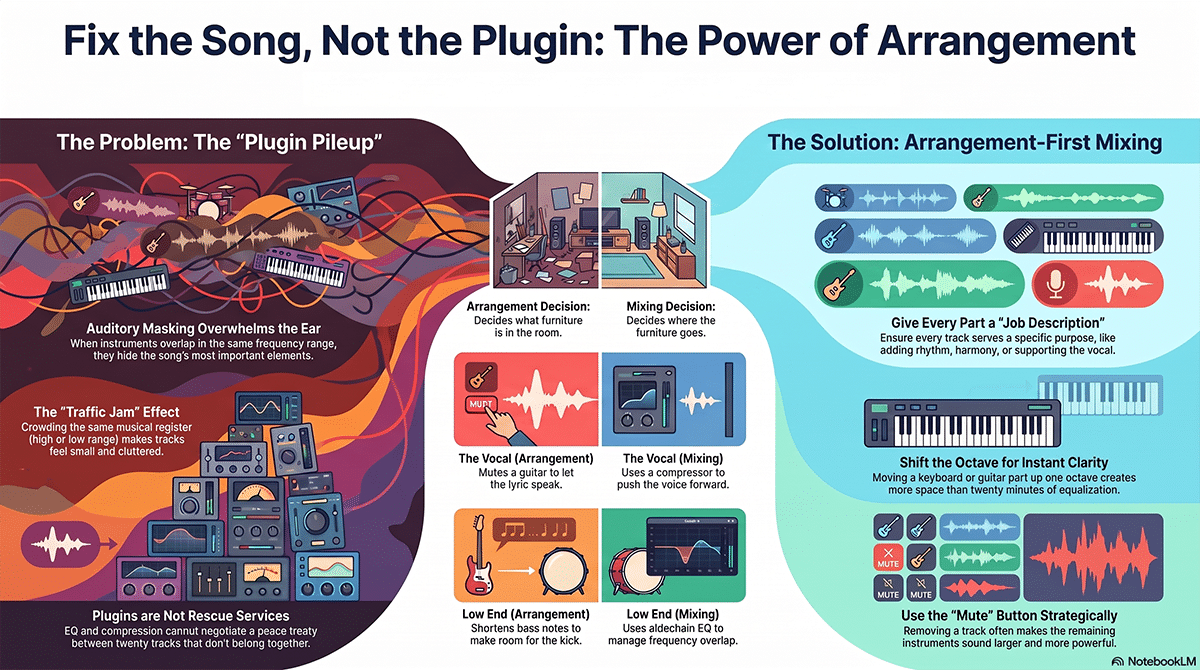
Arrangement decides what is in the room. Mixing decides where the furniture goes.
A mix engineer can move the couch, dim the lights, clean the windows, and place a nice plant in the corner. The engineer cannot make a comfortable living room if the arrangement has put six sofas, three dining tables, a drum kit, and a small parade in the same space.
A good mix does not force every recorded track to remain in the finished song. It helps the most important parts speak clearly. Sometimes the first mixing decision should not be which plugin to open. It should be which track to mute.
This does not mean plugins are useless. Equalization, compression, reverb, delay, automation, and saturation are powerful tools. They can shape a good recording into a finished production. They can control peaks, improve tone, create depth, and help a performance feel more exciting.
But they work best when the song already makes musical sense.
Mixing should reveal the arrangement. It should not have to negotiate a peace treaty between twenty tracks that never belonged together.
The Problem May Be Musical, Not Technical
Imagine a lead singer performing in the middle of the musical range. That is where many voices naturally sit. Now add two electric guitars playing full chords in the same octave. Add a piano playing the same chords with both hands. Add a warm synthesizer pad underneath everything. Then double both guitar parts and spread them left and right.
Every sound may be well recorded. Every player may be talented. Every part may sound impressive when heard alone.
Together, they can become a traffic jam.
The mix may feel muddy, crowded, harsh, or distant. The vocal may seem too quiet even when its meter says it is loud. Turning up the singer may only make the entire mix more aggressive. Cutting the guitars with an equalizer may make them thin. Cutting the keyboard may remove the richness that made you choose it. Compressing the vocal may make every breath and mouth sound jump forward without making the lyric easier to understand.
The real problem may be that too many parts are occupying a similar musical register.
Register means the general high or low range where a part is being played. A low piano chord, a low guitar chord, and a bass note may contain different tones, but they can still crowd the same area. A guitar riff played high on the neck may leave room for a vocal. The same riff played an octave lower may step directly on it.
An octave is the distance between one note and the next note with the same letter name, either higher or lower. Moving a keyboard part up one octave does not change the basic musical idea. It changes where that idea lives.
That simple move can sometimes create more clarity than twenty minutes of equalization.
Why Your Ear Cannot Give Every Part First Place
The human hearing system does not separate every sound with perfect accuracy. Auditory masking happens when one sound interferes with our ability to hear another. Masking is especially strong when sounds overlap in frequency and one is louder or more dominant. This is a studied part of psychoacoustics, which is the study of how people perceive sound. frequency masking can happen when two instruments produce energy in similar parts of the frequency range. An electric guitar may cover some of the same middle frequencies that help listeners understand words. A thick keyboard sound may overlap with guitars, vocals, and parts of the snare drum. A bass tone with a lot of deep energy may make the low thump of the kick drum harder to notice.
Mixing tools can reduce some of this overlap. An equalizer can turn down selected frequencies. Compression can manage changes in volume. Panning can move sounds toward the left or right side of a stereo mix.
But masking does not begin inside the equalizer.
It begins with the notes, range, tone, rhythm, and intensity of the performances.
If the keyboard holds a ten-finger chord through the entire verse while two guitars strum eighth notes and the singer delivers a dense lyric, the keyboard does not merely have a frequency problem. It has a job-description problem.
What is that keyboard doing for the song?
Is it adding harmony? Is it creating rhythm? Is it carrying a hook? Is it building atmosphere? Is it supporting the vocal?
If the answer is “all of those things at once,” the keyboard may be applying for management.
Every Moment Needs a Main Character
A strong arrangement guides the listener’s attention.
At almost every point in a song, something should be the main focus. It may be the lead vocal. It may be a guitar riff, a drum groove, a bass line, a lyric, a horn phrase, or a short instrumental hook.
The focus can change. The listener may follow the guitar during the introduction, move to the singer during the verse, notice a harmony in the pre-chorus, and feel the full band open during the chorus. That movement creates a sense of direction.
The problem begins when every part tries to become the main character at the same time.
A lead guitarist may play fills between every vocal phrase and also underneath every word. A drummer may add a fill at the end of every two bars. A keyboard player may answer every guitar phrase. The background singers may join the lead vocal from the first word of the verse. The bass player may decide that the quiet emotional bridge is the right moment to reveal a lifelong interest in jazz fusion.
None of these parts may be bad. The issue is attention.
Ask what the listener should notice during each section. Then make sure the other parts support that focus.
Support does not mean becoming boring. It means choosing the right moment.
A guitar fill can be more powerful when it appears after the vocal phrase rather than during it. A harmony can feel more emotional when it arrives on one important line instead of singing through the entire song. A drum fill can create excitement when it signals a real change rather than announcing that another four bars have somehow passed.
Music is conversation. If everyone speaks at once, nobody sounds clever.
Fixing the Vocal Without Attacking It With Plugins
A buried vocal is one of the most common home-studio complaints.
The usual response is to turn it up, brighten it, compress it, or add a plugin designed to push it forward. Those moves may help, but first listen to what the instruments are doing.
Are the guitars playing full chords while the singer is delivering the most important lyric? Is the piano playing in the same range as the voice? Is a synthesizer patch using a wide, bright tone that fills the middle of the mix? Are several harmony vocals singing the same rhythm as the lead?
Try muting one guitar.
Not forever. Just for a moment.
Does the vocal suddenly become easier to hear? Does the groove feel clearer? Does the remaining guitar sound larger because it no longer has to compete with its twin?
That is arrangement information.
Instead of carving four guitars into thin slices with equalizers, you may discover that two strong guitars sound better than four nervous ones. Instead of making every part smaller, you can remove one part and allow the remaining sounds to be full.
You can also change what the instruments play. A guitar can move from full six-string chords to smaller chord shapes. A piano can play fewer notes. A keyboard can move its right hand higher while leaving the lower range to the bass. A second guitar can play a short melodic answer instead of copying the main rhythm.
A chord voicing is the way the notes of a chord are arranged. The same chord can be played in many positions. Changing the voicing may keep the harmony while moving the sound away from the vocal.
That is usually more musical than cutting a large hole in the instrument with an equalizer and hoping nobody notices the missing furniture.
The Kick and Bass Do Not Need Couples Therapy
The kick drum and bass often share the low end of a song. The low end is the area containing the deepest audible frequencies. It provides weight, movement, and physical power.
Problems appear when the kick and bass are both deep, long, loud, and busy.
The first response may be to add saturation, sidechain compression, dynamic equalization, or a special low-end plugin. Those tools can be useful, but the arrangement should be checked first.
Listen to the rhythm.
Does the bass play a note every time the kick drum hits? That may create a powerful unified attack. It may also make the low end feel heavy if both sounds have long sustain.
Sustain is how long a sound continues after it begins.
What happens if the bass notes become shorter? What happens if the kick pattern becomes simpler? What happens if the bass holds a note while the kick creates the rhythm? What happens if the bass answers the kick rather than copying it?
The solution depends on the song. There is no rule that says the bass and kick must always play together or always stay apart. The goal is to give each one a clear role.
The sound choices matter too. A kick with a long, deep tail may work well with a bass tone that has more midrange definition and less sub-bass. A round bass sound may work better with a shorter kick. Choosing complementary sounds can reduce the amount of corrective processing needed later.
The biggest bass tone is not always the best bass tone.
The biggest kick drum is not always the best kick drum.
Two elephants do not become graceful simply because you pan one slightly to the left.
The Keyboard That Ate the Mix
Modern virtual instruments can sound enormous.
A single keyboard patch may contain several oscillators, stereo movement, reverb, delay, low bass, bright harmonics, and a slow cloud of sound that continues long after you release the keys. Played by itself, it may sound like the soundtrack to the birth of a new planet.
Inside a song, it may eat the singer.
Virtual instruments are software instruments played through a computer, keyboard controller, or other electronic device. They can reproduce familiar sounds such as piano and strings or create sounds that do not exist in nature.
The mistake is choosing a sound only because it is exciting in solo.
Solo means hearing one track by itself.
A sound should be chosen because it serves the complete arrangement. A plain keyboard patch that seems small alone may fit perfectly around the vocal, bass, and guitars. A huge patch may need to be edited, simplified, or saved for a section where it can become the main event.
Try reducing the number of notes. Change the chord voicing. Shorten the notes. Remove the left hand. Use the large patch only in the chorus. Replace it with a smaller tone during the verse.
These are arrangement choices.
You are not ruining the keyboard sound. You are giving it a place where it can succeed.
A well-chosen part can sound larger in the mix because the listener can actually hear it. A massive sound hidden beneath six other massive sounds is not powerful. It is expensive fog.
When Four Guitars Become One Gray Cloud
Doubling rhythm guitars can create width and power. A musician records a part once, records it again as a separate performance, and places the two takes on opposite sides of the stereo image.
That can sound excellent.
The trouble starts when doubling becomes a reflex.
The artist records two acoustic guitars, two electric guitars, a clean guitar, a distorted guitar, an extra guitar in the chorus, and a “texture guitar” that appears to be playing the same chords through a reverb plugin located somewhere near Saturn.
Each guitar adds sound. It also adds rhythm, frequency content, and musical information.
If several guitars play similar chord shapes in the same octave with similar tones, the result may not sound wider. It may sound blurry.
Try giving each guitar a different job. One can play full chords while another plays a higher inversion. An inversion is a chord that places a note other than the root at the bottom. One guitar can play long notes while another plays a short rhythmic pattern. One can answer the vocal. One can remain silent until the chorus.
Different tones can help, but different musical roles usually help more.
A bright guitar and a dark guitar can still become crowded if they are playing the same rhythm and notes. A clean guitar and a distorted guitar can still fight if they enter at the same time and remain active for the entire song.
The goal is not to collect guitar tracks.
The goal is to create a guitar arrangement.
The Background Vocals Have Seized Control
Background vocals can create lift, emotion, drama, and a sense of community. They can make a chorus feel larger and turn one key lyric into the emotional center of the song.
They can also become a very polite wall.
If every line has a double, a harmony above, a harmony below, and two extra voices spread across the stereo field, the lead singer may stop sounding like the storyteller. The lead may sound like a person trying to explain something during choir rehearsal.
Before compressing the harmonies harder or lowering them until they become distant ghosts, reconsider their arrangement.
Perhaps the harmony should appear only at the end of each line. Perhaps the lower harmony should enter during the second chorus. Perhaps the full stack should be saved for the final chorus. Perhaps one important word deserves harmony while the rest of the line stays exposed.
You can also move a harmony to a different octave. This changes its register and may separate it from the lead more naturally. The harmony may become easier to hear without being louder.
Vocal phrasing matters too. If every background singer copies every small bend and rhythm of the lead, the result may become thick. A simpler sustained harmony can frame the lead rather than wrestling it.
The lead vocal tells the story. Background vocals should help the listener believe it, not demand a separate book deal.
Why the Chorus Refuses to Get Bigger
A chorus should not always be louder than the verse, but it usually needs to feel like something has changed.
That change might come from added instruments, wider harmony, a new drum pattern, a higher vocal melody, stronger performance, longer notes, or a shift in rhythm. It might come from the removal of something just before the chorus.
The common mistake is making the verse too large.
If the full drum kit, bass, two guitars, piano, synthesizer pad, percussion, background vocals, and special effects are all playing during the first verse, what is left for the chorus?
You can add more tracks, but the listener may only hear more density. The chorus becomes busier without becoming more exciting.
Contrast is the difference between sections. It can be created through volume, register, rhythm, tone, instrumentation, performance, or silence. Berklee’s songwriting and arranging material treats dynamics, texture, form, instrumentation, and emotional direction as connected parts of building an arrangement. a guitar from the verse. Let the drums begin with a lighter pattern. Save the backing vocals for the pre-chorus. Keep the keyboard narrow or simple until the chorus. Allow the bass to become more active when the hook arrives.
The chorus may now feel bigger without adding a single plugin.
You did not make the chorus larger.
You made room for it to grow.
Silence Is Not an Empty Track
Home-studio artists sometimes fear silence.
Once unlimited tracks became available, it became easy to believe that every empty space needed another layer. If one tambourine is good, perhaps three tambourines will finally earn the respect of the industry.
Silence is part of arrangement.
A short pause before a chorus can create anticipation. A missing kick drum can make its return feel stronger. A vocal line with space at the end gives the listener time to understand the words. A guitar that stops for half a bar can make the next chord feel more important.
Space does not always mean total silence. It may mean longer gaps between notes. It may mean playing softer. It may mean shortening the sustain. It may mean choosing a smaller chord shape or moving to a different octave.
A musician does not have to leave the song completely to create room. The musician can change how the part is played.
This is performance arrangement.
Performance Is Part of the Arrangement
Arrangement is not only about deciding which instrument enters during which section. It also includes how each instrument performs.
Note length matters. Short guitar chords create more open space than long ringing chords. Long keyboard notes can support a vocal, but several sustained parts may blur together.
Articulation matters. Articulation means the way a note is started, shaped, and ended. A sharp, short piano part creates a different space from a smooth, connected piano part.
Playing intensity matters. A drummer playing the edge of the hi-hat creates a different texture from a drummer striking an open hi-hat with full force. A guitar played gently can remain present without competing with the singer. A bass played with fewer accents may leave more room for the kick.
Timing matters. Two rhythmic instruments playing the exact same pattern can create a powerful lock. They can also make the groove rigid or crowded. Changing one pattern slightly may create a conversation between the parts.
Vocal phrasing matters. A singer who fills every gap leaves little space for instrumental answers. A singer who allows a breath after an important line gives the arrangement permission to respond.
The notes may stay the same while the production becomes far clearer.
This is why arrangement cannot be separated from performance. What a musician plays matters. How the musician plays it matters just as much.
Sound Selection Is an Arrangement Decision
Sound selection often gets treated as a technical step. In truth, it is part of arranging.
A bright guitar amp tone may cut through a dark arrangement. The same tone may become harsh when paired with a bright vocal and a sharp snare. A warm piano may support a thin acoustic guitar. It may disappear beside several other warm instruments.
A drum sample with a huge room sound can create excitement in a sparse production. In a busy song, its long tail may fill every gap the other instruments were hoping to use.
The sound that impresses you alone may not be the sound that helps the song.
This can be difficult because solo buttons are seductive. They let us admire every detail. The guitar sounds rich. The synthesizer sounds wide. The vocal sounds glossy.
Then we release the solo button and discover that everybody dressed for a different event.
Choose sounds in context.
Listen while the main parts are playing. Ask whether the new sound adds something the arrangement needs. Does it add rhythm, width, warmth, attack, movement, or emotion? Is that job already being done?
A part without a clear job is not automatically creative depth. Sometimes it is a stranger who wandered into the session and found a shaker.
Panning Cannot Save a Crowded Song
Panning places a sound toward the left, center, or right side of a stereo recording. It is useful for creating width and helping the listener locate different elements.
But stereo space is not a replacement for musical space.
Two guitars may seem separate when one is panned left and the other is panned right. If they play the same notes with similar tones, their frequency content still overlaps. When the mix is heard through a system with limited stereo separation, that overlap may become more obvious.
Listening in mono is one way to test this. Mono combines the mix into a single channel instead of using separate left and right channels. It removes much of the separation created by panning, which can make competing levels, frequency overlap, and some phase problems easier to notice. ars collapse into one gray block in mono, do not immediately assume you need a smarter stereo plugin.
Try changing one part.
Move it to another octave. Change the rhythm. Shorten the chord. Remove it during the vocal. Replace full chords with two-note shapes.
Stereo placement can help the listener understand an arrangement. It cannot create an arrangement that was never there.
Conduct the Arrangement Check Before the Mix
Before opening your main mixing plugins, lower the listening volume.
At a quiet level, ask what remains clear. Can you still identify the vocal? Can you feel the rhythm? Does the chorus still seem different from the verse? Does one instrument suddenly seem far too loud?
Low-volume listening is not a scientific verdict. It is a practical way to reduce the excitement created by loud playback and focus on basic balance and musical priority.
Next, identify the focal point in each section. During the verse, it may be the lyric. During the chorus, it may be the hook. During the bridge, it may be a new chord movement or emotional change.
Listen to the other parts around that focus. Are they supporting it or talking over it?
Begin muting tracks one at a time. Do not stare at the screen and decide which track appears most guilty. Listen.
When a muted track makes the song feel smaller in a useful way, bring it back. When muting a track makes the song clearer without reducing its emotional power, leave it muted for a while.
Then check the section contrast. Jump from the middle of the verse to the middle of the chorus. Does the song grow, open, narrow, relax, or change direction? If both sections have the same density, the problem may be arrangement rather than mix automation.
Listen in mono. Do not panic if the stereo excitement becomes smaller. The point is to hear whether the musical priorities survive without wide panning.
Pay close attention to the low end. Listen to the bass and kick together. Are their rhythms helping one another? Are long sounds piling up? Does one of them need a shorter performance or simpler pattern?
Finally, ask whether every layer has a clear job.
The track does not need a complicated job. “Adds movement in the second verse” is a job. “Supports the final chorus” is a job. “Answers the vocal after the second line” is a job.
“Was difficult to record, so we are keeping it” is not a musical job.
AI Can Point at the Mess, but It Cannot Clean Your Room
Modern production tools can help artists study an arrangement.
A spectral display shows sound as visual energy across frequency and time. It may help you notice that several instruments are building up in the same range. A masking analyzer can compare tracks and show where their frequency content may be competing.
iZotope Neutron includes masking tools designed to display possible frequency conflicts between tracks. Its official product page is https://www.izotope.com/products/neutron. These tools can help direct your attention toward possible problems, but the display does not know which instrument carries the emotional point of the song. ation tools can divide a finished stereo recording into estimated groups such as vocals, drums, bass, and other instruments. Moises provides stem-separation features at https://moises.ai/. An artist could use separation to study a reference track, listen more closely to the rhythm section, or examine how often an instrument drops out. The separated results may contain artifacts, so they should be treated as learning and testing tools rather than perfect copies of the original multitrack recording. spectraLayers, available at https://www.steinberg.net/spectralayers/, combines spectral editing with AI-assisted unmixing. It can divide audio into layers and help users inspect or adjust components of a recording. That may be useful when studying how parts interact, repairing audio, or testing whether removing an element improves clarity. tarter, available at https://www.bandlab.com/songstarter, can generate customizable musical starting ideas. It may help an artist explore a different groove, tempo, or texture when a song feels stuck. It should be treated as a sketchpad, not as an authority that decides what the finished song needs. fy patterns. It can separate sounds. It can suggest alternatives. It can show frequency buildup.
It cannot decide which lyric matters most to your audience.
It cannot know that the slightly imperfect guitar part carries the emotional history of the song.
It cannot know that the silence before the last chorus should feel like the singer is gathering the courage to say one final thing.
That judgment still belongs to the artist.
Do Not Let the Waveform Become the Band Leader
Visual tools are helpful, especially in a home studio where the room and speakers may not provide perfect information.
But music is heard, not watched.
A spectral display may show that two instruments overlap. That does not always mean one must be removed. Instruments naturally share frequencies. The question is whether the overlap prevents the listener from understanding the song.
A masking meter may highlight a conflict between guitar and vocal. The best answer might be equalization. It might also be a smaller guitar chord, a different octave, a shorter note, a new rhythm, a quieter performance, or silence during the lyric.
Use the tool to ask better questions.
Do not use it to avoid making musical decisions.
The screen can show where the crowd is standing. It cannot tell you who should leave the party.
Arrangement Saves More Than Mixing Time
For an independent artist, time is money even when no invoice is being sent.
An hour spent forcing a crowded arrangement into shape is an hour not spent writing, rehearsing, booking shows, preparing merchandise, contacting music supervisors, answering fans, or building a direct-to-fan campaign.
A clearer arrangement can make recording faster because the purpose of each part is easier to understand. It can make editing faster because fewer layers need repair. It can make mixing faster because the engineer is balancing musical roles rather than solving a mystery. It can reduce revisions because the vocal, hook, groove, and section changes were built into the production from the start.
None of this guarantees a successful song. A clean arrangement does not automatically create fans, bookings, sales, or licensing placements.
It does give the song a better chance to communicate.
That matters because independent artists do not have unlimited budgets. Many are recording at home, paying musicians, hiring engineers, creating videos, pressing merchandise, and promoting releases with money earned from shows or other work.
Buying another plugin may feel like progress. Sometimes it is.
Sometimes progress is deleting a track.
A Better Arrangement Can Strengthen the Live Show
Arrangement decisions also affect live performance.
A studio recording built from dozens of overlapping layers may be difficult to reproduce onstage. The artist may need backing tracks, extra musicians, additional rehearsals, or a complicated technical setup.
A clear arrangement often reveals which parts are truly essential.
What carries the song when only the vocal, rhythm, harmony, and central hook remain? Which sound tells the audience that the chorus has arrived? Which part can disappear without harming the song?
These questions can lead to a stronger live version. They can also make rehearsals easier and help musicians understand their roles.
A song does not need to sound exactly the same live and in the studio. The goal is to preserve its identity and emotional direction.
When the arrangement is clear, the artist can scale it up or down. The song may work with a full band, a small group, or an acoustic setup. That flexibility can open more performance opportunities because the artist is not dependent on recreating thirty-seven tracks and one mysterious sound labeled “Final_Pad_New_Really_Final.”
Clear Songs Are Easier to Present to the World
A focused arrangement can also help when a song is being presented for licensing, promotion, or direct fan support.
Music supervisors, fans, venue buyers, journalists, and playlist curators are all listening for different reasons. None of them benefit when the central idea is hidden.
A clear vocal can help the lyric connect. A strong hook can make a short promotional clip more effective. Clear section changes can help an editor find useful moments for video. A focused arrangement can also make it easier to create alternate versions, such as an instrumental, an acoustic performance, a live arrangement, or a shorter edit.
Again, there are no guarantees. A strong arrangement does not force anyone to license, share, buy, or love a song.
It removes avoidable confusion.
The artist still needs a plan that connects the recording to an owned website, permission-based fan list, live shows, merchandise, direct music sales, publishing, licensing, memberships, and other forms of support.
The song is not the entire business.
But the song is often the reason the business has a heartbeat.
The Making a Scene Mindset
The old music industry trained artists to look for rescue.
Find a label to rescue the career. Find a manager to rescue the strategy. Find a playlist to rescue the release. Find a viral video to rescue the audience. Find a plugin to rescue the song.
Making a Scene takes a different position.
Build before you beg.
Own before you rent.
Create systems before chasing miracles.
Arrangement follows the same philosophy.
Do not wait until the mix to solve every problem. Build clarity into the song. Give each part a job. Give the lyric room. Let the chorus earn its size. Choose sounds that work together. Remove layers that do not serve the emotional purpose.
That is not a limitation on creativity.
It is creative control.
An artist who understands arrangement depends less on corrective processing. That artist can make stronger decisions in a modest home studio. The artist can communicate more clearly with musicians, producers, and engineers. The artist can protect the budget and spend more energy building the relationships and income streams that create a sustainable career.
This is how craft connects to independence.
Better decisions create better use of limited resources.
The Most Powerful Plugin May Be the Mute Button
The next time your mix feels muddy, crowded, weak, harsh, or strangely small, resist the urge to open another plugin immediately.
Return to the song.
Ask what the listener should notice.
Ask whether every instrument needs to play through every section. Ask whether the guitar can move higher. Ask whether the keyboard can use fewer notes. Ask whether the bass rhythm can become simpler. Ask whether the background vocals should wait. Ask whether the verse is leaving the chorus anywhere to go.
Then press the mute button.
Listen to what disappears.
More importantly, listen to what becomes visible.
You may hear the lyric clearly for the first time. You may notice that the bass suddenly feels deeper because it is no longer fighting another instrument. You may discover that one guitar sounds larger than four. You may hear the chorus open without adding anything.
Mixing is still important. Plugins are still useful. Technology can help you measure, shape, compare, and learn.
But the emotional power of a song does not begin in the plugin window.
It begins with the choices made before the window opens.
Fix the conflict in the notes. Fix the crowding in the parts. Fix the weakness through contrast. Fix the confusion by deciding what matters.
Serve the song first.
The mix will usually follow.
And never forget that the mute button may be the most powerful mixing tool in the studio.
It is also one of the few that has never asked you to renew a subscription.
 |  Spotify |  Deezer |  Breaker |
 Pocket Cast |  Radio Public |  Stitcher |  TuneIn |
 IHeart Radio |  Mixcloud |  PlayerFM |  Amazon |
 Jiosaavn |  Gaana |  Vurbl |  Audius |
 Reason.Fm | |||
Find our Podcasts on these outlets

Subscribe to Our Newsletter
Discover more from Making A Scene!
Subscribe to get the latest posts sent to your email.


