The Real Bottleneck in Music Isn’t Talent—It’s Attention




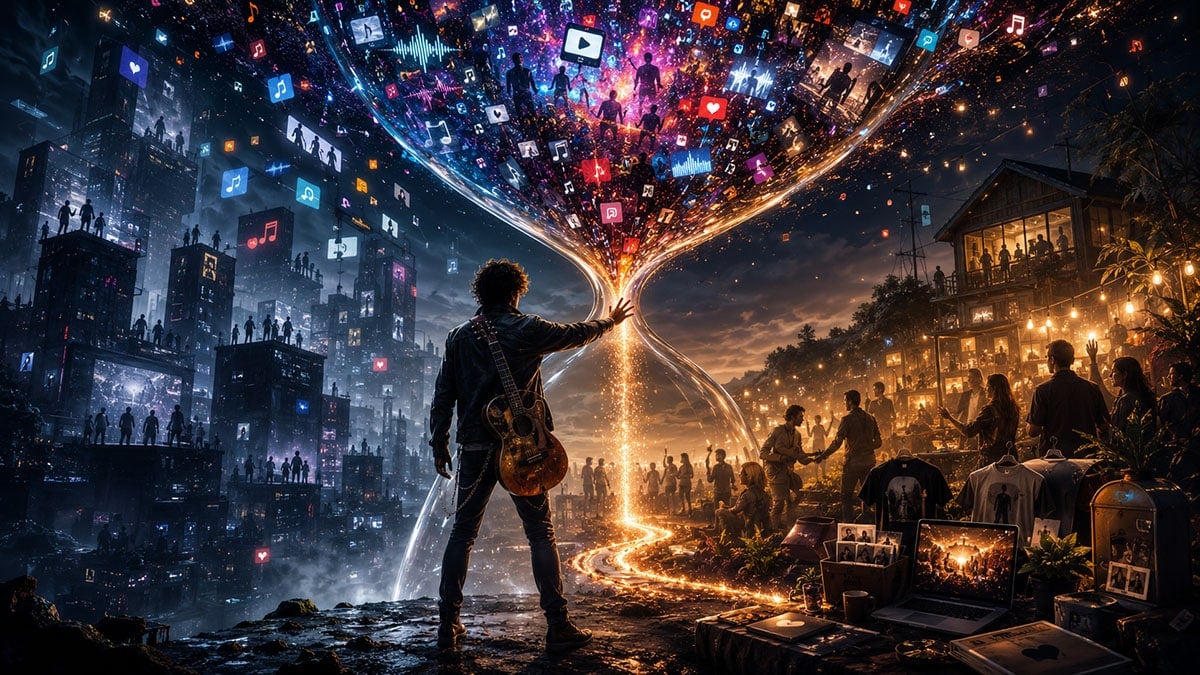
Making a Scene Presents – The Real Bottleneck in Music Isn’t Talent—It’s Attention
Listen to the Podcast Discussion
Why the Fight for an Indie Music Career Has Changed
There was a time when the hardest part of building a music career was getting access. You needed access to a studio. You needed access to a producer. You needed access to a label. You needed access to radio. You needed access to a distributor, a publicist, a booking agent, a magazine, a record store, and somebody behind a desk who could either open the gate or slam it in your face.
That world was brutal. It kept a lot of great artists out. But at least the enemy was easy to see.
Today, the gates are gone, or at least they look like they are. Any artist can record music at home. Any artist can upload a single. Any artist can make videos. Any artist can release a record to Spotify (https://www.spotify.com/), Apple Music (https://music.apple.com/), YouTube (https://www.youtube.com/), Bandcamp (https://bandcamp.com/), TikTok (https://www.tiktok.com/), Instagram (https://www.instagram.com/), Facebook (https://www.facebook.com/), and almost every other platform on earth.
That sounds like freedom. In many ways, it is. But it also created a new problem.
The real bottleneck in music is no longer talent. It is attention.
There are more songs, more videos, more artists, more playlists, more podcasts, more reels, more livestreams, more newsletters, more reaction clips, more behind-the-scenes posts, and more digital noise than any fan could ever consume in one lifetime. The problem is not that artists cannot make music. The problem is that almost everybody can make music now, and the platforms are packed wall to wall with content fighting for the same tiny slice of human focus.
That does not mean talent does not matter. Talent still matters. Songs still matter. The voice still matters. The groove still matters. The story still matters. The live show still matters. But talent without attention is like a record locked in a basement. It may be beautiful, but nobody knows it exists.
This is the hard truth indie artists need to face. Making the music is only the start. Releasing the music is not the finish line. Getting a stream is not the same thing as building a fan. Getting a like is not the same thing as building a relationship. Going viral is not the same thing as building a career.
The artist who understands this has a real chance. The artist who does not will keep feeding the machine and wondering why the machine never feeds them back.
The Platforms Are Not Built to Build Your Career
Let’s keep this real. Social media platforms and streaming platforms are not charities for musicians. They are not artist development programs. They are not your manager. They are not your fan club. They are not your street team. They are not your publicist. They are businesses.
That does not make them evil. It makes them what they are.
TikTok (https://www.tiktok.com/), Instagram (https://www.instagram.com/), Facebook (https://www.facebook.com/), YouTube (https://www.youtube.com/), Spotify (https://www.spotify.com/), and the rest of the digital giants are designed to capture attention, study behavior, collect data, keep users inside their system, and turn that activity into revenue for themselves. Some platforms do that through advertising. Some do it through subscriptions. Some do it through a mix of ads, subscriptions, commerce, data, and paid promotion. But the point is the same.
Their business model is not built around making sure you can pay your rent.
That sentence may sting, but it can also set you free.
When an artist posts on Instagram, Instagram benefits from the activity. When an artist posts on TikTok, TikTok benefits from the activity. When an artist uploads videos to YouTube, YouTube benefits from watch time. When an artist sends fans to Spotify, Spotify gets the user, the listening data, the subscription value, and the chance to keep that listener moving through the platform.
The artist may get exposure. The artist may get streams. The artist may get followers. The artist may get a few dollars. But the platform usually gets the better end of the deal because it controls the environment, the rules, the data, the reach, and the relationship.
This is why so many artists feel like they are working harder than ever and owning less than ever. They are creating content for platforms they do not control. They are building audiences they cannot fully reach. They are gathering followers they cannot export. They are chasing algorithms they cannot see. They are accepting tiny slices of income from systems that would rather keep the fan inside the app than send that fan into the artist’s world.
This is not a music career. This is digital sharecropping with better lighting.
That does not mean artists should leave these platforms. That would be foolish. These platforms are where attention moves. They are where discovery happens. They are where fans scroll, search, listen, watch, and stumble across new music. Used correctly, they are powerful.
But here is the key. Social media and streaming should be a door, not a destination.
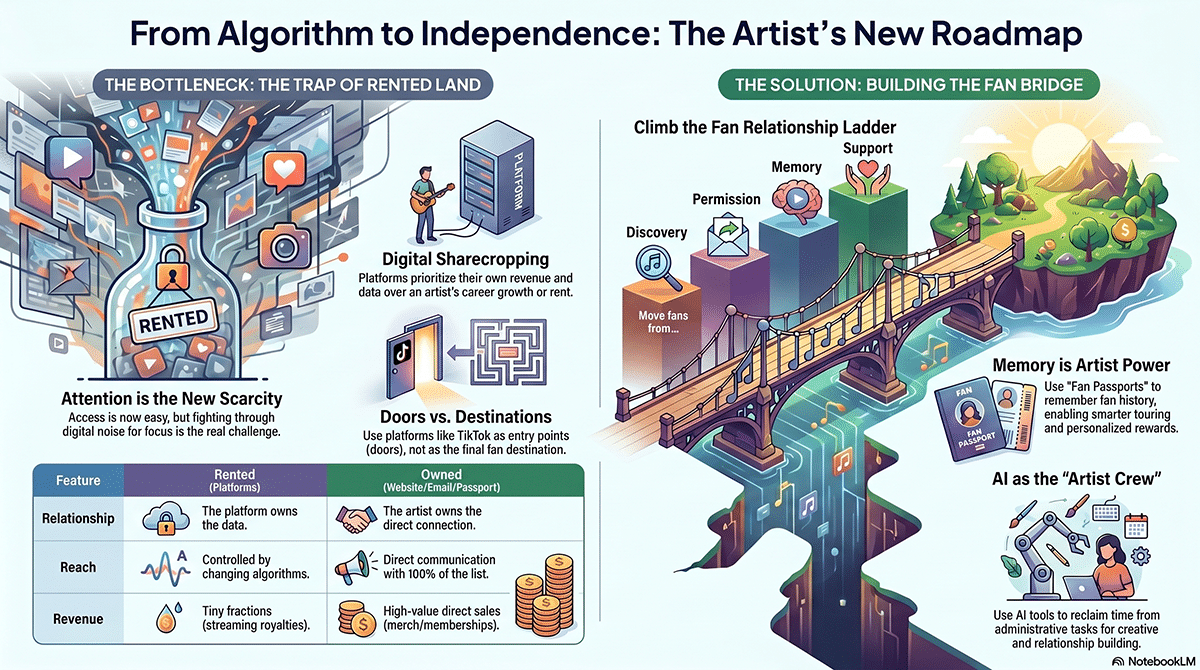
A door is something people pass through. A destination is where people stay. Too many artists treat Spotify, Instagram, TikTok, and YouTube as the final place where the fan relationship lives. That is the trap. The artist does all the work to get attention, then leaves the attention sitting on rented land.
The smarter move is to use these platforms as entry points. Let the platforms create discovery. Let the algorithm introduce strangers to your world. Let the stream start the relationship. Let the video earn the first look. But once you have attention, you need to move that attention into a place you control.
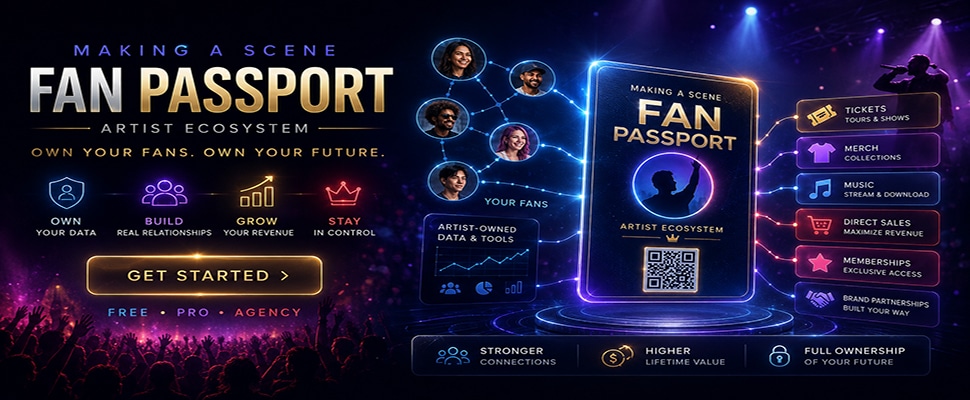
That place can be your website. It can be your email list. It can be your text list. It can be a fan passport. It can be a membership. It can be a private community. It can be your merch store. It can be your ticketing page. It can be your direct-to-fan hub.
The exact tool matters less than the strategy. The goal is simple. Stop renting your fanbase from companies that profit when you stay dependent.
Attention Is the New Scarcity
For years, indie artists were told that distribution was the hard part. Get your music out there, they said. Get on every platform, they said. Be everywhere, they said.
Now almost everybody is everywhere.
The cost of uploading music has dropped. The cost of recording has dropped. The cost of making videos has dropped. The cost of designing covers has dropped. The cost of creating a basic website has dropped. The cost of reaching people has changed, but the ability to publish is no longer rare.
What is rare is sustained attention.
A fan can discover your song today and forget your name tomorrow. A fan can like your video and never hear from you again. A fan can stream your track, enjoy it, and have no idea where to find you when you come to town. A fan can follow you on a platform and still never see your next post because the algorithm decided your content was not useful to its own goals that day.
Attention is slippery. It is not enough to grab it once. You have to earn it, catch it, respect it, and turn it into a relationship.
This is where many artists get stuck. They think attention means numbers. They chase views, likes, followers, saves, streams, and comments. Those numbers can matter, but only if they lead somewhere. A million views that do not create one real fan relationship may feel exciting, but it can disappear like smoke. A hundred people who join your email list, buy tickets, support your merch table, and bring friends to shows can become the foundation of a real career.
The game is not attention for attention’s sake. The game is attention that turns into trust. Trust that turns into permission. Permission that turns into communication. Communication that turns into community. Community that turns into income. Income that turns into independence.
That is the ladder.
Most platforms only want you to climb the first step. They want you to create more content so they can sell more ads, keep more users engaged, and train their recommendation systems. But artists need to think beyond the platform’s first step. The artist needs to ask a better question.
What happens after somebody pays attention?
If the answer is “I hope they follow me,” that is too weak.
If the answer is “I hope the algorithm shows them my next post,” that is not a strategy. That is a prayer.
The answer should be something stronger. Maybe they scan a QR code at your show and get a digital stamp in their fan passport. Maybe they join your email list to get an unreleased live track. Maybe they sign up for text alerts so they know when you are coming to their city. Maybe they buy a limited shirt tied to the new single. Maybe they join a monthly membership where they get demos, behind-the-scenes sessions, early tickets, private livestreams, or voting power on future releases.
That is how attention becomes business.
The Old Music Industry Sold Dreams. The New One Sells Distraction.
The old gatekeepers sold artists a fantasy. They said, “Get signed, and we will make you a star.” In exchange, artists often gave up control of their masters, publishing, image, money, and long-term rights. The old system was built on access. Labels controlled studios, radio promotion, physical distribution, press, and retail placement. If you wanted in, you had to make a deal with the people holding the keys.
The new gatekeepers sell a different fantasy. They say, “Post more, and the algorithm may bless you.” In exchange, artists give up time, data, focus, and direct access to their own fans. The new system is built on attention. Platforms control feeds, playlists, recommendations, search visibility, audience targeting, and discovery pathways. If you want reach, you have to feed the machine.
Different century. Same power game.
The old gatekeeper said, “We own the pipeline.”
The new gatekeeper says, “We own the audience.”
This is why independent artists need to stop confusing access with power. Yes, you have access to global platforms. Yes, your music can sit beside major label releases. Yes, your video can technically reach millions. But access without ownership is not enough.
If you cannot reach the fan again, you do not own the relationship. If you cannot contact the fan without paying a platform, you do not own the relationship. If you cannot see who bought, clicked, attended, supported, shared, scanned, saved, or subscribed, you do not own the relationship. If the platform can change the rules tomorrow and your connection disappears, you do not own the relationship.
That is the real problem.
The future belongs to artists who treat attention as the beginning of a direct relationship, not the end of a promotional campaign.
Streaming Is Useful, But It Is Not a Career Plan
Streaming has value. Let’s not pretend it does not. Spotify (https://www.spotify.com/), Apple Music (https://music.apple.com/), Amazon Music (https://music.amazon.com/), YouTube Music (https://music.youtube.com/), TIDAL (https://tidal.com/), Deezer (https://www.deezer.com/), and other services make music available around the world. They help listeners discover songs. They give artists a way to be heard without pressing CDs, begging retailers, or signing away control just to reach the public.
That part is powerful.
But streaming is not enough by itself. Streaming income is usually based on complex royalty systems, rights holders, subscription pools, advertising pools, market share, distributor terms, label deals, publishing rights, and listener behavior. It is not a simple “one stream equals one fixed payment” system. Even when streaming does generate money, the artist may only see a portion depending on how the music was released and who controls the rights.
That means an indie artist cannot build a serious plan around the fantasy that streams alone will save them. For a small number of artists, streaming income can be meaningful. For most, streaming is one layer in a larger revenue stack.
That is not failure. That is math.
The smarter artist uses streaming for discovery, credibility, and listening access. Then they build income through things that create stronger fan value. Shows. Merch. Vinyl. CDs. Digital downloads. Direct sales. Fan memberships. House concerts. Licensing. Publishing. Sync placements. Crowdfunding. VIP experiences. Workshops. Lessons. Sample packs. Behind-the-scenes access. Private communities. Fan support. Limited releases. Bundles. Sponsorships. Local partnerships.
Streaming should introduce the song. It should not be expected to carry the whole business.
The same is true for social media. A reel can introduce your personality. A TikTok can show your creative process. A YouTube video can build deeper trust. A Facebook event can help reach local fans. An Instagram story can remind people about a show. But none of that matters if the relationship stays trapped inside a platform that may or may not show your next post.
The artist has to build the bridge.
The Bridge: From Stranger to Fan to Supporter
Most artists do not have an attention problem because nobody cares. They have an attention problem because they do not have a clear path for people who care.
A stranger hears a song. What happens next?
A viewer watches a clip. What happens next?
A person comes to a show. What happens next?
A fan buys a shirt. What happens next?
A listener saves a track. What happens next?
If there is no answer, the relationship leaks out of the system. The artist keeps starting over. Every release feels like a new uphill climb. Every tour feels like a cold start. Every post feels like yelling into the wind. That is exhausting, and it is not sustainable.
The artist needs a bridge. The bridge should move people from casual attention to direct connection.
At the first stage, the fan discovers you. That can happen through TikTok (https://www.tiktok.com/), Instagram (https://www.instagram.com/), YouTube (https://www.youtube.com/), Spotify (https://www.spotify.com/), Bandcamp (https://bandcamp.com/), press, radio, podcasts, playlists, live shows, collaborations, or word of mouth.
At the second stage, the fan gives you permission. This is where they join your email list through Mailchimp (https://mailchimp.com/), Kit (https://kit.com/), Substack (https://substack.com/), or another email platform. They may join your text list. They may scan a QR code at your merch table. They may sign up for a fan passport. They may join a private community through Discord (https://discord.com/) or Patreon (https://www.patreon.com/). The key is that they are no longer just a number on somebody else’s platform. They have raised their hand.
At the third stage, the fan gets remembered. This is where a fan passport-style system becomes powerful. The artist does not just collect an email address and let it rot in a spreadsheet. The artist starts building memory. The system remembers that the fan came to a show in Atlanta. It remembers that they bought a vinyl record. It remembers that they scanned a QR code for a new release. It remembers that they joined the street team. It remembers that they supported a campaign. It remembers that they prefer show alerts, release alerts, or reward alerts.
That memory matters because relationships are built on being remembered.
At the fourth stage, the artist communicates with purpose. Not spam. Not begging. Not “please stream my song” every three days until people tune out. Purposeful communication means telling fans what matters, giving them a reason to care, and making offers that match the relationship. A fan who came to your last show in Cleveland should hear when you are coming back to Cleveland. A fan who bought a shirt should see the next limited merch drop first. A fan who supported a crowdfunding campaign should get thanked and invited deeper into the world. A fan who scans three show stamps should feel like they are part of the story.
At the fifth stage, the fan supports the artist because the relationship has value. They buy tickets. They buy merch. They join memberships. They share releases. They bring friends. They support livestreams. They pay for exclusive work. They show up because they are not just being marketed to. They are being included.
That is the difference between an audience and a fanbase.
An audience watches. A fanbase remembers, responds, supports, and returns.
Why the Fan Passport Idea Matters
A fan passport is bigger than a gimmick. It is a memory system.
That matters because most indie artists have been trained to think of fans as scattered numbers. Followers over here. Streams over there. Email addresses in one place. Ticket buyers in another. Merch buyers somewhere else. YouTube subscribers in another silo. Comments buried under old posts. Show attendance in somebody’s head. Street team activity in a forgotten spreadsheet. It is chaos.
The platforms love that chaos because it keeps artists dependent.
A fan passport-style system starts to organize the relationship. It gives fans a reason to identify themselves, check in, collect moments, unlock rewards, and become part of the artist’s world. It turns a show into more than a show. It turns a merch purchase into more than a transaction. It turns a QR scan into a relationship point. It turns fan support into a history the artist can understand and honor.
This is not about spying on fans. That is the platform model. The artist model should be permission-based, honest, and transparent. Fans should know what they are joining, what data they are sharing, and what value they get in return. The goal is not to trick people. The goal is to build trust.
When done right, a fan passport gives the artist something the platforms do not want them to have: memory.
Memory is power. If you know where your fans are, you can book smarter. If you know who buys merch, you can plan better inventory. If you know who attends shows, you can reward loyalty. If you know who wants new music alerts, you can communicate without depending on an algorithm. If you know which cities are heating up, you can route tours with less guesswork. If you know which fans bring friends, you can build a street team. If you know who supports directly, you can treat them like partners in the mission.
That is how artists stop acting like content suppliers and start acting like community builders.
AI Is Not the Artist. AI Is the Crew You Could Never Afford.
A lot of artists hear the word AI and immediately tense up. That is understandable. There is a real fight happening over music, rights, consent, training data, voice cloning, copyright, and the future of creative labor. Artists should not ignore those issues. They should not hand their identity to any tech company without thinking. They should not confuse automation with artistry.
But artists also need to understand something important. The industry does not hate AI. The industry hates AI it cannot control and monetize.
Major companies will use AI. Labels will use AI. Platforms will use AI. Marketers will use AI. Advertisers will use AI. Ticketing companies will use AI. Data companies will use AI. The question is not whether AI enters the music business. It already has. The real question is whether independent artists use it to build power or get buried by people who do.
AI should not replace the artist’s soul. It should reclaim the artist’s time.
Tools like ChatGPT (https://chatgpt.com/), Claude (https://claude.ai/), Perplexity (https://www.perplexity.ai/), Google NotebookLM (https://notebooklm.google.com/), Descript (https://www.descript.com/), Canva (https://www.canva.com/), CapCut (https://www.capcut.com/), Buffer (https://buffer.com/), and Hootsuite (https://www.hootsuite.com/) can help indie artists do work that used to require a team.
AI can help turn a long interview into social clips, newsletter ideas, blog posts, show promos, and press angles. AI can help an artist study which posts are bringing people to the website. AI can help organize a release calendar. AI can help write first drafts of emails. AI can help create tour market summaries. AI can help compare merch sales by city. AI can help build better subject lines. AI can help repurpose one piece of content into ten useful entry points. AI can help identify which fans are engaging and what they might want next.
This is where AI becomes a leveling tool.
The old advice was “work harder.” That is lazy advice. Most indie artists are already working hard. They are writing, recording, rehearsing, booking, posting, editing, driving, selling, shipping, mixing, emailing, and trying to have a life somewhere in the middle of all that madness.
AI can help the artist work with more focus. It can reduce the blank page problem. It can help the artist turn raw attention into structured follow-up. It can help the artist stop wasting time guessing and start making better decisions.
The artist still needs taste. The artist still needs judgment. The artist still needs a point of view. AI without human direction becomes beige digital soup. But AI guided by a real artist with a real mission can become a serious advantage.
The goal is not to become less human. The goal is to free up more time to be human where it matters most: in the songs, on the stage, in the fan relationship, and in the story.
Content Should Not Just Entertain. It Should Open a Door.
One of the biggest mistakes artists make is creating content with no job.
A post should have a job. A video should have a job. A livestream should have a job. A short clip should have a job. That job does not always have to be “sell something right now.” In fact, most content should not be hard selling. But every piece of content should help move the relationship forward.
Some content creates discovery. This is the short-form clip, the performance moment, the hook, the funny behind-the-scenes piece, the bold opinion, the song snippet, the studio mistake, the live crowd reaction, the story that makes a stranger stop scrolling.
Some content builds trust. This is the longer video, the newsletter, the blog post, the acoustic version, the podcast interview, the breakdown of a lyric, the documentary piece, the tour diary, the story behind the record, the honest look at the struggle.
Some content invites action. This is the show announcement, the merch drop, the fan passport scan, the membership offer, the pre-order, the limited vinyl, the house concert invite, the street team signup, the “join the list before Friday” message.
An artist needs all three. Discovery without trust is shallow. Trust without action becomes a nice conversation that never supports the work. Action without trust feels like begging.
The trick is to stop thinking of content as random posting and start thinking of it as a path.
A stranger sees a short clip. That clip points to a longer story. The longer story invites them to join the artist’s list. The list gives them a reason to care. The fan passport remembers where they entered. The artist sends the right message at the right time. The fan buys a ticket when the artist comes to town. After the show, the fan gets thanked, stamped, rewarded, and invited deeper.
That is a system.
Not a fake system. Not a hustle bro funnel. Not some soulless marketing machine that treats fans like wallets with Wi-Fi. A real artist ecosystem. A place where attention turns into belonging.
The Artist Website Comes Back From the Dead
For years, artists were told websites were old news. Just be on social media, they said. Just send people to your Linktree, they said. Just focus on platforms, they said.
That advice aged like milk in a hot van.
The artist website is not dead. It is becoming more important than ever because it is one of the few places where the artist can build a world they control.
Your website should not be a dusty digital business card with a bio from six years ago and a contact form that may or may not work. It should be your home base. It should be the place where attention lands and becomes relationship.
Your website can hold your music, videos, tour dates, merch, email signup, fan passport entry point, press kit, lyrics, stories, membership offers, private content, downloads, sponsor information, booking links, and direct support options. It can connect with Bandcamp (https://bandcamp.com/), Shopify (https://www.shopify.com/), Patreon (https://www.patreon.com/), Substack (https://substack.com/), Discord (https://discord.com/), Mailchimp (https://mailchimp.com/), Kit (https://kit.com/), and other tools that help you own more of the relationship.
Most important, your website is not controlled by the mood swings of a feed.
If Instagram changes its algorithm, your website still exists. If TikTok gets unstable, your website still exists. If a playlist drops your song, your website still exists. If a platform locks your reach unless you pay for ads, your website still exists. If your account gets hacked, flagged, throttled, or buried, your website still exists.
The website is not the whole business. But it is the anchor.
The artist who has no anchor gets dragged wherever the platform tide moves.
The Simple Roadmap: Turn Attention Into Income
The path forward is not easy, but it is achievable. Independent artists do not need to become tech experts overnight. They do not need to master every platform. They do not need to post twenty times a day. They do not need to chase every trend until they forget why they started making music in the first place.
They need a simple system.
The first step is to make attention easier to understand. Stop asking only, “How many views did I get?” Start asking, “What kind of attention did I earn?” A passive view is different from a comment. A comment is different from an email signup. An email signup is different from a ticket sale. A ticket sale is different from a fan who brings three friends and buys merch. Not all attention has the same value.
The second step is to create clear doors. Every platform should point somewhere. Spotify should point to tour dates, merch, and your artist hub. Instagram should point to your fan signup. TikTok should point to a deeper story. YouTube should point to your website and email list. Live shows should have QR codes at the merch table, on posters, near the stage, and in the room. The fan should never wonder what to do next.
The third step is to collect permission. This is where the artist starts to gain power. Email still matters. Text still matters. Fan passport signups matter. Memberships matter. Direct communities matter. Permission means the fan has agreed to hear from you outside the algorithm. That is a major step. Treat it with respect.
The fourth step is to build memory. Do not treat every fan the same. A fan in your hometown is different from a fan across the country. A fan who comes to shows is different from a fan who only streams. A fan who buys merch is different from a fan who joined for free. A fan who supports every release should not feel invisible. Use tools, tags, fan passport stamps, email segments, purchase history, show scans, and simple notes to remember what matters.
The fifth step is to communicate like a human being. Do not send empty noise. Tell stories. Share useful updates. Invite fans into the process. Thank them. Reward them. Give them reasons to show up. Let them know when you are coming to town. Give them first access. Make them feel like insiders, not targets.
The sixth step is to create direct offers. This is where income starts to move closer to the artist. Tickets. Merch. Vinyl. CDs. Downloads. Memberships. House concerts. VIP events. Livestreams. Workshops. Digital products. Fan clubs. Limited bundles. Sync-ready catalogs. Local sponsor packages. These are not side hustles. These are revenue streams. This is how an artist builds a middle-class music business instead of waiting for a platform payout to change their life.
The seventh step is to review the data without losing your soul. Data should help you make better decisions, not turn you into a robot. Look at which cities are responding. Look at which songs drive signups. Look at which emails get replies. Look at which merch sells after shows. Look at which content brings fans into your world. Use AI to help organize the patterns. Then use your human judgment to decide what to do next.
That is the new artist workflow. Capture attention. Move it into your world. Earn permission. Build memory. Communicate with purpose. Make direct offers. Reward loyalty. Repeat.
It is not magic. It is a business.
Stop Chasing the Algorithm Like It Owes You Money
The algorithm does not owe you a career.
That may be the most freeing sentence an indie artist can hear.
Once you understand that, you stop taking every dip in reach personally. You stop believing low views mean your music has no value. You stop confusing platform response with artistic worth. You stop asking a machine for permission to matter.
The algorithm is not a judge of your soul. It is a sorting system built around platform goals.
Sometimes those goals line up with yours. Often they do not.
Your job is not to worship the algorithm. Your job is to use it, study it, test it, and then move people into a relationship you control. The platform can be part of your strategy, but it should never be the center of your identity.
This is especially important for mental health. Artists are already vulnerable because they put pieces of themselves into public view. When every post becomes a vote on your worth, the machine wins. When every stream count becomes a measure of your talent, the machine wins. When every slow week makes you question your whole life, the machine wins.
You need a better scoreboard.
Did you add real fans to your list? Did more people come to the show? Did merch sales improve? Did fans reply to your email? Did someone bring a friend? Did a local venue notice your draw? Did a fan support directly? Did your new content explain who you are more clearly? Did your website capture more signups? Did your fan passport help you understand your community better?
That is the scoreboard that matters.
The New Middle Class Music Business
The Making a Scene philosophy is simple. Indie artists do not need another system that turns them into cheap content for somebody else’s platform. They need tools and strategies that help them own their music, own their data, own their fan relationships, and build real revenue.
That is how we build a music industry middle class.
Not every artist needs to become famous. Fame is not the only business model. In fact, fame can be a terrible business model if everybody else owns the income.
A healthier goal is sustainability. A strong base of real fans. A direct relationship. A smart catalog. A live show that can sell tickets. Merch that fans actually want. Email and text lists that work. A website that converts attention into action. A fan passport that remembers loyalty. AI tools that save time. A release plan that builds momentum. A touring plan based on real demand. A revenue stack that does not depend on one platform.
That kind of career may not look like the old fantasy. It may not come with limos, champagne, and a major label advance that turns into debt. Good. That fantasy was always rigged for most artists anyway.
The new win is freedom with cash flow.
It is being able to make the next record because your fans helped fund the last one. It is knowing where your strongest cities are before booking a tour. It is selling directly instead of hoping a tiny royalty statement changes your life. It is using social media to bring people home instead of letting platforms own the whole relationship. It is using AI as a crew, not a replacement. It is building a system where every release makes the next release easier because the fanbase does not disappear between campaigns.
That is not a dream. That is a strategy.
The Bottom Line
The world does not have a shortage of music. It has a shortage of attention, trust, memory, and real artist-fan relationships.
That is the bottleneck.
The artists who win the next era will not simply be the most talented. They will be the artists who understand how to capture attention without being owned by the platforms that sell it. They will be the artists who turn listeners into subscribers, subscribers into supporters, supporters into community, and community into long-term income.
This is not about abandoning streaming. This is not about quitting social media. This is not about hiding from technology. It is about using these tools with your eyes open.
Use Spotify as a door. Use TikTok as a door. Use Instagram as a door. Use YouTube as a door. Use every platform as a door.
But build your own house.
Build the website. Build the list. Build the fan passport. Build the merch table. Build the membership. Build the direct sales path. Build the data system. Build the community. Build the memory. Build the revenue stack.
The gatekeepers are not gone. They just changed clothes.
The good news is that indie artists have more power than ever if they stop handing that power away one post, one stream, and one rented fan relationship at a time.
The music still matters. The song still matters. The performance still matters. The story still matters.
But in this new world, talent is not enough by itself.
Attention is the spark.
Relationship is the engine.
Ownership is the future.
 |  Spotify |  Deezer |  Breaker |
 Pocket Cast |  Radio Public |  Stitcher |  TuneIn |
 IHeart Radio |  Mixcloud |  PlayerFM |  Amazon |
 Jiosaavn |  Gaana |  Vurbl |  Audius |
 Reason.Fm | |||
Find our Podcasts on these outlets
Subscribe to Our Newsletter
Discover more from Making A Scene!
Subscribe to get the latest posts sent to your email.


