

Canada Just Put Money Behind the People Who Build the Stage




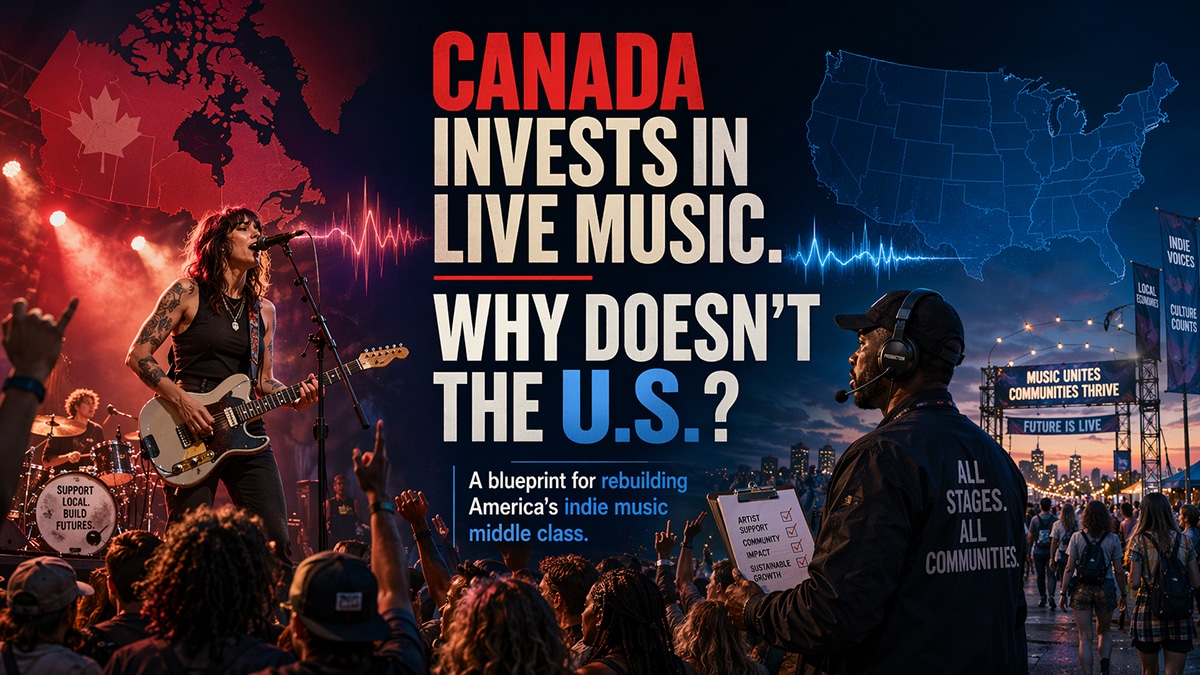
Making a Scene Presents – Canada Just Put Money Behind the People Who Build the Stage
Listen to the Podcast Discussion
FACTOR’s new live music investment is more than a press release. It is a reminder that if you want a real music middle class, you do not just fund songs. You fund the ecosystem that gets those songs in front of people.
There is a big difference between saying you support music and actually building a system that helps music survive.
Canada just gave us a very clear example of that difference. On April 21, 2026, FACTOR announced a $2 million investment in the live music sector through two new initiatives, the Promoter Program and the Festival Program. According to FACTOR, the goal is to strengthen what it called cultural sovereignty by sharing risk with Canadian-owned promoters and festivals that have a real track record of presenting Canadian artists and keeping diverse Canadian voices at the center of the live experience. FACTOR says the guidelines for both programs will go live on April 30, 2026, and applications are due by 5:00 p.m. ET on June 11, 2026.
That may sound like one more arts-funding headline to skim past, but it is not. This is really a story about power. It is about who gets to choose the artists on stage, who gets to take chances on local scenes, and who gets to shape the culture that audiences actually see and hear in a country. FACTOR’s announcement says the money is aimed at the people who connect artists with fans and shape how audiences discover homegrown music. In plain English, Canada is saying something the U.S. music business still struggles to admit: promoters and festivals are not just service providers. They are culture builders.
That matters because artists do not grow in a vacuum. Songs do not tour themselves. Festivals do not magically appear. A healthy scene needs people willing to book original music, market it, risk money on it, and build audiences around it. FACTOR’s announcement is smart because it targets that leverage point directly. It is not only investing in artists after the fact. It is investing in the people and organizations that decide whether artists get the shot in the first place.
Canada Did Not Accidentally Build This
This move also did not come out of nowhere. FACTOR describes itself as a private, nonprofit funding body that has been strengthening Canada’s cultural sector since 1982. Its mandate is to support the career development of Canadian artists and the competitiveness of the Canadian-owned music sector at home and abroad. FACTOR says its funding comes from the Department of Canadian Heritage through the Canada Music Fund and from Canada’s private radio broadcasters. It also supports not just artists and songwriters, but managers, labels, publishers, promoters, and event producers. That last part is important. Canada’s model has long recognized that a music industry is an ecosystem, not just a pile of recordings.
The Canada Music Fund reinforces that approach. Canadian Heritage says the fund exists to ensure that a diversity of Canadian music artists connect with audiences everywhere, and that it is delivered through FACTOR for the Anglophone market and Musicaction for the Francophone market. In March 2024, the Canadian government announced $32 million over two years for the Canada Music Fund to keep supporting Canadian artists and strengthen the competitiveness and stability of the sector.
That last phrase matters: competitiveness and stability. Those are business words, not just arts words. Canada is not treating music like a hobby that deserves pity. It is treating music like a strategic cultural industry that deserves infrastructure.
And the logic behind this new FACTOR announcement is backed up by Canada’s own policy review. In its evaluation of the Canada Music Fund covering 2018–19 to 2022–23, Canadian Heritage said the current economy and changes in consumer habits are hurting artists’ incomes and discoverability. The review stated that live performance has become the main source of revenue and discoverability for artists, and that promoters and venue owners are key stakeholders who are not regularly funded by the Canada Music Fund. It went even further, saying it seems necessary to examine how the fund, FACTOR, and Musicaction could further support live performance so artists can access venues and reach audiences everywhere. This new Promoter Program and Festival Program look a lot like Canada acting on that reality.
This Is About More Than Grants. It Is About Cultural Control.
The most important phrase in the FACTOR release may be “cultural sovereignty.” That is a serious phrase. It means a country understands that culture is not just content. It is identity, memory, local voice, and the right to have your own people shaping the rooms where your stories get told.
FACTOR President and CEO Meg Symsyk tied the program directly to rising costs and increased competition from foreign-owned companies. That framing is not subtle. Canada sees pressure coming from outside capital and outside ownership, and it is choosing to counter that pressure with policy. It is saying that if the market alone keeps rewarding whoever has the deepest pockets, then local promoters and festivals need backup or they will get squeezed out. And when those local players get squeezed out, local artists lose stages, audiences lose scenes, and culture starts getting programmed from somewhere else.
That should hit home for anyone paying attention in the United States. We talk all the time about supporting independent artists, but too often that conversation begins and ends with the artist alone. We tell musicians to work harder, post more, drive engagement, tour more efficiently, and pray to the algorithm. Meanwhile, the actual infrastructure around them keeps consolidating. The result is a business that loves indie aesthetics but hates indie leverage.
That is why this Canadian move deserves attention from U.S. artists, journalists, venue operators, promoters, and policymakers. It recognizes a hard truth: if you want a music middle class, you cannot just celebrate “creators.” You have to invest in the supply chain of independence.
Canada Has Already Tested This Thinking
This is not the first time FACTOR and the Canada Music Fund have put money into the live side of the business. FACTOR’s 2022–23 annual report shows that the organization offered $3,677,950 through a Festival Reopening program and $7,546,000 through Support to Music Venues and Concert Promoters, for a combined $11,223,950 reaching 218 eligible recipients. The report says the goal of the venue and concert promoter support was to keep Canadian-owned music venues and concert promoters operating during economic uncertainty so Canadian artists could continue performing to audiences across Canada.
That matters because it shows continuity. Canada has already spent the last several years learning that if you want artists to work, you need places to put them, people to book them, and organizations willing to market them. This new $2 million announcement is not some random nice gesture. It fits into a larger understanding that live music infrastructure is part of national cultural policy.
The U.S. Has Money for Music. It Just Rarely Builds the Right Machinery.
Now let’s bring this home.
The United States is not incapable of funding music. It just usually does it in fragmented ways that do not add up to a durable independent ecosystem. The National Endowment for the Arts does provide music funding, but its main Grants for Arts Projects program is project-based, not ongoing operating support. The NEA says eligible applicants include nonprofits, units of state or local government, and federally recognized tribal communities or tribes. Its music guidelines say applicants can seek $10,000 to $100,000, but the grants are for projects only and do not fund an entire season of programming or general operating support. That is real help, but it is not a system built specifically to stabilize independent promoters, regional festivals, and small live-music businesses as a class.
At the local level, though, you can see glimpses of what a smarter American model might look like. Austin’s Live Music Fund openly includes musicians, promoters, and live music venues. The city says the program’s goals include increasing cultural tourism, increasing revenue for musicians, promoters, and venues, supporting jobs in the creative economy, and promoting new artist development. Austin says its FY26 awards provide $7.14 million to 399 musicians, promoters, and live music venues. That is not theory. That is a city treating live music like economic infrastructure.
The federal government has also already proved it can step in when live music is in real danger. The SBA’s Shuttered Venue Operators Grant provided emergency assistance for eligible performing arts businesses during the pandemic, and an SBA watchdog report says Congress ultimately provided $16.25 billion for grants to businesses engaged in venue operations. In other words, America has already shown that when the crisis is obvious enough, it can write very big checks to stabilize live music infrastructure. The missing piece is turning emergency rescue into long-term cultural strategy.
What the U.S. Should Build Next
If America were serious about building a music industry middle class instead of a celebrity lottery, it would stop pretending that “exposure” is a business model and start investing in the infrastructure that creates local earning power.
A U.S. version of the FACTOR idea could begin with a national independent live music fund aimed at independent promoters, small and mid-size venues, regional festivals, and community-rooted presenting organizations. Not giant corporate operators. Not vanity showcases. The point would be to share risk with organizations that demonstrably book original music, pay artists fairly, and build local or regional audiences. Canada’s new promoter-and-festival investment offers the blueprint: support the decision-makers who can actually create more stages for homegrown artists.
It should also be built as a public-private system, because Canada’s model shows that cultural funding does not have to come from one pipe. FACTOR is funded by government and private radio broadcasters. In the U.S., a modern version could blend federal arts money, state cultural-development funds, city music-office programs, and industry-side contributions. That does not have to mean a bloated bureaucracy. It could be lean, competitive, and tied to measurable outcomes like artist pay, local hiring, audience development, and geographic reach.
But here is where Making a Scene should push the conversation further than most policy people will. A good U.S. fund should not only help promoters and festivals survive. It should reward the ones that help artists own the relationship. That means incentives for ticketing systems that share first-party fan data with artists, fair merch policies, marketing support that drives fans into artist-owned ecosystems, and real pathways for direct sales, memberships, fan clubs, premium live recordings, and local sponsorships. Do not just subsidize the show. Subsidize the systems that let artists leave the show with revenue, data, and leverage.
That is the difference between keeping musicians alive and helping them build wealth.
A serious American live music strategy should also reserve real funding for local and regional scenes, not just prestige markets. One of the biggest problems in U.S. music is that too much industry attention is concentrated in a handful of cities while the rest of the country is treated like routing filler. If public money is involved, it should be aimed at strengthening the places where scenes are actually made: college towns, working-class cities, arts districts, border regions, rural circuits, Black music corridors, Indigenous communities, Latino markets, and the independent rooms that keep original music alive when the big players are chasing the safest possible gross.
That is how you build resilience. That is how you stop every artist from having to win the same national lottery. That is how you rebuild a ladder instead of celebrating the few people who somehow jumped without one.
The Real Lesson
The lesson here is not that Canada is perfect. It is that Canada is at least willing to connect the dots.
It sees that live performance now drives revenue and discovery. It sees that promoters and festivals shape audience access. It sees that local ownership matters. And it sees that if rising costs and outside competition are squeezing domestic culture, then policy has a role to play.
The U.S. should be able to understand this too. We already have the proof of concept in pieces: federal emergency venue support, local live music funds, and arts grants that can seed projects. What we do not have is the will to stitch those pieces into a durable national strategy for independent music infrastructure.
And that is the real story inside this FACTOR announcement. It is not just about $2 million. It is about a country deciding that the people who build the stage are worth investing in.
That is the part America still needs to learn. Because if we keep waiting for platforms, conglomerates, and monopoly-adjacent gatekeepers to build a middle class for musicians, we are going to be waiting a very long time.
 |  Spotify |  Deezer |  Breaker |
 Pocket Cast |  Radio Public |  Stitcher |  TuneIn |
 IHeart Radio |  Mixcloud |  PlayerFM |  Amazon |
 Jiosaavn |  Gaana |  Vurbl |  Audius |
 Reason.Fm | |||
Find our Podcasts on these outlets

Subscribe to Our Newsletter
Discover more from Making A Scene!
Subscribe to get the latest posts sent to your email.


