
Your AI Twin: Building a Digital Version of Yourself That Markets While You Sleep





Making a Scene Presents – Your AI Twin: Building a Digital Version of Yourself That Markets While You Sleep
Listen to the Podcast Discussion
There used to be a simple rule in the music business. If you wanted more reach, you needed more people. A label. A manager. A publicist. A radio plugger. A street team. A content person. A marketing assistant. Maybe even somebody whose whole job was just following up on emails you forgot to answer.
That old system did not disappear because it got fair. It disappeared because it got too expensive, too centralized, and too slow for the average independent artist. The jobs are still there. The work still has to get done. The difference is that now the artist is usually the one doing all of it.
That is where the idea of an AI twin gets interesting.
Not because you need a robot version of yourself making fake handshakes and fake friendships. Not because fans want a plastic imitation of your soul. And definitely not because art should sound like software. The real reason is much simpler than that. A working indie artist needs scale. You need to answer more messages, write more posts, send better emails, follow up with more promoters, and keep your voice steady across a dozen channels, even when you are in a van, loading out at 1 a.m., or half asleep after a six-hour drive.
An AI twin, done right, is not a fake you. It is a trained system that knows how you sound, what you believe, what story you keep telling, what kind of fans you are trying to attract, and where you want those fans to go next. It helps you show up more often without becoming a content machine with dead eyes. It helps you scale your communication without flattening your personality. And in the real world, that matters because communication is not just branding. Communication is revenue. Communication is how you move a casual listener toward a ticket, a shirt, a vinyl record, an email signup, a membership, a repeat show visit, or a long-term fan relationship.
That is the whole game now. Not fame first. Not platform first. Relationship first. Ownership first. Money that goes to the artist first.
What an AI Twin Really Is
Let’s clear one thing up right away. Most indie artists are not going to “train a model” in the lab-coat sense of the term. You are probably not going to build a foundation model from scratch, hire machine learning engineers, or spend months fine-tuning weights on a private cluster.
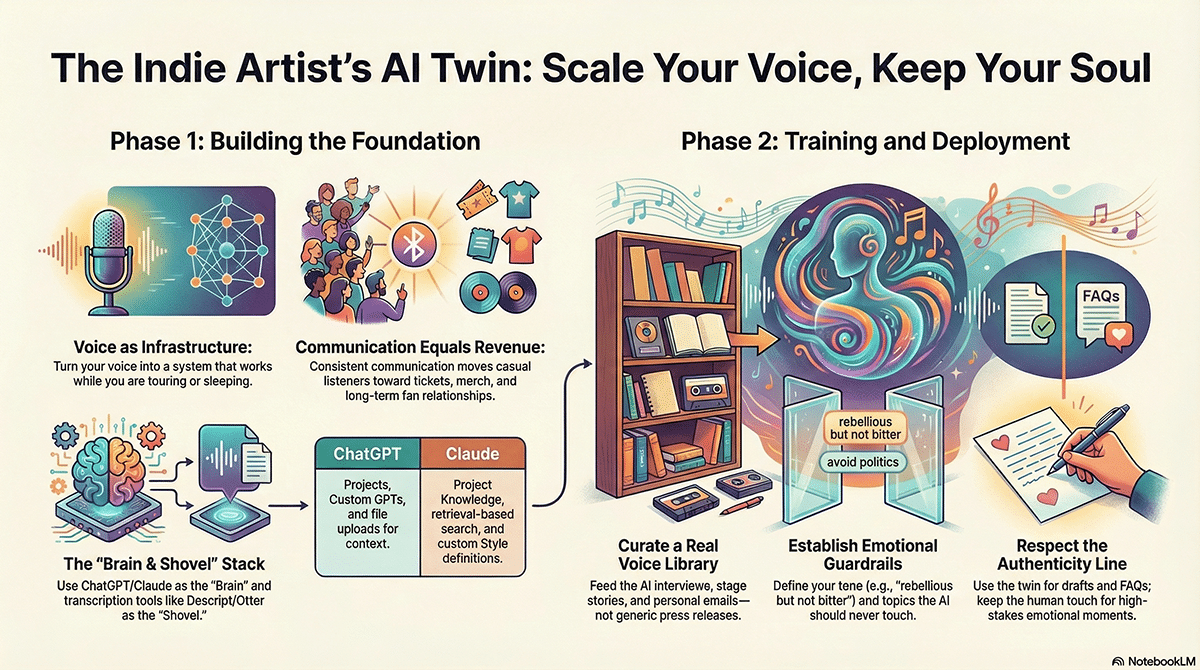
What you are actually doing is much more practical. You are building a reusable voice system on top of tools that already exist. In ChatGPT, that usually means using Projects, custom instructions, uploaded files, or a custom GPT. OpenAI describes Projects as workspaces where you can group chats, upload reference files, and add instructions, and it describes GPTs as tailored versions of ChatGPT that combine instructions, knowledge, and selected capabilities. In Claude, the closest equivalents are Projects, Project Knowledge, and custom Styles. Anthropic describes Projects as self-contained workspaces with their own knowledge bases, and its Styles feature lets you define how Claude should write and respond.
So when indie artists say, “I trained my AI on my voice,” what they usually mean is this: they fed the system enough examples, enough rules, enough context, and enough correction that it learned how to sound like them most of the time. That is not fake. That is process. It is closer to training a new assistant than creating a clone in a science fiction lab.
And that difference matters, because it keeps your expectations sane. Your AI twin is not magic. It will not automatically become wise, tasteful, funny, emotionally precise, and loyal to your brand just because you uploaded a few lyrics and said, “Write like me.” It needs source material. It needs boundaries. It needs jobs. It needs correction. Most of all, it needs a human artist who knows that authenticity is not a font. It is pattern, memory, intent, and taste.
Why This Matters for the Indie Artist Right Now
If you are an indie artist, you are probably operating inside a messy reality. You are playing local rooms, regional runs, support slots, songwriter rounds, house concerts, small festivals, listening rooms, maybe college dates if you are smart about routing. You are also expected to keep social moving, keep email moving, keep merch moving, keep the calendar moving, and keep fans feeling like they know you.
That is a lot of communication load for one person or one small band.
The problem is not that artists do not care about fans. The problem is that care does not automatically scale. Energy does not automatically scale. Time definitely does not scale. So what happens? A lot of artists go silent between releases. Their tone changes from platform to platform. Their Instagram sounds like one person, their email sounds like another, and their venue outreach sounds like it was written by a nervous intern who has never heard the music.
That inconsistency costs money.
It costs you when a fan signs up for your list and gets a dull welcome email that feels like it came from a lawn service company. It costs you when a promoter gets a vague follow-up that does not sound like a real working artist with a point of view. It costs you when your merch description is so flat that nobody feels anything. It costs you when your direct-to-fan system looks owned, but sounds rented.
An AI twin fixes that by turning your voice into infrastructure.
The Tools That Make This Real
The good news is that the basic stack already exists. You do not need a Silicon Valley budget. You need a brain, a shovel, a publishing arm, and a place you actually own.
For the brain, the two obvious starting points are ChatGPT and Claude. ChatGPT gives you Projects, file uploads, custom instructions, and custom GPTs. Claude gives you Projects, Project Knowledge, Styles, and memory/search features on supported plans. Claude also supports retrieval inside projects, which means it can search uploaded documents for the most relevant material instead of trying to keep every word loaded all at once. That is useful when your voice library starts getting big.
For the shovel, you need transcription. A lot of your voice is hiding in spoken language, not just written copy. Your interviews, your between-song stories, your voice memos, your live Q&A clips, your podcast guest spots, your rehearsal room talk, and your long weird rants about why you wrote a song often sound more like the real you than your polished bio ever will. Descript can transcribe audio and video and is built around text-based editing, while Otter focuses on real-time transcription, summaries, and searchable notes. Either one can help you turn your actual spoken personality into usable training material.
For the publishing arm, use a scheduler that can take your AI twin’s output and push it across channels without making you live inside every app all day. Buffer offers an AI Assistant for drafting and repurposing posts, and Metricool offers an AI assistant inside its social planning and analytics platform. That means your twin can help create the copy, and your scheduling tool can help you publish it on purpose instead of in a panic.
For the place you own, I still like WordPress for this kind of work because it is infrastructure, not a trend. If you want your AI twin to do real business for you, it should point people back to owned ground. The Newsletter Plugin is built for list building and email inside WordPress, and its docs note that WordPress can send mail out of the box throughwp_mail() , while also warning that delivery issues may require a more reliable delivery setup. That is where SendGrid comes in. Twilio SendGrid offers both Email API and Marketing Campaigns, and its pricing docs note those are separate product lines under one account.
That stack is enough to get started. Brain. Shovel. Publishing arm. Owned land.
Step One: Gather the Raw Material of You
This is where most artists either do the real work or start lying to themselves.
If your AI twin sounds generic, it is usually because you fed it generic material. If you upload one bio, two captions, and a press release written by somebody else three years ago, you are not building a twin. You are building a brochure.
What you want instead is a real voice library.
Start with your past emails. Not the stiff “for immediate release” junk. I mean the good ones. The thank-you notes after shows. The welcome emails that got replies. The personal updates that fans forwarded to friends. The messages where your point of view felt clear. Then pull in your better social posts. Not every post. Only the ones where people said, “This sounds exactly like you.”
Now add lyrics, but use them carefully. Lyrics show your themes, emotional temperature, recurring images, and favorite kinds of phrasing. They do not always show how you explain yourself in plain English. So lyrics are useful, but they are not enough.
Then add interviews. This part matters more than most artists realize. Interviews often reveal your natural pacing, the jokes you make, the stories you repeat, how direct you are, how you explain your work, what topics light you up, and what values keep showing up no matter who is asking the questions. That is gold.
Finally, add everyday speech. Voice memos. On-stage stories. Podcast clips. Studio talk. The moments where you sound like yourself before your “artist voice” tightens up and becomes a performance. Use Descript or Otter to turn all that speech into text, clean it up, and save it.
When you do this, do not collect everything. Curate. The goal is not a dump truck. The goal is a sharp library. A smaller set of strong examples beats a giant pile of weak, inconsistent writing every time.
Step Two: Turn the Library Into a Voice Playbook
Once you have the raw material, do not just throw it into ChatGPT or Claude and hope for a miracle. First, turn that material into a playbook.
This playbook is what teaches your AI twin how to make decisions when you are not there. It should answer simple questions like these. How warm are you? How funny are you? How direct are you? Do you sound like a teacher, a friend, a working-class road dog, a thoughtful outsider, a slightly rebellious builder, or some mix of all four? Do you use short sentences or long ones? Do you write like you talk, or cleaner than you talk? What phrases do you come back to again and again? What do you never say because it sounds fake coming from you?
You also want to define the emotional rules. Are you earnest without being corny? Confident without sounding arrogant? Slightly rebellious without sounding bitter? Hopeful without sounding naïve? Those tensions matter. That is where real voice lives.
Then define the mission. This is the part most artists forget. Your voice is not just style. It is direction. What is your communication trying to do? Bring fans closer? Move people toward live shows? Sell merch without feeling gross? Explain your values? Build a regional audience? Turn passive listeners into known supporters? Your twin needs to know that or it will create endless “content” with no business outcome.
A good playbook also includes what I call guardrails. These are the things the twin should not do. Do not pretend to have been at an event if the text was AI-generated later. Do not write fake vulnerable confessions. Do not use tragedy as engagement bait. Do not promise replies you cannot give. Do not sound like a guru. Do not talk like a startup founder who discovered empathy last Thursday.
If you give the system those boundaries early, the voice gets stronger, not smaller.
Step Three: Build It in ChatGPT
If you use ChatGPT, the cleanest way to do this is usually inside a Project or a custom GPT. OpenAI says Projects let you group chats, files, and instructions so the workspace stays on topic, and GPTs let you configure a version of ChatGPT with instructions, knowledge, capabilities, and version history. That makes either one a good home for an artist voice system.
Create a dedicated workspace for your artist voice. Upload your voice playbook, your best writing samples, cleaned transcripts, your artist bio, your one-sheet, past newsletters, and maybe a simple fan persona document. Then write a strong instruction block at the top. Tell it who you are, who your audience is, what your communication is trying to accomplish, and what the twin should never do.
Be specific. “Write like me” is junk. “Write in a plainspoken, conversational tone at roughly a 6th grade reading level. Use short to medium sentences. Sound thoughtful, human, slightly rebellious toward gatekeepers, but never smug. Focus on helping indie music fans feel closer to the artist and move them toward owned channels, shows, merch, and email signup” is much better.
Then test it with real tasks. Not abstract prompts. Give it an actual show announcement. A merch launch. A follow-up email to fans in Chicago after a support slot. A thank-you message to people who bought vinyl at the table. A short DM reply draft for someone asking where to start with your catalog. A venue inquiry for a room in Ohio. A text to local fans about a last-minute opening slot.
This matters because voice gets sharper when it is tied to situations.
Step Four: Build It in Claude
If you use Claude, set up a Project and load it with the same core material. Anthropic says Projects are self-contained workspaces with their own knowledge bases, and if retrieval is enabled, Claude can search the project knowledge when it needs relevant material instead of trying to keep every document equally active all the time. That can be useful when your source library includes transcripts, interviews, lyrics, newsletters, and promo copy all at once. Anthropic also lets you create custom Styles, including advanced custom instructions for how Claude should write.
The working method is similar to ChatGPT, but Claude often benefits from a very clean style definition. Give it a “voice constitution.” Tell it what your writing should feel like, what it should avoid, how much explanation you want, whether you prefer warmth or punch, how often you use humor, and what your real-world communication goals are.
Then have Claude summarize your style back to you before you use it for public writing. That simple step is powerful. If the summary sounds wrong, the output will sound wrong. Fix the summary first.
One smart move in Claude is to create multiple styles for the same artist. One style for public social copy. One for fan email. One for industry outreach. One for educational content. You still have one voice, but you are allowing the twin to wear different jackets depending on the room.
That is not inconsistency. That is professionalism.
Step Five: Train With Jobs, Not Vibes
This is one of the biggest differences between artists who get real value from AI and artists who just make themselves busy.
Do not spend all day asking the model to “sound more like me.” Give it recurring jobs.
Have it write a weekly newsletter draft. Have it turn one long email into three social posts and one SMS draft. Have it rewrite a show announcement three ways: venue audience, hometown audience, and touring audience. Have it draft a thank-you sequence for fans who signed up at the merch table. Have it turn a podcast interview into quotes, captions, and a blog excerpt. Have it create first-pass replies to common fan questions like where to find lyrics, where to buy vinyl, what time doors open, or which song to start with.
When you do this, the twin starts learning your voice in context. That is how assistants learn in the real world too. Not from personality tests. From repeated work.
It also lets you spot drift. Maybe your AI is too polished in email. Maybe it gets too slick on Instagram. Maybe it over-explains in Facebook posts. Maybe it sounds stiff when it writes venue outreach. Good. That is not failure. That is training data. Correct it, save the better version, and tell the model why the first one missed.
Over time, your system becomes less random and more reliable.
Step Six: Plug It Into Your Actual Revenue Paths
This is where the Making a Scene attitude comes in, because a lot of artists stop too early.
They build an AI twin and use it to make more rented-platform content. More captions. More posts. More reels copy. More little bursts of algorithm food. That is better than nothing, but it is not the power move.
The power move is using the twin to strengthen the places where money and ownership live.
Use it to write your welcome email sequence. Use it to build better product descriptions for merch and vinyl. Use it to create post-show follow-ups that turn one night into a lasting relationship. Use it to draft direct offers for house concerts, fan clubs, support tiers, private livestreams, signed bundles, limited-run drops, and regional repeat-show invites. Use it to create consistent language around your values, your story, and why joining your email list matters.
If you run WordPress, your AI twin can help write landing pages, fan funnel pages, blog posts, FAQs, membership copy, and automated email copy inside your owned system. The Newsletter Plugin is built for list building and email inside WordPress, and SendGrid can help with reliable delivery when your list grows or your host’s basic mail setup starts failing.
Now the twin is not just “helping with content.” Now it is helping build artist-owned infrastructure. That is a different thing entirely.
Step Seven: Let Social Feed the Funnel, Not Replace It
Social media is still useful. Let’s not get weird about it. It is still discovery. It is still signal. It is still where people stumble into your orbit.
But it is not the business.
Your AI twin should know that.
That means your social posts should not just announce things. They should lead somewhere. The twin should know how to write a caption that moves people toward a landing page, a list signup, a ticket page, a preorder, a merch bundle, or a meaningful piece of owned content on your site. It should understand that the goal is not just “engagement.” The goal is movement.
This is where Buffer and Metricool become useful. Your AI twin can generate a week of platform-specific posts around one actual event, like a single release or one hometown show, and then your scheduler can help distribute the work without forcing you to stay glued to every app. Buffer’s official materials say its AI Assistant can brainstorm, rewrite, and craft platform-specific posts, while Metricool’s official pages position its AI assistant inside a broader content planning and analytics workflow.
That combination is what artists need. Not more random posting. Better coordinated communication with a clear path back to owned ground.
Step Eight: Where Web3 Actually Fits
Now let’s talk about the part a lot of people either overhype or ignore.
Web3 is not required to build an AI twin. You can get huge value without touching it. But when it is used well, Web3 makes the twin more powerful because it can connect communication to ownership and access.
Think about the difference between talking to an anonymous follower and talking to a known supporter who holds a membership pass, claimed a proof-of-attendance collectible, or unlocked some kind of token-gated community access. That second relationship is richer. It has history. It has proof. It has a shape.
Tools like Unlock Protocol are built around memberships and subscriptions, Guild is designed for role-based community access with integrations, and POAP is built around proof of attendance collectibles. In plain English, that means you can start identifying not just who clicked “follow,” but who showed up, who joined, who collected, who supported, and who came back.
Now imagine your AI twin writing differently for those people.
It can draft one message for the general audience and a different one for people who already proved they care. It can write a thank-you note for fans who claimed a show collectible. It can explain a membership perk in plain language for newcomers. It can create a welcome sequence for a gated community that does not sound like tech cosplay. It can turn Web3 from a confusing object into a useful fan relationship tool.
That is the win. Not “look, blockchain.” The win is better ownership, better segmentation, and better direct communication.
Step Nine: The Line Between Authenticity and Fakery
Now we get to the part that matters most.
Just because your AI twin can answer messages does not mean it should answer everything. Just because it can sound like you does not mean it should pretend to be you in every emotional situation. This is where artists can wreck trust fast.
Fans are not stupid. They can feel when something has heart and when something has polish without presence.
So here is the clean line. Use the twin for repeatable communication, not irreplaceable intimacy.
That means it is great for drafts, rewrites, welcome emails, release announcements, merch descriptions, show reminders, follow-ups, FAQ replies, press pitch outlines, venue outreach, blog posts, and platform-specific versions of the same core message.
But it should not be the final voice in moments of grief, conflict, apology, trauma, crisis, or deep personal exchange. It should not write fake vulnerable confessionals just because those perform well. It should not handle serious fan support issues without human review. It should not flirt with fans, fake spontaneity, or imitate a private emotional connection that does not really exist.
You are not building a counterfeit soul. You are building a communications system.
The easiest rule is this: if the message carries emotional risk, relationship risk, legal risk, or reputation risk, the human artist has to touch it before it goes out.
That rule will save you.
Step Ten: Protect Your Data Before You Feed the Machine
An AI twin only works if you trust the process enough to give it real material. That means you need to understand the privacy side before you start throwing unreleased songs, contracts, passwords, splits, addresses, and sensitive documents into every chat window you see.
OpenAI says consumer ChatGPT users can turn off “Improve the model for everyone” in Data Controls so new conversations will not be used to train ChatGPT, and its retention docs say files uploaded to custom GPTs or Projects are kept until the GPT or Project is deleted, then removed within 30 days unless legal or security exceptions apply. Anthropic says users can adjust privacy settings, recommends being thoughtful about highly sensitive information, and notes that incognito chats are not used for training.
That does not mean “panic.” It means “act like a business.”
Do not upload private contracts unless you really need to. Do not drop in raw tax records. Do not give the model login credentials. Do not use your AI twin as a junk drawer for every confidential document in your life. Feed it what it needs to do its job well. Not everything you own.
If you handle that part with basic common sense, the system gets much safer and much more useful.
A Real Indie Artist Workflow
Let’s make this concrete.
Say you are a solo artist based in the Midwest. You have a new single coming out in six weeks. You have three regional shows booked around the release. You sell shirts, signed CDs, and a small vinyl run. You are trying to grow your email list and turn more casual listeners into repeat live attendees.
Your AI twin can start with one long source note from you. In that note, you explain what the song is about, what feeling you want fans to carry away from it, what kind of audience the release is for, what cities matter most right now, what merch is tied to the release, and what you want the next 45 days to achieve.
From there, the twin drafts a newsletter sequence. First email: story of the song. Second email: preorder push. Third email: hometown show push. Fourth email: post-release reflection and merch reminder. Then it turns those emails into platform-specific social variations, making Instagram more emotional, Facebook more conversational, and short-form captions cleaner and faster.
Next, it writes a venue follow-up for local rooms that did not respond the first time. Then it drafts a “thanks for signing up at the merch table” email for new contacts collected during the release shows. Then it writes product copy for your signed bundle. Then it creates a short FAQ for fans asking where to hear the track, where to buy physical copies, and whether you are coming to their city.
Now imagine doing all that by hand after midnight three nights a week. That is why the twin matters.
Not because it replaces your voice. Because it keeps your voice in circulation when your time is gone.
Sample Prompt: Build the Voice Map
Here is a prompt to use after you upload your best emails, posts, lyrics, interview transcripts, and artist bio into ChatGPT or Claude:
Study the uploaded material and create a voice map of how I naturally communicate.
I want you to identify:
1. My recurring themes and beliefs
2. My emotional tone
3. My sentence style and pacing
4. Words and phrases I use often
5. Words, tones, or marketing tricks that would sound fake coming from me
6. How I explain my music and story to fans
7. How I should sound in email, social posts, venue outreach, and fan replies
Write the result as a practical style guide I can approve and edit. Use plain English. Quote short examples from my material only when helpful. Flag any inconsistencies you see in my source material.
This kind of prompt works because both ChatGPT and Claude support file-based context, reusable instructions, and style-setting workflows inside their current products.
Sample Prompt: Write in My Voice Without Going Fake
Once your style guide is cleaned up, use a prompt like this for actual content:
Task: Write a release announcement email for my new single.
Goals:
– Sound like a real independent artist, not a brand
– Be warm, clear, and slightly rebellious
– Keep it at about a 6th grade reading level
– Make the fan feel personally invited into the story
– End with one clear call to action that moves them toward my owned ecosystem
Do not:
– Use hype language
– Overpromise
– Sound corporate
– Use cliches like “excited to announce”
– Fake vulnerability
Length: 350 to 500 words
After the draft, explain in 5 short sentences how you matched my voice.
Sample Prompt: Turn One Story Into a Full Campaign
This is where the twin starts acting like a real assistant:
1. An Instagram caption
2. A Facebook post
3. A short text message draft for opted-in fans
4. A merch page description for the signed bundle
5. A thank-you email for people who buy in the first 48 hours
Keep the core message consistent across all versions, but adjust tone and length for each channel.
Every version should feel like the same artist speaking in a different room.
Point all traffic back to my website and email list, not streaming platforms alone.
Sample Prompt: Fan Interaction Without Losing Boundaries
For fan replies, I recommend using AI for first drafts and review, not blind autopilot. This prompt helps keep that boundary clear:
Context: A fan wrote to say they discovered my music after a breakup and the song meant a lot to them.
Write a reply that is kind, human, and grateful.
Keep it short.
Do not sound scripted.
Do not overstep emotionally.
Do not pretend I know more than they shared.
End with a gentle invitation to stay connected through my email list or upcoming shows if appropriate.
Then give me a second version that is even simpler and more natural.
The Big Mistake to Avoid
The biggest mistake is not technical. It is emotional. A lot of artists think the goal is to make the AI invisible. To make fans never suspect that AI helped at all. I think that is the wrong goal. The right goal is to make the communication feel true.
Sometimes that will mean the artist wrote every word. Sometimes it will mean the artist shaped a draft. Sometimes it will mean the AI helped repurpose one message into ten versions the artist never had time to write from scratch. That is fine. What fans care about is whether the message feels honest, useful, and connected to a real person.
If your AI twin helps you stay present, stay organized, and stay in your own voice, it is doing its job. If it makes you sound emptier, slicker, colder, or more manipulative, it is not a twin. It is a costume. Throw it out and rebuild.
The Real Point
This is not really a story about AI. It is a story about leverage.
The old industry used scale to make artists dependent. Big teams, big pipelines, big gatekeepers, big budgets, big delays. Now the tools are cheap enough that scale can finally work the other way. A small artist can sound consistent across email, social, merch, blog posts, venue outreach, and fan follow-up without hiring a full department.
That is a power shift.
And if you connect that shift to owned infrastructure, direct fan data, merch, tickets, memberships, and repeat support, it becomes more than a productivity trick. It becomes a middle-class strategy for independent music.
Your AI twin should not exist to help you post more. It should exist to help you own more. Own your tone. Own your story. Own your list. Own your customer path. Own your relationship with the people who actually care.
That is the real rebellion now. Not louder branding. Better ownership. And the artist who learns that first is the one still standing when the next platform changes the rules again.
 |  Spotify |  Deezer |  Breaker |
 Pocket Cast |  Radio Public |  Stitcher |  TuneIn |
 IHeart Radio |  Mixcloud |  PlayerFM |  Amazon |
 Jiosaavn |  Gaana |  Vurbl |  Audius |
 Reason.Fm | |||
Find our Podcasts on these outlets
Subscribe to Our Newsletter
Discover more from Making A Scene!
Subscribe to get the latest posts sent to your email.


