
The Indie Artist’s Field Guide to Booking the College Circuit




Making a Scene Presents – The Indie Artist’s Field Guide to Booking the College Circuit
Listen to the Podcast Discussion
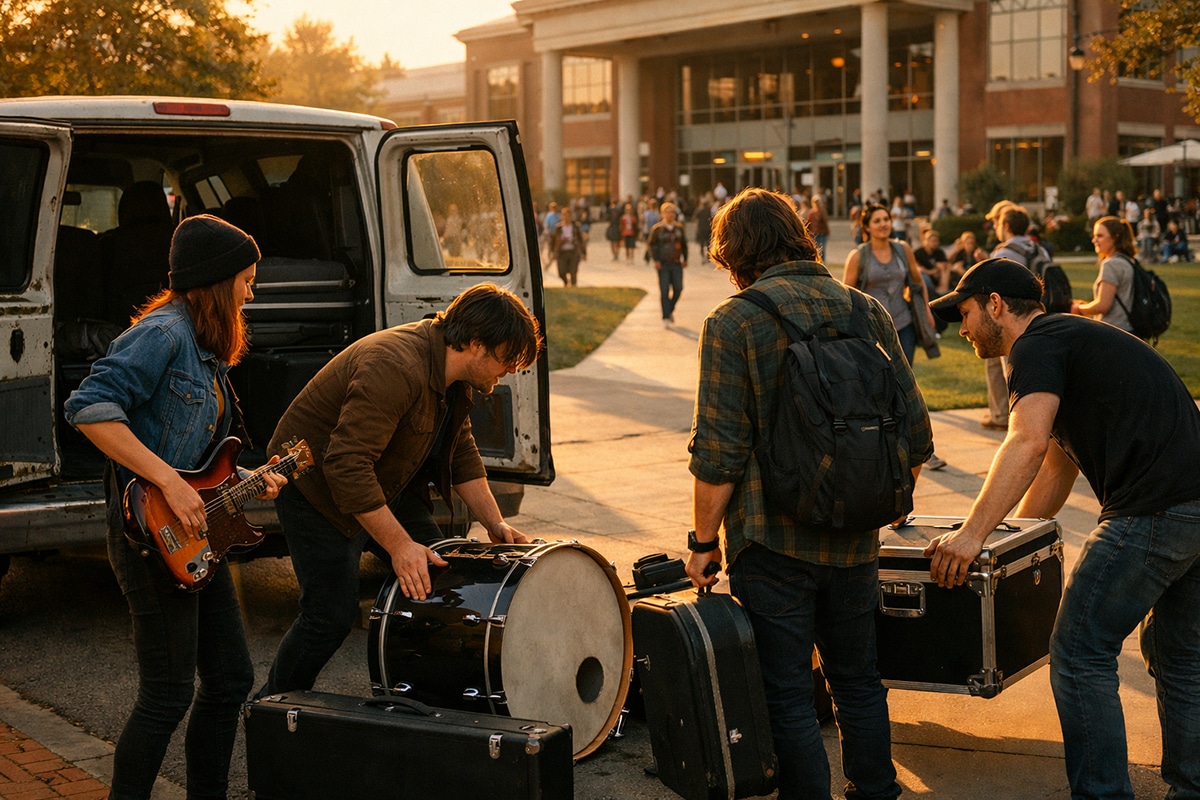
There is a certain kind of silence that only happens on the road on a Tuesday afternoon. The van is full of cables, hoodies, and half-finished gas station coffee. Friday and Saturday look decent. Sunday might work if the room is right. But the middle of the week is where a lot of tours quietly bleed out. That is the part nobody romanticizes. Gas does not care if your Friday show sold well. Hotels do not care that your last single made a playlist. A route becomes profitable when the dead spots stop being dead. That is where the college circuit starts to matter. Not as some shiny fantasy about “breaking into campuses,” but as a practical, artist-owned way to fill weekdays, earn guarantees, meet new fans, collect real fan data, and build relationships that can outlive one set in one room. That is the part of the live business too many indie artists still ignore.
The old music business taught artists to think small about college gigs. It treated the campus market like a side category for novelty acts, agency rosters, or major-label tour support. That thinking is outdated. NACA, the National Association for Campus Activities, calls itself the largest collegiate experience network and says its NACA 24/7 database matches schools with talent, vendors, and other campus partners. APCA, the Association for the Promotion of Campus Activities, says more than 600 schools and 2,000-plus students and higher education professionals attend its conferences and institutes each year, and that its cooperative buying process booked more than 1,000 dates for associates at the 2026 conference cycle. That is not a ghost town. That is a working market.
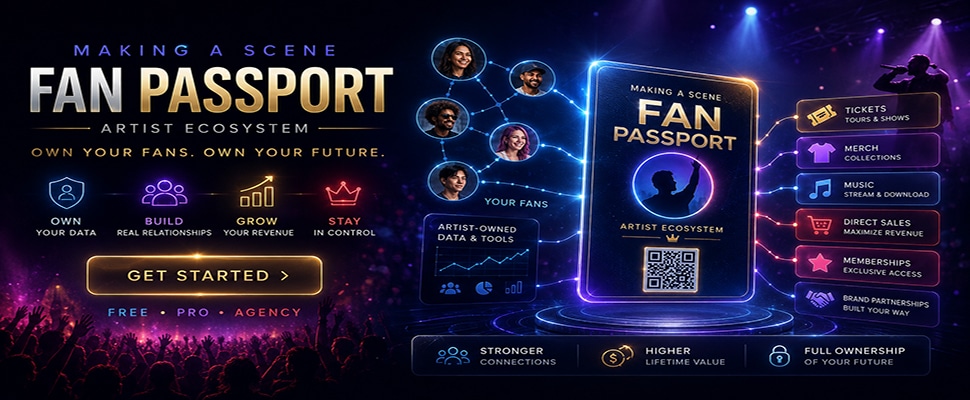
We are not talking about trying to impress gatekeepers. We are talking about building a music industry middle class by using a neglected part of the live economy to create direct revenue, direct relationships, and artist-owned infrastructure. A college show is not just a check. It can be a weekday anchor, a merch moment, a campus-radio stop, a student-media interview, a fan-passport checkpoint, a content day, and a way to push fans out of rented social platforms and into channels you control. Once you see it like that, the college circuit stops looking like “campus entertainment” and starts looking like what it really is: a business tool.
What the college circuit really is
In plain English, the college circuit is the network of student programming boards, campus activities offices, late-night committees, student governments, residence life teams, welcome-week planners, campus unions, and related departments that bring events onto college campuses. Some schools book one big act a semester. Some spread money across many smaller events. Some buy through campus buyers who go to conferences. Others build their calendars internally and respond better to direct outreach. NACA’s conference resources and APCA’s artist-and-agent page both make clear that campuses are still actively shopping for entertainment, educational programming, and student engagement experiences.
That matters because colleges do not think like clubs. A club owner cares about ticket count, bar spend, and local draw. A campus buyer often cares about attendance, event fit, calendar timing, student engagement, mission, and whether the event will land well with students and administrators. That changes how you package your act. The right campus pitch is usually not “here is our loudest set, take it or leave it.” It is more like, “We can do a full evening show, a stripped-down daytime set, and a short workshop or Q&A if that helps you serve more students with one booking.” APCA explicitly includes purposeful programming and educational sessions in its conference structure, and NACA now includes off-stage and immersive performance opportunities alongside showcases. That tells you something important: usefulness books.
For original indie artists, that is actually good news. If you are a songwriter, a roots act, an indie rock band with an acoustic version, or a solo artist who can talk about craft, touring, home recording, or artist independence without sounding fake, you are not walking into campus booking empty-handed. You are walking in with options. And options are money. The artist who can fit a student union, a coffeehouse, a radio room, and a small off-campus venue is worth more to a route than the artist who can only do one kind of room one way. That is not selling out. That is learning how to work.
Why the college circuit fits a working indie tour
The biggest value in the college circuit is not prestige. It is routing. APCA’s cooperative buying language says schools can merge buying power and offer performers a block of dates in exchange for lower prices and shared travel costs, with standard blocks such as one isolated date, two events in three days, three in five days, and five in seven days. That is almost a blueprint for profitability. It is the exact opposite of the reckless DIY tour model where artists drive six hours for one maybe-paying show and call it “building.” Real tour economics start to make sense when multiple dates share the same miles, food, and hotel cost.
This is why a college date should rarely be viewed by itself. A Wednesday campus show can make a Thursday college-town venue make sense. A campus appearance in the afternoon can push people to your public club date that night. A Thursday late-night event can bridge the gap between a Tuesday house concert and a Saturday theater support slot. The school is one node. The town around it is another. The route is where the money appears. The college circuit works best when you stop treating it like a side quest and start treating it like a way to connect the empty spaces in your calendar. That is how a tour becomes a business instead of a gamble.
There is another reason this matters for original acts. Students are still one of the few big groups of people who gather in shared spaces on a regular basis. They live close to each other. They talk to each other fast. They run organizations. They create media. They join clubs. They staff radio stations. They work the campus paper. They become alumni. One good room on one campus can lead to a radio spot, a student-journalism writeup, a faculty invitation, a repeat booking, or a second nearby school hearing your name from the first one. That kind of relationship chain is exactly what independent artists need now: not random reach, but connected reach.
Where to start when you have never done this before
If you are brand new, do not start by cold-emailing a hundred schools with one generic message. Start by building a map. The strongest free research tool here is College Navigator from NCES. NCES says the tool lets you search more than 7,000 institutions, pin school locations on a map, build lists, and export results into a spreadsheet. That is exactly what a DIY artist needs. You can build a region, spot clusters, and stop thinking like a fan and start thinking like a routing manager.
Once you have a state or a corridor in mind, go school by school and study how that campus organizes student life. Many campuses run their event and involvement systems through platforms like CampusGroups or Modern Campus. CampusGroups says it helps schools streamline communications and event management so students can navigate college life more easily. Modern Campus says it supports student engagement, event management, and analytics around student involvement. That matters because those systems reveal how a school thinks. If a campus is highly organized around student groups and event registration, your pitch should sound like it fits that machine. If a school highlights student engagement and skill-building, your add-on workshop may matter more than your genre tag.
Then build the town around the school. Use Songkick Tourbox, which says it helps artists manage tours and tickets while surfacing audience insights. Use Pollstar and its data tools, which say subscribers can search and filter live entertainment data and contact directories. Use Bandsintown for Artists, which says it helps artists promote shows, merch, and music while automatically collecting fan contacts. When you stack those tools together, you stop looking at one campus and start seeing a living market around that campus. That is how you move from “maybe we can play there” to “here is a run.”
The beginner mistake is trying to attack the whole country at once. Do not do that. Pick one lane. Maybe it is the Northeast corridor. Maybe it is college towns across the Midwest. Maybe it is a Southeast run where campuses are close enough to support weekday movement. The goal is not to be everywhere. The goal is to prove the model. One cluster of five to eight schools is worth more than a spreadsheet of two hundred names you will never actually work.
The two lanes: direct outreach and conference strategy
There are really two ways into the college market. One is direct outreach. The other is the showcase-and-conference lane.
Direct outreach means you identify the right schools, the right offices, the right dates, and the right format, then you pitch directly. This is slower, but it is cheaper and often smarter for beginners. It lets you learn what kinds of schools respond to you, what formats get the best reaction, and how much support your act actually needs to work on campus. If you have never done a college date, this is where your education starts. You do not need a booth. You need a real offer and a clean system.
The conference lane is the faster, more concentrated version. NACA’s event pages show that national associate members can exhibit and submit to showcase at all NACA conferences and NACA Live, while NACA Live 2026 is scheduled for February 13–16 in Columbus, Ohio. APCA’s conference page says artists can showcase, network in exhibit halls, and book blocks of dates through cooperative buying. APCA’s 2026 national conference page says the 2026 associate conference was set for March 5–8 in Hershey, Pennsylvania. Those are real points of entry, but they come with travel, fees, and the need to show up prepared.
For most indie artists, the smartest move is usually this: learn the market with direct outreach first, then decide whether a conference investment makes sense. If you already know your act works in coffeehouses, student unions, and small campus rooms, a conference can multiply what is already proven. If you do not know whether your act fits campus programming at all, the conference route can become an expensive guessing game. The college market is not impossible, but it does punish fuzzy thinking.
How to package an original act so a campus buyer can say yes
The campus-ready act is rarely just one show. It is a set of usable versions.
For a solo artist, that might mean a headlining performance, a stripped-down songwriter set for a lounge or campus café, and a short talk on songwriting, DIY release strategy, or home recording. For a band, it may mean the full electric show, a duo or acoustic version, and a radio-room setup that works without a huge production footprint. APCA’s conference structure around live showcases, purposeful programming, and educational sessions makes it clear that campuses are looking for more than one kind of value, and NACA’s materials likewise point to immersive and off-stage options, not only classic stage performances.
This does not mean you need to fake being an educator. It means you should understand how colleges buy. A campus often needs one event to serve multiple goals. Entertainment is one goal. Engagement is another. A conversation around creativity, independent art, mental resilience on the road, or building a career without waiting for permission can be useful to a student audience when it is real and tied to your experience. If it is fake, they will feel it. But if it is grounded, it can be the difference between a “maybe” and a “send the contract.”
Your materials need to make a buyer’s life easy. That means one clean live video, a short bio, a clear description of your formats, honest pricing, simple tech needs, and a sentence or two explaining why students will care. NACA’s conference preparation materials emphasize having key materials ready, including your bio and pricing. That sounds obvious, but a shocking number of indie artists still bury buyers in vague language, ten different links, and no real answer to the question, “What exactly are we buying?” Clarity is a competitive advantage.
The money: what campus dates can really do for a route
Let’s be honest. There is no one universal college fee. A large university spring event is not the same as a small student-organization coffeehouse. But official school documents do give us a useful ground-level picture.
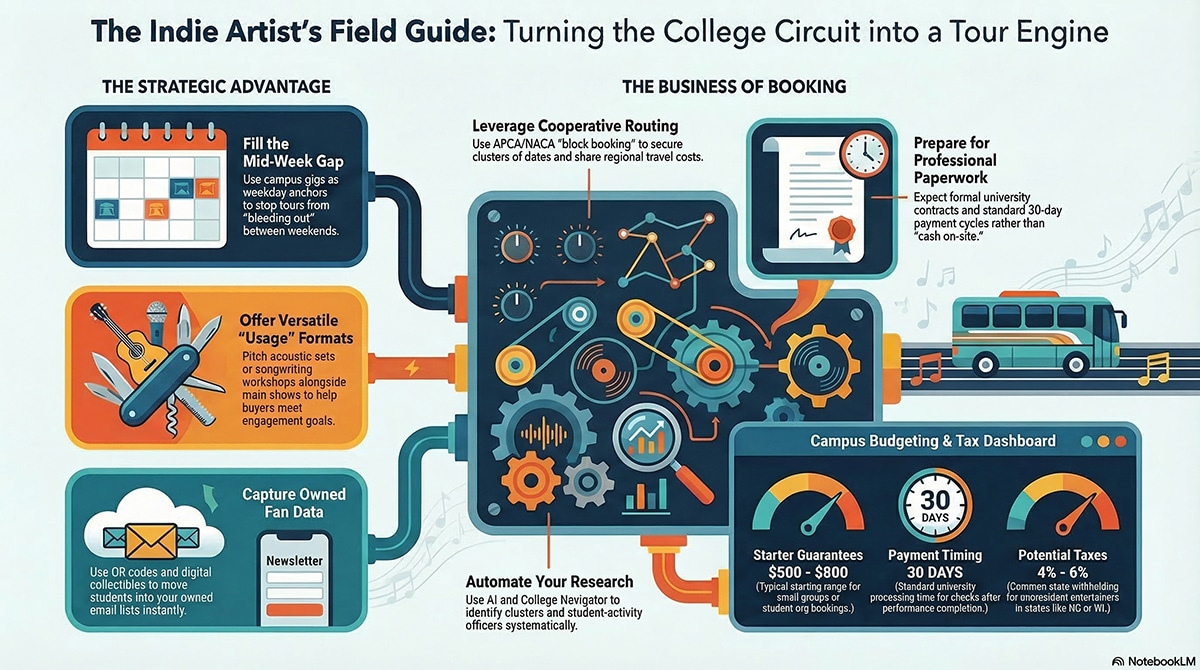
Minnesota State Mankato’s event budgeting guide says some speakers may charge as little as $100, but performers “typically start around $500 for smaller groups,” and notes that its performer pricing is handled as all-inclusive, meaning travel, lodging, meals, and sound or lighting need to be considered. Lafayette College’s student-government financial guidelines say speakers, guests, and performers, including accommodations, are funded up to $800 per semester for student organizations, with travel funded within reason. Those two published examples do not define the whole market, but they do show that starter-level campus money often lives in the low three-figure to low four-figure range for smaller bookings. That is not superstardom money. It is route-stabilizing money.
The important thing is how that money behaves inside a tour. A one-off $600 college date 350 miles from your route can be a bad deal. That same $600 can be a very good deal if it fills a Tuesday between a Wednesday college-town club and a Thursday campus union show. APCA’s cooperative buying model exists because shared travel is where both schools and artists win. If a school cluster can get you three dates in five days, your gas, hotel, and labor cost per show drops fast. That is not glamorous math. It is survival math.
Here is the field-guide version of the money. A solo artist or duo can sometimes make a college run work at modest fees because the travel footprint is light. A band needs to be more careful, because “all-in” pricing can eat the guarantee fast once you add van fuel, rooms, food, and crew. That does not mean bands should avoid the circuit. It means bands should think in clusters, scaled formats, and mixed runs. A full band might do the big campus room on Thursday, then send a duo version into radio or a smaller lounge format on Friday afternoon before a public club date that night. Flexibility keeps the route profitable.
The part nobody warns you about: contracts, payment, and policy
A lot of indie artists imagine campus gigs as casual. They are often the opposite.
Notre Dame’s Student Activities Office contract page says all student groups booking a service, guest speaker, or performer must use a university contract submitted through the office, and warns student leaders not to sign contracts themselves. The same page explains the contract-routing process and makes clear that internal approval matters. That means your real buyer may love you, but still need two other offices to approve paperwork before anything is final.
Payment timing is not standard either. A Notre Dame speaker contract template says the university will provide payment within 30 days after receiving the signed agreement, required tax form, and completion of the engagement. A University of Mary Washington performer instruction sheet says payment is generally 30 days after satisfactory performance unless other terms are specified. On the other hand, the University of Wisconsin Oshkosh entertainment contract says payment will be made immediately following the performance if the signed contract is received within 10 working days of the performance. That range tells you exactly why a campus artist cannot just “assume the check is there.” You need written payment terms before the tires start rolling.
Hospitality is not standard either. Elizabeth City State University’s entertainment agreement says the artist or producer is responsible for air travel, hotel, and meals unless otherwise provided, and also notes the school offers on-campus dressing areas but no professional dressing-room facilities. In other words, never assume the school is covering rooms just because it is a college. Ask what is included. Ask what is not. Put it in the agreement.
Then there are the little contract land mines. The University of Memphis performance agreement includes a clause that bars performances at another venue within 100 miles of the university within 30 days unless the university consents in writing. That kind of radius restriction will not show up everywhere, but it is a strong warning: read every contract. A campus date can help your route, but not if it quietly blocks your better-paying public room down the road.
Taxes can surprise you too. ECSU’s agreement says North Carolina may require 4% withholding for some nonresident entertainers when compensation is over $1,500. A University of Wisconsin–Eau Claire form says payments to nonresident artists over $7,000 are subject to a 6% nonresident entertainer tax unless they satisfy the state’s requirements. This is exactly why indie artists need to act like businesses. Have your W-9 ready. Know your payee name. Know whether you are being paid as an individual or an LLC. Know the payment schedule. Know whether the school needs vendor registration. That is not paperwork for paperwork’s sake. That is how you keep the check from shrinking or stalling.
College radio is not an extra. It is part of the plan.
Too many artists treat college radio like a cute bonus. That is a mistake.
The Intercollegiate Broadcasting System says it supports college and high school media outlets and organizations. The College Radio Foundation maintains College Radio Day resources and a participating-stations page that lists active stations. Spinitron says it is trusted by over 300 non-commercial stations. NACC, the North American College & Community Radio Chart, tabulates weekly airplay from college and non-commercial stations in the United States and Canada and also runs genre charts, including blues, folk, world, hip-hop, jazz, and more. That is not a side alley. That is infrastructure.
If you are booking a college show, your radio plan should start four to six weeks before the date. Find the station manager, music director, or relevant show host. Pitch a campus-angle interview, a live acoustic set, a giveaway, or a quick “playing tonight on campus” segment. If the campus event is closed to students or tightly controlled, use the radio hit to push listeners toward your website, your next public date, or your fan-passport signup. The point is not just to get “airplay.” The point is to turn one campus appearance into a bigger local footprint. That is how one day becomes multiple touchpoints.
And there is another layer here. College radio creates proof. It creates a searchable trail that future buyers can find. It creates clips you can reuse. It gives you something local and specific to talk about in follow-up outreach. “We played State U” is okay. “We played State U, did an in-studio at their station, and converted that visit into 78 new direct signups and a return-market audience” is a whole different sentence. That is the difference between performing and building.
How AI can become your booking office
This is where indie artists can punch above their weight.
ChatGPT and ChatGPT search help say the tool can search the web and return fast, timely answers with links to relevant sources. Airtable says it is designed to build AI-powered workflows and organize information. Notion says it is an AI workspace that can search across connected apps, automate work, and manage projects. Put those together and a solo artist suddenly has something close to a tiny booking department.
Here is what that looks like in real life. Use ChatGPT to identify a cluster of colleges within your route, pull the student-activities page, the event calendar, the likely booking office, and the radio station for each school. Then drop that data into Airtable with fields for campus name, contact, city, nearby venue, event format, fee quote, contract status, payment terms, and follow-up dates. Then use Notion to hold your outreach templates, school notes, radio talking points, and post-show recap system. Suddenly you are not improvising every week. You are operating a repeatable process. That is what AI should do for an indie artist. Not replace your voice. Reduce your chaos.
AI is also useful in shaping the offer. A commuter campus may need a lunchtime set. A residential campus may want a late-night event. A school with strong student leadership programming may respond to a DIY-career talk. A school with a strong music department may like a songwriting workshop. AI can help you study the school’s language and tailor your pitch without sending robotic spam. The artist still needs taste, honesty, and instinct. But the research load gets lighter. And when the research load gets lighter, the outreach gets better.
The real prize is not reach. It is fan data you own
This is the part where the college circuit becomes much bigger than a gig.
Bandsintown’s Fan Manager page says artists can grow and manage fan contacts, collect emails and phone numbers, and export contacts anytime for free. Its signup-form page says artists can collect first-party data directly from their websites. That is a huge deal, because it means a campus show does not have to evaporate into algorithm fog the next day. You can turn a one-night room into a direct relationship.
Your real home base should live on something you control. WordPress says it is open-source publishing software used by millions, and that is exactly why it still matters for artists. It is infrastructure, not fashion. A campus show should send people to a landing page on your domain, not just to another social post. Then you move those people into email or SMS through a platform like Mailchimp, which says it supports email and SMS marketing, or Kit, which says it helps creators grow lists, automate campaigns, tag and segment subscribers, and sell without burnout. That is the ownership move. The show creates attention. Your system captures it.
The best time to capture fan data is in the room, not two days later. Put one clean QR code on the merch table. Put it on a sign near the stage. Mention it once from the mic. Offer a reason to scan that is worth the gesture: a campus-session download, a live road track, early access to the next regional date, or a fan-passport stamp. The students who care will act right then. Your job is to make that action simple. That is how you turn applause into an owned audience.
Where Web3 actually helps on a college run
This is where a lot of artists either get weird or get scared. The smarter move is to keep Web3 useful, quiet, and ownership-focused.
POAP says it lets people mint memories as digital mementos called POAPs, and describes them as bookmarks for your life. That is almost tailor-made for the college circuit. A campus date is a moment with a place, a crowd, and a story. Give attendees a free attendance collectible through a QR claim. Now the show is not just a memory; it is a verified moment in a fan journey. That is a much more interesting use of digital collectibles than random speculation.
Unlock Protocol and its docs say Unlock is a protocol for creating onchain memberships and subscriptions as NFTs, and its use-case docs say membership NFTs can give holders direct access to media, music, videos, experiences, and more. That is the stronger ownership layer for the college circuit. Do not lead with jargon. Lead with access. A student comes to the show, claims a free attendance stamp, joins the email list, and later gets the option to unlock deeper membership: early demos, a campus-only acoustic EP, return-show presale, limited merch, private livestreams from the road, or access to a regional fan group. That is Web3 doing real work for an artist. It is not hype. It is portable membership.
If you want a decentralized social layer, Farcaster and its docs say users own their accounts and relationships and can move between apps. That makes it useful for artists who want community channels that are less dependent on one platform’s algorithm. But again, keep the fan experience simple. A student should not need a dissertation to join your world. The front door can still be email and SMS. Web3 becomes the deeper layer that protects portability, proof, and access over time.
How one campus date becomes a long-term asset
A weak artist sees a college show as one line on the calendar. A working artist sees it as a stack of assets.
The first asset is the guarantee. The second is the room. The third is the campus-radio or student-media angle. The fourth is the fan data. The fifth is the repeat relationship. The sixth is the off-campus room you can pair with it next time. The seventh is the content. The eighth is the fan-passport trail that makes your audience less disposable and more portable. That is how the college circuit should be understood. Not as “one more place to play,” but as a system that lets one event echo beyond itself.
And this is the deeper reason the college circuit belongs in a Making a Scene conversation. We are trying to help indie artists build durable income, not just chase attention. Durable income comes from stacking value. A campus date that gives you a guarantee, a radio stop, 80 new email signups, a POAP claim, a student-paper photo set, and a return invite is worth more than a random club slot that gave you exposure and two drink tickets. That may not sound sexy to old gatekeepers. Good. Old gatekeepers were never very good at building sustainable artist businesses anyway.
The college circuit is not a trick. It is a discipline.
The reason more indie artists do not work this market is not because it is closed. It is because it requires a different kind of discipline. You have to research. You have to package the offer. You have to understand campus timelines. You have to read contracts. You have to plan routing. You have to know the difference between a good isolated date and a bad one. You have to show up like a business. That scares people who still want the music business to operate like a lottery ticket. But if your goal is a music industry middle class, discipline is not optional. It is the whole game.
The good news is that the tools are better now than they used to be. You can map schools for free. You can find event systems. You can study conference structures. You can manage a route with AI. You can collect fan data directly. You can create portable membership layers. You can turn a campus room into an owned audience instead of a one-night applause burst. In other words, the college circuit fits this moment better than a lot of artists realize. It rewards the people who can connect live work, data ownership, and long-term relationship building. That is exactly what independent artists should be learning to do anyway.
So here is the real takeaway. Stop thinking of the college circuit as an old industry side path. Think of it as a route-fixing machine. Think of it as a weekday revenue tool. Think of it as a fan-acquisition engine that can feed your own site, your own list, your own SMS, your own passport, your own future offers. Think of it as a place where one good relationship can lead to three more rooms, one radio stop can lead to a market foothold, and one smart week can make a whole month healthier. That is not fantasy. That is field craft. And field craft is how working artists survive long enough to build something real.
 |  Spotify |  Deezer |  Breaker |
 Pocket Cast |  Radio Public |  Stitcher |  TuneIn |
 IHeart Radio |  Mixcloud |  PlayerFM |  Amazon |
 Jiosaavn |  Gaana |  Vurbl |  Audius |
 Reason.Fm | |||
Find our Podcasts on these outlets
Subscribe to Our Newsletter
Discover more from Making A Scene!
Subscribe to get the latest posts sent to your email.


