

The Home Studio Micro-Enterprise Stack





Making a Scene Presents – The Home Studio Micro-Enterprise Stack
Listen to the Podcast Discussion to Gain More Insight into the Studio Stack!
The Moment You Stop Calling It “Just A Home Studio”
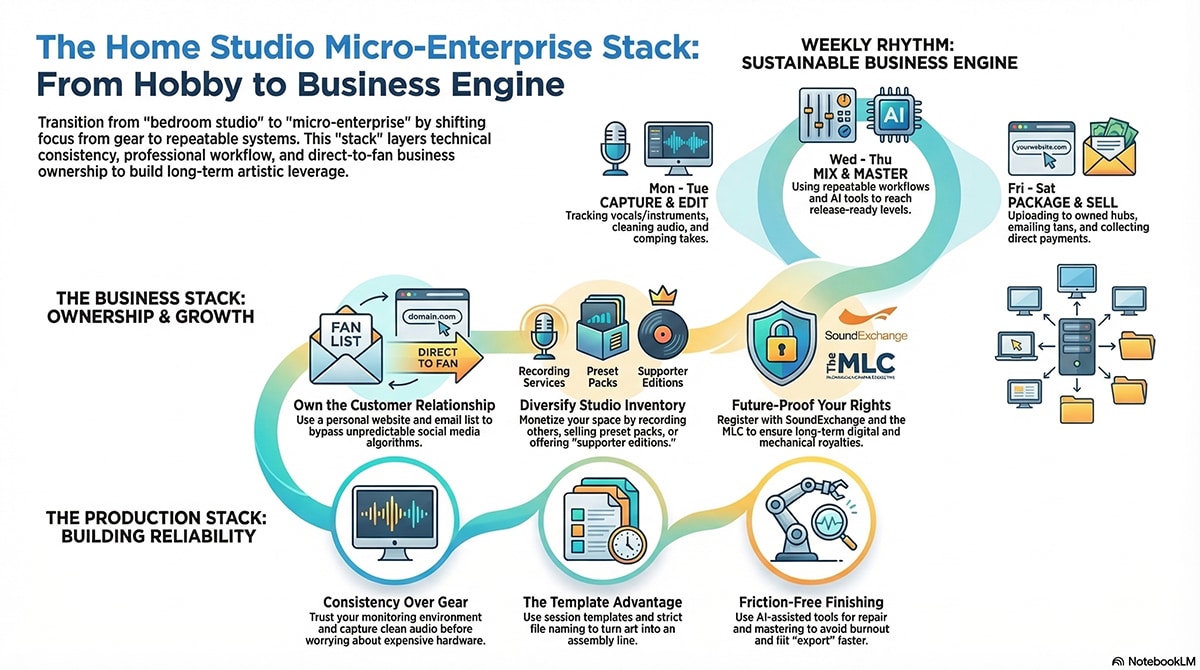
There’s a quiet moment that happens for a lot of U.S. indie artists. It usually hits when you finish a track at home that actually holds up in the car, on earbuds, and on a cheap Bluetooth speaker. Not “good for a bedroom.” Just good. You bounce the final mix, upload it, send it to a friend, and they say the one sentence that changes everything: “Who recorded this?” That’s the moment you realize the home studio isn’t only a creative space. It’s a production asset. It can make inventory. And inventory is what a micro-enterprise lives on.
A micro-enterprise doesn’t need a skyscraper office. It needs a repeatable loop: you make something, you package it, you deliver it, and you get paid. When you record yourself at home, and you can also record other people in your music community, that loop becomes real. It becomes the difference between chasing opportunities and building leverage.
This is a guided tour of the stack that makes that possible. Not a hype stack. Not a “buy this and you’ll be famous” stack. A practical, artist-first stack that turns your room into a small business engine while keeping the art in charge.
The Foundation: Your Room And Monitoring Are The First Layer Of Trust
If you want a home studio that pays, you need one thing before you need anything else: you need to trust what you’re hearing.
Not “I think this sounds cool.” Trust like, “If I fix the harsh vocal at 3k, it will actually be fixed everywhere, not just in this room.”
That’s why the first layer of the stack is boring on purpose. It’s the room and the monitoring.
You can build this layer without turning your house into a foam cave. The goal is control, not aesthetics. You want your monitors set up the same way every day. You want the listening position consistent. You want reflections reduced enough that your mix decisions don’t turn into a coin flip.
If you want software help on this layer, Sonarworks SoundID Reference is built to calibrate your speakers and headphones to flatten the response so you’re mixing against something more honest. If you want a loudness “truth meter” so you’re not guessing, Youlean Loudness Meter is a popular way to keep streaming-friendly levels in check without turning your master into a brick.
This layer is not about perfection. It’s about consistency. Consistency is what lets you finish, and finishing is what turns into releases, client work, and repeat income.
Layer Two: The Capture Chain That Makes You Reliable
Micro-enterprise studios don’t win by having the most expensive gear. They win by being reliable.
The capture chain is everything that happens from “sound in the room” to “audio in the DAW.” It’s the microphone choice, the interface, the gain staging, and the habit of capturing clean takes instead of trying to “fix it later.”
For a self-recording artist, this layer is where your time gets protected. If your vocals are clean and your levels are sane, you spend your energy making music, not repairing messes. For recording others, this layer is where your reputation gets built. Most clients don’t know what converter you’re using. They know if the vocal sounds clear and if the session feels smooth.
On the software side, a lot of modern DAWs can act like a safety net here. Fender Studio Pro is built around a fast workflow for tracking and editing. Pro Tools is still common in a lot of pro pipelines. Logic Pro stays popular for songwriter-heavy workflows. Ableton Live is everywhere in beat-making and performance-based production. REAPER is beloved by people who want deep control without a huge price tag.
Pick the DAW that keeps you moving. A micro-enterprise studio is not a “DAW debate.” It’s a “delivery business.” The best DAW is the one that makes you hit export more often.
Layer Three: Session Flow, Templates, And File Discipline
This is the layer that separates a hobby room from a studio people want to come back to.
When you’re recording yourself, file discipline is what keeps your creativity from getting buried in chaos. When you’re recording others, file discipline is what makes you look professional.
A micro-enterprise studio doesn’t run on inspiration. It runs on templates.
You want a default session template that opens with your routing ready. You want vocal tracks already labeled. You want a couple of buses already set. You want a rough mix chain ready for monitoring that you can bypass for export. You want a simple file naming system so you can find “LeadVox_Take03” without digging through 90 audio files called “Audio 1.”
This is also where you start thinking like an operator. You’re not only making art. You’re building an assembly line that doesn’t break when you’re tired.
For sharing and delivery, you want one or two “always works” services. Dropbox and Google Drive are common for sessions and stems. WeTransfer is a quick way to send larger files when you don’t want to invite someone into your folders. For backup that runs quietly in the background, Backblaze is popular because it’s built for continuous cloud backup.
None of this is glamorous. But this layer is the difference between “I make cool stuff sometimes” and “I can deliver work every week.”
Layer Four: Editing And Mixing That You Can Repeat Without Burning Out
Most indie artists don’t quit because they don’t have talent. They quit because finishing takes too long and the process starts feeling like punishment.
So the stack needs a finishing lane that reduces friction.
Editing is where time disappears. Vocal comping, tightening timing, cleaning breaths, smoothing transitions, making the chorus lift without getting harsh. If you record yourself, you can do this in small bursts. If you record others, you need a workflow that doesn’t eat your entire week.
This is where plugin suites become your “staff.” Not because plugins replace taste, but because they replace repetitive labor.
iZotope RX is built around audio repair tasks like noise reduction, clicks, mouth sounds, and cleanup, and it leans heavily on machine learning to speed up problem solving. For mixing and mastering, iZotope Ozone describes itself as a mastering suite “accelerated by a time-saving, AI-powered assistant.”
Tools like Sonible smart:EQ 4 are built around “AI” tone balancing, which is basically a fast way to get to a solid starting point before you do the human part: shaping vibe and emotion.
The micro-enterprise mindset here is simple. Your finishing lane should get you to “release-ready” without needing a spiritual battle every time. If every song feels like a week-long fight, your business can’t scale.
Layer Five: Mastering And Delivery That Doesn’t Kill Your Momentum
Mastering is where a lot of indie artists stall. Not because they don’t care, but because it feels like a dark art.
In a micro-enterprise stack, mastering is treated like a repeatable process. You build a method. You build a couple of reference tracks you know deeply. You build loudness targets based on where the music is going. You build a final checklist so you don’t forget the boring stuff like fades, spacing, and export formats.
Ozone’s Master Assistant is designed to give you a fast “starting point” based on analysis, which can be a huge momentum saver when you need to get a project out the door. The important part is not the automation. The important part is that you stay in control, and you move forward.
And this is also where you start thinking about deliverables beyond “the song.” A working micro-enterprise studio often delivers instrumentals, clean versions, stems, alt mixes, and short edits. Those versions aren’t busywork. They are income options. They are what makes licensing easier later. They are what makes live playback possible. They are what makes remix packs and fan perks possible.
Layer Six: Your Owned Hub, Your Storefront, Your Customer List
If the home studio is the factory, your website is the storefront and the filing cabinet.
This is where the middle-class model becomes real. Because streaming doesn’t give you a customer list. Social platforms don’t give you a customer list. You can have 50,000 followers and still not have a reliable way to reach the people who actually want to support you.
So the owned hub is not optional. It’s the center.
WordPress matters because it’s open source and designed for publishing that you control. WooCommerce gives you ecommerce inside that owned hub. Email plugins like The Newsletter Plugin or MailPoet give you list building and email delivery that you can connect to your own site.
This is where you stop depending on “the algorithm.” Your website becomes the place where you sell direct, collect email, and build a repeat relationship. That’s what a label used to control. Now you can control it.
For payments, Stripe and PayPal are common rails, and PayPal’s donation button system is a simple way to add direct support without complicated setup.
The main idea is not tech. It’s ownership. If you own the hub and the list, you can survive platform changes.
Layer Seven: Inventory That Fits Your Life And Pays You Back
This is where artists get nervous, because “inventory” sounds like a warehouse.
In a music micro-enterprise, inventory is just “things you can sell that you already know how to make.”
Your studio naturally produces more than one product. Every song can become a bundle. A single can become a “supporter edition.” A finished master can become a licensing-ready folder with alt mixes. A rehearsal session can become a behind-the-scenes video. A guitar tone session can become a preset pack. Your production process can become a lesson. Your community sessions can become paid remote work.
Direct-to-fan platforms like Bandcamp are still a strong part of this story because they’re built around fans directly supporting artists. But even there, the industry is getting stricter about trust and authorship. Bandcamp’s January 13, 2026 policy states that music generated wholly or in substantial part by AI is not permitted on Bandcamp.
That policy matters in a micro-enterprise stack because it points to the real currency: trust. If your business is direct support, trust is not a marketing word. Trust is rent money.
Layer Eight: Recording Others Without Becoming A Slave To Everyone’s Schedule
If you’re an artist recording yourself, you already have the core skill: you can capture performance and turn it into product. Recording others in your local community is a natural extension, and it can become a steady revenue stream if you structure it right.
The trap is becoming the free studio for your whole scene.
The micro-enterprise way to do it is to offer clear packages, clear boundaries, and clear delivery. Not because you want to be cold, but because you want your own artist career to stay alive.
This is also where remote work becomes your friend. You don’t have to record everyone in-person. You can edit vocals for other artists, tune vocals, mix demos, prep stems, and deliver final masters to people in other cities. You can do this using tools that support real-time listening sessions like Audiomovers LISTENTO or collaboration platforms like Sessionwire.
This is the simple math: if your home studio can earn from both your releases and your community services, your career stops depending on one fragile income stream.
The Ai Layer: Your Fastest Intern And Your Patient Teacher
AI in the home studio isn’t just a faster wrench. For a lot of indie artists, it’s the first “teacher” they’ve ever had on call at 2:00 a.m. when the mix isn’t translating, the chorus won’t lift, and you’re not sure if you’re hearing a real problem or just fatigue. That matters because the biggest gap between a bedroom studio and a micro-enterprise isn’t gear. It’s judgment. It’s knowing what “commercial enough” actually means, and how to close the distance without guessing your way into burnout.
The practical AI stuff is already baked into the production workflow. Tools like iZotope Ozone position their AI features as a way to get a smarter starting point for mastering decisions, so you spend less time stuck and more time shipping. Fender Studio Pro highlights AI-powered stem separation, which isn’t a party trick in a working studio—it’s a deliverables machine. Stems help you make instrumentals, clean edits, alt mixes, performance tracks, remix packs, and client assets faster, which is exactly the kind of output that turns a home studio into something that pays.
But the “teaching tool” angle is where AI gets quietly powerful for self-recording artists. Suno makes full tracks from a plain-English description, and that can function like a sandbox for learning arrangement and production structure. A new producer can generate a few variations of the same idea—different tempos, different moods, different instrumentation—and then listen like a student instead of a consumer. Where does the intro hand off to the verse? How long does the verse breathe before the chorus hits? What changes in the second chorus so it feels bigger? Even if you never use an AI-generated track as a “release,” you can absolutely use it as a study tool to train your instincts about structure, tension, and pacing, then rebuild those ideas the right way inside your DAW with your own performances and your own sound.
ChatGPT can play a similar role as a coach—especially when you combine it with objective info. You can bring it your genre, a couple of reference tracks you’re chasing, your loudness target, and your specific pain points (“vocal feels buried on earbuds,” “kick and bass blur in the low end,” “chorus doesn’t lift”). You can also feed it screenshots and readouts from analyzers like Youlean Loudness Meter and Voxengo SPAN, then ask it to translate what you’re seeing into practical mix moves and a step-by-step test plan. And if you’re using an audio-focused ChatGPT tool like Audio Analyzer, you can lean even harder into “coach mode” by sharing short bounces and asking for structured feedback against commercial reference behavior. It won’t replace taste, but it can speed up the learning loop by helping you diagnose patterns and stop repeating the same mistakes for six months.
One important reality check, especially if your micro-enterprise depends on direct-to-fan trust: platforms are drawing lines. Bandcamp’s January 13, 2026 policy says music and audio generated wholly or in substantial part by AI is not permitted on Bandcamp. That doesn’t kill the AI “teaching tool” use case—it actually makes it cleaner. Use AI to learn, to troubleshoot, to move faster, to get unstuck, to refine your craft, and to handle the busywork. Keep the thing you sell—your releases, your catalog, your relationship with fans—grounded in unmistakably human authorship. That’s how AI strengthens a home studio micro-enterprise instead of turning it into a trust problem.
The Web3 Layer: Receipts That Travel With Your Fans, Not With A Platform
Web3 only matters to an indie artist when it does one thing: it reduces dependency on gatekeepers and strengthens direct revenue.
If it can’t do that, it’s just noise.
The best way to understand decentralization in a micro-enterprise stack is to think of it as a receipts layer. It’s a way to prove support, prove access, and sometimes prove ownership in a way that isn’t locked inside one company’s database.
But it comes with a grown-up warning: platforms still die.
Sound.xyz is the cleanest example of both the promise and the risk. Sound.xyz states on its own site that it went offline as of January 16, 2026, while emphasizing that proof of support lives on chain and that music and metadata are stored in decentralized storage. That’s the decentralization story in one snapshot. The website can go away. The proof can still exist.
For indie micro-enterprises, that “proof” can be used for fan passport style perks, supporter badges, gated access, collectible drops, and verified membership that doesn’t depend on a single platform feed.
If you want token-gated access tools that focus on membership mechanics, Unlock Protocol is built around onchain memberships and subscriptions, including renewals and membership state management. If you want token-gated community access in places fans already hang out, Collab.Land is built around membership verification for tokenized communities. Guild is another token-gating and community management platform that focuses on roles, gating, and community structure.
Here’s the key micro-enterprise move: you don’t start with Web3 as the foundation. You start with your owned hub and your email list, then you add Web3 as a loyalty layer for your real supporters. That keeps normal fans from getting scared off, and it keeps your business from collapsing if a Web3 platform changes direction.
There’s also the storage side, which is less flashy but more future-proof. IPFS is a decentralized way of addressing and retrieving files, and services like Pinata help with uploading and pinning content so it stays available. Arweave positions itself around permanent information storage, which is basically the idea of keeping important data durable over time.
You don’t need to throw your entire catalog on decentralized storage tomorrow. The micro-enterprise play is to use decentralization strategically for high-value proof: supporter receipts, special releases, important documents, or anything you want to keep portable.
Decentralization isn’t the business. It’s insurance and loyalty tech for a business you already own.
The Rights Layer: The Part That Pays You Later While You Sleep
A micro-enterprise isn’t only about today’s sales. It’s about building assets that keep earning. That’s why the rights layer belongs in the stack.
In the U.S., if you’re releasing music you own, you want to make sure you’re plugged into the systems that pay out money that otherwise floats away. SoundExchange states that it has collected and distributed more than $13 billion in digital performance royalties to date. The Mechanical Licensing Collective explains that it administers blanket mechanical licenses for eligible streaming and download services in the United States, collects royalties due under those licenses, and pays eligible rightsholders.
This is not a “lawyer section.” This is a stability section.
If your home studio helps you build a bigger catalog, and you register that catalog correctly, you’re building a long-term earning engine. That’s the middle-class model again: ownership plus systems equals stability.
The Release And Community Layer: You Don’t Need Virality, You Need Repeat Support
The final layer of the stack is not software. It’s rhythm. A micro-enterprise studio doesn’t run on random bursts. It runs on a realistic release cadence and community connection. That cadence can be small. It can be one finished single every six to eight weeks. It can be one live session video a month. It can be quarterly EP drops. The point is not speed for its own sake. The point is staying consistent enough that fans learn to trust you and support you.
This is where the studio connects back to real revenue. Releases feed shows. Shows feed merch. Merch feeds email signups. Email feeds direct sales. Direct sales feed the next release. That loop is how you build a music industry middle class without begging a gatekeeper to pick you. And because you’re recording yourself, you can keep the loop alive even when money is tight. That’s the whole advantage of the home studio micro-enterprise stack: it lets you keep producing value without paying rent by the hour to a building you don’t own.
A Week In The Stack: What This Looks Like In Real Life
Picture an indie artist in the U.S. who’s not trying to “win the algorithm.” They’re trying to win stability.
Monday night, they track vocals and guitars in their home room. They use a template session, they label takes, and they keep levels clean. Tuesday, they edit in small bursts and use RX-style cleanup when needed. Wednesday, they mix with a consistent approach, reference a couple of trusted tracks, and don’t chase perfection. Thursday, they master using a repeatable method and a tool like Ozone’s assistant to get a fast starting point, then they do the human part and make it feel right.
Friday, they package the release for direct support. They upload the track for streaming distribution if they want discovery, but the real focus is the owned hub. They post it on their WordPress site, sell a supporter bundle through WooCommerce, and send an email through their WordPress email tool.
Saturday, they play a show. The show isn’t just “promotion.” It’s customer acquisition. They collect emails at the merch table. They sell direct. They invite fans into a deeper relationship.
Sunday, they spend one hour prepping the next week’s content, and they stop. Because this stack isn’t about burnout. It’s about repeatable work. That’s what a micro-enterprise looks like: small steps, owned systems, steady output, and direct revenue.
Where This Goes Next
The next era of home studios is not about everyone becoming a full-time engineer. It’s about artists becoming owners.
AI will keep showing up as workflow help, and the smart indie move is to use it for speed and cleanup while protecting trust and authorship. Web3 will keep evolving as a receipts and loyalty layer, and the smart indie move is to keep your owned hub at the center and use decentralization where it reduces platform risk and deepens direct support.
 |  Spotify |  Deezer |  Breaker |
 Pocket Cast |  Radio Public |  Stitcher |  TuneIn |
 IHeart Radio |  Mixcloud |  PlayerFM |  Amazon |
 Jiosaavn |  Gaana |  Vurbl |  Audius |
 Reason.Fm | |||
Find our Podcasts on these outlets

Subscribe to Our Newsletter
Share this:
- Share on Pinterest (Opens in new window) Pinterest
- Email a link to a friend (Opens in new window) Email
- Share on X (Opens in new window) X
- Share on LinkedIn (Opens in new window) LinkedIn
- Share on Facebook (Opens in new window) Facebook
- Share on Tumblr (Opens in new window) Tumblr
- Share on Reddit (Opens in new window) Reddit
- Share on Telegram (Opens in new window) Telegram
- Print (Opens in new window) Print
- Share on WhatsApp (Opens in new window) WhatsApp
- Share on Mastodon (Opens in new window) Mastodon
Related
Discover more from Making A Scene!
Subscribe to get the latest posts sent to your email.


