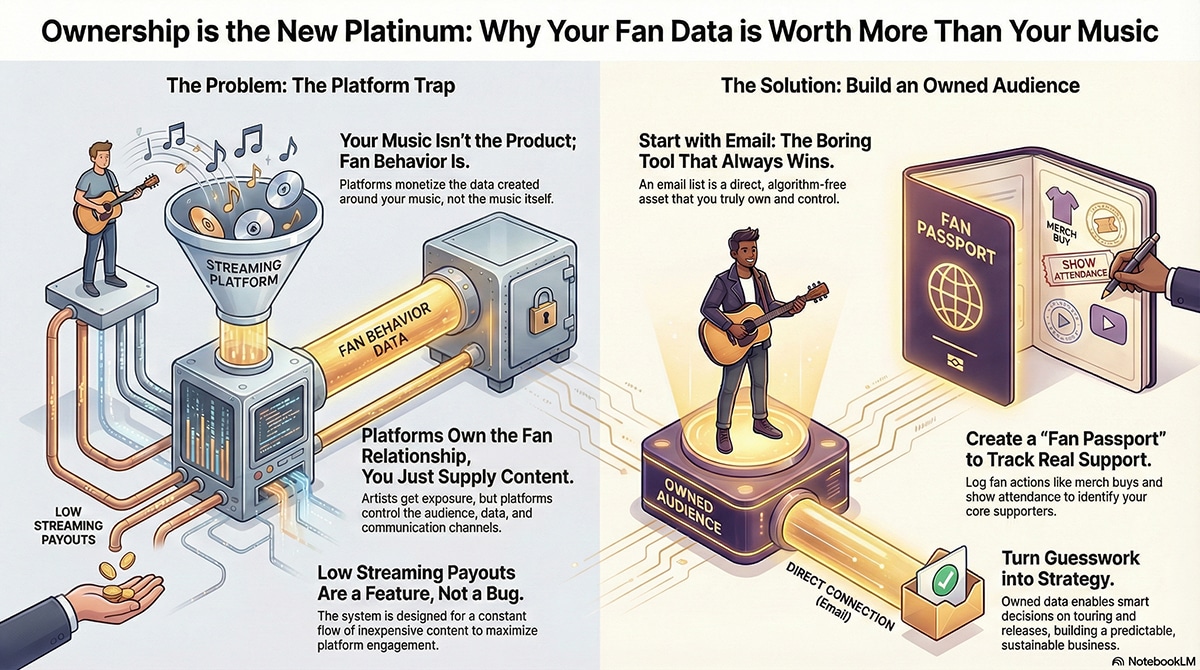
Why Your Fan Data Is Worth More Than Your Music




Making a Scene Presents – Why Your Fan Data Is Worth More Than Your Music
Listen to the Podcast Discussion to gain more insight into your Fan Data!
If you are an independent artist, this is a hard truth that cuts against almost everything you were taught. Your music is no longer the most valuable thing you create. Your fan data is. Even more uncomfortable is this reality: recorded music has largely lost its status as a product.
For most of music history, recordings were something you could hold in your hands. Vinyl records, cassette tapes, and CDs were physical objects. You paid money, you owned something, and that ownership gave the recording value. But that world is gone. Today, recorded music is no longer treated as a product. It is treated as a utility, a background service that lives inside massive platforms.
We are now in the fourth generation of music consumers who have little to no frame of reference for owning music as a physical product. Many listeners have never bought a CD. Some have never downloaded a file. Music, to them, has always been something you tap, skip, and move past. It lives in the cloud. It disappears when a subscription ends. The idea that a recording itself should be purchased feels foreign to a growing part of the audience.
That shift changed everything. When music stopped being owned, it stopped being priced like a product. It became an engagement tool instead of a commodity. Recorded music now functions as the fuel that powers much larger systems built around attention, behavior, and data collection.
That does not mean your music has lost its meaning or its power. The music is still the spark. It is still the reason fans care at all. But in the modern music business, the money no longer flows from the song itself. It flows from what the song creates around it. Attention. Loyalty. Habits. Identity. Relationships. And relationships are powered by data.
Every time someone listens to your music on a streaming platform, something far more valuable than a stream is created. Information. Who that person is. Where they live. How often they listen. What else they like. What makes them stay, skip, or come back. That information is quietly captured, analyzed, and monetized by platforms, not artists.
Right now, most independent musicians give that value away without realizing it. Platforms collect fan data, turn it into advertising power, and build billion-dollar businesses on top of it. Artists receive fractions of a cent for recordings and are told the real reward is exposure. Exposure sounds like opportunity, but without ownership, it mostly leads to dependence on the same systems that devalued the music in the first place.
This article is about pulling back the curtain on how that system actually works. It explains why recorded music was intentionally transformed from a product into a service, why fan data became the real asset, and how this shift benefits platforms far more than creators. More importantly, it shows how independent artists can quietly flip the power back by owning fan relationships instead of renting them.
The Music Industry Didn’t Stop Valuing Music, It Just Found Something More Valuable
Many artists believe streaming payouts are low because the music industry is broken or unfairly managed. The more uncomfortable truth is that the industry is not broken at all. It is working exactly the way it was designed to work. Streaming services depend on scale. They need massive catalogs so users feel like everything they could ever want is available in one place. They also need a constant flow of new releases to keep listeners engaged, curious, and coming back every day. That level of engagement is what drives subscriptions, advertising revenue, and long-term platform value.
Paying artists well for recorded music would directly threaten that model. If recordings were expensive, platforms would have to limit access, raise prices, or slow the flow of content. Instead, payouts are kept extremely low, which encourages artists to release more music, more often, and to do more of the promotional work themselves. Artists are pushed to chase playlists, trends, and algorithmic favor because that activity feeds the engagement machine.
From the platform’s point of view, this makes perfect sense. A steady stream of inexpensive content keeps users listening longer and interacting more. The cost of music stays predictable. The value of the platform keeps growing. The real profit is not in the song itself. It is in the listener profile that the song helps create. When advertisers pay streaming platforms, they are not paying to place an ad next to your track. They are paying to reach a specific type of person, at a specific moment, with a specific likelihood to respond.
Music is the engine that makes this possible. It captures attention, creates emotional connection, and encourages repeated behavior. That behavior becomes data. The data becomes revenue. And the artist, whose music powered the entire process, is paid last and least. Once you understand this, it becomes clear why relying on streaming payouts alone can never lead to sustainability. The system is not designed to reward recordings. It is designed to extract value from behavior.
Exposure Is Not Currency If You Don’t Own the Door
Artists are constantly told that exposure leads to opportunity. Sometimes that is true. More often, exposure just leads to more exposure, with no ownership attached and no stability built underneath it.
When a fan discovers you on Spotify, Spotify controls that relationship from the very first listen. You do not know who that fan is. You do not know where they live beyond vague regional data. You cannot email them. You cannot message them about a tour, a release, or a last-minute show. You cannot thank them for showing up twice or reward them for loyalty. As far as you are concerned, they are invisible unless the platform decides to surface you again.
Your visibility depends entirely on forces you do not control. If the algorithm favors you, you appear. If it shifts its priorities, your presence fades. If your account stalls, your reach shrinks. If a playlist editor moves on or a recommendation engine recalibrates, years of momentum can disappear without warning. There is no safety net and no direct line to the people who already proved they care.
This is not a partnership. In a partnership, both sides share access, information, and upside. This is dependency. The platform owns the audience, the data, and the communication channels. The artist provides the content and hopes to be chosen again tomorrow. Exposure feels like progress because numbers go up. Streams increase. Monthly listeners grow. But without ownership, those numbers do not translate into security, leverage, or planning power. They reset constantly, forcing artists to keep chasing attention instead of building relationships. Exposure without ownership keeps artists replaceable. It ensures there is always another song, another artist, another option ready to slide into the same slot. Ownership is what turns attention into a career. Without it, exposure is just motion, not movement.
What Fan Data Actually Means in Real Life
Fan data is not abstract, technical, or scary. It is simple, practical information that helps you make better decisions about your career. It is the difference between guessing and knowing.
Fan data means knowing who bought a ticket, not just how many tickets sold. It means understanding whether the same people keep showing up or if every show depends on finding new listeners. It means knowing which city actually supports you, not which city streamed you once because a playlist happened to include your song.
It also means recognizing patterns over time. You start to see which fans buy merch, which ones come to shows, and which ones engage with your emails or messages consistently. Instead of treating every listener as an anonymous number, you begin to see a real community forming, made up of people with history and behavior you can learn from.
Platforms already collect all of this information. They know far more about your listeners than you ever will through surface-level stats. They know where fans live, how often they engage, and what actions they take after listening. But that data stays inside the platform. You are shown simplified dashboards while the deeper insights are kept out of reach. Owning fan data changes how you operate. Instead of hoping a city will turn out, you can see whether it already has. Instead of wondering if a tour stop will break even, you can estimate it. Instead of releasing music into the void, you can communicate directly with the people most likely to care.
When you own fan data, you stop guessing and start planning. That shift alone is often the difference between burning out and building something that lasts.
Email: The Boring Tool That Still Wins
Email is not exciting, and that is exactly why it works. It is boring in the best possible way. It does not depend on trends, algorithms, or constant reinvention. It simply delivers a message from you to someone who asked to hear from you. An email list is one of the very few assets an independent artist truly owns. No algorithm decides whether your message is allowed to be seen. No platform can suddenly throttle your reach or make you pay to talk to people who already said yes. If someone gives you their email address, they are giving you permission to speak to them directly, on your own terms.
That permission matters. It is a big step beyond a casual stream or a passive follow. It means the fan is willing to hear from you outside of a platform’s feed, in a space that is quieter and more intentional. That alone makes email more powerful than most artists realize.
Services like Mailchimp at https://mailchimp.com and ConvertKit at https://convertkit.com make this practical even for artists with no technical background. They let you collect emails through simple signup forms, send updates about releases or shows, and automate messages so you are not constantly managing everything by hand. These tools are not built specifically for musicians, but that is actually a strength. They are stable, well-supported, and designed around ownership rather than attention farming.
Email also creates memory. Over time, you can see who opens messages, who clicks links, and who consistently shows up. That turns vague “listeners” into real people you recognize and understand. You begin to see who your core supporters actually are, instead of guessing based on stream counts. Email turns casual listeners into known humans. And once fans are known, you can communicate with intention instead of noise. That is the first real step toward sustainability, because sustainable careers are built on relationships, not reach.
Why Social Media Feels Like Ownership but Isn’t
Social platforms feel personal, but they are still rented land. They are privately owned spaces with rules you do not control and terms that can change at any time. Platforms like Instagram, TikTok, and others decide who sees what, when they see it, and how often you are allowed to show up. Your posts are filtered, ranked, and sometimes buried based on priorities that have nothing to do with your career.
These platforms collect enormous amounts of fan behavior data. They track what people watch, like, share, scroll past, and come back to. That data is then used to sell advertising and paid reach, including back to artists who are trying to reach their own followers. The relationship feels direct, but it is tightly controlled from above.
The biggest risk is that none of this audience actually belongs to you. You cannot export your followers. You cannot download a list of names or email addresses. You cannot contact them outside the platform unless they take an extra step to follow you somewhere else. If your account is suspended, hacked, shadowbanned, or simply stops getting reach, your audience effectively disappears overnight.
For many artists, this loss is not hypothetical. It happens quietly and without warning. Years of posting, engagement, and community building can vanish with no recourse and no backup. Social media works best when it is treated honestly. It is a discovery tool. It helps new people stumble across your music. It gives fans a lightweight way to keep up with you. It can amplify moments when things are already moving. But it was never designed to be a foundation for a career.
Treating social media as ownership is one of the biggest traps independent artists fall into. It encourages constant posting without long-term payoff. It creates the illusion of connection without control. When artists mistake visibility for stability, they build their careers on ground that can shift at any moment. The moment social media becomes a bridge to something you own, like an email list or a direct fan relationship, it starts working for you instead of against you. Until then, it is just borrowed attention.
The Fan Passport Idea, Explained Simply
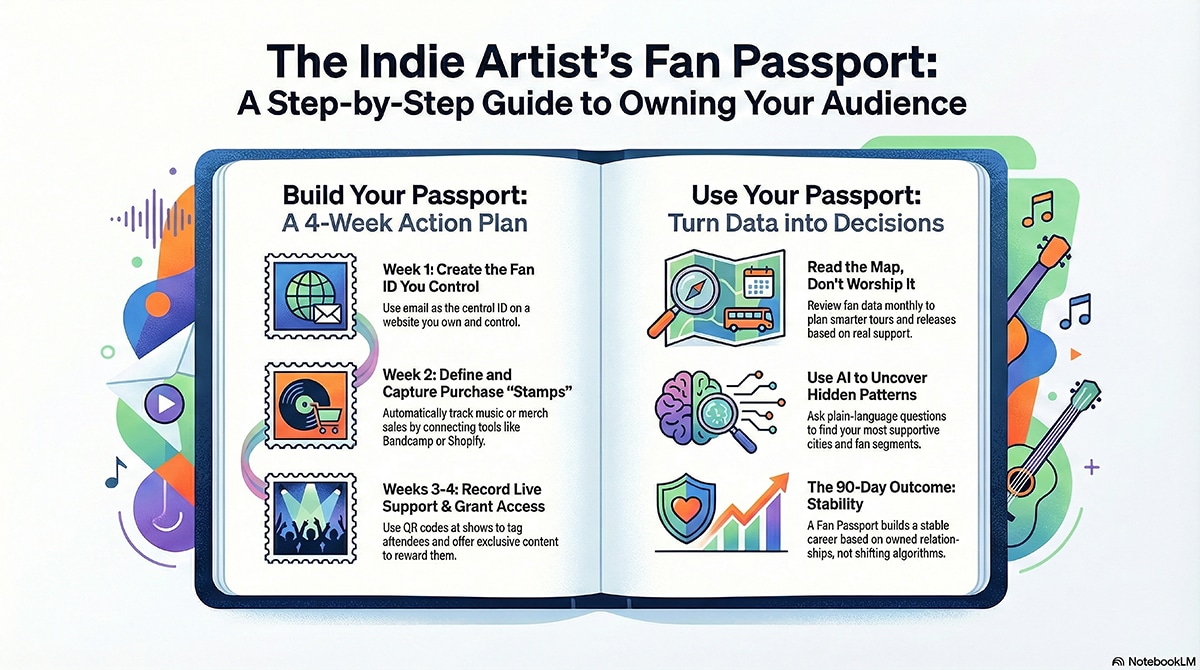
A Fan Passport is not a product you buy or an app you download. It is a mindset about how you treat fans and how you track relationships. It starts with a simple idea: every meaningful fan interaction should leave a trace you can remember.
In most of today’s music platforms, fans exist only as numbers. A stream. A follow. A like. Those numbers reset constantly, and they tell you very little about who actually supports you. A Fan Passport flips that thinking. Instead of seeing fans as anonymous traffic, you treat them as participants with history. People who have shown up before. People who have invested time, money, or attention more than once.
At its core, a Fan Passport is just a record. It connects a fan’s identity, usually an email address, to their actions over time. That can include signing up to your list, buying merch, attending shows, or unlocking fan-only content. As those actions accumulate, you are no longer guessing who your real supporters are. You can see them. You do not need custom software to start this. You need intention and a few tools that already exist.
The foundation of any Fan Passport system is identity, and the simplest form of identity is an email address. When a fan signs up to your email list, that is the moment their “passport” begins. From that point on, every interaction you capture gets attached to that same person instead of floating around as anonymous data.
Platforms like Bandcamp at https://bandcamp.com already do part of this work for you. When someone buys music or merch on Bandcamp, their purchase is tied to an email address. That means you already know who bought what, and when. On its own, that is useful. When combined with your email system and website, it becomes powerful.
To turn this into a true Fan Passport, you need to start thinking in terms of “stamps.” A stamp is simply a recorded action. It is proof that a fan showed up in some way. Buying a shirt. Attending a show. Supporting a release. Each stamp adds context to the relationship.
For example, when someone buys merch through your website using a tool like Shopify at https://www.shopify.com, that purchase can be automatically connected to their email address. That purchase is a stamp. You now know this fan did more than listen. They spent money and supported you directly.
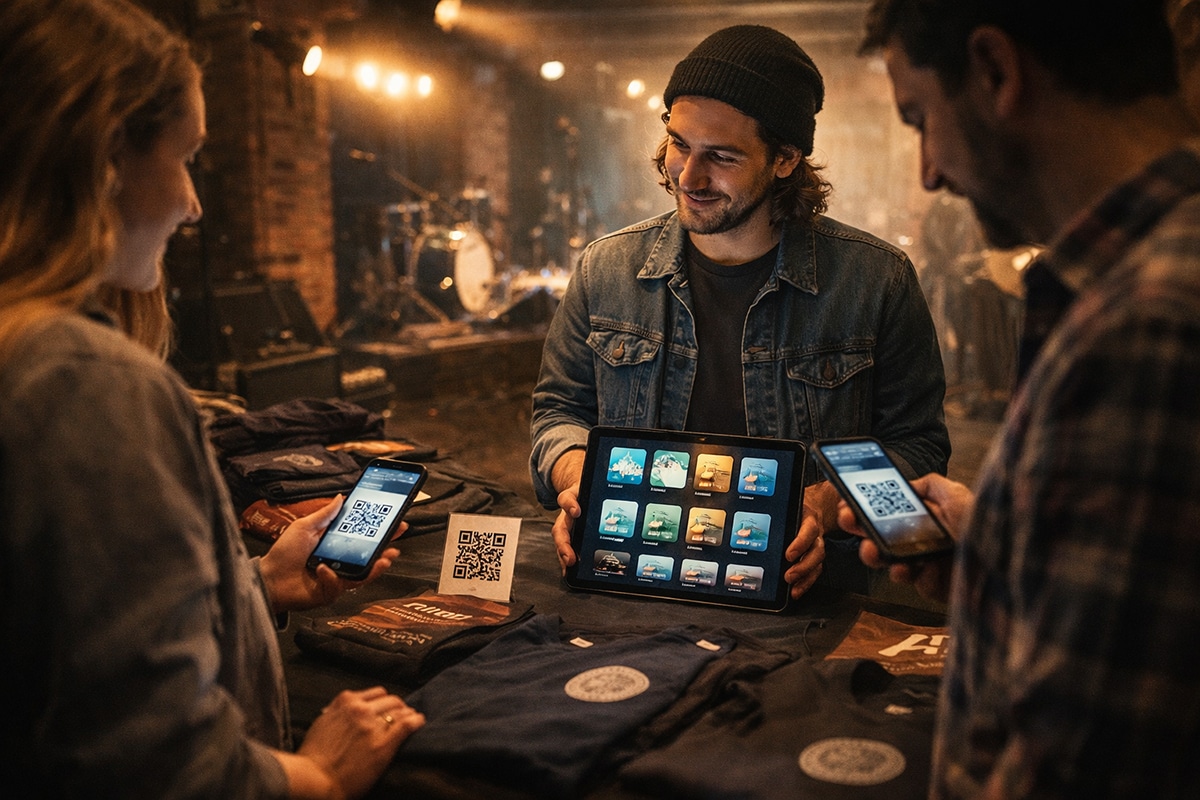
When a fan attends a show, you can issue a stamp in a few different ways. One simple method is to offer a QR code at the merch table or venue entrance that links to a signup or confirmation page on your website. The fan enters their email or clicks a link from an email you send them later. That action becomes a show attendance stamp. You now know this person was physically present.
You can also create digital stamps through email automation. After a show, you send a follow-up email to everyone who signed up locally. Anyone who clicks a specific link in that email gets tagged in your email system as “attended show.” That tag is a stamp. It is not fancy, but it works. Over time, these stamps start to stack. One fan might have stamps for buying music, attending two shows, and opening every email. Another might only have one stamp from a single stream-to-signup moment. Both are fans, but they are very different kinds of fans. The Fan Passport lets you see that difference.
Once stamps exist, they unlock new possibilities. You can reward repeat supporters with early access, private livestreams, discounted tickets, or exclusive merch. You are no longer guessing who deserves what. The passport shows you. This is where fan-only access comes in. You might create a private page on your website that only fans with certain stamps can access. Or you might send special links only to people who have attended a show or bought merch before. The key is that access is earned through participation, not algorithms.
The most important thing to understand is that none of this requires complex technology. It requires consistency. You decide what actions matter to you. You decide how to record them. And you make sure every meaningful interaction gets remembered somewhere you control. Over time, what you build is not a follower count. It is a relationship map. You can see who is growing with you, who shows up repeatedly, and where your real support lives. That knowledge is incredibly valuable, especially when planning tours, releases, or new revenue streams.
A Fan Passport does not replace streaming, social media, or platforms like Bandcamp. It sits above them. It turns scattered moments into a coherent story about your audience. You do not need custom software. You do not need to move fast. You need intention. Once you start treating fan interactions as something worth remembering, everything else starts to change.
Where Web3 Actually Helps (Without the Noise)
Web3 is often explained badly, which makes it feel confusing, risky, or unnecessary. Strip away the hype and the jargon, and it becomes much simpler. Web3 tools let you verify ownership without asking a platform for permission.
That is the key idea. Ownership and verification without a middleman.
In the Web3 world, a wallet is not some mysterious finance tool. It is simply a digital ID that a fan controls. Just like an email address proves someone can receive messages, a wallet proves that someone owns something. That something could be a ticket, a fan pass, access to content, or proof of support. If a fan owns it, you can verify it directly without relying on a platform to confirm it for you.
Tools like MetaMask at https://metamask.io make this practical for fans. MetaMask lets anyone create a wallet in a few minutes. No approval process. No gatekeeper. The fan controls it, not a platform and not you. That control is important, because it builds trust. Fans are not handing their identity to another company. They are using something they own.
Once a fan has a wallet, you can use Web3 tools to check ownership and unlock access. That is where platforms like Unlock Protocol at https://unlock-protocol.com come in. Unlock Protocol allows artists to create digital “keys” that grant access to things you decide. That could be a private page on your website, early access to tickets, exclusive merch drops, or a fan-only community.
Think of it like a digital wristband. If the fan has it, they get in. If they do not, they do not. No platform needs to approve that decision. No algorithm decides who is worthy. The rules are yours. Used correctly, Web3 does not replace email lists, websites, or traditional fan communication. Those tools are still the foundation. Email is how you talk to fans. Your website is where you live. Web3 simply adds an extra layer of ownership on top of what you already control.
For example, an email list can tell you who wants updates. A wallet can prove who supported you in a specific way. Together, they are powerful. One handles communication. The other handles access and verification.
The mistake many people make is treating Web3 as an all-or-nothing replacement for existing systems. That approach usually fails. The real strength of Web3 for independent artists is how quietly it strengthens ownership. It lets you reward real participation, protect fan-only spaces, and build systems that do not disappear when a platform changes its rules.
In other words, Web3 is not about chasing trends or buzzwords. It is about removing permission from the equation. When combined thoughtfully with email and your own website, it helps you build fan relationships that are harder to take away and easier to sustain over time.
Touring Breaks Artists Because They Tour Blind
Touring is still essential. Performing is the job. For most independent artists, live shows remain one of the few reliable ways to generate real income. But touring without data is not strategy. It is gambling.
Every tour has real costs. Gas prices fluctuate. Lodging adds up quickly. Food, crew pay, vehicle maintenance, and lost time all carry a price. When artists book shows based on hope, hearsay, or vanity metrics like total streams, those costs start to stack against them. A sold-out night in one city does not help if the next three shows lose money.
The biggest problem is not effort. It is uncertainty. Artists often do not actually know where their engaged fans live. Streaming dashboards might show listeners in dozens of cities, but they do not tell you who is willing to leave the house, buy a ticket, and show up. Without that clarity, routing becomes guesswork.
Owned fan data changes everything. When you can see where fans have signed up, bought merch, or attended past shows, patterns emerge. You start to recognize which cities consistently respond and which ones only look good on a chart. That knowledge lets you route tours intelligently, cluster shows geographically, and avoid stops that are likely to lose money.
With data, touring stops being reactive. You are no longer chasing every opportunity or saying yes out of fear of missing out. You can plan fewer shows that make more sense. You can negotiate better guarantees. You can focus your energy where it actually pays off. This shift is what turns touring from a drain into a support system. Instead of burning money to stay visible, live shows begin to reinforce your career. They feed merch sales, deepen fan relationships, and create repeat supporters who show up again next time.
Platforms will not give you this level of clarity. They have no incentive to. Their job is to maximize listening, not to help you build a sustainable touring business. If you want touring to work long term, you have to build this visibility yourself by owning your fan data and paying attention to what it tells you.
Why Platforms Don’t Want You to Own Relationships
If owning fan data is so powerful, a fair question follows. Why is it so rarely encouraged by the platforms artists depend on? The answer is simple. Owning fan data weakens platform control.
When artists can reach fans directly, the platform loses leverage. Paid promotion becomes less effective because artists no longer need to pay to reach people who already care. Algorithms matter less because communication does not depend on being surfaced in a feed. The grip of the platform loosens. Platforms are built to centralize relationships, not distribute them. Their value depends on keeping artists and fans inside their ecosystem, where attention can be measured, shaped, and monetized. Direct relationships bypass that system. They reduce dependency. They shift power away from the middle.
This is why tools for exporting fan data are limited, buried, or discouraged. It is why links that send people off-platform are often deprioritized. It is why artists are pushed toward features that keep fans interacting inside the platform instead of moving into spaces the artist controls. None of this is personal. It is not about individual artists being targeted or punished. It is structural. These companies are doing what their business models require them to do. Protecting control is how platforms maintain valuation and growth.
Understanding this is important because it removes confusion and guilt. When you feel friction trying to move fans off-platform, that resistance is not accidental. It is a signal. It tells you where the real power lives. Once you see that clearly, owning your fan relationships stops feeling optional or rebellious. It becomes a rational response to a system that was never designed to put artists first.
The Music Industry Middle Class Starts With Ownership
The music industry does not need more lottery winners. It needs stability. Viral hits and breakout moments make headlines, but they do not build an ecosystem that lasts. An industry cannot survive on rare wins and constant churn. It survives when there is a strong middle.
That middle is made up of artists who earn consistent income, pay their collaborators fairly, and build careers that last for decades instead of burning out in a few years. These artists may never dominate global charts, but they form the backbone of the music economy. They tour steadily. They release regularly. They support studios, venues, designers, engineers, and countless other music workers.
Owned fan data is the foundation of that music industry middle class. It creates predictability in a world that currently runs on volatility. When artists know who their fans are and how those fans engage, decisions become intentional instead of reactive. Releases can be planned. Tours can be routed intelligently. Budgets can be built around reality instead of hope. Ownership replaces panic with planning. It replaces constant hustle with systems that work quietly in the background. Instead of chasing every opportunity out of fear, artists can choose the ones that make sense. Instead of starting from zero with every release, they build on relationships that already exist.
This is how artists stop being disposable. Disposable artists are easy to replace because nothing ties fans to them beyond the latest song. Durable artists, on the other hand, are anchored by relationships. Fans know them. Support them. Return to them. That durability is what allows careers to survive algorithm changes, platform shifts, and cultural trends.
A music industry middle class does not emerge by accident. It is built deliberately, one owned relationship at a time.
A Practical Walkthrough: How to Start Owning Fan Data Right Now
Start with a simple website. This is your home base. It is the one place online that you actually control. Services like Squarespace at https://www.squarespace.com or WordPress at https://wordpress.org give you that control. The goal is not flashy design or constant updates. The goal is ownership. Your website is where fans can always find you, no matter what happens to algorithms, feeds, or platforms.
Once the site exists, add an email signup form. This is where an important choice appears. Tools like ConvertKit are easy to use and familiar, but they still live on someone else’s servers. You are allowed to use your list, but you do not fully own the infrastructure behind it. For many artists, that is fine as a starting point. But if your goal is long-term independence, there is a stronger option.
Using the Newsletter Plugin at https://www.thenewsletterplugin.com lets you keep your email list inside your own WordPress site. The subscriber data lives in your database, under your control, not on a third-party platform that can change terms, pricing, or policies. This is what real ownership looks like. Your list is not rented. It is part of your system.
When you ask for an email, offer something small but meaningful in return. Early access to new music, first notice of tour dates, or behind-the-scenes updates all work. This is not about spam. It is about permission. Someone giving you their email is choosing a direct relationship instead of an algorithmic one.
Once the signup exists, normalize it everywhere. Put the link in your social bios. Include it on your Bandcamp page. Mention it from the stage. Print it on flyers. The goal is to make joining your list feel like the natural next step for anyone who wants to stay connected.
Use Bandcamp at https://bandcamp.com for direct sales whenever possible. Bandcamp ties purchases to email addresses automatically, which means every sale also becomes a relationship. You are not just selling music or merch. You are building early fan history. This is the beginning of your Fan Passport, even if you never call it that publicly.
When you sell tickets or merch outside of Bandcamp, make sure emails are still captured. Platforms like Shopify at https://www.shopify.com integrate cleanly with WordPress and email systems, allowing purchases to attach to known fans over time. Each purchase becomes another stamp in the passport.
Once this foundation is in place, you can add Web3 lightly and intentionally. This is not the first step. It is an optional layer for deeper fans. Tools like Unlock Protocol can create token-gated pages or fan-only access areas on your website. Do not force wallets. Offer them as a choice for fans who want closer access or special experiences.
Over time, patterns appear without effort. You see who consistently shows up. You see where they live. You see what they support and how often. At that point, you are no longer guessing or chasing numbers on a dashboard.
That knowledge is worth more than streams, because streams disappear. Owned relationships compound.
Why This Quiet Shift Matters More Than Viral Moments
Viral success is unpredictable by nature. It cannot be planned, repeated on command, or relied on as a foundation for a career. Ownership is different. Ownership compounds. When artists control their relationships, they are no longer at the mercy of algorithms, trend cycles, or platform priorities that change without warning.
When relationships are owned, planning becomes possible. Tours can be routed with confidence instead of hope. Releases can be timed around real engagement instead of chasing momentum. Income becomes something that can be forecast, not guessed at. That clarity is what allows artists to make long-term decisions instead of living from release to release.
This is how careers last. Not through constant viral moments, but through steady, intentional growth. Artists who own their fan relationships can survive algorithm changes, platform shifts, and cultural swings because their connection to fans does not disappear when a feed stops showing their work.
This is also how a music industry middle class grows. A healthy industry is not built on a handful of superstars and millions of struggling creators. It is built on a broad base of working artists who can sustain themselves, pay collaborators fairly, and contribute consistently to the ecosystem. Ownership makes that stability possible.
The future of music will not be decided by charts, playlists, or short-term attention spikes. It will be built quietly by artists who own their audiences and treat fans like partners rather than data points.
BONUS CONTENT!
Designing a Full Fan Passport System for Indie Artists
 |  Spotify |  Deezer |  Breaker |
 Pocket Cast |  Radio Public |  Stitcher |  TuneIn |
 IHeart Radio |  Mixcloud |  PlayerFM |  Amazon |
 Jiosaavn |  Gaana |  Vurbl |  Audius |
 Reason.Fm | |||
Find our Podcasts on these outlets
Buy Us a Cup of Coffee!
Join the movement in supporting Making a Scene, the premier independent resource for both emerging musicians and the dedicated fans who champion them.
We showcase this vibrant community that celebrates the raw talent and creative spirit driving the music industry forward. From insightful articles and in-depth interviews to exclusive content and insider tips, Making a Scene empowers artists to thrive and fans to discover their next favorite sound.
Together, let’s amplify the voices of independent musicians and forge unforgettable connections through the power of music
Make a one-time donation
Make a monthly donation
Make a yearly donation
Buy us a cup of Coffee!
Or enter a custom amount
Your contribution is appreciated.
Your contribution is appreciated.
Your contribution is appreciated.
DonateDonate monthlyDonate yearlyYou can donate directly through Paypal!
Subscribe to Our Newsletter
Order the New Book From Making a Scene
Breaking Chains – Navigating the Decentralized Music Industry
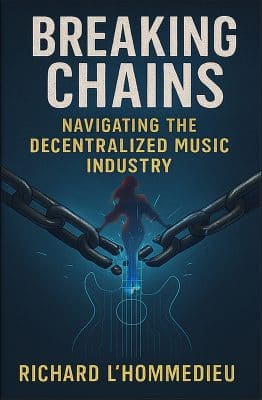
Breaking Chains is a groundbreaking guide for independent musicians ready to take control of their careers in the rapidly evolving world of decentralized music. From blockchain-powered royalties to NFTs, DAOs, and smart contracts, this book breaks down complex Web3 concepts into practical strategies that help artists earn more, connect directly with fans, and retain creative freedom. With real-world examples, platform recommendations, and step-by-step guidance, it empowers musicians to bypass traditional gatekeepers and build sustainable careers on their own terms.
More than just a tech manual, Breaking Chains explores the bigger picture—how decentralization can rebuild the music industry’s middle class, strengthen local economies, and transform fans into stakeholders in an artist’s journey. Whether you’re an emerging musician, a veteran indie artist, or a curious fan of the next music revolution, this book is your roadmap to the future of fair, transparent, and community-driven music.
Get your Limited Edition Signed and Numbered (Only 50 copies Available) Free Shipping Included
Discover more from Making A Scene!
Subscribe to get the latest posts sent to your email.


