Why an Indie Artist Needs Two Additional Companies, Not a Dream and a Prayer





Making a Scene Presents – Why an Indie Artist Needs Two Additional Companies, Not a Dream and a Prayer
Listen to the Podcast Discussion to Gain More Insight into creating your own Record and Publisher Companies
Let’s start by being honest, because this is where most music advice goes soft. If you are an independent artist releasing music without a record company or a publishing company, you are not actually “free.” You are exposed. You may feel creative freedom because no one is telling you what to write or record, but from a business point of view, your music is drifting with no structure holding it in place. There is no clear owner on paper. There is no system collecting everything you are owed. There is no container protecting your work long-term. That is how artists quietly lose money, slowly give up control, and eventually lose confidence in their own future.
This article exists to fix that problem at the root.
A real music career does not begin with a viral moment, a playlist add, or a lucky break. Those things are unpredictable and temporary. A real career starts with structure. Structure is what turns music from a hobby into an asset. When your music lives inside real companies, you gain ownership that is clear, provable, and respected by the industry. Ownership creates leverage, because now you control the terms under which your music is used. Leverage creates options, and options are what allow artists to survive the slow years, pivot when platforms change, and grow without desperation. This is how careers last long enough to actually matter.
For decades, the music industry has pushed a dangerous story onto artists. You were told that companies are complicated, expensive, and only meant for people with lawyers, labels, or major success. That story was never meant to protect you. It was meant to keep you small, informal, and easy to exploit. When artists do not formalize their business, everyone else gets to define the rules. Today, that excuse no longer holds up. An independent musician can create a record company and a publishing company with tools that are affordable, accessible, and designed for small operators. These tools simply did not exist in this form ten years ago. You do not need permission. You do not need a deal. You do not need to be “chosen.” You need clarity, intention, and the willingness to follow through.
This article is a straight walk-through of how a single indie artist creates two companies, one that holds recordings and one that holds songs, using plain language and real-world logic. There is no hype here and no mystery to decode. You will not be told to manifest success or wait for validation. Instead, you will see practical steps, modern systems, and a mindset built for the future. That future includes AI tools that reduce workload and decentralized options that protect ownership beyond any one platform. The goal is simple. What you build today should still serve you tomorrow, no matter how the industry shifts around you.
The Simple Difference Between a Record Company and a Publishing Company
Before we touch a single form or filing, we need to clear up the biggest point of confusion in the entire music business. Most artists are not confused because they are careless. They are confused because the industry has done a terrible job explaining this on purpose.
A record company exists to own or control sound recordings. Sound recordings are the actual finished audio files people listen to in the real world. When someone streams your song on Spotify or Apple Music, watches your video on YouTube, buys a vinyl record, downloads a file, or hears your track in a film or TV show, they are interacting with a sound recording. If you paid for the studio time, hired the producer, or recorded the project yourself, you almost certainly already own those recordings, even if you never wrote it down or called it a “label.” Ownership does not disappear just because you did not formalize it. The problem is that undocumented ownership is weak ownership.
A publishing company deals with something entirely different. It owns or administers songs, not recordings. A song is the underlying composition, the lyrics and the melody. That song can be recorded a hundred different ways by a hundred different artists, but it is still the same song underneath. Publishing income follows the songwriting, not the performance. This is why the same song can generate money even when someone else records it, plays it live, or uses it in a commercial. When you write a song, you create an asset that lives independently from any one recording of it.
If you never create companies to hold these rights, then legally everything belongs to you as a person. On the surface, that sounds simple and harmless. In reality, it is fragile. People get sick. People pass away. Businesses grow. Taxes change. Platforms shut down. Contracts get signed under pressure or without full understanding. When music lives only under your personal name, it has no long-term container. Companies give your music a stable home that survives memory lapses, life changes, and industry chaos. They create continuity where individuals cannot.
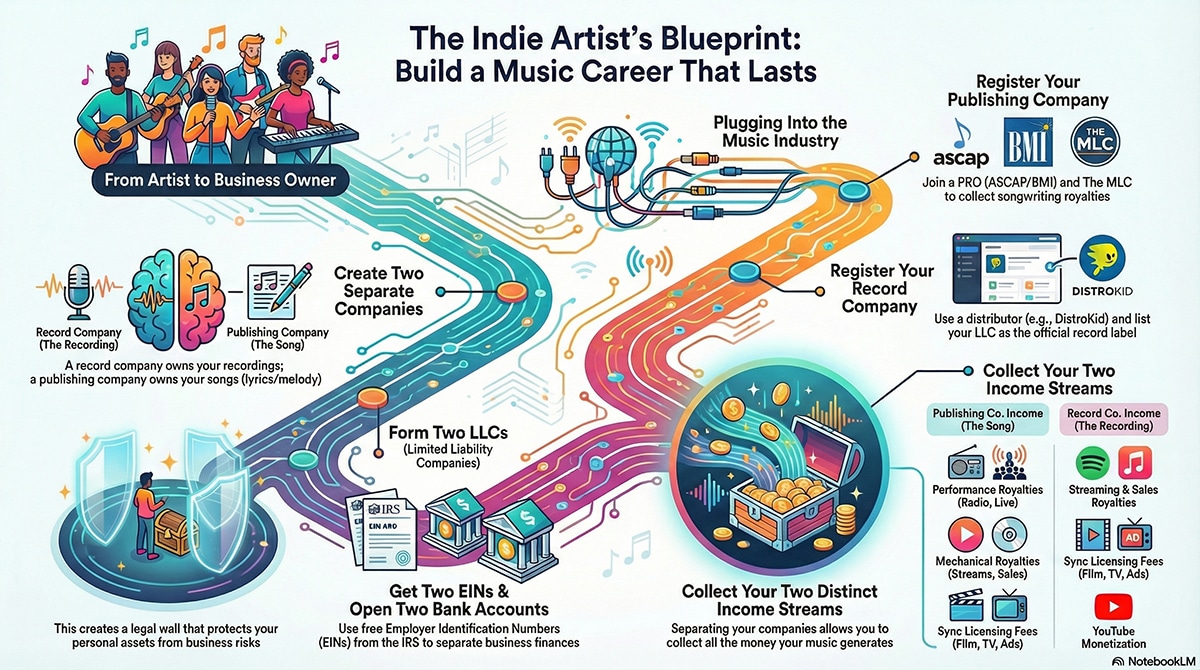
This is exactly why this entire approach is framed as one artist with two companies. One company exists to hold and exploit recordings. The other exists to hold and administer songs. When those roles are clear, everything else in the music business becomes easier to understand, easier to manage, and far harder for anyone else to take advantage of.
Why an LLC Is the Backbone of Artist Control
An LLC stands for Limited Liability Company. The name sounds intimidating, but the idea behind it is actually very simple. An LLC creates a legal wall between you, the human being, and the business activities connected to your music. That wall matters more than most artists realize. When your music exists only under your personal name, every risk attached to it follows you home. If something goes wrong, there is no separation between your art and your personal life.
When you operate through an LLC, your music business becomes its own legal entity. If that business ever gets sued, audited, or ends up owing money, the LLC helps protect what is personal. Your house, your savings, and your family are no longer automatically tied to your catalog, your releases, or your contracts. This does not make you invincible, but it dramatically reduces risk and gives you a layer of protection that individual artists simply do not have.
LLCs are popular in the music industry for a reason. They are flexible, relatively inexpensive, and universally understood. Labels, publishers, distributors, and licensing companies all recognize LLCs as legitimate business entities. There is nothing flashy about them, and that is a good thing. They exist to do a job, not to impress anyone.
In this model, you will create two separate LLCs. One LLC will operate as your record company, and the other will operate as your publishing company. That might sound like overkill if you are new to this, but it is not. This is standard practice, even at the highest levels of the industry. Keeping recordings and songs in separate entities creates clarity, simplifies accounting, and prevents problems later when opportunities or partnerships appear.
LLCs are registered at the state level. Every state has a Secretary of State website where business registrations happen. The process is usually straightforward and can often be completed online in under an hour. The cost varies by state, but most artists will spend somewhere between fifty and three hundred dollars to set one up. There is also typically a small yearly filing fee to keep the company active. This is not a recurring expense that grows out of control. It is the cost of having a real foundation.
Once your LLC is formed, it becomes its own legal person in the eyes of the law. That company can sign contracts instead of you doing it personally. It can open bank accounts in its own name. It can receive payments, pay expenses, and hold assets. From that moment on, your music is no longer just something you made. It is something you own through a structure designed to protect it.
Choosing Names That Work in the Real World
Your company names matter, but not for the reasons most artists assume. This is not about sounding cool, clever, or mysterious. This is about being usable in the real world. Your company names will show up on contracts, bank statements, royalty reports, tax forms, and licensing agreements. If they are confusing, hard to spell, or easily mistaken for someone else’s business, you are creating friction for yourself before you even release music.
A good record company name and a good publishing company name should be simple and clear. They should be easy to spell when spoken out loud and easy to remember when someone hears them once. They should also be distinct enough that they are not confused with an existing label, publisher, or brand. Before you settle on a name, you should check availability on your state’s business registry through the Secretary of State website and do basic online searches to make sure you are not stepping on someone else’s identity. This is not about trademarks yet. It is about avoiding obvious problems from day one.
Many independent artists keep this simple by using the same root name for both companies and changing only the function at the end. For example, “Midnight Harbor Records LLC” for recordings and “Midnight Harbor Publishing LLC” for songs. This approach creates instant clarity. Anyone looking at a contract or a royalty statement can immediately understand what each company does. You get consistency without unnecessary complexity, which is exactly what you want when you are building a business you plan to live with for years.
If you want to operate publicly under a different name than your legal LLC name, you can use a DBA. DBA stands for “Doing Business As.” A DBA allows your company to present itself under a brand name while keeping the legal structure underneath unchanged. For example, your legal entity might be “Midnight Harbor Publishing LLC,” but you might publicly operate as “Midnight Harbor Music.” The DBA bridges that gap.
DBAs are not required for most artists, but they are useful when branding, marketing, or presenting yourself to the public. They give you flexibility without forcing you to restructure your company. Think of a DBA as a nickname your business can use when it steps into the public eye, while the legal name handles the serious paperwork behind the scenes.
EINs and Why You Should Never Use Your Social Security Number
An EIN is an Employer Identification Number. The name makes it sound like it only matters if you plan to hire employees, but that is not how it works in practice. Even if you never hire a single person, you still want an EIN for each of your companies. An EIN is how the world recognizes your business as separate from you.
The easiest way to understand an EIN is to think of it as a Social Security number for your company. It identifies your business to banks, distributors, payment processors, and the IRS. Most banks will not open a business account without one. Many music distributors and licensing platforms ask for it during setup. Tax forms absolutely require it once your company starts earning money. Trying to operate without an EIN quickly becomes frustrating and unprofessional.
You get an EIN directly from the IRS, and it is completely free. There is no reason to pay a third-party service to do this for you. The official IRS application is online and takes only a few minutes to complete at https://www.irs.gov/businesses/small-businesses-self-employed/apply-for-an-employer-identification-number-ein-online. Once approved, you receive the number immediately.
Because you are creating two separate companies, you will apply for two separate EINs. One EIN belongs to your record company LLC, and one belongs to your publishing company LLC. This keeps the businesses clean, organized, and clearly separated in the eyes of the law and the tax system.
You should never give out your personal Social Security number when an EIN can be used instead. Using an EIN protects your identity, reduces risk, and signals that you are operating as a legitimate business. This is not about pretending to be bigger than you are. It is about acting like a professional from the start so your music business grows on solid ground instead of shortcuts.
Opening Bank Accounts and Keeping Money Clean
Every company needs its own bank account, and this is one of those areas where there is no shortcut. If you want to be taken seriously by banks, platforms, partners, or the IRS, your business money cannot live in your personal account. Mixing personal and business funds is one of the fastest ways to create confusion, tax problems, and legal exposure.
Your record company income should go into a bank account opened in the name of your record company LLC. Your publishing income should go into a separate bank account opened in the name of your publishing company LLC. From those accounts, the companies can then pay you. That might feel strange at first, but this is how real businesses operate. You are no longer just collecting money. You are managing it.
This separation is what allows you to see the truth about your music business. When money is cleanly organized, you can track what each part of your operation is actually earning. You can see whether your recordings are profitable, whether your songwriting is generating consistent income, and where expenses are eating into your margins. It also makes tax time far less painful, because income and expenses are already categorized instead of tangled together.
Most banks make this process easier than artists expect. Once you have your LLC formation documents and your EIN, many banks will allow you to open business accounts online without visiting a branch. Some artists choose traditional banks, while others use online business banking platforms designed for small companies. The specific bank matters less than the habit. Separate accounts create clarity, and clarity is what turns music into a business you can actually control.
Registering Your Publishing Company the Right Way
Once your publishing company exists as a legal entity, it is not enough to simply own songs on paper. You have to connect that company to the systems that actually track usage and send money. This is where many artists fall apart, not because it is impossible, but because no one ever explained it clearly.
The first connection you make is with a Performing Rights Organization, usually called a PRO. In the United States, the two main options are ASCAP, which you can find at https://www.ascap.com, and BMI, available at https://www.bmi.com. You choose one of them, not both. A PRO’s job is to track when your songs are performed publicly and pay you for that usage. Public performance includes radio play, live venues, television, background music in businesses, and even streaming activity that qualifies under performance rules.
When you register, you do it twice in a sense. You register yourself as the songwriter, because you wrote the songs, and you register your publishing company as the publisher, because that company administers and collects the publishing share. This split matters. Songwriters and publishers are paid separately, even when they are owned by the same person. If you skip the publisher registration, you are leaving money on the table that no one will chase for you.
The next system you must plug into is mechanical royalties for digital streaming in the United States. This is handled by The MLC at https://www.themlc.com. The MLC exists specifically to collect and distribute mechanical royalties from services like Spotify, Apple Music, and Amazon Music. These royalties are different from performance royalties, and they do not automatically flow through your PRO. If you are not registered with The MLC as both a songwriter and a publisher, that money can sit unclaimed or be paid incorrectly.
Once your catalog grows or your music starts reaching listeners outside the United States, managing publishing worldwide becomes more complex. This is where publishing administration services come in. A company like Songtrust, which you can find at https://www.songtrust.com, acts as an administrative layer between your publishing company and collection societies around the world. They register your songs internationally, track usage across dozens of countries, and collect royalties on your behalf in exchange for a percentage.
It is important to understand what this is and what it is not. Using a publishing administrator does not mean you are giving up ownership of your songs. Your publishing company still owns the catalog. You are simply hiring help to do the paperwork at a scale that would be overwhelming on your own. Think of it like hiring an accountant instead of trying to memorize the entire tax code. The control stays with you, but the work gets done correctly.
When your publishing company is properly registered with a PRO, The MLC, and, if needed, an administrator, your songs are no longer invisible. They are tracked, accounted for, and paid out through systems designed to recognize businesses, not just individuals. This is the moment where songwriting stops feeling like a mystery and starts behaving like an asset.
Registering Your Record Company for Distribution
Once your record company exists, it needs a way to deliver music to the world. That is the role of a distributor. A distributor is the bridge between your record company and platforms like Spotify, Apple Music, Amazon Music, YouTube Music, and dozens of others. Without one, your recordings simply do not show up where listeners expect to find them.
Today, independent artists have access to distribution tools that used to be reserved for labels with staff and connections. Services like DistroKid at https://distrokid.com, CD Baby at https://cdbaby.com, and TuneCore at https://www.tunecore.com allow your record company to distribute recordings worldwide for relatively low cost. These platforms handle delivery, reporting, and payments while you retain ownership of your masters. They are not labels. They are logistics providers.
This is where a small but critical detail makes a big difference. When you upload music through a distributor, you are asked to list a label name. You should always enter the name of your record company, even if you are the only artist on it and you own it outright. Do not leave this blank and do not put your personal artist name there unless your artist name and label name are intentionally the same.
Listing your record company as the label trains the entire ecosystem to recognize you as a business. Metadata systems start associating your recordings with a company instead of a person. Royalty reports become cleaner. Future licensing partners see structure instead of informality. If a sync supervisor, brand, or distributor looks up your catalog later, they see a label that owns recordings, not an artist who happens to have files online.
This also matters for the future in ways most artists do not anticipate. If you ever license recordings, sell part of a catalog, partner with another company, or move distribution, having a consistent label identity across releases prevents confusion and disputes. Your record company becomes the steady anchor while platforms, trends, and strategies change around it.
In simple terms, your distributor gets the music out, but your record company is the entity that stands behind it. When you treat distribution as a business function instead of a one-time upload, your recordings stop feeling temporary and start behaving like assets that belong to something real.
Where the Money Actually Comes From
This is where the real power of running two separate companies finally comes into focus. Publishing income and record company income come from different places, even when they are triggered by the exact same song playing at the exact same moment. Most artists never see this clearly because everything gets lumped together into one vague idea of “royalties.” Once you separate the rights, the fog lifts.
Publishing income flows from the song itself, not the recording. The song is the lyrics and the melody, the underlying work that exists even before anything is recorded. Whenever that song is performed publicly, whether it is streamed online, played on terrestrial or satellite radio, performed live in a venue, or used as background music in a business, it can generate publishing royalties. Mechanical royalties are another piece of publishing income and come from the reproduction of the song. Today, that mostly means digital streaming, but it also includes downloads and physical formats. Sync licensing creates publishing income when a song is placed in film, television, commercials, video games, or online content. In some cases, publishing can even generate money from printed sheet music, lyric reprints, or educational uses. All of this income exists because the song was written. It does not depend on who recorded it or how popular a specific version becomes.
Record company income, on the other hand, is tied directly to the sound recording. This is the money earned when a specific recorded performance is streamed, downloaded, sold on vinyl or CD, or licensed for use in visual media. If a television show, film, or advertisement uses your actual master recording instead of a cover version, the record company that owns that recording gets paid. In many countries outside the United States, neighboring rights income also flows to the owner of the recording when it is broadcast or publicly performed. YouTube monetization is another major recording-based revenue stream. Whether the income comes from your own official uploads, content ID claims on user-generated videos, or licensed uses, that money belongs to the record company that controls the master.
These two income streams are often confused because they are triggered at the same time. When someone streams your song, money is generated on both sides. Publishing royalties are earned because the song was performed and reproduced. Recording royalties are earned because a specific master recording was used. When a song appears in a television show, the songwriter and publisher are paid for the composition, and the record company is paid if the master recording is used. To an artist without structure, all of this feels like one blurry payment source, often arriving late, inconsistently, or not at all. In reality, it is two separate revenue paths that should be tracked, collected, and paid to two separate companies.
When you own both the publishing company and the record company, you are not exploiting a loophole or gaming the system. You are simply collecting what you are legally entitled to collect. Music is valuable precisely because it contains multiple rights layered on top of each other. When artists fail to formalize both sides, they usually only see part of the picture. In many cases, they miss half of what they earned without ever realizing it, because there was no structure in place to receive it.
This is why structure is not a luxury. It is a requirement. When your publishing company collects income from songs and your record company collects income from recordings, you gain real visibility into how your music performs in the world. You can see which songs continue to earn over time, which recordings drive the most revenue, and where new opportunities exist to license, promote, or reinvest. Owning both sides does more than increase income. It gives you insight, leverage, and control. Most artists never experience that power because they never built the container capable of holding it.
Using AI to Run Lean Instead of Burning Out
AI is not here to replace artists, no matter how many headlines try to scare you into thinking that. What AI is actually replacing is unpaid labor, guesswork, and burnout. For independent artists running their own record and publishing companies, that distinction matters. You are not using AI to remove creativity. You are using it to remove friction.
Tools like ChatGPT, available at https://chat.openai.com, act like a business assistant that never gets tired. It can help you draft basic contracts and agreements so you are not starting from a blank page. It can help organize your catalog by turning messy notes into clean documentation. It can generate release timelines, marketing outlines, and administrative checklists that would otherwise take hours to think through. Most importantly, it can explain complex music business concepts in plain language when you need clarity instead of jargon. This does not replace lawyers, accountants, or professionals when you truly need them, but it dramatically reduces how often you need to pay someone just to understand what is going on.
On the data side, tools like Chartmetric at https://chartmetric.com help your companies see what is actually happening with your music in the world. Instead of guessing where listeners are coming from or which songs are gaining traction, you can see real signals across streaming platforms, playlists, and social growth. This allows your record company and publishing company to make informed decisions instead of reactive ones. You stop chasing every opportunity and start focusing on the areas that are already working.
AI also plays a growing role in production-adjacent tasks that quietly drain time and money. AI-assisted mastering tools can help prepare releases quickly when budgets are tight. Scheduling tools can automate posts, emails, and reminders so nothing falls through the cracks. Content tools can help repurpose one piece of work into multiple formats without starting over each time. All of this reduces overhead, which is critical when your companies are still small.
The real advantage of AI is scale without staff. It allows one artist to operate with the efficiency of a much larger organization. That means your record company and publishing company can stay lean, profitable, and focused on ownership instead of constantly scrambling to keep up. Used correctly, AI does not make your music less human. It gives you the breathing room to stay human while your business keeps moving forward.
Decentralized Options for Long-Term Control
Web3 is not about hype, buzzwords, or chasing the next trend. At its core, it is about infrastructure. It is about building systems that do not disappear just because a platform changes its rules, shuts down, or decides your work no longer fits its business model. For an independent artist building a record company and a publishing company, that distinction is critical.
Decentralized storage is one of the most practical places where Web3 already makes sense. Systems built on IPFS allow you to store masters, artwork, contracts, and key documents in a way that is not tied to any single company’s servers. When files live only on a distributor’s backend, a cloud drive, or a platform you do not control, your access depends on someone else staying in business and honoring their terms. Decentralized storage changes that dynamic. Platforms like https://ipfs.tech support this model by allowing files to exist across a distributed network rather than in one fragile location. This does not replace your local backups or normal workflows. It adds a layer of permanence and resilience that traditional systems lack.
Smart contracts are another piece of Web3 infrastructure that matter to artists who care about ownership. Smart contracts are programmable agreements that live on a blockchain and execute automatically when conditions are met. In the context of music, this means royalty splits, licensing terms, and usage permissions can be enforced transparently instead of relying on trust and paperwork alone. This area is still early, and it is not yet a full replacement for traditional contracts. But it is evolving quickly, and the direction is clear. Automation reduces disputes, speeds up payments, and makes rights easier to audit. For artists who have spent years waiting on statements or chasing missing royalties, that transparency is not theoretical. It is overdue.
Token-gated access platforms take this infrastructure one step further by changing how fans interact with your catalog. Tools like Unlock Protocol, which you can find at https://unlock-protocol.com, allow your companies to offer access to music, content, experiences, or communities only to supporters who hold a specific digital key. This could mean early access to releases, exclusive versions of songs, private streams, or long-term fan memberships. The key point is that your record company and publishing company retain ownership the entire time. You are not handing control to a platform. You are using infrastructure to manage access on your own terms.
None of this requires abandoning the existing music system overnight. Streaming, traditional publishing, and standard distribution still matter today. The goal is not to burn bridges. The goal is to stop building your entire business on rented land. By structuring your companies in a way that can connect to decentralized tools as they mature, you future-proof what you are building now.
When Web3 is stripped of hype, it becomes something very simple. It is a way to make sure your music, your companies, and your rights can survive platform shifts, policy changes, and industry churn without forcing you to start over every few years. That is not rebellion for the sake of rebellion. That is basic infrastructure thinking for artists who plan to be around for the long haul.
Why This Structure Changes Everything
When you operate through a real record company and a real publishing company, something fundamental changes in how you move through the music industry. You stop asking for permission. You stop waiting to be chosen. Instead of hoping someone notices you, you show up with structure that demands to be taken seriously.
With companies in place, you negotiate instead of beg. You are no longer just an artist asking for exposure. You are a business discussing terms. You license music instead of crossing your fingers and hoping a stream turns into rent money. You plan releases, revenue, and growth instead of reacting to whatever the algorithm, the platform, or the industry throws at you next. Structure turns chaos into strategy.
More importantly, you start building something that can outlive trends, platforms, and even your own active career. Streaming services will change. Social platforms will rise and fall. Technologies will be replaced. But companies, catalogs, and clearly defined ownership endure. A record company and a publishing company give your music a permanent home instead of a temporary spotlight.
This is how artists stop being disposable and start being durable. Disposable artists are easy to replace because nothing about their work is anchored. Durable artists build systems that continue to function even when attention fades. Durability is not about fame. It is about control, continuity, and confidence.
At this stage, the foundation is clear. The remaining decisions are about scope and direction. One choice is whether this structure should be framed strictly around the United States, or whether it should include brief international considerations where they matter, especially around publishing, royalties, and neighboring rights. Another decision is how far to take the vision in this piece. This structure can stand on its own, or it can be directly tied into a long-term, decentralized music business plan that shows how these companies evolve alongside Web3, AI, and direct-to-fan infrastructure.
Those choices do not change the core message. They determine how far down the road this article travels. The destination is the same either way. Ownership. Control. And a music career built to last, not just to be noticed.
 |  Spotify |  Deezer |  Breaker |
 Pocket Cast |  Radio Public |  Stitcher |  TuneIn |
 IHeart Radio |  Mixcloud |  PlayerFM |  Amazon |
 Jiosaavn |  Gaana |  Vurbl |  Audius |
 Reason.Fm | |||
Find our Podcasts on these outlets
Buy Us a Cup of Coffee!
Join the movement in supporting Making a Scene, the premier independent resource for both emerging musicians and the dedicated fans who champion them.
We showcase this vibrant community that celebrates the raw talent and creative spirit driving the music industry forward. From insightful articles and in-depth interviews to exclusive content and insider tips, Making a Scene empowers artists to thrive and fans to discover their next favorite sound.
Together, let’s amplify the voices of independent musicians and forge unforgettable connections through the power of music
Make a one-time donation
Make a monthly donation
Make a yearly donation
Buy us a cup of Coffee!
Or enter a custom amount
Your contribution is appreciated.
Your contribution is appreciated.
Your contribution is appreciated.
DonateDonate monthlyDonate yearlyYou can donate directly through Paypal!
Subscribe to Our Newsletter
Order the New Book From Making a Scene
Breaking Chains – Navigating the Decentralized Music Industry
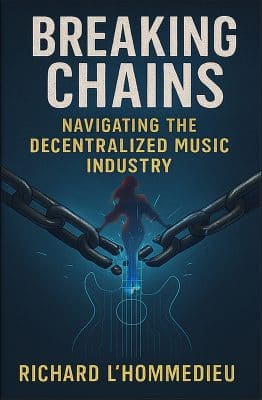
Breaking Chains is a groundbreaking guide for independent musicians ready to take control of their careers in the rapidly evolving world of decentralized music. From blockchain-powered royalties to NFTs, DAOs, and smart contracts, this book breaks down complex Web3 concepts into practical strategies that help artists earn more, connect directly with fans, and retain creative freedom. With real-world examples, platform recommendations, and step-by-step guidance, it empowers musicians to bypass traditional gatekeepers and build sustainable careers on their own terms.
More than just a tech manual, Breaking Chains explores the bigger picture—how decentralization can rebuild the music industry’s middle class, strengthen local economies, and transform fans into stakeholders in an artist’s journey. Whether you’re an emerging musician, a veteran indie artist, or a curious fan of the next music revolution, this book is your roadmap to the future of fair, transparent, and community-driven music.
Get your Limited Edition Signed and Numbered (Only 50 copies Available) Free Shipping Included
Discover more from Making A Scene!
Subscribe to get the latest posts sent to your email.


