

Webb Wilder Hillbilly Speedball




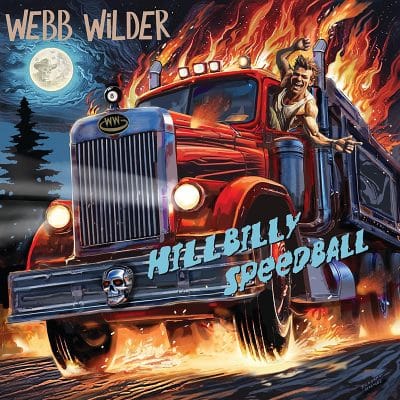 Webb Wilder
Hillbilly Speedball
Landslide Records
With eight of his twelve albums produced by the “outstanding in his field” Nashville-based producer R.S. Field, one must assume there’s something special about John Webb McMurry, A.K.A. Webb Wilder. And there is. Quite a bit. What other singer, songwriter, and guitarist refers to his music as progressive country while holding in equally high regard everything Brit Invasion, surf rock, southern rock, blues, and 1970s New Wave music?
Born in Hattiesburg, Mississippi (Field’s birthplace as well), Wilder began playing guitar at 12 and started leading bands at 14. His Landslide Records debut album, It Came from Nashville, received heaps of praise upon its release in 1986. So much so that major label Island Records released his sophomore outing and BMG picked up his third. But apparently Wilder was just too wild, so he went back on the indie trail for the long haul. This is his first album in five years.
Wilder wrote a handful of new songs for Hillbilly Speedball that mesh seamlessly with several obscure covers by his heroes. While not as nu-wavy/surfy/rockabilly-rich as his debut, the songs do echo those elements of his eccentric oeuvre. Generally, they’re just an accessible, toe-tappin’, finger-snappin’, head-shakin’ bundle of rock ‘n’ roll entertainment.
The album-opening title song reminds me of a late 90s Stephen Bruton rocker. It has the late, great Texan’s Faces-inspired, hook-filled, pop-leaning stamps all over it. Perhaps that’s because the song was penned by Wilder’s buddy—and Bruton’s buddy—David Grissom, the celebrated Texas guitar slinger who lends his perfectly thick riffing and a quick, screaming solo to it.
Beautiful Delilah,” a Chuck Berry B-side, becomes a Wilder A-lister here, the jaunty rocker irresistible for its quirky rhythm, fiery guitar and piano, and Wilder’s penetrating tenor reading of it in voice. “Coupla Good Moves,” with its dramatic dashes, also features Faces and Stones-styled riffing. Wilder began writing the song decades ago after having a conversation with the Georgia Satellites’ Dan Baird, so that makes sense. The beautiful and catchy “Sorrow,” with Vince Gill lending harmony vocals, could be a cross between Wilco, the Long Ryders, and England’s 1960s popsters, the Merseybeats. “V-8 Ford Blues” sounds exactly as it should, the ancient Willie Love and his Three Aces blues all ramshackle and cool.
A revolving cast of Wilder’s prominent friends assist him on these songs, and as produced by Wilder, George Bradfute, and Landslide owner Michael Rothschild, the results should broaden Wilder’s audience. But he knows the deal. In the last song, ironically (or not) the Everly Brothers’ “The Last Song (I’m Ever Gonna Sing), Wilder sings the refrains “They didn’t want to hear my song’ and ‘I’m never gonna be a star’ in all his honky-tonkin’ glory. Even the words ‘Born to Lose,’ painted by the legendary Flourney Holmes (The Allman Brothers Band’s Eat a Peach) on the license plate of the car bursting out of hell on the back cover, seem to be self-deprecating. Those are just the ways of Webb Wilder.
What matters in the end is to get down and twist and shout and boogie to this Hillbilly Speedball, just as Wilder and his band do.
Tom Clarke for MAS
BUY NOW

Subscribe to Our Newsletter
Discover more from Making A Scene!
Subscribe to get the latest posts sent to your email.


