

Udeigwe FOUR LEMMAS (Toward a Proof of Identity in Music and Mathmatics)




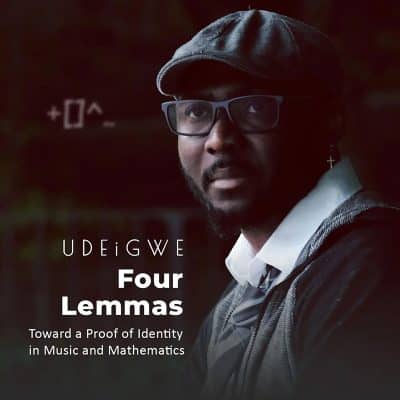 UDEIGWE
FOUR LEMMAS (Toward a Proof of Identity in Music and Mathmatics)
Independent Label
Lawrence Udeigwe, vocals/composer/lyricist/piano/keyboards/arranger; Josh Green, drums/arranger; Rade Bema, bass; Steph Clement & Wayne Tucker, trumpets/arrangers.
Here is an album that challenges me to think about music in new and different ways. Lawrence Udeigwe, (pronounced oo-dee-gway) is a Nigerian, born in a town called Makurdi and a member of the Igbo tribe. That town had only one television station. It began working at 4pm. They had and one FM radio station that played a lot of American music.
“I wanted to study music and theater, but I had always been very strong in math, so my parents encouraged me to pursue that path. Along the way, I also studied computer science. After college, I wanted to move to New York to explore music and theater more seriously. That route would have been difficult as an international student. … it was easier to remain in the country on a student visa. I decided to go to graduate school in mathematics instead,” Udeigwe explained his educational path.
Udeigwe’s love of music remained strong. Even while teaching at Manhattan University, after a full day of lesson leading and research in the afternoon, the hidden artist still managed to hang out and participate in local jam sessions. This led to him begin to compose music, as well as sing it.
In this project, he blends mathematical and scientific ideas into musical forms. His album title, “Four Lemmas” relates to the mathematical term, lemma, as a statement that supports a larger concept. Udeigwe composed an eight-track suite of music that breaks down four main expressions of lemmas. He mixes his singing with poetic narration and has composed all the music and written every lyric.
Backed by fusion jazz, free improvisation, solid rhythms and rich percussion, he adds trumpets and a funky bass. Udeigwe’s voice floats above the tracks. The singer also plays piano and keyboards. I liked his tune “I Don’t Care” with its catchy rhythm and world music groove. This sounds quite commercial to my ear. It reminds me a little bit of the Hugh Masekela music of the 1960s, with a twenty-first Century, updated production. The trumpet solo is fire; smooth, soulful and silky. This tune falls under the “Lemma 1 – Orthogonality, Independence Without Isolation.” This one should get lots of airplay. It mixes African dialect with English and Nigerian slang splashes through the lyrics. I played this tune three times in a row.
The second Lemma is called “Sparse Matrix.” Its corollary is “Reduction Without Loss of Meaning” where Udeigwe shows his scat powers. The “LU Principle” is a slow funk with a very pretty melody and lyrics that relate to mathematical terms. Udeigwe explains it this way:
“A matrix is a table of numbers arranged in rows and columns. In a sparse matrix, many of the rows have zeroes. So how does this apply to our lives? It applies to all the clutter of information we have in our brains. Certain things are just not useful, and when you declutter them, you are able to keep moving in the direction that you’re supposed to move. You’re able to say no to certain things.”
This is World Music, blended with Cultural Nigerian roots, American funk and traditional jazz, all propelled by improvisation and Udeigwe’s vivid imagination. Lawrence Udeigwe merges science and music in an unusual recording of poetic renderings and songs of life and protest. After all, he is a Professor of Mathematics and Director of Integrative Programs, as well as a Research Affiliate in Brain and Cognitive Sciences. On this project, he is Udeigwe, the artist, the poet, the composer.
Reviewed by Dee Dee McNeil

Subscribe to Our Newsletter
Discover more from Making A Scene!
Subscribe to get the latest posts sent to your email.


