The Living Room Circuit How to Book House Concerts




Making a Scene Presents – The Living Room Circuit How to Book House Concerts
Listen to the Podcast Discussion to Learn More About House Concerts
Turn House Concerts Into Touring Infrastructure
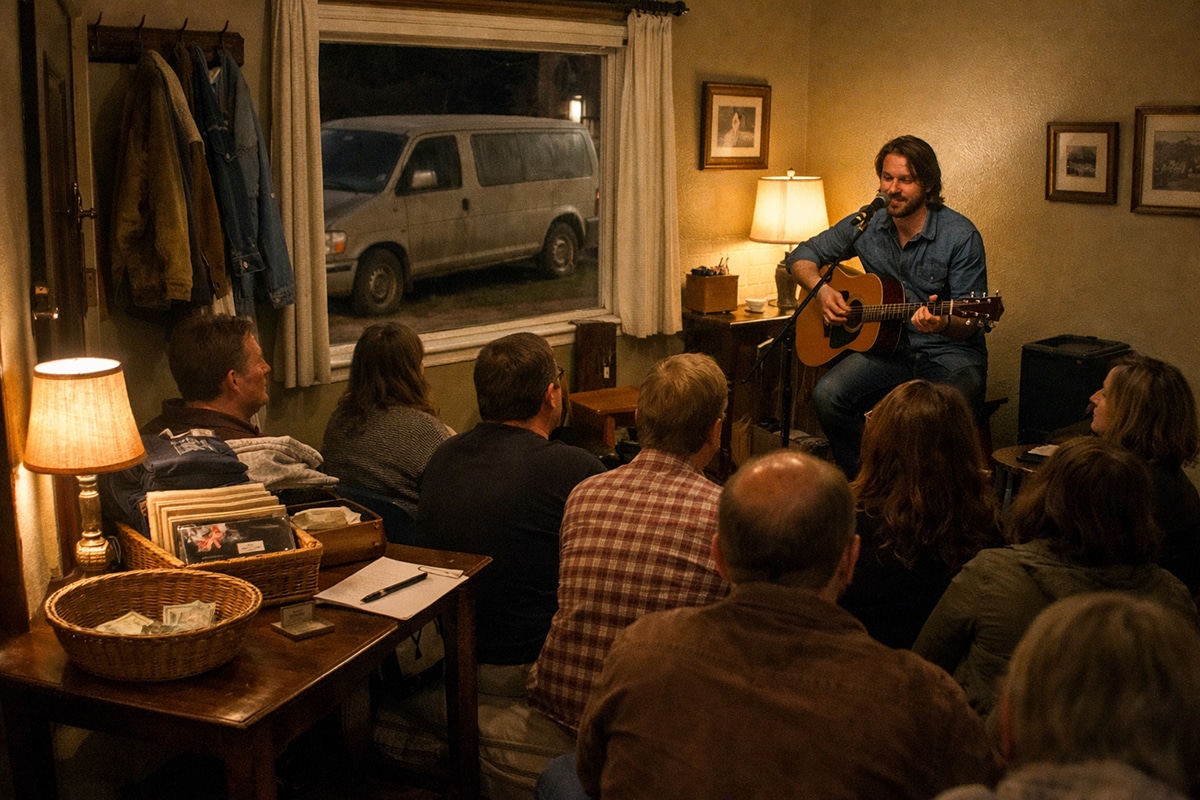
The van pulls off the highway just after dark. Not into a club alley. Not behind a theater. Not into the sad side lot of a bar that promised “great promotion” and forgot to mention the Tuesday trivia crowd. This time the GPS leads you into a quiet neighborhood. Porch lights glow. A dog barks once. Somebody opens the front door before you even knock.
Inside, the chairs are already set. There is a rug in the corner where you will play. A couple of lamps throw warm light over the room. Someone is slicing cheese in the kitchen. Someone else is carrying in folding chairs from next door. By the time the audience settles in, there are thirty people in the room and every one of them came to listen. Not to drink through your set. Not to shout at the TV over your quiet song. To listen.
That is the first shock of a good house concert. The second shock is the money.
For a lot of independent artists, house concerts still get treated like side hustle gigs, a nice little detour for folkies and singer-songwriters who could not land “real” venues. That thinking is old, lazy, and expensive. In the world we live in now, where club guarantees are thin, routing is brutal, and overhead can eat a whole week of work, the house concert is not a fallback. It is infrastructure. It is one of the cleanest ways left to turn songs, trust, and community into direct revenue without handing the whole night to a gatekeeper.
And that is exactly why house concerts matter to the Making a Scene idea of a music industry middle class. They put the artist closer to the money, closer to the fan, and closer to the data. They let artists build touring lanes that do not depend on algorithms, venue buyers, or a streaming platform suddenly deciding who exists this month. A living room is not just a room. It is a node in an owned network.
A house concert, in the classic form, is an invitation-only show in someone’s home where the host does not profit from the event. Listening Room Network says these shows are usually held indoors, often draw about 20 to 50 people, are commonly paid for through guest donations for the performer, and are most often performed by solo acts, duos, and small groups with little or no amplification. It also notes that the audience sits close and pays attention, which is the whole magic of the thing.
That definition matters because it tells you right away what this format is built to reward. It rewards songs over spectacle. It rewards presence over volume. It rewards artists who know how to make a room feel like a room, not a downgraded club date. And when you understand that, you stop asking whether house concerts are “worth it” and start asking how many nights on your next route should be built around them.
Why House Concerts Work When the Club Model Doesn’t
The traditional venue world sells a night out. The house concert world sells attention.
That difference changes everything. In a club, you are sharing the room with the bar register, the staff, the sports game on the screen, and whoever happened to wander in because the parking was easy. In a house concert, the music is the event. Listening Room Network literally builds its identity around “gigs where people listen,” and Concerts In Your Home describes house concerts as intimate gatherings where audiences sit close, stay attentive, and engage directly with the performer.
That attention has business value. Concerts In Your Home says the financial upside of house concerts comes from low overhead, no host profit motive, minimal promotion costs, better merchandise sales per attendee, and the common tradition of offering the artist food and lodging. It also notes that these perks can make even smaller shows financially worthwhile. In plain English, a house concert does not have to be huge to be profitable. It just has to be efficient.
That is the part too many artists miss. A club date may look bigger on paper because it has a stage, lights, a bar, and a fancy poster. But if the venue takes a cut, the crowd is distracted, merch is weak, and you still need a hotel, the “bigger” show can leave you poorer than the living room date. A house concert strips away all the fake scale and gets right down to what matters: Did the artist get paid, did the artist sell, did the artist sleep, and did the artist leave with deeper relationships than they had when they walked in?
That is middle-class music business thinking. Not ego. Margin.
What a House Concert Is Really Selling
A house concert is not just a smaller show. It is a different product.
If you are going to book this circuit well, you need to understand what the host is actually offering their guests. They are not offering nightlife. They are offering intimacy, discovery, conversation, and trust. The host is putting their own social capital on the line and telling friends, neighbors, and co-workers, “Come into my home. This artist is worth your time.” That is a stronger endorsement than a bar calendar listing. It is closer to a personal introduction.
Concerts In Your Home says the audience at these events is often made up of the host’s friends, neighbors, and acquaintances, while Listening Room Network describes the room as attentive and close. That means you are not playing to anonymous consumers. You are stepping into a relationship network.
That is also why the format works so well for independent artists who care about ownership. In a house concert, the relationship is not hidden behind a platform feed or swallowed by a venue brand. The audience came because a host trusted you. If you handle the room right, they leave trusting you too. That trust becomes merch sales, email signups, referrals, future hosts, private-event leads, and repeat dates. The show money matters. The network effect matters even more.
Where to Find House Concerts Without Wasting Months Guessing
This is where the conversation has to get practical.
A lot of artists think house concerts are invisible. They are not invisible. They are just private by design. So the job is not to find one giant public master list. The job is to get inside the networks where hosts and artists already meet.
One of the strongest places to start is Side Door. Side Door’s house-concert platform says hosts can create Space Profiles, publish Show Calls, connect with artists, set flexible ticket prices, split show revenue, manage performance royalties and payouts, and get paid directly to bank or PayPal within 72 hours of show completion. It also says the platform is available in the U.S. and internationally, which matters if you are routing beyond one region.
Another major resource is Concerts In Your Home. This is one of the long-running hubs in the house-concert world, and it is useful not only because it explains the culture and safest practices of house shows, but because it leads into a wider network of artists, hosts, and listening-room thinking. Its sister ecosystem, Listening Room Network, lives and is more curated. LRN says artists create profiles aimed at house concerts and small venues, search hosts and venues in tour areas, and reach out directly. It also says artists apply with video links, a website, and an application fee, and that only part of the applicant pool is invited to join. In other words, this is not a random directory. It is a quality-filtered community.
That curation is important because it tells you something about the market: house-concert hosts are not looking for generic availability blasts. They are looking for artists who clearly fit the room. LRN’s artist application page says full bands with drum sets or four or more members have limited opportunities in the network, and it asks artists to show something they can picture in most living rooms. That is not gatekeeping for the sake of gatekeeping. That is the format telling you how to win.
If you want a platform that handles money flow more formally, HomeDitty is another useful piece of the ecosystem. HomeDitty’s FAQ says hosts do not receive compensation, artists keep 100 percent of merchandise sales, cash at the door is prohibited, advance reservation through the platform is required, and artists can either use crowdfunded guest contributions or a host-paid flat fee. It also spells out the fee structure: Stripe card fees plus a 10 percent HomeDitty app fee. That kind of clarity is useful if you want less mystery and fewer awkward money conversations.
If you want to look beyond the U.S. or keep your options open for future routing, SofaConcerts is worth knowing. SofaConcerts says artists can create profiles, get booked by new and existing fans, reach out to experienced hosts, manage bookings and fee handling, and fill free days on tour with intimate shows in unconventional spaces. Its host guide also makes clear that artists see city-level location, capacity, photos, and availability preferences while the exact address stays private. That privacy model lines up with the house-concert ethos.
Then there is Folk Alliance International, which matters more than some artists realize. The FAI attendee tools let users filter presenters by House Concert, and the broader FAI resource section includes its PRO House Concert Agreement. For artists working in folk, roots, Americana, singer-songwriter, acoustic blues, and adjacent lanes, that presenter directory can be one of the cleanest ways to identify active house-concert people who are already part of a professional network.
And then there is the resource too many artists overlook because it feels too simple: your own audience.
Side Door explicitly encourages artists to think about their audience as a source of hosts, and its touring guidance is built around turning one existing date into a chain of connected opportunities. Concerts In Your Home says artists use house concerts to establish or deepen their fan base in a city or town. Taken together, that means the fan who bought a shirt after your last show, the subscriber on your email list, or the couple who always comment on your posts might already be the key to your next route.
That is the deeper lesson here. The house-concert ecosystem is not just a directory problem. It is a relationship problem. The best bookings often come from one host who introduces you to another, one fan who becomes a presenter, or one room that becomes the seed of a regional loop.
How to Identify the Right House Concert for Your Act
Not every house concert is a fit. Not every artist is either. The trick is to be honest before the ask.
The house concert sweet spot is usually music that can survive closeness. If a listener is six feet away from your voice and three feet away from your guitar, does the song still land? If your drummer is gone, does the groove still exist? If your set depends on spectacle, smoke, click tracks, or walls of volume, you may need a new configuration before you start pitching living rooms.
Listening Room Network says straight out that full bands with drum sets or four or more members have limited opportunities in its network, and HomeDitty says house concerts are meant to be stripped down for the size of the room even when they are not fully acoustic. Those two facts should shape how you market yourself. If you are a band, do not pitch the house-concert circuit as your full electric club show with the volume knob turned left. Pitch it as a deliberately reworked intimate set.
For solo artists and duos, that usually means leading with your strongest live video in a listening format. For bands, it often means building a second version of the act. Maybe the five-piece becomes a trio. Maybe the drummer switches to cajon, hand percussion, brushes, or no kit at all. Maybe the lead guitar moves from high-gain electricity to texture and melody. Maybe the harmony parts come forward. Maybe the stories behind the songs become part of the actual value of the night.
That does not mean you become less powerful. It means you become more precise. The bands that do well in house concerts are not the ones who “tone it down.” They are the ones who rearrange with purpose.
How to Pitch a House Concert Without Sounding Desperate
Here is the mindset shift that matters most: you are not asking for a favor. You are proposing a format.
A good house-concert pitch says, in effect, “I know how to deliver a memorable intimate show, I understand the room, I know how to work with a host, and I can help make this night easy and meaningful.” That lands very differently than “Hey, can I come play your house sometime?”
Listening Room Network says artists in its ecosystem create profiles that appeal to house concerts and small venues, then search by region and reach out. It also emphasizes the importance of compelling live video, a real website, and materials that give hosts confidence. FAI’s attendee-list guidance adds another good rule: sort your targets, personalize your emails, and do not blast irrelevant people. That is basic respect, but it is also basic conversion.
So your pitch needs to answer the host’s real questions before they ask them. What version of the act are you bringing? How many people are in the group? Do you need amplification? How much space do you need? Do you do one set or two? Are you comfortable with Q&A, storytelling, or an intermission? What does compensation usually look like? Do you travel with a tiny PA? Do you sell merch neatly? Are you easy to host?
The more uncertainty you remove, the more bookable you become.
And never forget what the host is risking. They are opening a home, not renting you a room. They are not just buying a set. They are trusting your professionalism. A strong pitch respects that.
How House Concerts Are Monetized in the Real World
This is where romance needs to turn into math.
In the classic model, the host does not profit. Listening Room Network defines a house concert that way, and HomeDitty says the same thing plainly. But “not for host profit” does not mean “not commercial.” It means the money is structured to support the artist rather than feed a venue business.
The oldest model is the suggested donation. Concerts In Your Home says the traditional standard is a suggested donation, in part because that language helps protect the private-home nature of the event. It also warns that “selling tickets” or “charging admission” can raise zoning and insurance issues in many residential areas. That does not mean money cannot be collected. It means hosts and artists need to be careful about how the event is framed, how the address is shared, and what the local rules actually are.
The newer platform model is more formal. Side Door says artists and hosts can set ticket prices, split revenue, manage payouts, and use a transparent settlement process. HomeDitty requires advance reservation, routes all payments through the platform, and allows either crowdfunded guest support or a host-paid flat fee. These systems reduce the awkwardness of passing a jar and guessing what happened at the end of the night. They also create a paper trail, which can be good for artists who are serious about tracking touring income.
Then comes the part too many musicians undercount: the side revenue and cost savings.
Concerts In Your Home says merch usually performs better at house concerts than at traditional venues, and it highlights the value of free food and lodging. HomeDitty says artists keep 100 percent of merch sales. That means the true value of a house concert is not just the show payout. It is the whole stack. The payout. The shirt or vinyl sale. The tip or direct support scan. The bed you did not have to buy. The breakfast you did not have to expense. The future host sitting three chairs from the lamp.
This is where smart artists think like owners. They do not walk into a house concert with only a guitar and a hope. They walk in with a clear merch plan, a way to capture fan data, a simple QR path to their owned ecosystem, and a follow-up strategy. If you run your own site on WordPress, that house concert should feed that site, not just your social profile. WordPress describes itself as an open-source publishing platform for creators and small businesses, and that is exactly the right mindset here: use the gig to send people into infrastructure you own.
That is the difference between playing a nice little show and building a touring business.
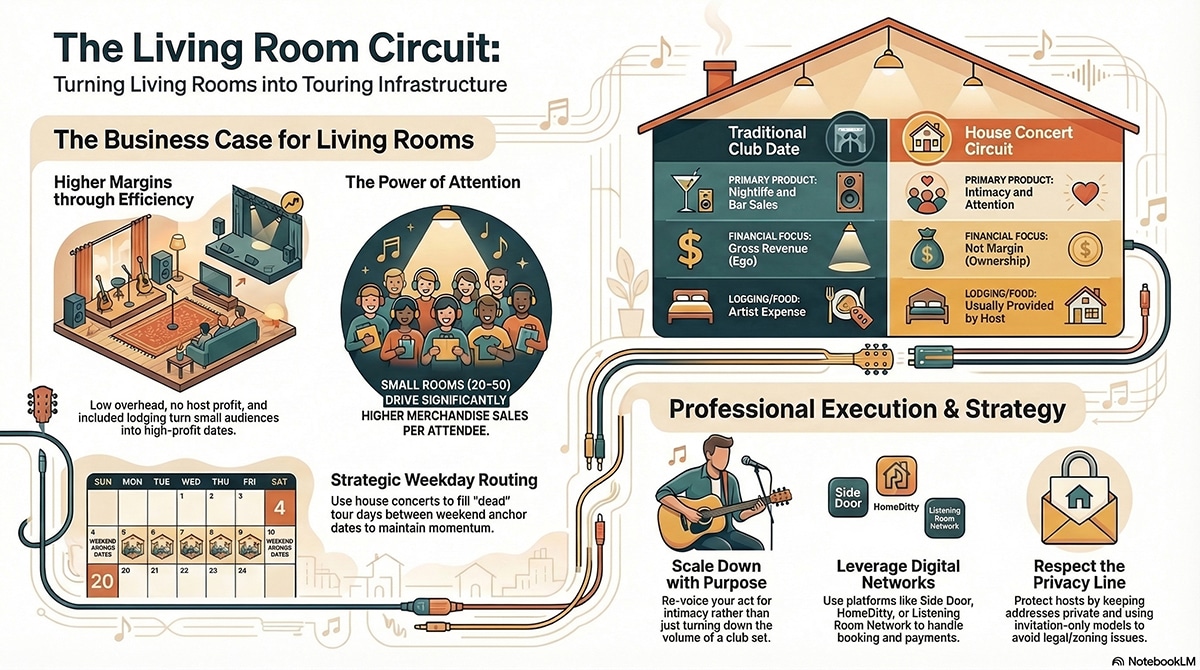
House Concerts as Weekday Routing Gigs
Now we get to one of the most powerful uses of the format.
A house concert is not only a destination date. It is one of the best routing tools an independent artist can have. It can turn dead calendar space into useful, profitable motion.
Side Door’s own booking guidance frames the issue this way: you start with one anchor date and then ask how to fill the rest of the route. It explicitly positions homes and other unconventional spaces as a way to stack dates around an existing tour plan. SofaConcerts says artists can use its platform to fill free days on tour. That is not a side note. That is the whole touring hack.
Think about the standard run. You have a Friday club date in one city and a Sunday festival in another. Saturday might take care of itself. Thursday often does not. Monday definitely does not. Those are the days that drain money. Those are the miles that turn a promising run into a red-ink loop.
A house concert can fix that because it lowers the break-even point. You do not need a room full of random walk-ins and bar sales. You need a host who can gather an attentive circle, a format that fits the room, and a revenue plan that includes merch and low lodging cost. Concerts In Your Home makes the math plain: no overhead, little promotion cost, better merch, and often free lodging. That is exactly why a Thursday or Monday living-room date can be worth more than a “bigger” room that pays badly and leaves you in a motel by midnight.
This is also where house concerts become market-building tools. A good weekday house concert does not just pay for itself. It seeds a town. It gives you a warm pocket of listeners. It creates photos, testimonials, host referrals, and an email cluster in a city that may someday support a club date, a workshop, a songwriter round, a backyard series, or a fan-funded return.
The dead night is not dead anymore. It becomes the night your route gets smarter.
How Bands Scale Down Without Gutting the Show
This part matters because bands often either overcompensate or under-prepare.
A house concert is not your regular set minus stage volume. It is a re-voiced version of your act. If you do it right, people will not hear what is missing. They will hear what was always strong in the songs.
Listening Room Network’s warning about full bands and HomeDitty’s guidance about stripping down for the room both point to the same truth: the format favors control, dynamics, and clarity.
For a band, scaling down usually starts with deciding what the song actually needs. Not what the club version uses. What the song needs. Maybe the backbeat can live in a stomp box, cajon, or shaker. Maybe the bass part can be simplified so the low end does not swallow the room. Maybe the electric player moves to acoustic or cleaner tones and plays fewer notes with better choices. Maybe the lead singer finally has enough space to let the lyric breathe.
You also need to change how you think about set flow. In a club, energy often comes from relentless motion. In a house concert, energy comes from contrast. The quiet song matters more because the room can hear it. The story matters more because people are close enough to catch the turn in your face. The harmony matters more because no one is shouting over it. This format rewards artists who trust silence.
And here is the hard truth: if your band cannot scale down, you do not yet have a house-concert show. You have a club show looking for smaller furniture.
The good news is that building this second format will often make the full band better too. When you strip back the arrangement and still make the song work, you learn what the song is made of. That is useful on every stage.
The Legal Line and the Privacy Line
House concerts feel casual, but they still need discipline.
Concerts In Your Home warns hosts not to pretend their homes are proper places for public events and says artists and hosts should be careful not to stretch the bounds of what counts as a private gathering. HomeDitty says house concerts in private homes can avoid performance-licensing requirements when they are by invitation only, while also making clear that nothing on the site is legal advice. Folk Alliance International’s PRO House Concert Agreement uses the same core rules: private home, invitation only, no public marketing with the address exposed.
The practical meaning is simple. Do not blast the address publicly. Do not treat the event like a public bar gig if the host is relying on the private-home model. Do not assume the rules are the same in every town. Do not confuse “intimate” with “sloppy.”
Concerts In Your Home also warns that when artists invite unknown people into a host’s home, there are real risks, including making the event feel public and bringing in unvetted strangers. Its advice is to be cautious and intentional. That is not paranoia. That is professionalism.
This is one reason some networks hide calendars or require memberships. Listening Room Network says many concerts in its system are private events and asks fans to join to access concert calendars. Privacy is not a bug in this world. It is part of the structure.
So if you are using house concerts, respect the culture that makes them possible. Protect the host. Protect the artist. Protect the room. A good living-room circuit runs on trust, and trust disappears fast when people start behaving like a residential address is just another venue listing.
How AI Can Help You Book More House Concerts Without Becoming a Robot
This is where artists can get real leverage.
You do not need AI to book house concerts. But if you are doing your own routing, your own outreach, your own follow-up, your own copy, and your own fan segmentation, AI can help you act like a small booking office instead of one exhausted human trying to answer emails from a van.
ChatGPT is built as a general-purpose AI assistant for exploring ideas, writing, and problem-solving. For an independent artist, that means you can use it to draft house-concert outreach, rewrite the same pitch for different regions, turn old fan notes into a host prospect list, build city-specific follow-up emails, create pre-show reminder language for hosts, and map out a route built around anchor dates and likely off-night opportunities. The trick is not to let AI replace your voice. The trick is to let it handle the repetitive first draft so you can spend your brain where it matters: fit, tone, and relationship.
This is one of those places where AI directly supports artist independence. It lowers the admin cost of booking. It helps solo operators work like small teams. It gives you more time to rehearse the stripped-down set, talk to hosts, and build the owned fan pipeline that actually pays later.
And that is the key. AI is not the business. It is the wrench. The business is still the room, the songs, the host, the fan, and the follow-up.
What Happens After the Show Is Where the Real Career Gets Built
A lot of artists treat the end of a house concert like the end of a gig. It is not. It is the start of the next market.
Concerts In Your Home repeatedly frames house concerts as community events that grow from invitation lists, referrals, and host involvement. Side Door frames the game as turning one gig into many by building from existing connections. Those two ideas together are the blueprint.
So after the show, you do the work that keeps the room alive.
You thank the host well. Not with a lazy group text. With a real note. You ask if they know two or three people in nearby towns who love live music and might be good fits. You invite attendees into your owned list. You make it easy for them to buy later, not just tonight. You leave the merch area neat, the room respected, and the relationship stronger than when you arrived.
You also take notes. Which songs landed in the room? Which stories worked? Did the stripped-down arrangement actually beat the full-band version? Who bought vinyl? Who talked about hosting? Which town is closer to the next anchor market than you first realized? House concerts are rich in signal if you are paying attention.
This is where the living room stops being a one-night event and becomes a route. One house becomes three. One town becomes a lane. One lane becomes a reliable touring spine. That is how independent careers get built when artists stop waiting for the larger system to bless them.
The Bigger Picture
The old music business taught artists to chase scale first. Bigger rooms. Bigger platforms. Bigger numbers. Bigger noise. But scale without ownership is just rented attention.
House concerts flip that logic. They start small on purpose. They force the artist to work close, sell direct, speak clearly, arrange honestly, and leave with something more durable than applause. They also create a touring economy that is much harder for gatekeepers to choke off, because it lives in people, not institutions.
That is why the house-concert circuit matters so much right now. It is not just charming. It is resilient. It is not just intimate. It is practical. It is not just for beginners. It is for any working artist smart enough to understand that a profitable Tuesday with thirty listening people can matter more than a flashy Friday where nobody remembers your name.
For solo artists and duos, house concerts can be a main lane. For bands, they can be an alternate format that fills routes, deepens markets, and reveals the strength of the songs underneath the production. For all of them, they can be part of a real business plan built on direct support, direct relationships, and better use of every mile.
And maybe that is the most radical thing about the whole format. In a world that keeps trying to push artists farther from the fan and closer to the platform, the house concert does the opposite. It brings the artist into the room. It brings the fan into the story. It brings the money closer to the work.
No gatekeeper. No algorithm. No borrowed crowd.
Just a room, a song, a host, and a business model that still makes sense.
 |  Spotify |  Deezer |  Breaker |
 Pocket Cast |  Radio Public |  Stitcher |  TuneIn |
 IHeart Radio |  Mixcloud |  PlayerFM |  Amazon |
 Jiosaavn |  Gaana |  Vurbl |  Audius |
 Reason.Fm | |||
Find our Podcasts on these outlets
Buy Us a Cup of Coffee!
Join the movement in supporting Making a Scene, the premier independent resource for both emerging musicians and the dedicated fans who champion them.
We showcase this vibrant community that celebrates the raw talent and creative spirit driving the music industry forward. From insightful articles and in-depth interviews to exclusive content and insider tips, Making a Scene empowers artists to thrive and fans to discover their next favorite sound.
Together, let’s amplify the voices of independent musicians and forge unforgettable connections through the power of music
Make a one-time donation
Make a monthly donation
Make a yearly donation
Buy us a cup of Coffee!
Or enter a custom amount
Your contribution is appreciated.
Your contribution is appreciated.
Your contribution is appreciated.
DonateDonate monthlyDonate yearlyYou can donate directly through Paypal!
Subscribe to Our Newsletter
Order the New Book From Making a Scene
Breaking Chains – Navigating the Decentralized Music Industry
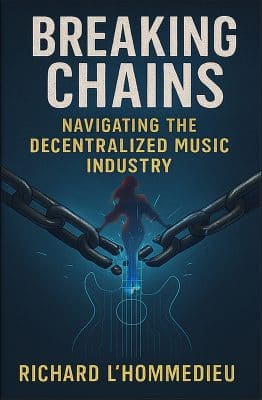
Breaking Chains is a groundbreaking guide for independent musicians ready to take control of their careers in the rapidly evolving world of decentralized music. From blockchain-powered royalties to NFTs, DAOs, and smart contracts, this book breaks down complex Web3 concepts into practical strategies that help artists earn more, connect directly with fans, and retain creative freedom. With real-world examples, platform recommendations, and step-by-step guidance, it empowers musicians to bypass traditional gatekeepers and build sustainable careers on their own terms.
More than just a tech manual, Breaking Chains explores the bigger picture—how decentralization can rebuild the music industry’s middle class, strengthen local economies, and transform fans into stakeholders in an artist’s journey. Whether you’re an emerging musician, a veteran indie artist, or a curious fan of the next music revolution, this book is your roadmap to the future of fair, transparent, and community-driven music.
Get your Limited Edition Signed and Numbered (Only 50 copies Available) Free Shipping Included
Discover more from Making A Scene!
Subscribe to get the latest posts sent to your email.


