

Tanasi




 Tanasi
Indidog Records
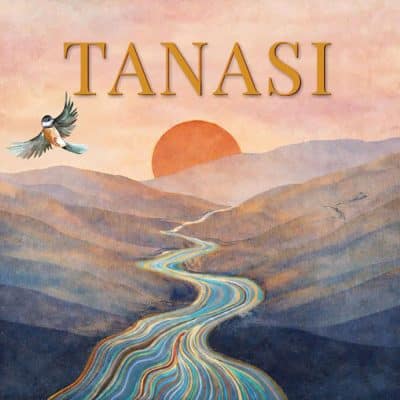
The name Tanasi was chosen to honor the people who have lived in the Appalachian Mountains for thousands of years. Principal Chief Hicks of the Eastern Band of Cherokee gave permission to use it, and we do so with deep gratitude. The roots of the music run deep through these creeks and hollers, coursing through the rhododendron (an evergreen or shrub having rounded clusters of showy pink, purple, or white flowers) and mountain laurel, filling the air alongside the songs of the white-breasted nuthatch (a small, short-tailed, sharp-beaked bird) and red-tailed hawk.
The Tanasi band includes Bill Cardine, dobro, chaturangui, pedal steel, and vocals; Mary Lucey, clawhammer banjo, bass, and vocals; and Anya Hinkle, guitar and vocals. Additional instrumentation is provided by fiddler Julian Pinelli and electric bassist Cody Wright.
“Mahalia/Let’s Hold On” is based on a melody written by South African slide guitarist Hannes Coetzee. Cardine and Lucey learned it directly from Hannes at a music camp in Port Townsend, Washington. Hannes left his village and came to the United States with South African singer, songwriter, playwright, and director David Kramer. With Hannes’ blessing, Lucey added lyrics and a complementary vocal melody, as Tanasi sings, “I have danced the night to an old cajun band, I watched the moon rise, over the black sand. And I know, yes I know, when the morning comes, you might be gone, and I know, yes I know, this night is ours, so let’s hold on,” with beautiful clawhammer banjo from Lucey, Cardine’s dobro, Wright’s electric bass, and harmony from the band.
“Get Up/Ore Mi Kini Se” is a traditional Yoruba chant adapted to Appalachian string band instruments, with words written by Hinkle and Lucey. The rhythm of the song invites everyone to get up and dance, as they chime, “Get up boy, get up, won’t you dance with me. Stay all night, stay, and let your troubles free. On our way, on our way, on our way, we’ll dance this day away.”
“Sweetest Breeze” is written by Steve McMurry, a founding member of the band Acoustic Syndicate, and carries the legacy of family farming in the hills of western North Carolina. Opening with Cardine’s dobro, it is based on a story about a man who had grown too old for hard labor and was reassigned as a cook. One of the girls wails, “Sometimes I’d like to cut down early, when the sweetest breeze is blowing, that ole summer season down, and the hard times come back from where only strong men can go and the dirty work’s all done here in town. I could…collect what pay I’m due me from the man, from the man…and follow you old river to my home.” This is another great lead vocal, followed by their fabulous harmony.
“The Fif” is an instrumental written by Cardine in 5/4 time. On Jimmy Cliff’s “Many Rivers to Cross,” Tanasi bursts out with another fine lead vocal: “Many rivers to cross but I can’t seem to find my way over, wandering I am lost, as I travel along the white cliffs of Dover…Many rivers to cross and it’s only my will that keeps me alive, I’ve been kicked, washed up for years, and I merely survive because of my pride,” with Pinelli on fiddle and Cardine’s dobro. After the damage wrought by Hurricane Helene, the song has taken on a special significance for residents of Asheville.
“Pickin’ in the Pines” once again features Lucey’s clawhammer banjo and the fiddle of Pinelli. It is a second instrumental written by Cardine while he was sitting in an aspen grove on a mountain overlooking Flagstaff, Arizona. “Lightning Flashing” is an adaptation of a popular Nepali song that Cardine and Lucey learned, as the harmony becomes the lead. In Nepali, everyone sings along with this song, urging the band to play it faster and faster. Inspired by the similarities with Appalachian melodies and grooves, the band arranged the traditional song, writing lyrics that imagine a young couple meeting secretly on Nepal’s high plateau.
“Rock the Cradle Joe/Ducks on the Millpond” is an instrumental medley of traditional Appalachian old-time tunes, highlighting Lucey’s clawhammer banjo, Hinkle’s guitar, and Cardine’s dobro as they stretch the edges of tradition while remaining firmly rooted in it.
The closer, “Give Me Love (Give Me Peace on Earth),” was written by George Harrison and is given a beautiful treatment. Harrison helped introduce classical Indian instruments into pop music, and Cardine plays the chaturangui, an Indian slide-guitar family instrument, as the band croons, “Give me love, give me love, give me peace on earth, give me light, give me life, keep me free from birth, give me jope, help me cope with this heavy load, trying to touch and reach you with heart and soul. Oh my lord, please take hold of my hand, so I might understand you, won’t you please, oh won’t you.”
Billy Cardine, Mary Lucey, and Anya Hinkle bonded over their love of exploring culture through music and their shared desire to hop on planes, trains, and any mode of road or water transport to get out and see their country and the wide, wonderful world. Together we celebrate the debut album from the band Tanasi.
Richard Ludmerer

Subscribe to Our Newsletter
Discover more from Making A Scene!
Subscribe to get the latest posts sent to your email.


