

Steve Howell, Dan Sumner, and Jason Weinheimer I Don’t Mind




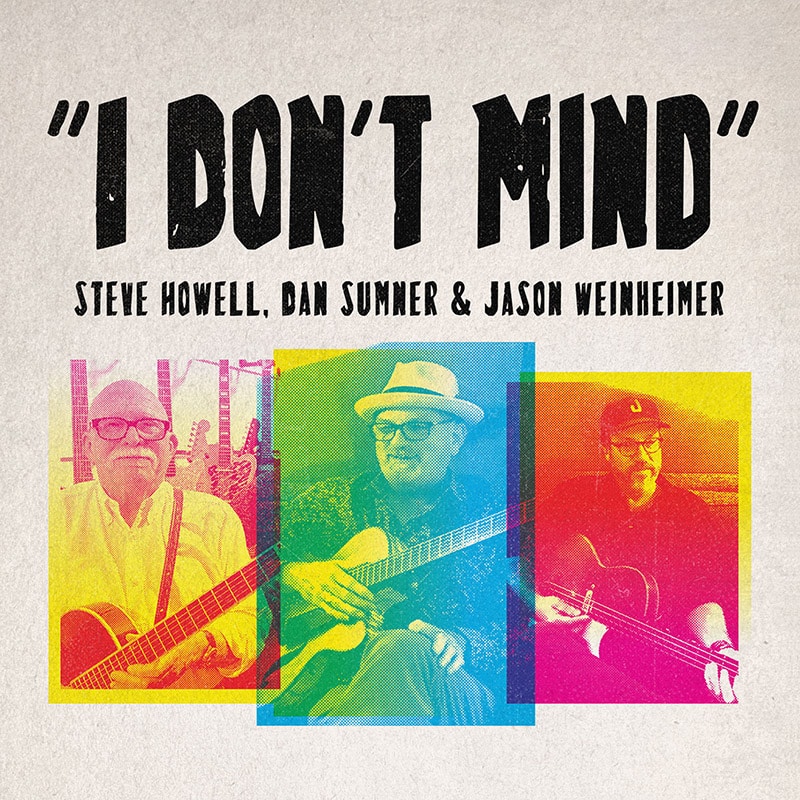
Steve Howell, Dan Sumner, and Jason Weinheimer
I Don’t Mind
Out Of The Past Music
Texas-born Steve Howell lives just outside of Shreveport, Louisiana. In 1965, at the age of thirteen, he first heard Mississippi John Hurt fingerpicking country blues, and the experience changed his life. From there, Howell immersed himself in the music of Blind Willie McTell, Leadbelly, Robert Johnson, Son House, the Rev. Gary Davis, and a host of other early acoustic blues guitarists and vocalists. Over the decades he has become a master interpreter of this rural Southern tradition, blending warm vocals and deft fingerpicking with a deep reverence for the songs themselves.
Howell recorded his debut album, Out of the Past, in 2006. His third album received a Historical Significance Award from the Academy of Texas Music, honoring his dedication to preserving the spirit and fidelity of early blues and folk recordings. I first discovered Howell with his fifth release, Friends Like Me (2010), credited to Steve Howell & the Mighty Men, featuring longtime collaborator Jason Weinheimer on bass. The partnership continued through several subsequent albums, including A Hundred Years from Today (2017), recorded as a duo; Good as I Been to You (2018), which again reunited the full band; and Know You from Old, with multi-instrumentalist Fats Kaplin. Weinheimer has also focused on recording and producing albums for other artists.
Dan Sumner is a Louisiana-based guitarist, arranger, and music producer. He is an internationally acclaimed artist who tours the world regularly with acts including Doug Duffey and BADD, Louisiana Soul Revival, Steve Howell, the Louis Romanos Quartet, and the LA Legacy Jazz Band. He owns and operates Fort Sumner Studio in Monroe, Louisiana, where he has recorded dozens of critically acclaimed albums. He has also co-written the book Snoozer Quinn: Fingerstyle Jazz Guitar Pioneer with Katy Hobgood Ray. I Don’t Mind is produced by bassist Weinheimer and features Howell on guitar and vocals and Sumner on guitar.
The album opens with “Choo Choo Ch’Boogie,” an R&B chart topper originally released by Louis Jordan & His Tympany Five in 1946. It is from the point of view of a guy returning home from the Second World War, as Howell sings, “Headin’ for the station with a pack on my back, I’m tired of transportation in the back of a hack, I love to hear the rhythm of the clickety-clack, and hear the lonesome whistle, see the smoke from the stack, and pal around with democratic fellas named Mac. So take me right back to the track, Jack.”
Howell states he first heard “The Fresno Shuffle” sung by Dave Van Ronk in 1971. He learned it from Erik Frandsen, its composer, a NYC guitarist, singer, songwriter, and actor. I saw Frandsen once in Greenwich Village playing under the name Blind Erik Flatpick.
“I Don’t Mind,” written by Duke Ellington and Billy Strayhorn, was recorded by Ellington and His Famous Orchestra in 1944; the song featured the great Joe Anderson on vocals. It was further popularized when it was brilliantly sung by Bob Dorough in 1957, as Howell chimes, “I don’t mind, I’ll take a chance, perhaps I’ll find some sweet romance, so stand a bit closer ’cause I don’t mind, I don’t mind the achin’ pain, though love is blind and so insane, so give me your hand, dear, ’cause I don’t mind.”
“Love for Sale” was written by Cole Porter for the 1930 Broadway show The New Yorkers. It was considered to be in bad taste and radio stations avoided playing it. Porter took it to the Cotton Club in Harlem, where it became a staple in the repertoire of Elisabeth Welch. Howell chants, “When the only sound in the empty street is the heavy tread of heavy feet that belong to a lonesome cop, I open shop. When the moon so long has been gazing down on the wayward ways of this wayward town, that her smile becomes a smirk, I go to work. Love for sale, appetizing young love for sale, love that’s fresh and still unspoiled, love that’s only slightly soiled, love for sale. Who wil buy? Who would like to sample my supply? Who’s prepared to pay the price, for a trip to paradise. Love for sale.”
“St. Louis Blues” was first published in 1914 by W.C. Handy and was one of the first blues songs to succeed as pop. The song has been called “the jazzman’s Hamlet” and was recorded by Bessie Smith with Louis Armstrong on cornet in 1925. It was inducted into the Grammy Hall of Fame in 1993. Howell belts, “I hate to see that evening sun go down, I hate to see that evening sun go down, ’cause my baby, he’s gone left this town. Feelin tomorrow like I feel today, if I’m feelin’ tomorrow like I feel today, I’ll pack my trunk and make my get-a-way. St. Louis woman with her diamond ring, pulls that man around by her, if it weren’t for her and her, that man I love would have gone nowhere, nowhere. I got the St. Louis blues, blues as I can be, that man’s got a heart like a rock cast in the sea, or else he wouldn’t have gone so far from me.”
“Hummin’ to Myself,” written by Herb Magidson, Monty Siegel, and Sammy Fain, was sung by Connee Boswell in 1932 with the Dorsey Brothers. It was also performed in the 1933 short film Betty Boop’s Birthday Party. Great versions have been performed by Kay Starr, Linda Ronstadt, and Dan Hicks. Howell bursts, “I should sing of sweethearts, Bluebirds, and blue skies above, but how can I sing of sweethearts I got no-one to love. I’ve got the words, I’ve got the tune, I’ve even been rehearsin’ under the moon, but I got nobody to hear my song, I’m hummin’ to myself. I’ve got the place, I got the time, I got a lot of words that rhyme, but I got nobody to hear my song. So I’m hummin’ to myself.”
“In Walked Bud” was written by Thelonious Monk in 1947 in honor of his friend, the great jazz pianist Bud Powell, with lyrics added later by Jon Hendricks. The song is a contrafact of Irving Berlin’s “Blue Skies.” Hendricks’ lyrics refer to jazz musicians Dizzy Gillespie, Oscar Pettiford, Don Byas, Monk, and Powell, as Howell wails, “Dizzy, he was screamin’, next to O.P. who was beamin’, Monk was thumpin’. Suddenly in walked Bud, and then they got into somethin’. Oscar played a mean sax, Mr. Byas blew a mean axe, Monk was thumpin’. Suddenly in walked Bud, and then the joint started jumpin!”
“Don’t Get Around Much Anymore,” an instrumental originally titled “Never No Lament,” written by Duke Ellington, became a hit in 1940. Lyrics written by Bob Russell were added in 1942, as Howell moans, “When I’m not playing Solitaire, I take a book from the shelf, and what with programs on the air, I keep pretty much to myself. Missed the Saturday dance, heard they crowded the floor, couldn’t bear it without you. Don’t get around much anymore.”
“The Shadow of Your Smile,” written by Paul Francis Webster and Johnny Mandel, is from the 1965 film The Sandpiper. It won an Academy Award for Best Song in 1966. Notable versions have been recorded by Astrud Gilberto, Bill Evans, Wes Montgomery, and Oscar Peterson, as Howell plays it as an instrumental.
“Once in a While,” written by Bud Green and Michael Edwards in 1937, was a number one hit for Tommy Dorsey. It has been recorded by everyone from Louis Armstrong and Sarah Vaughan to Mose Allison and Fats Domino, as Howell groans, “Once in a while, will you try to give one little thought to me, though someone else may be nearer your heart? Once in a while, will you dream of the moments before we drifted apart? In love’s smoldering ember, one spark may remain, if love still can remember, that spark may burn again, I know that I’ll be contented with yesterday’s memory knowing that you think of me, once in a while.”
“It Don’t Mean a Thing (If It Ain’t Got That Swing)” was written by Duke Ellington in 1931, with lyrics by Irving Mills. The song was first sung by Ivie Anderson in 1932. Howell shouts, “What good is melody, what good is music, if it ain’t possessin’ something sweet? Nah, it ain’t the music, there’s something else that makes this tune complete. Yes, it don’t mean a thing, if it ain’t got that swing.”
The closer, “Out of Nowhere,” written by Edward Heyman and Johnny Green, was popularized by Bing Crosby in 1931. This great tune was also recorded by Charlie Parker, Art Tatum, Chet Baker, Don Byas, Stéphane Grappelli, and Django Reinhardt. It has become a true jazz standard, as Howell croons, “You came to me from out of nowhere, you took my heart and found it free, wonderful dreams, wonderful schemes from nowhere, make every hour as sweet as a flower to me. If you should go back to your nowhere, leaving me with just a memory, I’ll always wait for your return out of nowhere, hope you bring your love to me.”
Steve Howell is a man of many musical talents, but his secret power is time travel, scouring the past for music he loves in order to make it fresh again. Steve Howell has summoned the essence of classic American jazz into the grooves of I Don’t Mind, crafting an evocative session where musical memories come alive. It’s a masterful musician’s back-to-the-future journey, with its soundtrack of great music.
Richard Ludmerer

Subscribe to Our Newsletter
Discover more from Making A Scene!
Subscribe to get the latest posts sent to your email.


