Spotify is the Billboard, Not the Building




Making a Scene Presents – Spotify is the Billboard, Not the Building
Listen to the Podcast Discussion on Using Spotify as a billboard Not the Building
If you’re an indie artist in 2026, you don’t have a “marketing problem.” You have an ownership problem.
Most indie release plans still follow the same tired loop: post the Spotify link everywhere, chase saves, chase playlists, watch a bump happen, then start over next month. It feels like progress because the numbers move. But it’s not leverage, because you still can’t reach the people who listened unless Spotify decides you can.
Spotify isn’t evil. It’s just not your business partner.
It’s a discovery platform with incentives that favor keeping listeners inside the platform. Spotify for Artists gives you useful signals—like Age, Gender, Top Countries, and Top Cities—and Spotify literally frames those charts as a way to refine promotion and partnerships. That information is real and helpful. But the signals are not the relationship. They’re just radar.
And radar doesn’t pay the bills unless you build infrastructure that turns “someone listened” into “someone I can reach and serve directly.”
This is where Making a Scene draws the line in the sand: stop moving fans from artist to Spotify. Start moving fans from Spotify to artist. Use Spotify as top-of-funnel discovery, then bring people home to your website, your list, and your fan passport system so you can create direct revenue that doesn’t depend on a platform’s mood.
That’s how you build a music industry middle class: a world where more artists earn enough to keep going, because they own the relationship and the data.
Why Paying for Playlist Placement Breaks the Ownership Model
Let’s address the thing that gets indie artists into trouble—financially, strategically, and sometimes literally.
Paying for playlist placement is counter to owning your fan data, because it’s spending money to rent attention you don’t get to keep. Even in the “best case,” you buy a spike in streams and you still don’t get the listener’s email, phone number, or any permission-based way to contact them. You’re basically paying for foot traffic in a mall where you can’t collect receipts.
That’s not an investment in your business. It’s an investment in someone else’s funnel.
If you’re serious about owning fan data, your money has to go into the middle of your funnel—not the top. Your website. Your landing pages. Your email system. Your store. Your membership. Your fan passport. Those are assets that keep paying you back.
Playlist chasing is also a culture problem. It trains you to believe the “win” is getting into somebody else’s gate. The ownership model is the opposite: the win is building your own gate, then giving fans a reason to walk through it.
So the point isn’t “never be on playlists.” Discovery is fine. The point is don’t treat playlist placement—especially paid, pay-to-play placement—as your business plan. It’s the exact kind of rented-space thinking that keeps artists dependent.
What Spotify for Artists Actually Gives You and How to Use it
Spotify for Artists is useful when you treat it like a map instead of a paycheck.
Spotify’s own guidance points out that you can learn about listener demographics using Age, Gender, Top Countries, and Top Cities charts, and that this can help refine promotion or secure partnerships. That’s your clue. Spotify is telling you what it’s good for: signals that help you decide where to focus.
Your top cities are not trivia. They’re touring intelligence. They’re content targeting. They’re partnership targeting. They’re the early warning sign that you have a pocket of fans you should bring into your world before somebody else does.
Your sources of streams are also a clue. If most listens come from algorithmic playlists or radio, you’re being discovered by strangers. That means your job is to build a bridge that catches those strangers the moment they lean in. If most listens come from your profile or your own traffic, you already have an audience searching for you. Those people are easier to convert, and you should treat them like gold.
Spotify data won’t hand you the fan’s identity, and you should not try to “get around” that. Spotify’s Developer Policy is explicit: don’t email users unless they gave explicit consent, or you obtained their email and permission from somewhere other than Spotify. That’s not just rule talk. It’s the business reality: Spotify is set up to keep the fan relationship inside Spotify.
So your job is to build a clean, consent-based path that moves listeners into your owned systems.
The Reverse Funnel Mindset: Spotify Discovery, Artist Ownership
Traditional indie marketing sends fans away from the artist. Ownership marketing brings fans back.
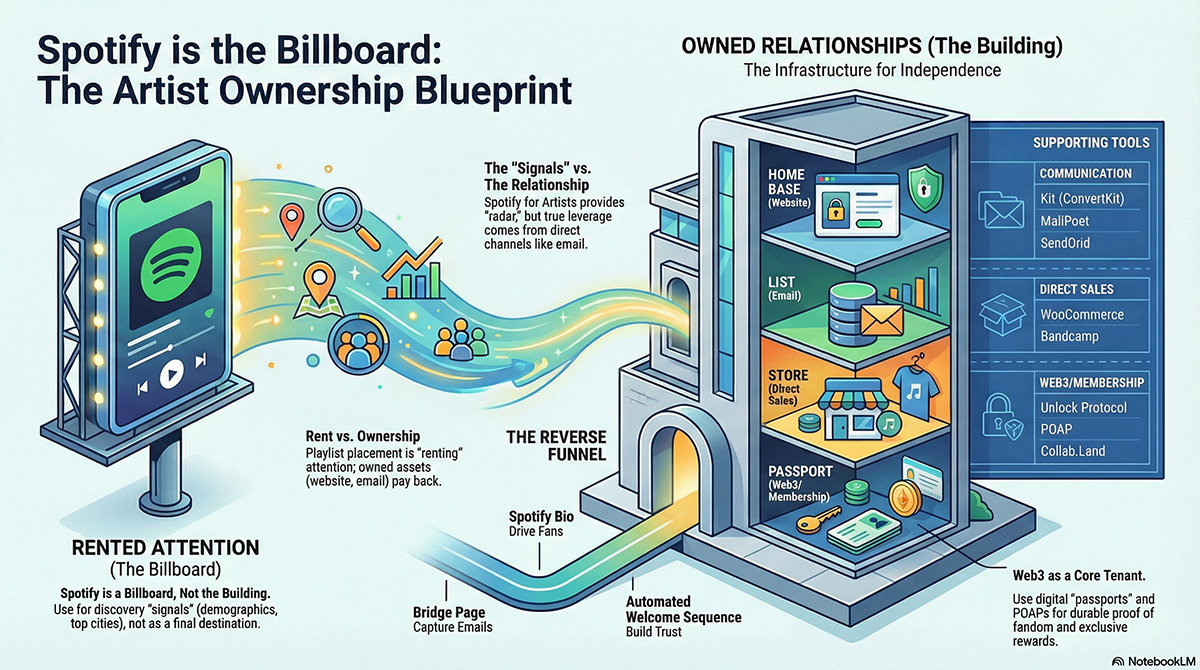
Instead of “go to Spotify,” your default becomes “come to my home base.” You still use Spotify, but you use it like a billboard on a highway: it creates awareness, then points people to a place you own.
The reverse funnel looks like this.
A listener discovers you on Spotify. They click your profile because they’re curious. Your Spotify bio link sends them to a bridge page you control. That bridge sends them to a campaign landing page with a clear offer. They opt in with email and, because Web3 is a core tenant in this model, they also have the option to claim a fan passport credential tied to real benefits. Then an automated welcome sequence turns that one-time listener into an ongoing relationship. From there, you guide them toward direct support: shows, merch, memberships, direct music purchases, fan-funded drops.
Spotify stays in the system, but it stops being the destination.
The Infrastructure Blueprint: Build Once, Use Forever
If you want to stop begging algorithms and start building leverage, you need infrastructure. Not complicated infrastructure. Just owned infrastructure that does the job every time.
At a minimum, you need a home base, a bridge, a list, a store, and a passport layer.
Your home base is your website on your domain. Platform-neutral is fine. WordPress is common because it’s flexible and widely supported, and if you’re building on WordPress, tools like MailPoet describe themselves as an email marketing plugin for WordPress that lets you send newsletters and automate marketing.
Your bridge is the single link you put everywhere, including your Spotify bio. It should guide fans toward one next step instead of dumping them into a messy link list.
Your list is your owned communication channel. Email is still the backbone because it’s portable and direct. If you want a creator-focused email platform, Kit (formerly ConvertKit) positions itself as a creator-first email marketing and newsletter platform built to grow your audience and automate campaigns. If you’re more technical or want a scalable marketing platform, Twilio SendGrid describes its Marketing Campaigns product as a platform to create, send, and optimize email marketing campaigns.
Your store is where direct revenue becomes normal again. If you’re WordPress-based, WooCommerce is described on WordPress.org as the open-source ecommerce platform for WordPress. If you want a music-native direct-sales hub, Bandcamp describes itself as a record store and community where fans directly support artists.
And because Web3 is a core tenant in this blueprint, your passport layer is not an afterthought. It’s where you build durable membership, proof, and rewards.
Unlock Protocol describes its smart contracts as tools to manage membership state, including expirations and renewals. POAP describes itself as Proof of Attendance Protocol and says it lets you mint “memories” as digital mementos called POAPs. Collab.Land documents token gating rules and role assignment based on token-related criteria, and notes that balance checks can remove roles when someone no longer holds the required token.
That stack is the engine of the middle class: discovery flows into ownership, ownership flows into direct revenue, and Web3 makes the relationship durable instead of fragile.
The Bridge Layer: Smart Links that Capture Permission
You do not “extract” fan data from Spotify. You build a bridge that makes fans willingly give you permission to contact them.
Smart link platforms exist for exactly this moment, because they can function as a universal “link in bio” for music while collecting email opt-ins when you configure them properly.
Linkfire’s help docs explain how to capture emails from Linkfire landing pages and even describe setting “Email sign-up” as a permanent feature in board settings. Linkfire also documents creating pre-release links and includes a step for exporting fan data.
Feature.fm documents an email collection feature that allows fans to sign up directly on a Smart Link or Pre-Save link, without requiring account connections to services like Spotify. Feature.fm also discusses looking at fan emails and exporting collected addresses as CSV.
This is the practical point: you’re not asking fans to do extra work. You’re giving them a clean path. Tap link, get something valuable, join the relationship.
The Offer Layer: What You Create So People Actually Opt In
If your opt-in offer is weak, your funnel dies. If your offer is strong, your entire business gets easier. Most artists try to capture emails with “join my newsletter.” That’s not an offer. That’s homework.
A Spotify listener is in lean-back mode. They’re not trying to join a marketing list. They’re trying to feel something. So your offer has to be connected to the feeling they just had. This is what “strong offer” looks like in an indie funnel.
It can be a private alternate version of the song they just heard. It can be a live session video recorded in a real room. It can be a behind-the-song story that gives the track emotional weight. It can be early ticket access. It can be a monthly drop that makes your world feel alive.
The key is that the deeper experience lives with you, not on the rented platform. You’re not “taking music away.” You’re adding depth that only exists inside the relationship. This is how you stop sending fans to rented space to experience your music. You make your own space the place where the better experience lives.
The Landing Page Layer: Your Conversion Page, Not Your Homepage
Your homepage is for browsing. Your campaign landing page is for conversion. The landing page should do one job: turn curiosity into permission.
That means it should be fast, simple, and emotionally aligned with the song that brought them there. It should promise one thing, and then deliver that thing immediately after the fan opts in. This is where indie artists accidentally sabotage themselves. They put up a giant biography, a bunch of press quotes, and a list of every link they’ve ever had. That’s not a landing page. That’s a museum.
A landing page is a door. A door should be easy to open.
If you’re WordPress-based, you can build campaign pages quickly and host your bonus content yourself. If you’re platform-neutral, you can still do the same with any page builder or website platform. The principle is ownership, not software.
The Welcome Sequence Layer: Turning a Listener into a Relationship
Most indie funnels fail because they capture the email and then go silent. Silence is expensive. Silence teaches a new subscriber that the relationship is not real. So you need a welcome sequence. A real one. Not one email. A short journey. The welcome sequence has one job: make the fan feel like joining was worth it, then show them what the next step looks like.
The first email delivers the bonus immediately. Trust first. The next emails deepen connection by giving context. Why you made the song. What you’re building. What kind of artist-fan relationship you want. Then you invite participation: reply with a city, vote on something, choose a setlist, pick a merch colorway. Participation turns passive subscribers into active fans.
This is also where you start building your owned data in a way Spotify will never give you. Spotify can tell you “Top Cities.” Your email list can tell you, “These 183 people live in Denver and they respond to me.” That’s not marketing fluff. That’s touring leverage.
And yes, there’s a business reason for all of this: the job of a musician is to perform, and touring is a core revenue stream for indie artists. When you know where real fans are and you can reach them directly, you don’t guess at routes. You don’t spray posts into the void. You build shows where support already exists.
The AI Layer: Turning Spotify Signals Into Weekly Actions
Spotify for Artists gives you signals. AI turns signals into decisions, fast. This is the rhythm that keeps the ownership machine running without burning you out.
Once a week, you look at Spotify for Artists and grab a small snapshot: your top cities, your top countries, which track is growing, and where discovery is coming from. Spotify emphasizes those audience charts as useful to refine promotion.
Then you use ChatGPT at https://chatgpt.com/ to translate that snapshot into an action plan built around moving listeners off Spotify and into your owned systems.
AI is great at turning “data fog” into plain-language marching orders. It can help you write localized content that speaks directly to your top cities. It can help you draft a landing page offer that matches the emotional tone of your most discovered track. It can help you write a welcome sequence that feels like a story instead of a corporate drip campaign.
This is the part artists need to hear clearly: AI is not the star. AI is the operations assistant. It helps you execute consistently so your funnel compounds.
And there’s one more important boundary.
Do not treat Spotify content or data like training material for an AI product or some kind of profiling engine. Spotify’s policies are explicit about permission and use, and they draw clear limits around how data can be used and how users can be contacted. Use AI on your own notes and your own aggregated summaries. Use it to write, plan, segment, and execute. Don’t turn Spotify into an ingestion pipeline.
The Web3 Layer: Fan Passports as a Core Tenant, Not a Novelty
This is where the ownership model gets teeth. Email is how you reach people. Web3 is how you build durable membership and proof of participation that platforms can’t take away. A fan passport system is simple in concept. Fans earn “stamps” by showing up, supporting, or participating. Those stamps unlock benefits. The fan feels seen, and their history with you becomes real.
POAP literally frames itself as a way to mint memories as digital mementos, and that’s a perfect match for live music. A show stamp can be a badge a fan collects. It can unlock early tickets next time you come through. It can unlock a private live recording. It can unlock a merch drop that’s only for people who were there.
Unlock Protocol is built for membership mechanics, including expirations and renewals. That’s how you build a supporter club that’s not trapped inside Patreon-style platform rules. You can create a membership key that renews monthly or annually, and you can attach real benefits to it: presales, discounts, private content, community access, meetups.
If your community lives on Discord, token gating tools like Collab.Land exist specifically to assign roles and access based on token-related criteria, with ongoing checks. If you want to make wallet connections easy, WalletConnect positions itself as an open-source protocol that securely connects wallets to apps and standardizes wallet-to-app communication.
Here’s why Web3 needs to be a core tenant if you’re serious about a middle class. Because Web3 is the difference between “fans who like you” and “fans who have a durable stake in your world.” It makes fandom portable. It makes membership provable. It lets you reward supporters without asking permission from a platform. And when you can consistently reward supporters, you stop relying on virality as a business model.
The Revenue Layer: Converting Ownership into Real Money
Let’s keep this grounded. Ownership is not a philosophy. Ownership is a path to revenue that goes directly to the artist.
The funnel should clearly lead to direct support options that match how fans actually behave.
For some fans, direct support is buying music and merch. Bandcamp explicitly frames itself around fans directly supporting artists. For others, it’s tickets and live experiences. For others, it’s a membership. For others, it’s a season pass model. For others, it’s licensing and sync, which tends to grow when your catalog is organized and your brand story is clear.
This is why the middle of the funnel matters. A stream doesn’t give you a way to offer a ticket. Your list does. A playlist add doesn’t give you a way to offer a membership. Your passport system does. A “viral moment” doesn’t automatically create a durable community. Your owned infrastructure does.
And here’s the most Billboard-level truth of all: the goal is not to “get bigger.” The goal is to get freer. To have enough direct revenue and direct reach that your career stops depending on gatekeepers.
Compliance and trust: u.s. plus international notes you can’t ignore
When you capture fan data, you’re handling something valuable and regulated: personal information. You don’t need to be scared of it, but you do need to respect it.
In the U.S., the FTC’s CAN-SPAM compliance guide states that commercial email must include a valid physical postal address. That’s one of those unsexy details that still matters, because getting “professional” isn’t about looking big—it’s about operating clean.
If you have EU/UK fans, consent standards are stricter. GDPR consent is commonly described as needing to be freely given, specific, informed, and unambiguous, given by a clear affirmative action.
If you have Canadian fans, the CRTC’s CASL FAQ summarizes requirements like obtaining consent, providing identification info, and including an unsubscribe mechanism.
The practical takeaway is simple: build your list on explicit opt-ins, keep your promises, and make it easy to unsubscribe. That isn’t “legal compliance.” That’s trust. And trust is the only thing that turns a casual listener into a supporter.
The Full System in Motion: A Real-world Example
Here’s what this looks like when it’s working, without the fantasy tech layer.
A listener discovers your track on Spotify radio. They like it enough to tap your profile. Your bio link points to a bridge page. That bridge offers a deeper experience tied to the song: an alternate take, a live video, or a behind-the-song story. They opt in with email and immediately get the content. Your welcome sequence begins and invites a reply: “What city are you in?” They reply. Now you have a real data point.
A month later, Spotify for Artists shows your top cities include Denver and Atlanta. You send a segmented email to people who said they live near those areas. You announce a small run of shows or even a single test show. You offer early access to supporters.
At the show, you run your fan passport. Fans scan a QR code to claim a POAP stamp as a proof-of-attendance collectible. Supporters who hold an Unlock membership key get a private aftershow stream the next week. Your community roles update via token gating so the “supporter” space stays real.
Now your relationship is not trapped in Spotify. Spotify still feeds discovery, but the support economy is happening in your owned world.
That’s the music industry middle class model in plain sight.
Closing: The Billboard Takeaway
Spotify is useful. It’s also rented space.
Spotify for Artists gives you signals—top cities, top countries, demographics—that can help refine promotion. But signals are not leverage unless you build infrastructure that converts them into owned relationships.
That’s why paying for playlist placement is so strategically backward in an ownership model. It’s paying to rent attention instead of building assets. It might inflate activity for a week, but it doesn’t build a list, it doesn’t build a community, and it doesn’t build direct revenue. It keeps you trapped at the top of the funnel while starving the part that makes you durable.
The indie artist middle class isn’t going to be “fixed” by streaming payouts, new playlist programs, or another round of platform promises. It gets built the old-fashioned way: by owning the relationship and making direct revenue normal again. Spotify as the billboard. Your site as the building. Email as the reach layer. Web3 as the membership and proof layer. AI as the operations engine that turns signals into weekly action. Direct revenue as the outcome.
That’s not a trend. That’s infrastructure. And infrastructure is what makes indie artists impossible to erase.
 |  Spotify |  Deezer |  Breaker |
 Pocket Cast |  Radio Public |  Stitcher |  TuneIn |
 IHeart Radio |  Mixcloud |  PlayerFM |  Amazon |
 Jiosaavn |  Gaana |  Vurbl |  Audius |
 Reason.Fm | |||
Find our Podcasts on these outlets
Buy Us a Cup of Coffee!
Join the movement in supporting Making a Scene, the premier independent resource for both emerging musicians and the dedicated fans who champion them.
We showcase this vibrant community that celebrates the raw talent and creative spirit driving the music industry forward. From insightful articles and in-depth interviews to exclusive content and insider tips, Making a Scene empowers artists to thrive and fans to discover their next favorite sound.
Together, let’s amplify the voices of independent musicians and forge unforgettable connections through the power of music
Make a one-time donation
Make a monthly donation
Make a yearly donation
Buy us a cup of Coffee!
Or enter a custom amount
Your contribution is appreciated.
Your contribution is appreciated.
Your contribution is appreciated.
DonateDonate monthlyDonate yearlyYou can donate directly through Paypal!
Subscribe to Our Newsletter
Order the New Book From Making a Scene
Breaking Chains – Navigating the Decentralized Music Industry
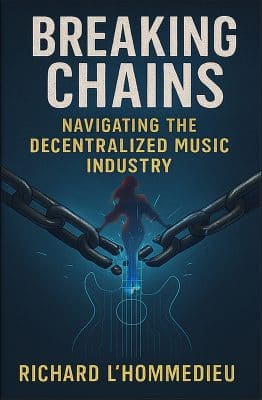
Breaking Chains is a groundbreaking guide for independent musicians ready to take control of their careers in the rapidly evolving world of decentralized music. From blockchain-powered royalties to NFTs, DAOs, and smart contracts, this book breaks down complex Web3 concepts into practical strategies that help artists earn more, connect directly with fans, and retain creative freedom. With real-world examples, platform recommendations, and step-by-step guidance, it empowers musicians to bypass traditional gatekeepers and build sustainable careers on their own terms.
More than just a tech manual, Breaking Chains explores the bigger picture—how decentralization can rebuild the music industry’s middle class, strengthen local economies, and transform fans into stakeholders in an artist’s journey. Whether you’re an emerging musician, a veteran indie artist, or a curious fan of the next music revolution, this book is your roadmap to the future of fair, transparent, and community-driven music.
Get your Limited Edition Signed and Numbered (Only 50 copies Available) Free Shipping Included
Discover more from Making A Scene!
Subscribe to get the latest posts sent to your email.


