Rick Roe Wake Up Call




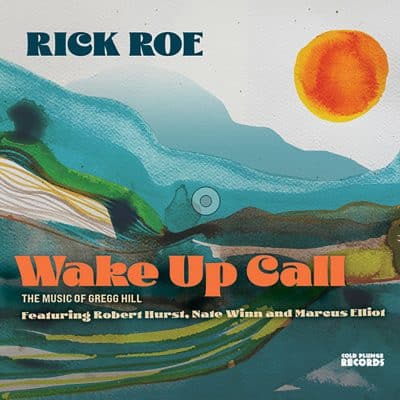 Rick Roe
Wake Up Call
Cold Plunge Music
Pianist, arranger, and bandleader Rick Roe’s Wake Up Call marks the 19th time the subtitle of “The Music of Gregg Hill” has appeared on an album in the last decade. The 79-year-old Hill has become a Duke Ellington or Wayne Shorter in terms of stature as a composer to several Detroit and southeast Michigan-based musicians, including Michael Dease, Rodney Whitaker, Randy Napoleon, and Roe. While Roe is the least recognized of the four, this is his second album of Hill’s music, following 2024’s Tribute: The Music of Gregg Hill, also on these pages. Roe has also contributed to albums from both Whitaker and Napoleon featuring Hill’s music.
Roe, 59, has never achieved much national attention despite an enviable resume. He was a two-time semifinalist in the Thelonious Monk International Jazz Piano Competition and won the 1994 Great American Jazz Piano Competition. Besides accompanying Napoleon and Whitaker, he has played with luminaries such as Wynton Marsalis, Frank Foster, Greg Hutchinson, Karriem Riggins, and more. Here, Roe leads a quartet comprised of widely acclaimed and versatile bassist Robert Hurst, drummer Nate Winn, and saxophonist Marcus Elliot, the latter two of a younger generation, a group that embodies Detroit’s jazz tradition.
Some of these pieces have appeared on other recordings of Hill’s music but have taken new shapes due to Roe’s arrangements. The best example is the title track, conceived by Hill as a fast swinger, a lobby call for touring musicians with stop-and-go rhythms and an 8-bar bridge, as recorded by Michael Dease on The Other Shoe. Roe heard the staccato, Monk-like theme differently. He slowed the tempo significantly and introduced a nuevo tango-like beat. He extended the A section to 8 bars, tweaked the melody, and invented a new harmonic scheme while preserving the original ABB form. Here, the soloists also have more freedom. Elliot basks in it.
As Detroit jazz expert Mark Stryker points out in the liners, Roe’s arrangements are like a first-rate literary editor making changes within the author’s voice. “Sunspiration” is one of Hill’s most infectious melodies, rendered in a waltz form. Roe devised an introduction where there was none, playing with Hill’s rhythmic hook. He raised the melody and harmony a whole step to better connect the new material with what comes before and after. Elliot thrives on soprano while Roe launches a bright piano solo. On other pieces, the changes are more subtle, such as the minor-key Latin tune, “La Cancion,” featuring Elliot on soprano.
Roe selected a wide variety of tunes within Hill’s catalog of 200. The opener, “Inside Straight,” is a slightly off-kilter 12-bar blues wherein Roe slightly altered the harmony. Elliot’s relaxed, forceful tenor struts mightily over Roe’s comping before yielding to the pianist’s buoyant, swinging solo, followed by Hurst’s steady turn as well as that of Winn on the eighths. Roe slows down and emphasizes blues again, making it another great vehicle for Elliot’s tenor in Hill’s light bossa “Wide River,” which appeared on Napoleon’s 2022 Puppets: The Music of Gregg Hill, on which Roe played. The burning “The Return of Mr. Pea” is a slight alteration to “Mr. Pea,” which appeared on Roe’s 2024 tribute to Hill. “Modal Yodal #2” also rambles rambunctiously in feverish post-bop form. The original, “Modal Yodel,” appeared on 2020’s Portrait of an Artist: The Music of Gregg Hill by the Ben Rosenblum Trio. It features whirlwind activity on the kit from drummer Winn.
The Monk-like (“Well You Needn’t” comes to mind), “The Ringer” stays true to Hill’s concept of marrying a 5/4 introduction to set up a tune in ¾. Hurst drives this one hard, another up-tempo heater, which originally appeared on Whitaker’s 2019 Common Ground: The Music of Gregg Hill. “Hyperbarity” is that rare Hill composition that has no reference points in other recordings. Eliot soars on soprano here in double time. Similarly, it’s difficult to find a previous rendering of the closer, “Double Play,” a swinging blues that features outstanding arco work from Hurst in a joyous, bouncy vibe.
You won’t find any ballads here, but an album that swings nicely in a rather relaxed way, shy of any showboating. Roe’s selections from Hill are mostly steeped in blues and angular forms that recall Monk or twists on post-bop in this lively session.
- Jim Hynes

Subscribe to Our Newsletter
Discover more from Making A Scene!
Subscribe to get the latest posts sent to your email.


