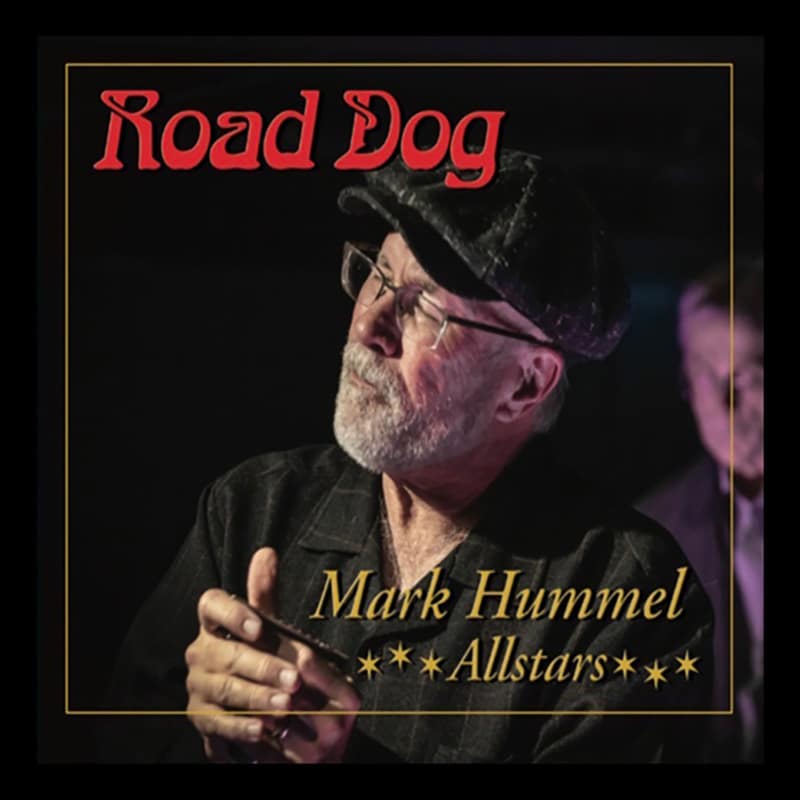
Mark Hummel Road Dog




Mark Hummel
Road Dog
Rocinitis Records
Mark Hummel was born in New Haven, Connecticut, in 1955, but his family relocated to Los Angeles soon after. While in high school, he studied the music of Muddy Waters, Little Walter, and Sonny Boy Williamson. He frequented the Ash Grove, an L.A. nightclub, where he witnessed Sonny Terry, James Cotton, and Charlie Musselwhite. Hummel formed his band the Blues Survivors in 1980 and released his debut recording as a bandleader in 1985. Hummel has the tone, passion, and commitment to front any blues aggregation. He is both a student and a teacher, as you only have to listen to learn. His Blues Harmonica Blowout Revue continues to tour the country. This is Hummel’s 24th recording in his own name. He also appears on numerous anthologies, including the Grammy-nominated Remembering Little Walter, which he produced and for which Hummel won two Blues Music Awards: Album of the Year and Traditional Blues Album of the Year. Overall, Hummel has eleven BMA nominations. His last album was 2024’s True Believer. This album was engineered by Kid Andersen and recorded at Andersen’s Greaseland Studios in San Jose, California, except for “Gypsy in My Soul” and “Gadjo’s Swing,” recorded at Jim Day Studios in Pacifica, California. It’s Hummel’s harmonica and vocals that are heard on all tracks.
Mark Hummel’s All-Stars include Anson Funderburgh, whose musical journey began when he was eight years old. Funderburgh received his first guitar and a box of 45s by artists Jimmy Reed, T-Bone Walker, B.B. King, Albert Collins, and Freddie King — singles that pointed him on his musical path. In 1978, he formed the iconic blues band Anson Funderburgh and the Rockets. Funderburgh has played with the biggest names in the blues. His unmistakable style, tone, and sensibility have made him one of contemporary blues music’s most important guitar players. Today, Funderburgh is widely regarded as a legacy artist whose influence on generations of blues guitarists is immeasurable.
Another All-Star, Junior Watson, is widely regarded as one of the premier architects of the West Coast blues guitar sound. A first-call session musician and acclaimed solo artist, he has appeared on more than 200 recordings and has performed with blues legends Charlie Musselwhite, Kim Wilson, William Clarke, Rod Piazza, Jimmy Rogers, Canned Heat, and many others. His unmistakable tone, swing, and tasteful playing have made him one of the most respected guitarists in modern blues.
The band is completed by bassist Kedar Roy and drummer Wes Starr, both of whom have previously played with Funderburgh, Watson, and Hummel. RW Grisby sits in on bass on three tracks. On eight of the tracks, Bob Welsh is on piano, while Brett Brandstatt and Chris Burns each play on one. On four tracks, Eric Spaulding is the featured saxophone player. Other guitarists include Little Charlie Baty, Rusty Zinn, and Randy Rattray. Six of the fourteen songs are Hummel originals, while eight are carefully selected covers.
The album opens with “Black Nights,” written by Fats Washington in 1965 and first recorded by Lowell Fulsom on Kent Records. Hummel sings, “It used to be, I could call, you were mine alone but now I see, you wanna be left on your own. You must have someone new, to make me go through black nights,” with some great piano from Welsh, guitar from both Funderburgh and Watson, and harmonica from Hummel.
“Jugglin'” is the first of the Hummel originals, as he chimes, “I love the music I make, the guys I play with rock, makes no difference if it’s empty or a line around the block. That’s why I’m juggling. Juggling my blues away…you know I work so damn hard but I still got more dues to pay.”
On another original, “Real Good Woman,” Hummel chants, “A real good woman is worth more than money can buy, real good woman worth more than money can buy, to keep a real good woman you got to treat her right…I don’t need no woman to rule my world, just a real sexy mama to keep my toes curled…a real good woman is worth more than money can buy, to keep a real good woman, you got to treat her right.”
“I Got to Find My Baby” was written by Peter Joe Clayton in 1941 and popularized by Chuck Berry in 1960. Hummel groans, “I’ve got to find my baby, I declare I wouldn’t lie, I ain’t had no real good love since my gal said goodbye. I searched this town from door to door. The love that I craved I can’t find no more.”
“Why Did It Happen” was written by Willie Mabon and released in 1962. Hummel moans, “I know you said that you wanted to be free. It was a shock when you said those words to me. Still I wonder why did it happen to me…I know it looks rough for me picking cigarettes off the ground, my heart is full of sorrow, all I can do is weep and moan, that’s why I’m begging you to come back home…still I wonder what’s gonna happen to me,” with some great saxophone from Spaulding.
On the title track, “Road Dog,” written by Hummel, he wails, “Been down many lonely byways, interstates and country roads. Looking out my windshield, thinking about my heavy load. When a road dog starts to barkin’, he packs his bag and out he goes, when he leaves this town, you know he might be back no more.”
“You Better Watch Yourself” was written and recorded by Little Walter Jacobs in 1954. Hummel howls, “You better watch yourself, you better watch yourself…’cause I got my eyes on you…you may steal my love and go away but don’t tell me you’ll see me another day, you better watch yourself, you better watch yourself, you better watch yourself, ’cause I got my eyes on you.”
On “Rockin’ Blues,” written by Johnny Otis in 1950, Hummel cries, “I’m sitting here rocking, I’m trying to rock my blues away, my baby left town last night and people I just got the news today, well sometimes I’m happy and gay, but right now I don’t feel that way. My baby left town last night and people I just got the news today.”
“Say You Will” is another original from Hummel, as he shouts, “Why did you say I do, when you meant to say you don’t, when you said you will, you meant to say I won’t. Treat me right baby, I’ll work hard day and night…treat me wrong baby, you can see me walk away.”
On “Gypsy in My Soul,” written by Van Morrison in 2005, Hummel chirps, “It’s just the gypsy in my soul, made me pack up my things and go. It may seem like I’m on a roll, but it’s just the gypsy in my soul, sometimes it seems like I just keep movin’ and movin’, seems like sometimes I ain’t got any goal, but it’s just the gypsy in my soul.”
“You Are Right” is another original by Hummel, as he bursts, “You fix everything even fix my car, when it broke down, I wouldn’t get far if she weren’t around, you right, I’m wrong, just to thank you baby, I wrote this song…I can be sort of dense. You right, I’m wrong, I just want to thank you baby, that’s why I wrote this song.”
On “She’s My Baby,” written by Rice Miller, a.k.a. Sonny Boy Williamson II, in 1966, Hummel declares, “She’s my heart, pride and soul. She’s my heater when the world is cold, she’s my baby, she’s my baby, she’s my baby, and I don’t mean maybe.”
“When You’re Doin Alright” was written by Jimmy Reed in 1962. Hummel croons, “Don’t say nothing if you don’t know what your talking about…don’t be talking about your business, telling it to your friends, don’t be talking about your buisness, telling it to your friends. I’m gonna tell you right now, that’s when your trouble begins,” as Hummel hits those high notes.
“Gadjo’s Swing” is a Django Reinhardt–styled gypsy instrumental written by Hummel that closes out this fine album.
Hummel states, “Regarding this album, it was a sheer joy, as all the musicians here go back decades to different cross-configurations and bands. I recorded 2024’s True Believer with Watson, Welsh, Roy, and Wes. I recorded two Golden State Lone Star records in 2013 and 2015 that included Wes, Anson, and Charlie. The Anson/Junior combo made perfect sense as a continuation of a unique pairing. Kid Andersen’s Greaseland Studio was the site of all of these recordings since 2008, with spectacular results. I hope you enjoy Road Dog by the Mark Hummel All-Stars.”
Richard Ludmerer

Subscribe to Our Newsletter
Discover more from Making A Scene!
Subscribe to get the latest posts sent to your email.


