

Jim Kweskin A Songsters Journey




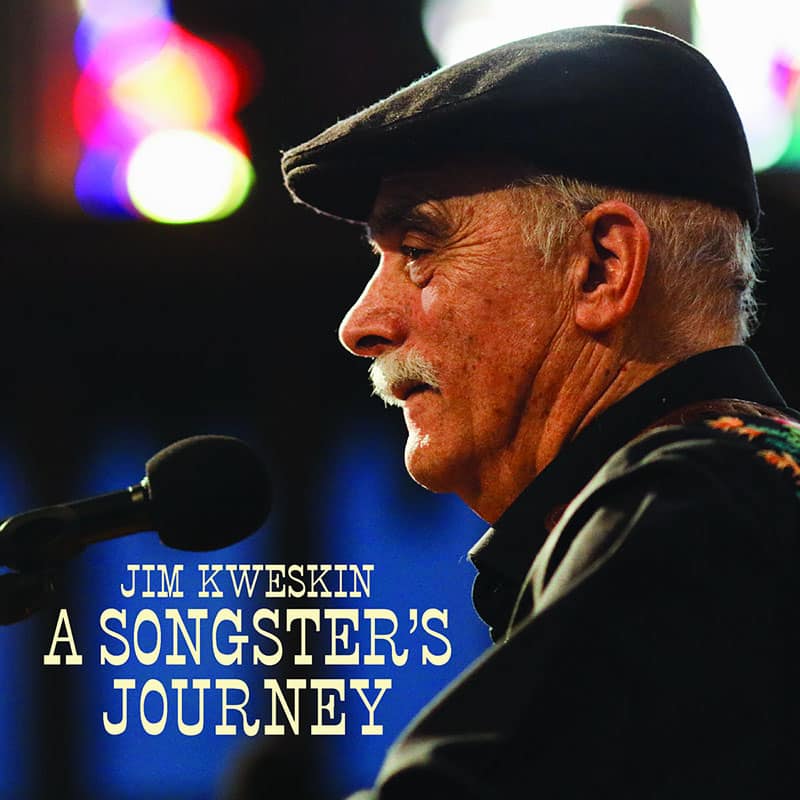
Jim Kweskin
A Songsters Journey
Jalopy Records
During the early 1960s there was a thriving folk music revival coming out of New York’s Greenwich Village. In 1963 the Even Dozen Jug Band released their album on Elektra Records. The music was fun, and among the band members were harmonica player John Sebastian and Maria D’Amato. The following summer, at the Berkshire Music Barn, I witnessed the Jim Kweskin Jug Band. Not only was I mesmerized by the guitar and vocals of Kweskin, but alongside D’Amato — now Maria Muldaur — were her husband Geoff, banjo picker extraordinaire Bill Keith playing pedal steel, and violinist Richard Greene. The 1965 album Jim Kweskin and the Jug Band: Jug Band Music on Vanguard Records delighted me with songs like “The Blues My Naughty Sweetie Gives to Me,” “Sadie Green, the Vamp of New Orleans,” and “Ukulele Lady.” Relishing each of Kweskin’s follow-up recordings, I was upset when they disbanded.
Kweskin continued to bring us old-time music. He teamed with Samoa Wilson to record 2003’s Now and Again and 2004’s Live the Life. With a voice comparable to Maria Muldaur’s, Wilson joined him on vintage folk, blues, and jazz, singing the songs of the Carter Family, Jimmie Rodgers, Bessie Smith, and many more collected by Harry Smith (no relation) in his Anthology of American Folk Music.
In 2018, co-producers Kweskin and Matthew Berlin decided to launch a new project with Samoa, settling on the 1930s jazz recordings of a then unknown Billie Holiday. At the time Holiday was the singer with pianist Teddy Wilson and His Orchestra, and many of Holiday’s elegant early songs are included. Among them are “I Wished on the Moon,” “I Cried for You,” “He Ain’t Got Rhythm,” “Me, Myself and I,” and wonderful versions of “Our Love Is Here to Stay” and “Until the Real Thing Comes Along.”
A “songster” is someone who distills tradition and passes a song on to a wider audience, thus growing its popularity. Early songsters include Leadbelly, Mississippi John Hurt, Mance Lipscomb, Jesse “Lone Cat” Fuller, and Big Bill Broonzy — legendary artists who sang songs across genres. More recent songsters include Maria Muldaur, Dave Van Ronk, Jorma Kaukonen, Taj Mahal, Dom Flemons, Geoff Muldaur, and Spider John Koerner.
Kweskin opens with “Would You Like to Play the Guitar.” He states that the melody is “Swinging on a Star,” a Bing Crosby hit from the movie Going My Way, which won the 1945 Academy Award for Best Song. New words were written and added by Pat Donohue, a guitar player and songwriter, as Kweskin sings, “Would you like to play the guitar? Take your money home in a jar. From a coffee house or a bar? Or would you rather get a job? Well, a job is the thing that makes you get out of bed, and work every day until you’re dead. Your back is aching and your brain is numb, and you just can’t wait until the weekends Ome, but if you don’t want to starve or beg or rob, you just might have to get a job.”
“Just Because” was written and credited to the Shelton Brothers in 1935, although the first recording was by Nelstone’s Hawaiians in the late 1920s. Kweskin chimes, “Just because you thin you’re so purty, just because you think you’re so hot. Just because you think you’ve got something, that nobody else has got. Though you make me soend all my money, then you laughed and called me old Santa Claus, but I’m tellin’ you honey, I’m leaving you. Because, just because.”
Kweskin states that “Dig My Grave” was learned from a series of Folkways records that came out in the late 1950s. Sam Charters, a musicologist, went down to the island of Andros in the Bahamas and discovered legendary guitarist Joseph Spence. The song was originally performed slowly, but Kweskin and Samoa Wilson added some rhythm.
“Mind Your Own Business” is a Hank Williams tune. The original verse mentioned someone singing on a party line, so Kweskin added an additional verse to update the song: “if the government is interested in what I do, they can tap my phones, hack my texts and emails too, so why don’t they mind their own business.”
“Chattanooga Choo Choo” was a massive hit for the Glenn Miller big band in 1941. This song is often credited as the first “gold record.” The arrangement includes the horns and drums combining to sound like a train.
Kweskin adds that he first learned “Doctor Jazz Stomp” from the classic original recording by Jelly Roll Morton’s Red Hot Peppers. Subsequently Kweskin heard a version by Woody Herman, and his additional verse is included here.
Additional highlights include “Bye Bye Blackbird,” with harmony from Kweskin’s granddaughter Fiona; “The Glory of Love,” written by Billy Hill in 1936, a hit for Benny Goodman and also recorded by Big Bill Broonzy; Lightnin’ Hopkins’ Texas blues “Needed Time”; and Willie Nelson’s “Still Not Dead.”
There are eighteen songs included overall. Kweskin likes to share the histories of the songs he plays. He concludes that he gets great joy in keeping these wonderful songs alive.
Richard Ludmerer