

Gregory Groover Jr. Old Knew




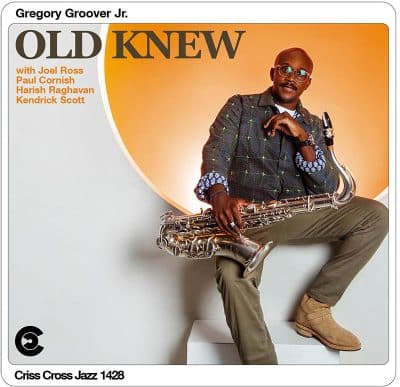
Gregory Groover Jr.
Old Knew
Criss Cross
Old Knew is the sophomore release from tenor saxophonist and composer Gregory Groover Jr. It is a follow-up to his 2024 Criss Cross debut, Lovabye, which somehow escaped my attention, which is rather odd considering the top-shelf cast he had aboard. Groover returns with a similar formidable lineup here, however, with vibraphonist Joel Ross again appearing, alongside his Blue Note label mates, pianist Paul Cornish and drummer Kendrick Scott. The bassist is acclaimed Harish Raghavan, who has often collaborated with the project’s producer, another Blue Note luminary, saxophonist Walter Smith III, who also produced this project. Both Smith and Groover are faculty members at Berklee College of Music, which is how they are connected.
Groover set out to make a record steeped in interaction, writing and/or arranging the pieces tailored to the tonal personalities of his bandmates, retaining the concept of the tenor and vibraphone as the front line as on the previous record. There was no rehearsal leading up to the session, although he did send the music in advance.
Given that both Groover, the namesake son of the pastor of Boston’s Charles Street A.M.E Church, and pianist Cornish’s background as a church pianist, the sound of the Black Church looms large. Groover’s syncopated, hard-edged short bursts result in a tone of agitation in the opener, “Spaces.” Groover says, “the noise in your head, the over-thinking, but also physical spaces that can create agitation or worry – and how to navigate and overcome the issue.” Cornish plays off-kilter chords, and Scott adds to the jittery mood, while the exchanges between Groover and Ross in the last section represent the cure. “551” is named for his father’s church, where Groover still plays. The piece is built on a series of chords, with Groover’s statements slightly more sustained but still retaining the jagged edges. Ross and Cornish follow suit accordingly in their own turns.
Scott pushes the momentum in “Go for Broke” with Groover and Ross in unison and then separately dancing sprightly around them. Ross has accumulated plenty of experience with Scott on the bandstand as both were part of Blue Note’s touring quintet for their 2024 85th Anniversary Tour, which led to two albums from the group, Out Of/Into. Their Motion II was just released. Lest we digress, “Rain Shall Fall” begins as a ballad but soon morphs to an alestic, swinging groove, over which Ross painterly delivers a ‘raindrop-like’ solo. Groover is firm and deliberate in his lines while Cornish’s counterpoints are curiously inventive. The melody becomes hypnotic before fading gorgeously. The quintet vigorously locks into Jason Moran’s “Retrograde,” inspired by Andrew Hill’s “Smokestack.” This standout track brings out the very best in these players, wave upon wave, as they inspire each other, all pushed forward by Scott’s agile kit work. Naturally, “Sumner,” named for Groover’s childhood street in Boston, is more relaxed, centered on Groover and Ross trading solos, while imbued by Raghavan’s rich bass tones and Scott’s deft brushwork.
“Good Sir,” arranged by Scott, is a tribute to both Groover’s father and Walter Smith, intentionally written in the latter’s heavily syncopated style. The rhythm is not keyed to the downbeat and moved forward by an eighth note to create an anticipation. Cornish delivers a gleaming solo here while Groover and Roos deliver their unison lines sublimely. “Juanita and Betty” is also a tribute, in this case, to Groover’s grandmothers. Groove delivers authoritative liquid runs, while Ross goes into animated overdrive. The trilogy of tributes concluded with “William and Vinson, honoring the leader’s grandfathers, one he never knew and the other only briefly. There’s a march-like rhythm over which Groover soars with his richly toned lines. Cornish channels shades of Geri Allen, while Ross mostly comps before soloing briefly before joining Groover on the melody as they take it out.
Groover began writing the multi-sectional title track in 2012, inspired by Ambrose Akinmusire’s first album. As you’d expect, it’s a piece that finds Groover in his most exploratory stance. “Arrivals,” a section excerpted from a nine-minute suite, closes. Groover and his bandmates make a forceful statement in a brief two minutes. An arrival can be awkward, but Groover senses the importance of making a strong first impression.
The album is rich in melody and harmonics across shifting moods. Groover, of course, can’t miss with this stellar lineup, but his confident manner shows that he can more than hold his own. He is an artist to keep on your radar.
- Jim Hynes

Subscribe to Our Newsletter
Discover more from Making A Scene!
Subscribe to get the latest posts sent to your email.


