Ella Fitzgerald Live at Falkoner Theatre Copenhagen 6th February 1966




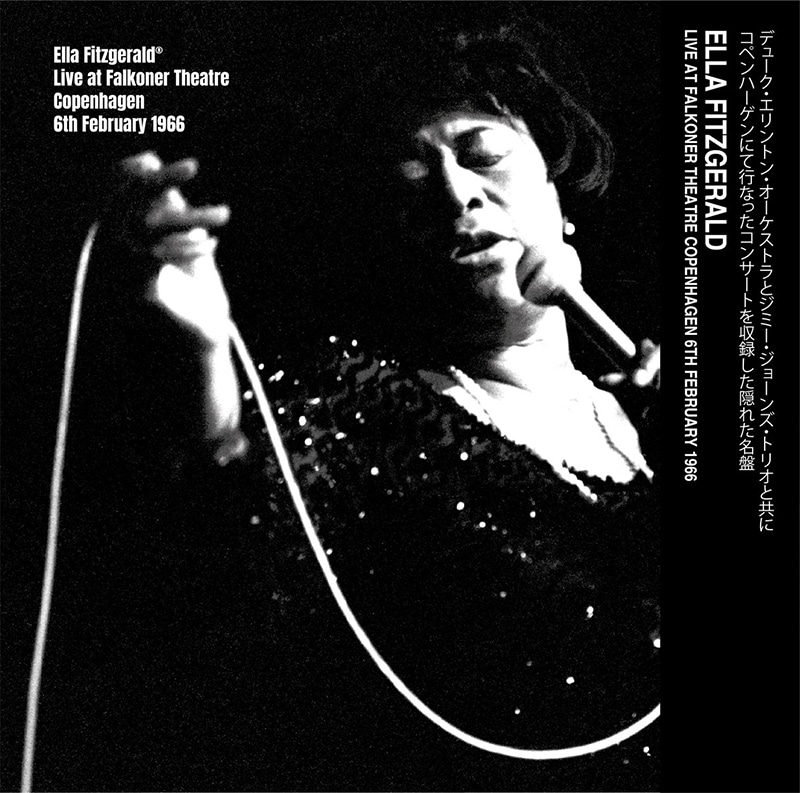
Ella Fitzgerald
Live at Falkoner Theatre Copenhagen 6th February 1966
Gearbox Records
Ella Jane Fitzgerald was born April 25, 1917, in Newport News, Virginia. She was an American jazz vocalist, songwriter, and composer, sometimes referred to as the “First Lady of Song.” She was noted for her purity of tone, impeccable diction, phrasing, timing, intonation, and a horn-like improvisational ability, particularly in her scat singing. After a tumultuous adolescence, Ella found stability in musical success with the Chick Webb Orchestra. Her rendition of the nursery rhyme “A-Tisket, A-Tasket” helped boost her and Webb to national fame. When Webb died in 1939, Ella took over the orchestra; she left it behind and started her solo career in 1942.
Ella’s manager was Moe Gale, co-founder of the Savoy, until she turned the rest of her career over to Norman Granz, who founded Verve Records to produce new records by her. Outside her solo career, Ella created music with Louis Armstrong, Duke Ellington, and the Ink Spots. These partnerships created songs such as “Dream a Little Dream of Me,” “Cheek to Cheek,” “Into Each Life Some Rain Must Fall,” and “It Don’t Mean a Thing (If It Ain’t Got That Swing).” In 1993, after a career of nearly sixty years, she gave her last public appearance. Three years later, Ella died at age 79. Her accolades include fourteen Grammy Awards.
Wondrously uninhibited and liberated from the added pressure of either a studio or a planned live recording, Ella is truly magical, sparkling with energy and with no lowering of intensity, on this never-before-released, unearthed gem recorded live at the Falkoner Theatre in Copenhagen on February 6, 1966. Denmark felt like home to Ella; it was a country where Black American jazz musicians found a degree of respect that the United States too often denied them. And now the results are released on record for the first time. Copenhagen meant a lot to her, as Ella had been performing there since 1952, returning regularly over the following ten years and recording an album there in 1961. In fact, Ella maintained an apartment in Klampenborg, on the coast north of the city.
The first seven tracks were recorded with Ella and the Duke Ellington Orchestra, which included director/arranger Jimmy Jones on piano; four trumpeters; six saxophonists, with two doubling on clarinet; two trombonists; Joe Comfort on double bass; and Gus Johnson on drums. The last three tracks were recorded earlier with the Jimmy Jones Trio, with Jones on piano and the rhythm section of Comfort and Johnson, joined by trumpeter Cootie Williams and clarinetist Jimmy Hamilton.
The concert opens with “Satin Doll,” an instrumental written by Duke Ellington and Billy Strayhorn in 1953, with lyrics added by Johnny Mercer in 1958. Ella sings, “Cigarette holder which wigs me over my shoulder, he digs me. Out cattin’ my satin doll. Baby, shall we go out steppin’, careful, amigo, you’re flippin’. Speaks Latin, that satin doll. He’s nobody’s fool so I’m playing it cool as can be. I’ll give it a whirl but I ain’t for no boy catching me, swich-e-rooney. Telephone numbers well you know, I’m doing my rumbas with uno, and that’s my satin doll…my, my that’s my satin doll.”
On 1959’s “Hey Little Girl,” written by Otis Blackwell and Bobby Stevenson, Ella chimes, “Hey, little girl in the high school sweater. Gee, but I’d like to know you better. Just a-swingin’ your books and chewin’ gum. Lookin’ just like a juicy plum. Hey, hey, hey, hey, hey, hey, hey, little girl. Hey, little girl in the black silk stockin’s. Gee, but you got my heart rockin’. A-wearin’ that crazy skin-tight skirt and that crazy Ivy League shirt. Hey, hey, hey, hey, hey, hey, hey, little girl. Hey, little girl, can I come along? Carry your books; and a-hold your arm? I’m hopin’ that you’ll tell me yes, because you’re the girl that I love best…Hey, hey, hey, little girl. Mm-mm.”
On “Something to Live For,” written by Billy Strayhorn in 1939, Ella chants, “I have almost ev’ry thing a human could desire, cars and houses, bear-skin rugs to lie before my fire. But there’s something missing, something isn’t there. It seems I’m never kissing the one whom I care for. I want something to live for. Someone to make my life an adventurous dream. Oh, what wouldn’t I give for, someone who’d take my life, and make it seem gay as they say it ought to be. Why can’t I have love like that brought to me? My eye is watching the noon crowds, searching the promenades seeking a clue, to the one who will someday be my something to live for…I want someone to live for.”
On Cole Porter’s 1928 Broadway hit “Let’s Do It, Let’s Fall in Love,” Ella declares, “Birds do it, bees do it, even educated fleas do it. Let’s do it, lets fall in love. In Spain, the best upper sets do it, Lithuanians and let’s do it. Let’s do it, let’s fall in love. The Dutch in old Amsterdam do it, not to mention the Finns. Folks in Siam do it. Think of Siamese twins. Some Argentines without means do it. People say in Boston even beans do it. Let’s do it. Let’s do it, let’s fall in love. Romantic sponges, they say, do it. Oysters down in Oyster Bay do it, Let’s do it, let’s fall in love. Cold Cape Cod claims, ‘gainst their wish, do it. Even lazy jellyfish do it. Let’s do it, let’s fall in love. Electric eels, I might add, do it. Though it shocks ’em, I know. Why ask if shad do it? Waiter, bring me shad roe. In shallow shoals, English soles do it. Goldfish in the privacy of bowls do it. Let’s do it, let’s fall in love…If 007, James Bond can do it, let’s do it, let’s fall in love.”
“Sweet Georgia Brown,” written by Ben Bernie, Maceo Pinkard, and Kenneth Casey in 1925 and first recorded by Ben Bernie and His Hotel Roosevelt Orchestra, features Ella as she belts out, “No girl made has got a shade on sweet Georgia Brown. Two left feet but, oh, so neat, has sweet Georgia Brown. They all sigh and wanna die for sweet Georgia Brown, I’ll tell you why. You know I don’t lie, not much. It’s been said she knocks ’em dead when she lands in town. Since she came, why, it’s a shame how she cools ’em down. Fellers she can’t get are fellers she ain’t met. Georgia named her, Georgia claimed her. Sweet Georgia Brown.”
On “How High the Moon,” written by Morgan Lewis and Nancy Hamilton in 1940, Ella cries, “Somewhere there’s music. How faint the tune. Somewhere there’s heaven. How high the moon. There is no love, when love is far away too, till it comes true, that you love me as I love you. Somewhere there’s heaven. How near, how far. Somewhere there’s music. It’s where you are. The darkest night would shine, if you would come to me soon. Until you will, how still my heart. How high the moon,” as she scat sings and morphs into “…it’s been a hard days night, and I’ve been working like a dog…I got plenty of something and something’s plenty for me…how high, high, high is the moon.”
“Lover Man (Oh, Where Can You Be?),” written by Jimmy Davis, Roger Ramirez, and James Sherman, finds Ella moaning, “I don’t know why, but I’m feeling so sad. I long to try something I’ve never had. Never had no kissin’, oh, what I’ve been missin’. Lover man, oh, where can you be? The night is cold and I’m so all alone. I’d give my soul just to call you my own. Got a moon above me, but no one to love me. Lover man, oh, where can you be? I’ve heard it said, that the thrill of romance can be, like a heavenly dream. I go to bed, with a prayer, that you’ll make love to me. Strange as it seems. Someday we’ll meet and you’ll dry all my tears, then whisper sweet little things in my ears. Huggin’ and a kissin’. Oh, what we’ve been missin’. Lover man, oh, where can you be?”
On “Só Danço Samba (Jazz ‘n’ Samba),” a bossa nova tune written by Antônio Carlos Jobim, Vinicius de Moraes, and Norman Gimbel and first recorded in 1962, Ella chirps, “Here she comes, here she comes. So danco samba, so danco samba, so danco samba, so danco samba. Yo do si yo twista que je mais. My no say me con se do calypso, cha cha cha. So danco samba, so danco samba, so danco samba, so danco samba. The jazz samba, the jazz samba. How it gets to you. The jazz samba, the jazz samba. Thrills you through and through. You get that feelin’ you start a’reelin’. That crazy beat, the way they play their tunes. The calypso beat can’t be beat, you’ll be hummin’ too. The jazz samba, the jazz samba. How it gets to you. Come on get with ’em and start that rhythm.”
“I’m Just a Lucky So-and-So” was written by Duke Ellington and Mack David in 1945. Ella wails, “As I walk down the street, seems everyone I meet, gives me a friendly hello. I guess, I’m just a lucky so and so. The birds in every tree, they are so neighborly, they sing wherever I go. I guess, I’m just a lucky so and so. If you should ask me the amount, in my bank account. I’d have to confess that I’m slippin’, but that don’t worry me, confidentially, I’ve got a dream that’s a pippin’. And when the day is through, each night I hurry home to where love waits, I know, oh babe. I guess, I’m just a lucky so and so.”
On the improvisational closer, “Mack the Knife,” written by Kurt Weill and Bertolt Brecht in 1928, with English lyrics by Marc Blitzstein, Ella croons, “Oh, the shark has pretty teeth, dear, and he shows them pearly white, j ust a jackknife has old Macheath, dear, and he keeps it out of sight. When the shark bites with his teeth, dear. Scarlet billows, scarlet billows start to spread. Fancy gloves, though, wears old Macheath, dear, so there’s not a trace, not a trace, not a trace of red. On the sidewalk on a Sunday morning, Ah, lies a body cozin’ life. Someone’s sneakin’ ’round the corner. Is that someone, someone, someone, someone, someone, Mack the Knife? Yeah, on a tugboat by the river, don’t you know. A cement bag drop, drop. drop, droppin’ down. The cement’s just, it’s just for the weight, dear. Bet you all Mackie, Mackie, Mackie’s back in town. Oh, Louie Miller disappeared, dear. After drawing out his honest cash, and Macheath, dear, he spends like a sailor. Did our boy do, boy do, do something rash?”
On July 24, 2026, London analogue specialists Gearbox Records will unearth yet another long-lost gem, having just announced the worldwide release of this rare, previously unreleased live recording of the legendary singer, songwriter, composer, and humanitarian Ella Fitzgerald. Ella remains one of the most influential voices in music history, but her legacy isn’t stuck in the past — it’s alive and constantly rediscovered. Her effortless range, improvisation, and iconic scat style shaped generations of artists. From jazz purists to modern producers sampling her work, her sound continues to ripple throughout our culture.
Richard Ludmerer

Subscribe to Our Newsletter
Discover more from Making A Scene!
Subscribe to get the latest posts sent to your email.


