Donna Herula Cold Feet




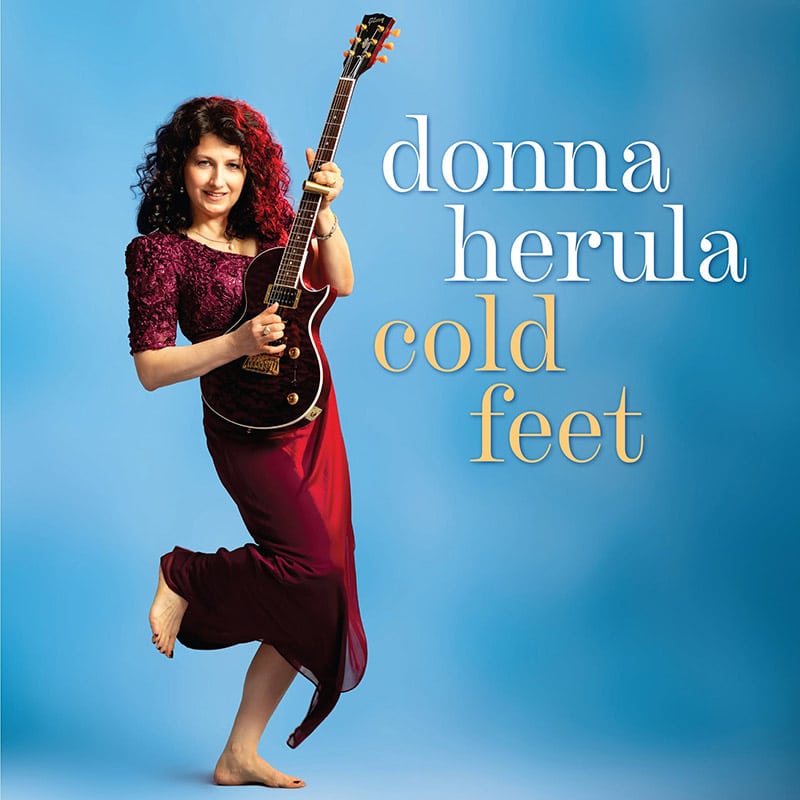
Donna Herula
Cold Feet
Independent
Donna Herula is, among other things, a Chicago-born blues singer, slide guitarist, songwriter, and Chicago Blues Hall of Fame inductee. Those “other things” include her award-winning 2021 release, Bang at the Door, which hit No. 1 on the 2021 Acoustic Blues Album Chart and was named Best Acoustic Blues Album by the 2022 Independent Blues Awards, where she was also named Best Traditional Blues Artist. The title song won Best AAA/Alternative Song in the 2022 International Acoustic Music Awards. She leads both the acoustic folk-blues Donna Herula Trio and the electric blues Donna Herula Band. Donna is also a blues fingerstyle and slide guitar teacher at the Old Town School of Folk Music in Chicago. Seven of the tracks were written by Donna, one co-written, and two are well-chosen covers.
Donna’s acoustic virtuosity is on full display with her National Tricone slide work on the elegant instrumental opener, with guitarists Tony Wittrock (providing harmony) and Jon Shain. Rick Barnes is on the shaker.
The title track, “Cold Feet,” features the six-piece electric band with Donna, slide guitar and lead vocals; guitarists Wittrock and Jon Shain; organist Alton Smith; bassist Marc Edelstein; and the Blues Music Award–winning drummer Kenny “Beedy Eyes” Smith. Backup vocalists include Kary Ream and Rebecca Toon. Barnes is on shakers and tambourine. Donna sings, “Church bells ringing, people waiting in the pews, should be walking down the isle, but now I feel confused. Last night he had to get someting off his chest, today I want to call it off, take off this wedding dress. The organ’s playing ‘Here comes the bride’, I’m backed in a corner, running out of time, I got cold feet, Cold Feet, I got cold feet, got a knot in my stomach, I’m grinding my teeth, I’m having second thoughts, I got cold feet…now, I’m thinking I could do a whole lot better, hey, I got cold feet.”
On “Honey Darlin’ Baby Please,” co-written with Wittrock, the electric band performs without Shain, as Donna chimes, “Honey darlin baby please. pick up your phone and talk to me, I know that I was wrong, three days have been too long, honey darlin’ baby please. I try and try and try and try, but I can’t make you satisfied, I know I hurt you so, never wanted you to go. Honey, please don’t say goodbye. I’m gonna give you all you need, ’cause you mean everythng to me, I’m gonna treat you right, love you every day and night. Could you, would you, won’t you please, open the door and talk to me, I know that’s it’s wrong to make you wait so long, won’t you please open the door and talk to me.”
“Cypress Grove Blues” is a cover of a song written by Nehemiah “Skip” James in 1931, with Wittrock on guitar, Edelstein on bass, and “Beedy Eyes” on drums. Donna chants, “I would rather be buried in some Cypress grove, than to have someone, mama, Lord, that I can’t control, and I’m going away now, I’m going away to stay…I would rather be down at six feet in my grave, than to be up here, and treated this way.”
On “Backseat Driver,” a road trip inspired the humor, with John Jochem on harmonica, as Donna moans, “Move to the left, move to the right, If you don’t shut your mouth we’re gonna get in a fight. The sign says ‘To Chicago’, ‘go west on 94’, he’s sitting in the back seat, spilling coffee on the floor. He said ‘You passed the exit’, ‘you better change your lane’, you should ‘a signaled sooner’, he’s driving me insane. Backseat driver, can’t stand the way you do, backseat driver…you’re on my nerves, don’t want to hear another word from you…I’m pulling over now, I’ll be a backseat driver for you.”
“What You Gonna Do?” includes soulful saxophone from Steve Eisen, with the full six-piece electric blues band, as Donna asks other-woman relationship questions: “I don’t wanna know the details, about who, what, where, or when, I just need to know it’s over, and it won’t happen again…I’ll wait and see what happens, you’ll have to decide, will it be me, will it be her, that’ll be left behind. What you gonna do? Who you gonna choose?”
“Wish I Could See You Again” is just the two of them, a gorgeous acoustic guitar duet with Jon Shain, and Donna’s longing vocal as she groans, “Poppies in the flowerpot, your coffee cup on the countertop, no tick tock, from that old front room clock, wish I could see you again…Memories are on display, graduation, wedding day, I’m packing all of them away, wish I could see you again.”
On “Things Can Change,” rich with gospel overtones, Alton Smith’s organ and Jochem’s harmonica, Donna’s commanding vocal, and backing vocal from Candy LaFlora paint a picture as they wail, “Things can change, no one know what’s gonna happen child, things can change. You’re having bad luck, bet on black instead of red, working overtime and you can’t get ahead. See the light in the lighthouse as your boat comes to shore. A long-lost friend that’s knocking at your door. A clear blue sky hidden by the storm, and arms to hold you when you scream, no, no, no more…only the lord knows what will happen child, things can change.”
“Float to Heaven” is a John Prine–styled story song about a man’s lifelong sense of blame for the tragic death of a teenage friend, featuring the five-piece electric band with Donna’s fingerstyle guitar and Anne Harris’ emotive violin, as Donna howls, “Some say Ed’s a reckless man, but he works hard with calloused hands. He’ll give anyone the shirt off his back, likes to go fishin’ in his White Sox cap. Had a union job, it didn’t work out, said the wrong thing, in a blackout, they gave him a chance, but he threw it away. It was too hard living with the shakes everyday. But tomorrow he’s gonna take his boat, down to the river and he’s gonna float to heaven, I’m going to float to heaven.”
On the rousing closer, “Dust My Broom,” written by Elmore James and Robert Johnson, with a four-piece electric band, Donna croons, “I’m going to get up in the mornin’, I believe I’ll dust my broom, girlfriend, the black man you been lovin, girlfriend, can’t get my room. I’m gonna write a letter, telephone everytown I know, if I can’t find her in West Helena, she must be in East Monroe. I don’t want no woman, wants every downtown man she meet, she’s a no good doney, they shouldn’t allow her on the street.”
Donna Herula states, “I am particularly proud of how I stretched myself artistically and vocally. I wrote songs in genres beyond acoustic blues, utilizing electric and acoustic styles while blending soul, pop, gospel, folk, and Chicago blues influences.” Donna Herula’s sophisticated production of Cold Feet steps easily through a stylish blend of songs and genres that kick her electric influences into one artistic delight. This is highly recommended listening.
Richard Ludmerer

Subscribe to Our Newsletter
Discover more from Making A Scene!
Subscribe to get the latest posts sent to your email.


