

Bob Stroger & The Headcutters Bob Is Back




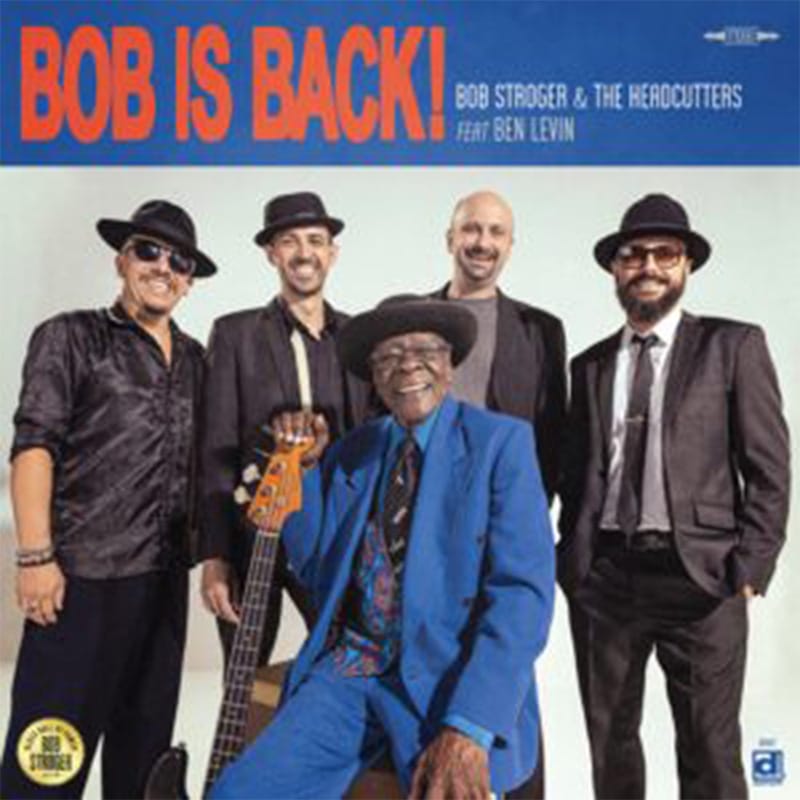
Bob Stroger & The Headcutters
Bob Is Back
Delmark Records
Bob Stroger was born on December 27, 1930, on a farm outside of Hayti, Missouri. In 1955, he relocated with his family to the West Side of Chicago, in an apartment in back of Silvio’s nightclub. Stroger was inspired by the sights and sounds from the club. He was further encouraged to try for a career in music after being employed driving his brother-in-law to play in a blues band with J.B. Hutto. A self-taught guitarist, Stroger formed a family-based band, the Red Tops. Willie Kent was drafted to boost their proficiency, and the combo was renamed Joe Russell (Stroger) and the Blues Hunters, but the name did not endure. Stroger went on to play jazz with Rufus Forman, but it was his meeting Eddie King which started his lengthy career playing blues. Stroger, having started playing bass guitar, played on King’s single “Love You Baby” in 1965. Stroger backed King for fifteen years, after which he took a hiatus from music.
Stroger’s interest was rekindled when he was recommended to Otis Rush, whom he backed up in the late ’70s and ’80s. He toured Europe with Rush and played on two of his albums, “Live in Europe” and “Lost in the Blues.” Stroger became a session musician and played with Sunnyland Slim and Mississippi Heat in the late ’80s and ’90s. He then joined Odie Payne in a rhythm section that played a series of American Blues Folk Festivals. Encouraged by Sunnyland Slim, Stroger began writing his own material. In 1996, Stroger played on Mark Hummel’s album “Heart of Chicago.” This led to the recording of his debut solo album on Crosscut Records, “In the House: Live at Lucerne, Vol. 1,” on which he was accompanied by Ken Saydak and Billy Flynn. In 2007 in Chicago, Stroger recorded “Bob Is Back in Town” on Airway Records, with guitarist Steve Freund, harmonica player Willie “Big Eyes” Smith, backing vocalist Deitra Farr, and baritone saxophonist Juli Wood. That same year, he backed up Carey Bell on his final recording and also played on Smith’s 2008 “Born in Arkansas” and Pinetop Perkins’ 2010 “Joined at the Hip.” In 2011, and again in 2013, Stroger won Blues Music Awards as “Best Blues Bassist”; overall, he has won that BMA five times. In 2022, Stroger recorded his Delmark debut album, “That’s My Name.” Stroger was named to the Blues Hall of Fame in 2025.
The band lineup includes Stroger on bass and vocals; guitarist Ricardo Maca; special guest pianist Ben Levin; harmonica ace Joe Marhofer; additional bassist Arthur Catuto; and drummer Leandro Cavera. This core band is heard repeatedly on all tracks. The backing vocalists on one track include Candice Ivory and Renee Gros. The album was produced by Bob Stroger and the Headcutters and was recorded by Ricardo Maca at the Grooveland Recording Studio in Itajaí, Brazil, in March 2023.
Included are seven carefully selected covers and five Stroger originals. The album opens with “Look Over Yonders Wall,” written by Elmore James and Marshall E. Sehorn and first recorded by Elmore James in 1961. On this new version, Stroger sings “Look on yonder’s wall and hand me down my walkin’ cane…I got me another woman, baby, yonder come your man…I love you baby, but you just don’t treat me right, spend all of my money and walk the streets all night…I got me another woman.”
On Muddy Waters’ 1978 “Champagne and Reefer,” which featured guitarist Bob Margolin and harmonica by James Cotton, now it’s Stroger who chimes “Yeah, bring me champagne when I’m thirsty, bring me reefer when I want to get high, well you know when I’m lonely, bring my woman, set her down, right here by my side.”
“Jazz Man Blues” is the first of the originals written by Stroger, as he chants “Jazz man is like going home,” with a bass solo from Stroger followed by a drum solo from Cavera.
On “Don’t You Lie To Me,” written by Hudson Whittaker, a.k.a. Tampa Red, in 1940, Stroger cries out “Let’s talk it over, baby, ‘fore we start, I hear about the way you overdo your part. Don’t you lie to me, it makes me mad and I get evil as a man can be,” with a call and response.
“My First Love” is another song by Stroger, as he moans “When I stand alone…I’m in love with you, baby, before I know your name.”
On 1998’s “Loan Me Train Fare,” written by Stroger, he tells his girlfriend “Come on and loan me train fare, don’t you loan me another dime…I will pay it back to you, when you’re trouble get like mine, well, I’m gonna wait, get you off my mind, well you keep me worried, bothered all the time.”
“Thinking And Drinking” is a song written by Rudy Toombs and recorded by Amos Milburn in 1952, as Stroger groans “When I’ve been thinkin’ and I’ve been drinking, and the more I think the more I drink, the more I drink the more I think, I can’t stop thinkin’ about what you did to me. Well, I’ve been walkin’ and I’ve been talkin’, and the more I walk, the more I talk, and the more I talk, the more I walk.”
On “Bob Is Back In Town,” written by Stroger in 2006, with guitarist Freund, harmonica player Smith, backing vocalist Farr, and baritone saxophonist Wood, Stroger wails “Hello baby, Bob is back in town…”
“Love You Baby” was written by Joe Brown and Edward Milton, as Stroger howls “Love you baby, all day long, hey, hey, hey…you did me wrong.” The instrumental title track, “Bob Is Back,” features great guitar, Hammond B-3, and bass from Stroger.
In 1973, “Gold Tailed Bird,” written by Jimmy Rogers, was produced and released with guitarist Freddie King, as Stroger bursts “till I’m back in Georgia, Mississippi too, you know I won’t be satisfied.”
On the closer, “Let The Good Times Roll,” written by Fleecie Moore Jordan, a.k.a. Louis Jordan, and Sam Theard, and recorded by Louis Armstrong and his Tympany Five in 1946, Stroger croons “Hey everybody, lets have some fun, you only live but once, and when you’re dead you’re done, so let the good times roll. Don’t care if you’re young or old, get together, let the good times roll.”
The Brazilian-based Headcutters have an old-school style, influenced by Muddy Waters, Little Walter, and Jimmy Rogers. They have backed American artists when they are on tour in Brazil, artists such as Billy Branch, Kim Wilson, and Mud Morganfield. At the time of this recording, Bob Stroger was 94 years old, and he still won the 2025 Living Blues Award for “Best New Album.” The release of this album aligns perfectly with Stroger’s induction into the Blues Hall of Fame. Congratulations go to Bob Stroger.
Richard Ludmerer
 |  Spotify |  Deezer |  Breaker |
 Pocket Cast |  Radio Public |  Stitcher |  TuneIn |
 IHeart Radio |  Mixcloud |  PlayerFM |  Amazon |
 Jiosaavn |  Gaana |  Vurbl |  Audius |
 Reason.Fm | |||
Find our Podcasts on these outlets

Subscribe to Our Newsletter
Discover more from Making A Scene!
Subscribe to get the latest posts sent to your email.


