Art Hirahara Peace Unknown




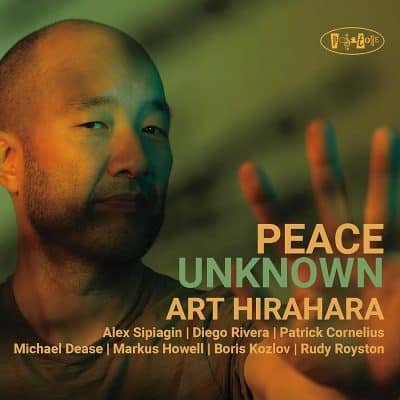 Art Hirahara
Peace Unknown
Posi-Tone
It’s not always the artist who generates the idea for the album. Sometimes it’s an event, a painting, or simply a memory. At other times, it could be a bandmate or, in this case, the producer who has the idea. If you read our last review on Something Blue, a collective celebrating Posi-Tone’s 30th anniversary, you have some understanding of how label head and producer Marc Free works. For pianist and composer Art Hirahara’s Peace Unknown, Free suggested an album of Hirahara originals, both old and new, rendered by a four-horn septet. Given the label’s mantra for swinging music, one would expect that from such an ensemble, yet most of these compositions are highly textured and richly harmonic, with just a few falling into the former camp.
The album was recorded during a busy week, so several musicians relieved Hirahara by contributing arrangements. Team spirit prevailed, which is not surprising given the many times these stalwarts of the label have collaborated on albums. They are Diego Rivera (tenor saxophone, two arrangements), Alex Sipiagin (trumpet and flugelhorn), Patrick Cornelius (alto saxophone on six tracks and one arrangement), with Markus Howell (on alto for two tracks where Cornelius was absent), Michael Dease (trombone), Boris Kozloz (bass, one arrangement), Rudy Royston (drums), and Misha Tsiganov (one arrangement).
It’s relatively uncommon to open with a ballad, but Hirahara’s title track from his 2011 Noble Path takes its inspiration from Italian composer Ennio Morricone’s soundtrack to the film Cinema Paradiso. The ensemble delivers a mournful lament for the Israeli-Palestinian conflict. Hirihara composed the piece in 2002. The situation has only worsened since, as conveyed by the blending of the four horns. Sipiagin’s flugelhorn blends so well with the saxophones in the dirge-like melody, a piece free of solos save the pianist, but plenty of improvisation around the theme.
Hirahara’s Monk-like lines introduce “Anomina,” an ode to all the unsung and anonymous supporters of improvised music. Dease is the featured soloist, playfully and ingeniously quoting melodies and eras. “Irons in the Fire” is a piece composed during the two-day recording session, the musicians (Howell on alto here) displaying their uncanny ability to sight-read on the spot, navigating through-composed forms not often found in jazz. These latter two pieces reveal an ensemble playing both ‘in’ and ‘out’ as opposed to the common perception of the label sticking solely to the straight-ahead.
We find the septet in big band swing mode with a bevy of hard-hitting solos on “The More Things Change,” originally appearing on Kozlov’s 2022 First Things First. Kozlov is the arranger, and the soloists step up in this order: Sipiagin (on trumpet), Rivera, Dease, Cornelius, and the leader. Rivera arranged the pensive ballad “Drawing With Light,” which first appeared on Hirahara’s 2017 Central Line, another great example of the blending of the horns with Sipiagain again on flugelhorn and Howell on alto. Hirahara wrote the piece for his photographer wife, a piece that is both intricate and elegant, highlighted by his effervescent piano solo. In a complete contrast of mood and tempo, “Brooklyn Express,” also arranged by Rivera, follows. It’s Hirahara’s figurative version of Elington’s “A Train. Aptly, like a train it too motors, driven by the tight bass-drum tandem of Kozlov and Royston with rambunctious solos from each horn as well as the pianist as the septet builds to an explosive climax.
The last three pieces all first appeared on Hirahara’s 2015 Libations and Meditations. Cornelius arranged and solos beautifully on “The Looking Glass,” an intriguing piece that captures the perils and temptations Alice faced in Lewis Carroll’s classic. Packed with dramatic passages, it too has a cinematic feel. The piece also has some of Hirahara’s most riveting piano and Royston’s exceptional kit work. Fellow pianist Tsiganov arranged Hirahara’s ode to his dad, “Father’s Song,” a meditative tune that highlights Sipiagin’s gorgeous tone on the flugelhorn, set against a textured horn backdrop. Rivera, also known for his emotional playing, delivers that here as well. Choosing to go out with a bang, rather than a whimper, “Two Cubes” is a contrafact to Cole Porter’s “What Is This Thing Called Love,” unleashing the fury of soloists Rivera, Sipiagin (trumpet), and Dease. Yet, the spotlight shines most brightly on Royston, who kicks up a storm on the drum set.
The breadth of Peace Unknown is extraordinary in terms of shifting moods, and the styles of jazz employed. Considering it was a spontaneous session, the results speak volumes.
- Jim Hynes
BUY NOW

Subscribe to Our Newsletter
Discover more from Making A Scene!
Subscribe to get the latest posts sent to your email.


