

Anthony Geraci Where Were You




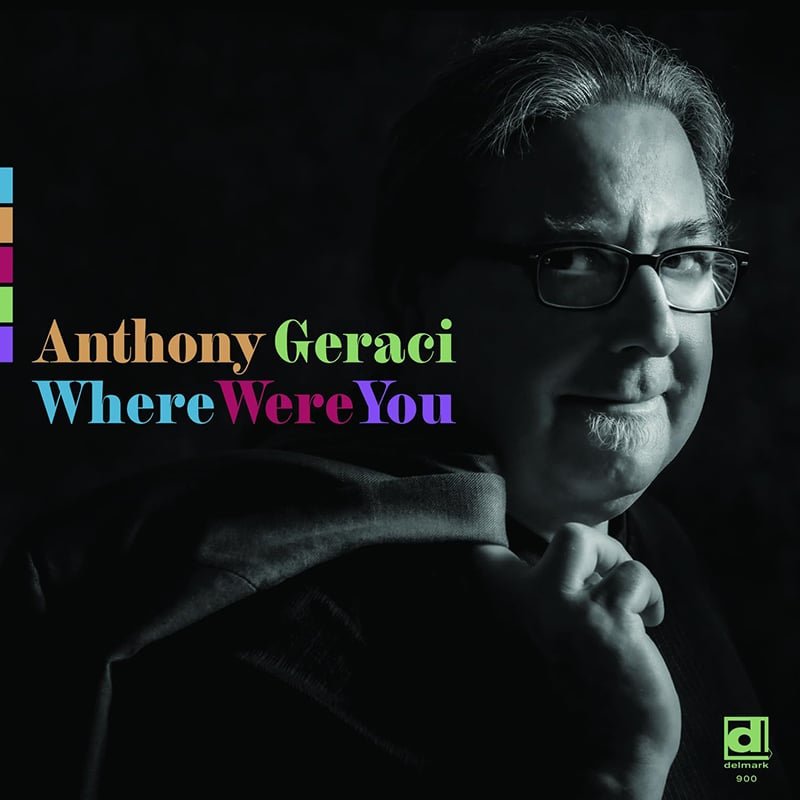
Anthony Geraci
Where Were You
Delmark Records
Anthony R. Geraci was born in 1954 in New Haven, Connecticut. He was raised in a home without any music, but decided at the age of four that he wanted a piano. His family acquired an old upright piano for him, and Geraci started taking piano lessons. As his proficiency grew, his mother purchased a baby grand. At the age of sixteen, Geraci heard Jimmy Rogers’ 1954 recording of “Chicago Bound,” and it shaped his destiny.
Geraci went on to graduate from the Berklee College of Music with a Bachelor of Arts degree, and then from Skidmore College with a master’s in jazz studies. In the early 1970s, Geraci relocated to Boston and began immersing himself in the local blues and jazz scenes. Around 1974, he was the opening act for a week of performances by Muddy Waters, and he began playing with Jerry Portnoy and Bob Margolin when they were not touring with Muddy. He was approached by Michael “Mudcat” Ward and Ronnie Earl, and they jointly took gigs in the greater Boston area. Their drummer, Neil Gouvin, then brought Sugar Ray Norcia to one of their performances, and the original lineup of Sugar Ray & the Bluetones was formed. They backed touring Chicago blues musicians including Big Walter Horton, J.B. Hutto, Hubert Sumlin, Junior Wells, and Memphis Slim. In 1984, Ronnie Earl and the Broadcasters was formed, with Geraci a founding member. He continued to work with both the Broadcasters and the Bluetones. In 1993, Geraci recorded the first of two albums as Little Anthony & the Loco-Motives.
In 1994, Little Anthony and Sugar Ray Norcia released the album Take It from Me on Tone-Cool Records. In 1999, the Superharps album, featuring four harmonica players — James Cotton, Charlie Musselwhite, Billy Branch, and Sugar Ray Norcia — was issued, with Geraci on piano. It garnered a 2001 Grammy Award nomination for Best Traditional Blues Album. Since then Geraci has released eight more albums in his own name, including 2015’s Boston Blues All-Stars Fifty Shades of Blue on Delta Groove Records; 2018’s Why Did You Have to Go on Shining Stone Records; and 2024’s Tears in My Eyes on Blue Heart Records. Geraci also plays with the Proven Ones, featuring Kid Ramos, Willie J. Campbell, Jimi Bott, and Brian Templeton.
All the compositions on Where Were You were written, arranged, and conceived by Geraci, and recorded at Delmark Riverside Studios in Chicago by Julia A. Miller, and mixed by Elbio Barilari and the legendary Fred Breitberg at Freddie B Audio in Evanston, Illinois. On the opening title track, Geraci, on piano and Hammond organ, is joined by vocalist-drummer Sheryl Youngblood and bassist Rodrigo Mantovani, as Sheryl sings, “Where were you when the blues said goodbye, where were you when the blues said goodbye, woke up early in the morning and I cried and I cried…where were you when the blues said goodbye, where were you when the blues said goodbye, we’ve got to carry the torch, sing those blues lullabies, sing those blues lullabies.” On the instrumental “Brooklyn Boogie,” pianist-organist Geraci is joined by guitarist Barrett Anderson (Ronnie Earl, Monster Mike Welch) and drummer Nick Toscano.
On “All’s I Got Is You,” with guitarist Jon McDonald, bassist Tom Terry, and drummer John Medeiros Jr., keyboardist Geraci takes the lead vocal as he chimes, “All’s I got is you, all’s I got is you, all’s I got is you, pretty baby, all’s I got is you…you said you were my woman, I was your hoodoo man…you dress me in the morning, about the break of day, you dress me in the morning about the break of day, all I got is you, pretty baby, all I got is you.” On the jazzy instrumental “Caterpillar Dance,” Geraci is joined again by bassist Tom Terry.
“Rockin’ til Dawn” is another boogie-woogie instrumental, featuring the brawny tenor sax of Mario Perrett (Luther “Guitar Jr.” Johnson, Ronnie Earl). On the New Orleans–styled “Say La-Ti-Da,” Geraci plays piano in the Chicago Otis Spann–Pinetop Perkins tradition, while guitarist Dave Specter appears for the first of five stints, with Rodrigo Mantovani on bass, Pooky Styx (Buddy Guy) on drums, and Sheryl Youngblood returning for another vocal as she chants, “saw you alone on a Saturday night…Say-La-Ti-Da, cha cha cha, there’s food on the table…I told you that I love you and I want to hold you tight, we sang and we danced, we sang and we danced the cha, cha, cha, sang La-Ti-Da.”
The gorgeous instrumental “Flowers for Marianne” features the unmistakable violin sound of Anne Harris, as she adds harmonics to Geraci’s keys, with the rhythm section of bassist Mantovani and drummer Toscano.
Sheryl Youngblood takes her third and final vocal on “Even a Fool’s Right Once in Awhile,” with guitarist Specter and drummer Medeiros, as she bursts, “Even a fool’s right once in awhile, even a fool’s right once in a awhile, when you look my way, it feels like a brand new day…even a fool’s right once in awhile. Holding hands, I won’t let go…at a picture show…I wanna hold you and never leave, wanna hear your voice in the morning breeze, when I hear your voice, it feels like a brand-new day.”
“Stop Sneaking Around” features guitarists Specter and McDonald, bassist Terry, drummer Medeiros, and a lead R&B vocal from 71-year-old Barrence Whitfield, of Barrence Whitfield & the Savages, as he cries out, “Won’t you stop sneaking aound, won’t you stop sneaking around, won’t you stop sneaking around, sneaking around. I keep on looking but you can’t be found, your always hiding underground, holding hands with your new man, under the street light in the middle of town, you won’t stop sneaking around…,” with some great Hammond B-3 from Geraci.
On the most fully realized instrumental in the set, “Breaking Bread,” featuring guitarist Specter, bassist Mantovani, drummer Toscano, and saxophonist Perrett, Geraci’s musical intentions are complete. On “Oobiedoobie Man,” with bassist Terry, drummer Medeiros, and saxophonist Perrett, keyboardist Geraci takes his second and final vocal as he croons, “I wanta be your oobiedoobie man, I wanta be your oobiedoobie man, I wanta tell you how good a man can be, I wanta tell you how good a man can be, I wanta dance with you honey and rock around the Christman tree. I wanta be your oobiedoobie man.” On the closer, “Suite: Blues,” the sixth and final instrumental, keyboardist Geraci is joined by guitarist Specter, bassist Mantovani, and drummer Toscano.
On Where Were You, the repertoire moves through many different styles of the blues: boogie-woogie, jazz-inflected instrumentals, R&B, soul, balladry, and Americana. Voices shift among Sheryl Youngblood, Barrence Whitfield, and Geraci himself, while the instrumental tracks reveal the full architecture of his compositional imagination. Anthony Geraci proves once again that tradition is neither museum nor mausoleum; his blues is forever breathing. His playing joins rigor to abandon, memory to surprise, scholarship to joy. Delmark acknowledges in Geraci a musician and songwriter whose art reminds us that the blues tradition, though rooted in the past, remains gloriously unfinished.
Richard Ludmerer
Version 1.0.0

Subscribe to Our Newsletter
Discover more from Making A Scene!
Subscribe to get the latest posts sent to your email.


