
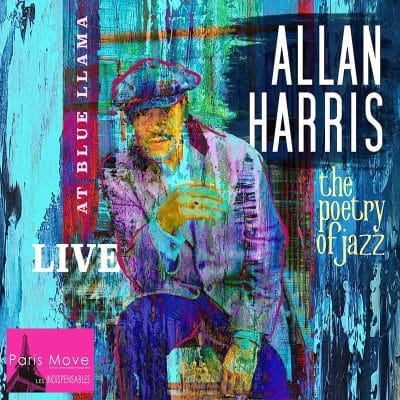
Allan Harris The Poetry of Jazz: Live at Blue Llama




 Allan Harris
The Poetry of Jazz: Live at Blue Llama
Blue Llama
The Poetry of Jazz: Live at Blue Llama is Brooklyn-born and Harlem-based vocalist, guitarist, and songwriter Allan Harris’s second live album recorded at the prestigious Ann Arbor club, Blue Llama, and the second on its label. It’s Harris’s 17th overall. Harris leads a tight ensemble of pianist John Di Martino, bassist Jay White, drummer Sylvia Cuenca, and violinist Alan Grubner. In any one track, Harris can be singing, scatting, and delivering spoken word as he weaves in poetry by William Shakespeare, Dylan Thomas, Maya Angelou, Langston Hughes, and Mary Oliver with his original compositions and familiar jazz standards.
We’ve covered Harris twice on these pages, and this writer reviewed his 2023 date at the Blue Llama and his brilliant Kate’s Soulfood (2021) for another outlet. The Poetry of Jazz is understandably more esoteric but does offer an even wider view of Harris’s talents in this delectable, highly crafted mix of poetry, jazz, and soul.
Displaying a keen awareness of his audience, Harris opens with “Groovy People,” an easy-on-the-ears tribute to Lou Rawls. He then works his way into “The Weary Blues,” a classic Langston Hughes 1925 poem with spoken word, an instrumental intro of original music, and words that speak to the Harlem Renaissance, of which Harris is an expert. Few know Harlem history any better than Harris. The spoken word morphs to singing while his guitar and Grubner’s violin become dynamic in the instrumental break. When he sings, “I’m happy no more, and wish I had died,” it’s commanding and deeply poignant.
Mostly, Harris couples the poems with tunes, some of them well-known. He recites Shakespeare’s Sonnet 18, “Shall I compare thee to a summer’s day,” with the gorgeous ballad “Midnight Sun.” Di Martino sparkles on piano. Harris reverses the sequence, coupling his original ballad “Autumn,” about change and surrender, with “Wild Geese” by Mary Oliver. Her poem, too, is about finding one’s place in the world. At times, Harris’s baritone is so deep, it evokes Billy Eckstine, at least to these ears. This melody lightly swings, with great support from the backing quartet and emotive soloing from Grubner. One can easily sense Harris’s superb command of the audience as they listen intently to his words. Often, even the spoken word passages have a unique cadence and emotional tinge.
He pairs Mancini and Mercer’s “Charade,” a tune that blurs the boundary between performance and reality with Sonnet 29 “When in disgrace with fortune in men’s eyes.” One can’t help but think this could be directed at our Reality TV POTUS and/or some of his cabinet members. Rather aptly he follows with a piece replete with the word ‘rage” as resistance is theme of “Shallow Man: and Dylan Thomas’s “Do Not go Gentle into That Good Night,” the latter, of course, urging one not to succumb too easily to death.
He adapts another Shakespeare sonnet, 116, “let me not to the marriage of true minds admit impediments,” coupling it withj Antonio Carlos Jobim’s “Definado.” It’s another feature for the impressive Grubner. He delivers most intimately “With You I’m Born Again,” appending Lord Byron’s “She Walks in Beauty” in the set’s most romantic moments, punctuated by Di Martino’s late-night piano styling.
Pivoting quickly he turns to two of the most rebellious Black women of the last century, pairing Maya Angelou’s unapologetic “Still I Rise” with Nina Simone’s “See Line Woman.” Angelou’s lines “You may write me down in history…But still, like dust, I’ll rise” take on special poignancy given the recent attempts of erasure of Black history. He doesn’t dwell on the social justice statements long in this set, quickly moving to romantic material or other subjects. In that way, the former have more impact. He delicately renders his original “Secret Moments,” appending Elizabeth Barrett Browning’s “How Do I Love Thee.”
In his final bow he connects his original “Time Just Slips Away” with the enduring Robert Frost poem “The Road Not Taken.” This seems especially emblematic of Harris’s own career, as he took the road less traveled. He could have easily been simply a jazz vocalist, a guitarist, or a soul singer but instead became a masterful storyteller who merged all those elements and more into his singular artistry.
– Jim Hynes

Subscribe to Our Newsletter
Discover more from Making A Scene!
Subscribe to get the latest posts sent to your email.


