
Alexa Tarantino The Roar and the Whisper




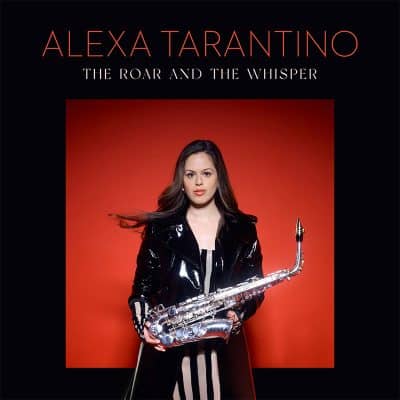 Alexa Tarantino
The Roar and the Whisper
Blue Engine
Accomplished woodwind master Alexa Tarantino, a stalwart member of the Jazz at Lincoln Center Orchestra (JLCO), returns with her fifth album as a leader, The Roar and the Whisper. The album features arguably her finest lineup to date, including pianist Steven Feifke, bassist Phillip Norris, and drummer Mark Whitfield, Jr. Longtime friend and collaborator Cecile McLorin Salvant (Tarantino played in Salvant’s Ghost Song band) as well as percussionist Keita Ogawa join as guests. Tarantino, known primarily as an altoist, plays an array of saxophones and flutes. She composed seven of these ten with “This Is For Albert” from Wayne Shorter, “Moon Song” from Salvant, and “Tigress” from Billy Strayhorn.
The album title takes its name from an interesting incident involving Tarnatino and Salvant. A total stranger interrupted their conversation repeatedly on one day in New York, causing a strong response from Tarantino – ‘the roar”; and a quiet reaction, “the whisper” from Salvant. On any given day, each could have taken the opposite response, which got Tarantino thinking about the various and unpredictable aspects of the human personality.
The potent “Inside Looking Out’ opens with a bass intro from Norris (also currently in Joshua Redman’s quartet) and quick swipes from both Feifke and Whitfield Jr. before Tarantino launches her soaring improvisation on soprano, reaching high before passing the baton to a rollicking Feifke and the kinetic Whitfield Jr. The title track lives up to its billing, with alternating ferocious and pensive passages delivered in a bluesy vibe, punctuated by Norris’s inspired bass solo. Just as one thinks the tune will end in a whisper, she caps it with two emphatic notes as if to say, “So, there!” Tarantino weaves her lines lyrically in Shorter’s rhythmically complex “This Is for Albert.” She balances aggression with fluidity each time she solos, and pianist Feifke generally mirrors her approach as he does here.
Following three burners, “Portrait of a Shadow’’ turns slightly more pensive, showcasing her beautiful tone and melodic feel, yet it, too, builds in intensity. We do find the pensive mood in the aptly titled gorgeous “Luminance” as Tarantino shifts to the flute. She stays with the instrument for the ethereal “Moon Song,” which features the incomparably emotive, resonating vocals of Salvant.
As if itching to return to hard swinging fare, “Back in Action” does just that, motoring along with each quartet member firing full throttle. “Provoking Luck” is a mid-tempo tune built on a series of engaging call-and-response exchanges between Tarantino and the rhythm section. The tune has the kind of indelible riff that will swim in your head for days. “All Along” is the second fully instrumental ballad, played here on alto, again with engaging conversation between Tarantino and Feifke in a bluesy motif. Strayhorn’s “Tigress” closes, a great vehicle for Salvant, as Ogawa makes his one appearance on percussion. Tarantino’s saxophone soars over some dense, dazzling chords from Feikfe as the tune moves in several directions over a concise three-and-a-half minutes.
Tarantino delivers a tour-de-force as one might expect with this high caliber quartet. The energy quotient is at ten for many of these pieces!
- Jim Hynes
BUY NOW

Subscribe to Our Newsletter
Discover more from Making A Scene!
Subscribe to get the latest posts sent to your email.


