AI Writing Secrets for Musicians – Write Like a Marketer Without Sounding Like One





Making a Scene Presents – AI Writing Secrets for Musicians – Write Like a Marketer Without Sounding Like One
Listen to the Podcast Discussion for better insight into using AI to Write Your Marking in Your Voice
The biggest lie indie artists are told about marketing is that it’s about tricks. Hooks. Hacks. Algorithms. Magic phrases that somehow turn strangers into fans. That’s not marketing. That’s noise.
Real marketing is translation. It’s the act of turning what you feel into something a fan can recognize as their own. The problem is that most artists were never taught how to translate emotion into words without sounding fake, desperate, or like a brand manager cosplaying as a human. That’s where AI comes in—not as a replacement for your voice, but as a mirror. Used right, AI writing doesn’t make you sound corporate. It makes you sound clear. And clarity is what converts attention into shows, merch sales, email signups, direct support, and long-term fans you actually own a relationship with.
This is not about writing better captions. It’s about building a mindset where AI helps you communicate like a real artist who respects their audience, instead of performing marketing rituals for platforms that don’t care about you. If you hate marketing, this is for you. If you’ve ever posted “new song out now” and felt nothing, this is for you. If you want to sound human, emotional, and unmistakably you, this is for you.
Why Most Music Marketing Sounds Dead on Arrival
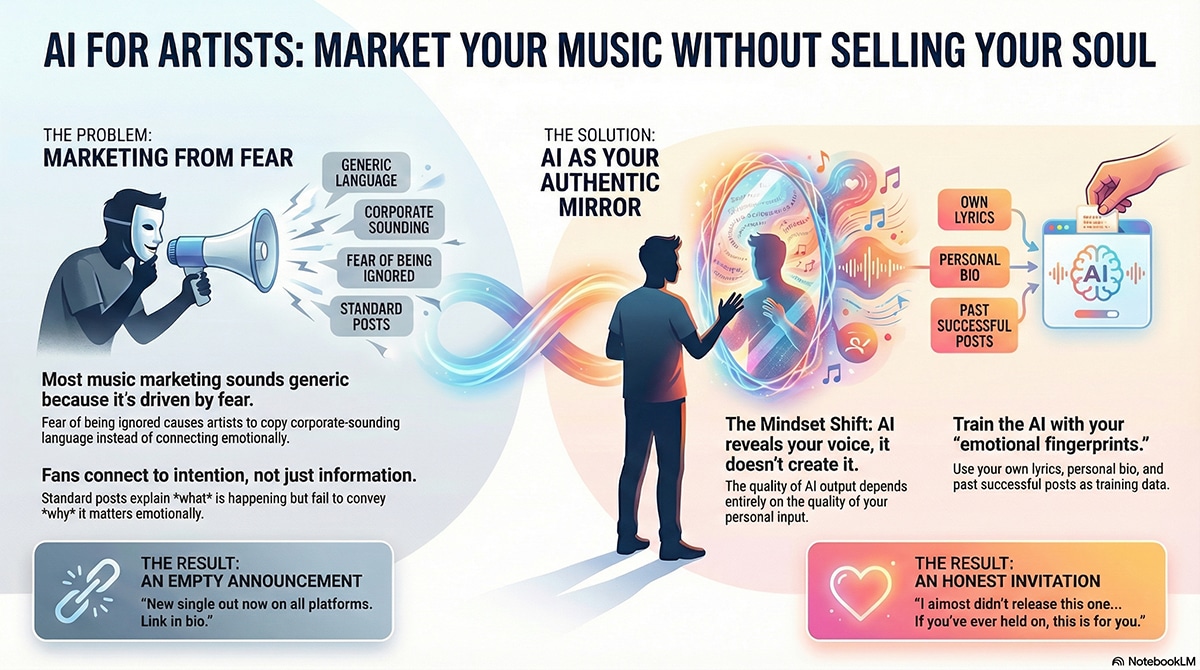
Let’s say the quiet part out loud. Most music marketing sounds bad because it’s written from fear. Fear of being ignored. Fear of not posting enough. Fear of doing it “wrong.” That fear pushes artists into copying language that looks like marketing instead of language that feels like connection. You see it everywhere. Announcements that talk at people instead of with them. Posts that explain what something is, but never why it matters emotionally.
Fans don’t connect to information. They connect to intention. This is why labels spend millions trying to manufacture “authenticity” after the fact. Indie artists already have the raw material. What they’re missing is a system to consistently express it without burning out or sounding like a cliché.
AI gives you that system—but only if you stop treating it like a copy machine and start treating it like a collaborator.
The Core Mindset Shift: AI Is Not the Voice, You Are
If you take one idea from this, let it be this.
AI does not create your voice.
AI reveals your voice.
When artists say “AI makes everything sound generic,” what they’re really saying is that they gave it generic input and expected magic on the other side.
If you feed AI:
“I’m an indie artist releasing a new song,”
you will get the musical equivalent of elevator music.
If you feed AI:
Your lyrics.
Your bios.
Your old posts.
Your half-finished thoughts.
Your emotional context.
You get something entirely different. You get language that sounds like you on your best day—clear, grounded, and intentional. This is not cheating. This is leverage. Labels have teams. Indie artists now have tools.
Training ChatGPT on Your Actual Brand Voice (Not a Fake One)
Here’s where most tutorials fail you. They tell you to “define your brand voice” like you’re building a soda company. You don’t need adjectives. You need evidence. Your brand voice already exists. It’s hiding in places you’ve never thought to use as training data.
Start with your lyrics. Not because fans read them line by line, but because lyrics are emotional fingerprints. They show how you talk about longing, anger, hope, nostalgia, doubt. That emotional grammar matters more than clever phrasing. Then your bio. Not the sanitized one for streaming platforms, but the version you’d tell someone at 1 a.m. after a show when they ask why you do this.
Then your past posts. Especially the ones that felt right, even if they didn’t perform well. Performance is algorithmic. Resonance is human. When you feed these into ChatGPT, you’re not asking it to invent you. You’re asking it to learn how you think. Here’s a foundational prompt to start that process.
“Act as a long-term creative collaborator for an independent musician. I am going to paste my lyrics, artist bio, and past posts. Study them carefully and analyze my emotional tone, recurring themes, pacing, sentence length, vulnerability level, and how I speak to fans. Do not write anything yet. Confirm when you understand my voice and summarize it back to me in plain language.”
That last line matters. You want the AI to reflect your voice back to you before it writes anything. This is how you avoid drift. Once it summarizes your voice accurately, then you start using it for marketing.
Why Generic Prompts Produce Generic Marketing
Let’s look at a common mistake.
A bland prompt:
“Write an Instagram post promoting my new single.”
That tells the AI nothing about who you are, who the fan is, or why this moment matters. So it fills the gap with marketing defaults. Now compare that to a layered prompt that actually carries intention.
“Write an Instagram post in my established artist voice. The goal is not to promote a song, but to invite fans into the emotional moment behind it. This song was written after realizing a relationship couldn’t be saved, but still loving the person deeply. The post should feel like a quiet confession, not an announcement. Avoid marketing language. Speak directly to one person, not an audience.”
Same AI. Completely different result. This is the secret most people miss. AI doesn’t need better words. It needs better context.
Rewriting Bland Posts Into Fan-Focused Language
Let’s get concrete. Here’s a typical post artists default to.
“New single out now on all platforms. Link in bio.”
It’s not wrong. It’s just empty. It gives fans no emotional reason to care, and no personal reason to engage. Now let’s run that through an emotionally trained AI with intent.
Prompt:
“Rewrite this post in my artist voice. The goal is to make one fan feel seen. Focus on the emotion behind the song, not the release itself. Avoid phrases like ‘out now’ or ‘stream everywhere.’”
Result:
“I almost didn’t release this one. Not because it wasn’t finished, but because it was too honest. If you’ve ever held onto something that was already gone, this song is for you. It’s finally ready to be heard.”
Notice what changed. The song didn’t change. The platform didn’t change. The relationship did. This kind of copy doesn’t just perform better. It builds trust. And trust is what gets fans to buy tickets, show up early, grab merch, and join your mailing list instead of disappearing after 30 seconds.
Using AI to Sell Without Sounding Like You’re Selling
A lot of artists think emotional copy can’t sell. That’s backwards. Emotional copy is the only thing that sells without burning goodwill. Let’s take ticket promotion.
The bland version:
“Tickets on sale now. Don’t miss it.”
Now the same idea, reframed with AI assistance.
Prompt:
“Write a show announcement in my voice. Assume the reader has never seen me live. The goal is not urgency, but trust. Make it feel like an invitation, not a pitch.”
Result:
“If you’ve only heard these songs through headphones, this is where they change. Louder. Messier. More alive. I’m playing [venue] on [date], and if you’ve been waiting for the right night to come out, this might be it.”
That’s marketing—but it doesn’t feel like it. It feels like respect. This approach consistently outperforms hype because it aligns with how fans actually decide to support artists. People don’t buy tickets because of commands. They buy tickets because they feel included.
Building an AI “Marketing Intern” That Actually Learns You
Once you’ve trained ChatGPT on your voice, you can stop starting from scratch every time. This is where Custom GPTs or saved instruction workflows shine. Instead of prompting repeatedly, you establish a role.
“From now on, you are my AI marketing assistant. You understand my artist voice, values, and audience. Your job is to help me communicate clearly, emotionally, and honestly without using marketing clichés. You will always ask clarifying questions if context is missing.”
This turns AI into infrastructure instead of inspiration roulette.
Now you can say:
“Help me write a post about merch without sounding salesy.”
or
“Rewrite this email so it feels like a personal note, not a newsletter.”
And the results stay consistent. Consistency is how artists build brands that feel real instead of random. And consistency is what allows fans to recognize you instantly, even off-platform.
Email, Merch, and Direct Support: Where Copy Turns Into Income
Social posts get attention. Owned channels get revenue. This is where AI copywriting becomes a financial tool, not just a creative one. Let’s say you’re emailing fans about merch. The mistake is describing the product. The opportunity is describing the meaning.
Prompt:
“Write an email in my voice explaining why this merch exists. Assume the reader already likes me. The goal is to make them feel like buying it is a way to participate, not consume.”
Result:
“I didn’t make this merch to slap a logo on something. I made it because touring costs are real, and I wanted a way for the music to keep moving without asking permission. If you wear this, you’re not repping a brand. You’re backing the work.”
That’s not manipulation. That’s transparency. Fans respond to that because it treats them like partners, not targets. This is how copy supports independence. Not by chasing scale, but by deepening connection.
The Anti-Marketing Rule That Changes Everything
Here’s a rule that’s worth unlearning old habits for.
If it wouldn’t make sense to say it to one real person after a show, don’t post it.
Picture that moment clearly. Someone just watched you play. They came up to say hi. They’re standing right in front of you. If the words you’re about to type would feel awkward, forced, salesy, or robotic in that moment, they don’t belong on your feed either. Screens don’t change human behavior. They just remove eye contact.
This is where AI actually helps in a healthy way.
Instead of using AI to sound louder or more “professional,” use it to test your instincts. When a post feels off, pause and ask a simple question: “Does this sound like something a real person would say out loud?” Or even better: “Would I feel comfortable saying this to one fan, face to face, after a show?”
If the answer is no, the fix usually isn’t better marketing language. It’s fewer words, clearer intent, and more honesty. AI can help you strip away the filler, soften the pitch, and bring the message back to something human.
Over time, something unexpected starts to happen.
The way you write with AI begins to influence the way you speak off-screen. You start choosing clearer words in conversations. You explain things more simply. You stop hiding behind phrases that sound impressive but mean nothing. Clarity breeds clarity.
That’s when marketing stops feeling like a mask you put on and take off. It stops feeling like performance. It becomes communication. Real, direct, human communication that sounds the same online as it does in the room. And that’s the kind of voice people trust, remember, and support.
AI Is How Indie Artists Catch Up Without Selling Out
The old music industry was built around teams. Copywriters shaped the message. Strategists decided what to say and when. Email marketers optimized subject lines. Brand managers protected tone and image.
Indie artists, by comparison, were expected to survive on vibes and hope. Make great music, post when you can, trust the algorithm, and somehow get noticed. That imbalance wasn’t accidental. It was structural. The people with resources controlled the narrative, and everyone else was told to be grateful for exposure.
That imbalance is finally starting to crack.
AI doesn’t erase the human part of music. It does the opposite. It protects it by removing friction. It handles the repetitive, draining, behind-the-scenes work that used to require a full team or endless late nights. It helps you show up consistently without sounding canned, clearly without overthinking, and honestly without burning the energy you need to actually create.
Used this way, AI isn’t about scaling hype. It’s about preserving focus.
When you own your voice, your data, your fan relationships, and your message, marketing stops feeling like a necessary evil. It stops feeling like something you have to do to your art. It becomes something that grows out of it. Your posts sound like conversations. Your emails feel like updates from a real person. Your message stays coherent because it’s coming from one place: you.
That’s the real shift happening right now.
Not sounding like a marketer doesn’t mean avoiding intention. It doesn’t mean being vague, passive, or hands-off. It means choosing intention that actually sounds like you. Clear purpose. Human language. Real connection. When the tools finally work for the artist instead of the system, intention stops feeling fake and starts feeling honest. And that’s where real support is built.
 |  Spotify |  Deezer |  Breaker |
 Pocket Cast |  Radio Public |  Stitcher |  TuneIn |
 IHeart Radio |  Mixcloud |  PlayerFM |  Amazon |
 Jiosaavn |  Gaana |  Vurbl |  Audius |
 Reason.Fm | |||
Find our Podcasts on these outlets
Buy Us a Cup of Coffee!
Join the movement in supporting Making a Scene, the premier independent resource for both emerging musicians and the dedicated fans who champion them.
We showcase this vibrant community that celebrates the raw talent and creative spirit driving the music industry forward. From insightful articles and in-depth interviews to exclusive content and insider tips, Making a Scene empowers artists to thrive and fans to discover their next favorite sound.
Together, let’s amplify the voices of independent musicians and forge unforgettable connections through the power of music
Make a one-time donation
Make a monthly donation
Make a yearly donation
Buy us a cup of Coffee!
Or enter a custom amount
Your contribution is appreciated.
Your contribution is appreciated.
Your contribution is appreciated.
DonateDonate monthlyDonate yearlyYou can donate directly through Paypal!
Subscribe to Our Newsletter
Order the New Book From Making a Scene
Breaking Chains – Navigating the Decentralized Music Industry
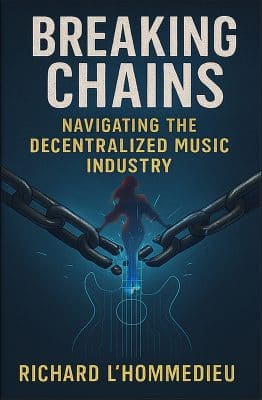
Breaking Chains is a groundbreaking guide for independent musicians ready to take control of their careers in the rapidly evolving world of decentralized music. From blockchain-powered royalties to NFTs, DAOs, and smart contracts, this book breaks down complex Web3 concepts into practical strategies that help artists earn more, connect directly with fans, and retain creative freedom. With real-world examples, platform recommendations, and step-by-step guidance, it empowers musicians to bypass traditional gatekeepers and build sustainable careers on their own terms.
More than just a tech manual, Breaking Chains explores the bigger picture—how decentralization can rebuild the music industry’s middle class, strengthen local economies, and transform fans into stakeholders in an artist’s journey. Whether you’re an emerging musician, a veteran indie artist, or a curious fan of the next music revolution, this book is your roadmap to the future of fair, transparent, and community-driven music.
Get your Limited Edition Signed and Numbered (Only 50 copies Available) Free Shipping Included
Discover more from Making A Scene!
Subscribe to get the latest posts sent to your email.


