The Most Valuable Thing You Take Home From a Show Might Not Be the Money at the Door




Making a Scene Presents – The Most Valuable Thing You Take Home From a Show Might Not Be the Money at the Door
Listen to the Podcast Discussion
Why a $27 million investment in live-event marketing should change how independent artists think about touring, fan relationships, and building a sustainable music career.
The Most Expensive Thing You Can Leave Behind at a Gig
Picture a familiar Saturday night. You’re playing a packed little music venue about two hours from home. The band is tight, the sound is good, and the audience is responding to every song. The bartender is moving drinks like there’s a national emergency, someone near the stage is recording the performance on a phone, and the bass player has somehow managed to find another cable that wasn’t broken during soundcheck. By the final encore, everyone agrees it has been a great night.
After the show, you sell a few shirts, sign a couple of CDs, pack the equipment, and settle up with the venue. Maybe you made a few hundred dollars after expenses. Maybe you made enough to cover gas and buy breakfast on the way home. Either way, the show is over, the money is counted, and everyone heads home with the satisfaction of knowing they put on a good performance.
But here’s the part that should bother every independent musician trying to build a career. Somewhere in that audience were people who genuinely connected with your music. Some would gladly come see you again. Others might buy a new album, subscribe to exclusive content, bring friends to your next show, or even help introduce you to another venue. Yet by the time you finish unloading the van, most of those people have disappeared into the night without any reliable way for you to reach them again.
The venue may know who purchased tickets. The ticketing company certainly processed those transactions. The promoter may have a customer database filled with names, email addresses, and purchasing history. Everyone involved in the business of putting on your show may have learned something valuable about your audience, except the musicians who actually created the reason those people bought tickets in the first place.
There’s something wonderfully absurd about an industry where an artist can spend years building an audience and still have to ask a social media algorithm for permission to speak to that audience. It’s rather like owning a restaurant, serving a thousand meals, and discovering that the company providing the cash register gets to keep the customer relationships.
For decades, working musicians have measured the success of a performance by the size of the crowd, the money collected at the door, and the merchandise sold afterward. Those numbers still matter. But the modern music business is revealing another form of value that may have an even greater effect on an artist’s future income: the ability to maintain a direct relationship with the people who came to see them.
And apparently, Wall Street has started noticing.
Why Investors Just Put $27 Million Into Knowing Who Attended the Show
On October 21, 2026, live-event marketing company Hive announced that it had secured a $27 million Series B investment from Frontier Growth, a growth equity investment firm. The announcement wasn’t about building a new concert hall, signing the next superstar, or creating another streaming service. The investment was directed toward software that helps venues, promoters, festivals, and event organizers understand their ticket buyers and bring those customers back for future events.
According to its announcement, Hive serves more than 1,600 venues, promoters, and festivals and has helped its customers generate more than $1 billion in ticket sales. The company says it connects with more than 40 ticketing platforms, including Ticketmaster, AXS, Eventim, Etix, Tixr, and DICE. Those connections allow participating event businesses to bring ticketing information into marketing systems that can organize audiences by event history, location, artist preferences, and purchasing behavior.
Those figures are impressive, but they deserve an important qualification. The billion-dollar figure represents ticket sales that Hive says its customers generated with the platform’s assistance. It does not establish that Hive independently caused an additional billion dollars in sales, nor should a company announcement be treated as an audited financial study. The distinction matters because music technology has a long history of turning perfectly reasonable business results into marketing claims that sound suspiciously like someone discovered how to manufacture money.
Still, the underlying business idea is difficult to ignore. A venue that knows which customers attended a blues concert last spring may be better positioned to promote another blues performance this fall. A festival that understands which audiences respond to particular artists can make more informed decisions about advertising and programming. A promoter who can identify repeat ticket buyers may have an advantage over someone who starts every campaign by throwing advertising money into the digital equivalent of a wishing well.
Hive combines ticket-related information with email, text messaging, customer relationship management, and advertising tools. The company also says it plans to expand its use of AI-powered assistants to help event businesses prepare marketing campaigns, reduce repetitive work, and act on audience information. Some of these AI capabilities are part of its development plans rather than features that should automatically be assumed to be available today.
What makes this investment especially interesting is what it tells us about the value of customer relationships in live music. Investors are not putting $27 million into the idea that a concert happens once and everybody forgets about it. They are investing in the opposite idea: that the information and relationships created around a concert can generate additional business long after the last amplifier has been switched off.
Hive CEO and co-founder Ian Roberts described the industry’s problem as one involving disconnected data and marketing. That’s an important observation because venues have been collecting ticket sales information for years, yet that information often remains separated from the tools needed to put it to practical use.
For independent artists, however, there’s another question worth asking. If technology that connects concertgoers to future ticket sales is valuable enough to attract millions of dollars in investment, why are so many musicians still treating their audience relationships as something that belongs to somebody else?
The Music Industry Has Been Giving Away Its Most Valuable Relationships
To understand why this matters, consider how the traditional live music business developed. Venues invested in buildings, sound systems, staff, insurance, and the countless other expenses required to operate a performance space. Promoters handled advertising, booking, and event production. Ticketing companies provided systems to sell admission, manage payments, and distribute tickets. Musicians supplied the performances that made the entire arrangement worth supporting.
Each business had its own responsibilities, and each developed systems to manage those responsibilities. Over time, however, the information generated by a concert became divided among companies that were not necessarily interested in sharing it. The ticketing provider maintained purchase records, the venue tracked attendance, the promoter managed advertising, and the artist concentrated on performing and getting paid.
This arrangement wasn’t necessarily created as a conspiracy against musicians. Much of it resulted from separate business systems, contractual arrangements, privacy obligations, and the simple fact that nobody built the industry around the idea of giving every participating artist a direct connection to every ticket buyer. But whatever the original reason, the result can be a serious disadvantage for independent performers.
An artist might sell out a 200-capacity venue and return six months later to discover that the next show needs to be promoted almost from scratch. Perhaps the venue sends an email to its customers. Maybe the promoter buys social media advertising. The band posts repeatedly on Facebook and Instagram, hoping the right people notice. Meanwhile, the artist has no dependable way to contact many of the people who were standing three feet from the stage during the previous performance.
Think about what that means financially. Advertising is often necessary, and good venues can be valuable marketing partners. But every dollar spent repeatedly finding the same audience is a dollar that cannot go toward recording music, maintaining equipment, paying musicians, or expanding into another city.
The missing ingredient isn’t necessarily a larger advertising budget. Sometimes it’s simply remembering who already cares about your music.
At Making a Scene, we’ve been arguing for years that independent artists need to build businesses around the things they can control. That includes ownership of their recordings, publishing rights, websites, merchandise, and direct relationships with supporters. Social media and streaming services can help people discover music, but discovery becomes much more valuable when interested listeners have a clear way to connect directly with the artist.
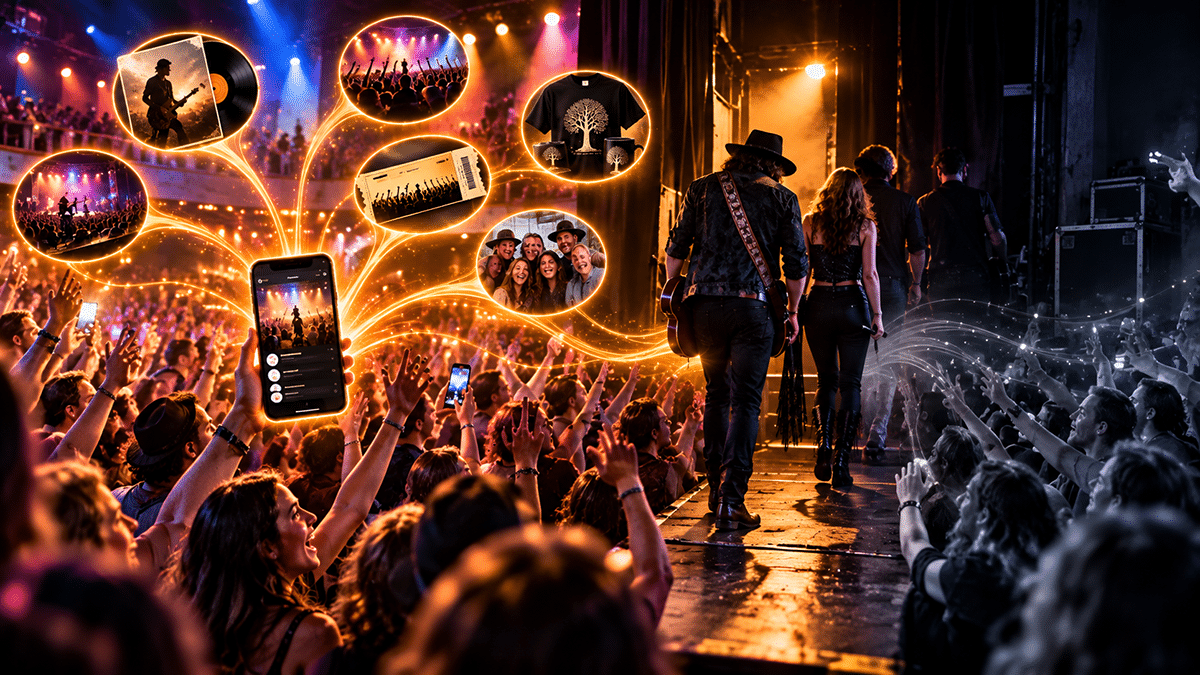
The same philosophy applies to live performances. A venue is an important partner, but it should not have to serve as the permanent gatekeeper between an artist and everyone who enjoyed that artist’s music. An independent musician needs a practical way to invite those fans into an ongoing relationship that can survive changes in venues, promoters, ticketing providers, and social media platforms.
That doesn’t mean demanding every ticket buyer’s personal information or treating the venue like an enemy. It means recognizing that a good performance creates something more lasting than one evening’s ticket revenue, and then building a respectful system for carrying that relationship forward.
A Ticket Buyer Is Not Automatically Your Customer
Before anyone decides that the solution is to demand a spreadsheet containing every email address sold at the door, we need to discuss a very important distinction. Someone who purchases a ticket to an event has not necessarily agreed to receive promotional messages from every performer appearing onstage.
This is where musicians must separate access to information from permission to use it. The fact that a venue possesses a customer’s email address does not automatically mean it can legally or contractually hand that address to the opening act for an unlimited series of marketing campaigns.
Ticketing agreements, event contracts, privacy notices, and applicable laws can all affect how customer information may be collected, transferred, stored, and used. A ticketing provider may share information with an event organizer for certain purposes while restricting other uses. In some cases, the artist may be an authorized event partner. In others, the artist may have no independent access to personal customer records.
Ticketmaster’s published privacy policy, for example, explains that information can be shared with event partners, including artists, promoters, labels, and venues, for purposes related to the event and other uses described in relevant privacy policies. It also describes marketing choices offered to consumers in applicable circumstances. That does not establish a universal right for every performer to receive an unrestricted copy of the customer database.
The distinction may sound inconvenient, especially to musicians who are already struggling to reach audiences. But there’s a good reason to take it seriously. Fans should be able to enjoy a concert without discovering that buying one ticket has enrolled them in promotional campaigns from seven bands, two sponsors, a festival organizer, and a mysterious company that suddenly wants to sell them discount sunglasses.
A real fan relationship begins with a choice. Someone hears your music, enjoys the experience, and voluntarily decides they want to hear from you again. That decision has more value than an email address acquired through a questionable data transfer, because it represents an actual expression of interest rather than a name sitting inside a spreadsheet.
The smartest approach is to work with venues and promoters to create legitimate opportunities for fans to connect with the artist. A venue may be willing to include an artist’s signup link in a pre-show email, provide a clear artist opt-in option during an approved ticket checkout process, or feature a post-show invitation in its customer communications. What is permitted will depend on the agreements, privacy notices, technical capabilities, and applicable law.
Those arrangements can be valuable to everyone involved. The artist develops a direct fan relationship, the venue maintains proper control over its customer information, and the fan decides whether to participate. Nobody needs to sneak a mailing list out through the kitchen door.
The Real Opportunity Begins When the Fan Says Yes
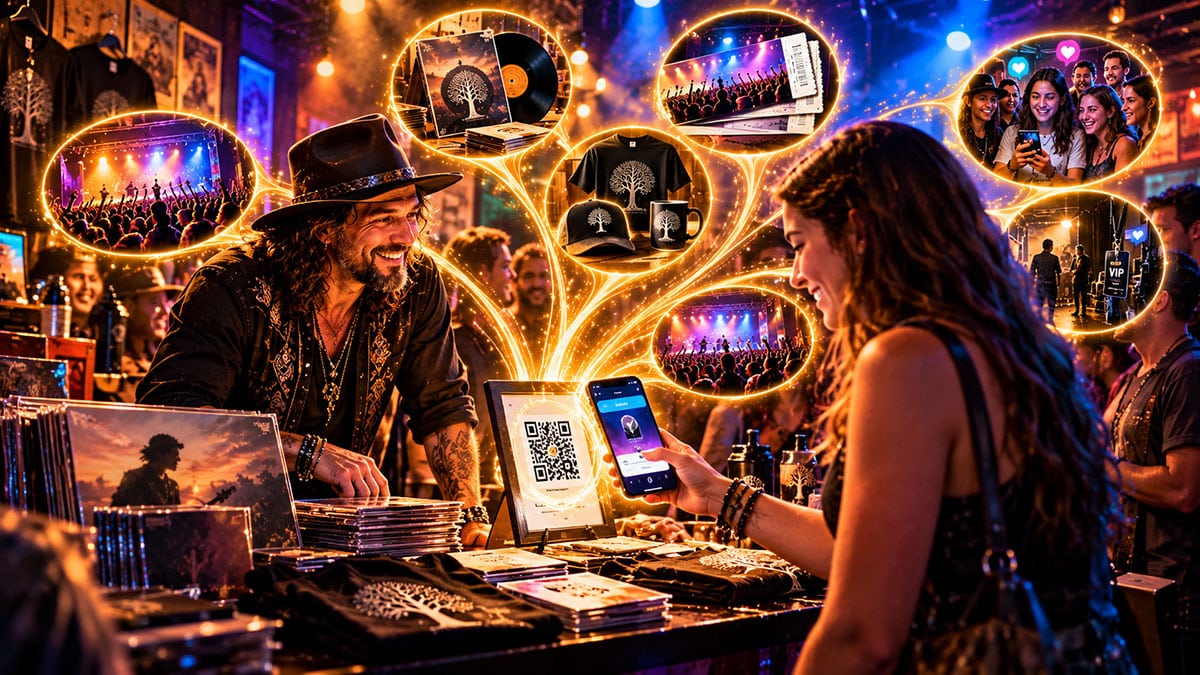
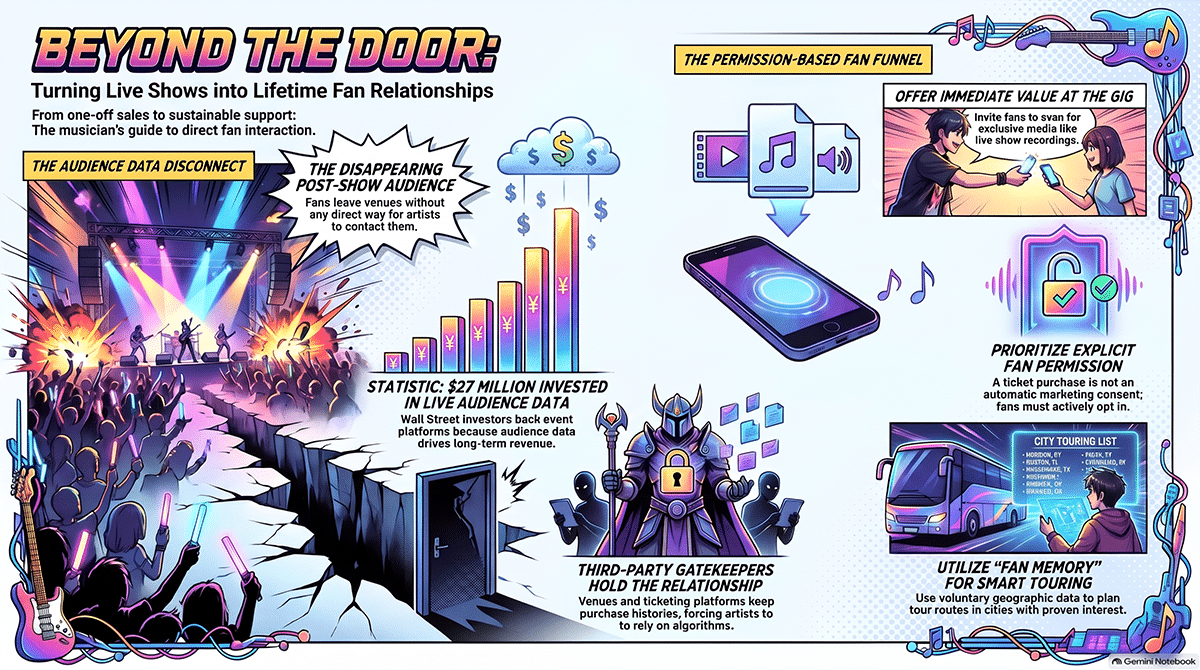
Now imagine that same Saturday night show, but with one meaningful difference. During the performance, the singer tells the audience that anyone who enjoyed the music can visit the band’s website or scan a QR code near the merchandise table to get a free live recording from tonight’s show.
The offer isn’t complicated. Fans can enter an email address, clearly choose whether they want future music and show announcements, and receive something connected to the experience they just enjoyed. If they want text alerts, that is presented as a separate, clearly explained option with any legally required consent. The artist also provides a privacy notice explaining how the information will be used.
This is a much stronger foundation than trying to obtain a general ticket buyer list afterward. The invitation comes directly from the artist, the fan receives something of value, and the relationship begins at the precise moment when interest in the music may be strongest.
The free recording doesn’t have to be a complete concert album, and it doesn’t even have to be music. Depending on the artist, the offer might be an unreleased song, a short backstage video, a downloadable poster, early access to the next release, or entry into a voluntary fan rewards program. The important part is making the exchange meaningful rather than asking people to surrender personal information merely for the privilege of receiving more advertising.
Musicians sometimes underestimate how much fans appreciate a small gesture that makes them feel connected to a performance. A recording from the night they attended carries a memory that the same song on a generic promotional page may not. A photograph from the stage or a personal thank-you message can accomplish something similar when it is offered sincerely.
This is where the idea of a Fan Funnel becomes useful. Instead of pushing people into a complicated membership process, an artist offers a simple first step. Interested fans accept the gift, decide what communication they want, and begin a relationship that can grow naturally over time.
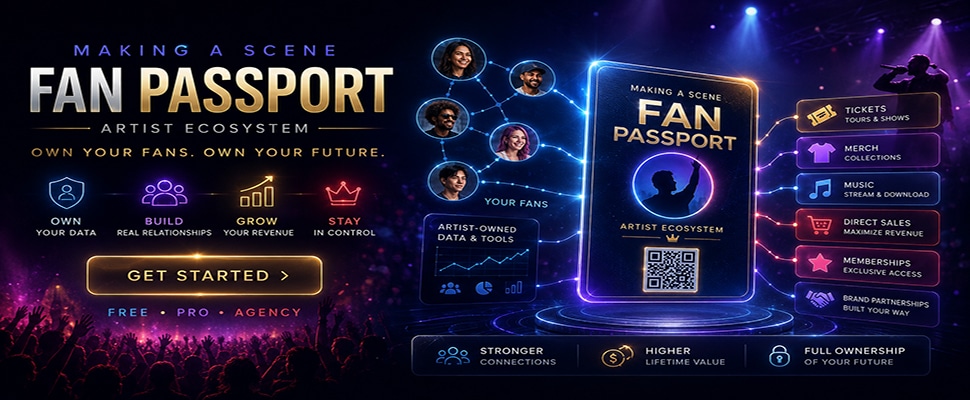
For artists using the Making a Scene Artist Ecosystem, this is the purpose behind connecting a simple Fan Funnel with the deeper Fan Passport relationship model. The first interaction should be easy enough for someone to complete while standing beside a merchandise table with a drink in one hand. The longer-term system should then help the artist remember the relationship, support future contact, and offer additional experiences when the fan wants them.
A signup shouldn’t feel like applying for a mortgage. And the musician shouldn’t have to hire a software engineer just to remember that someone from Charlotte loved the show and wants to know when the band comes back.
Your Audience Is Not One Giant Crowd
One of the most useful ideas behind modern live-event marketing is that audiences become easier to serve when artists understand the differences among them. A fan who has attended three shows in Atlanta may have different interests from someone in Nashville who discovered the band through a streaming playlist. Neither is necessarily more important, but they are at different points in their relationship with the artist.
Traditional music promotion often ignores those differences. A band announces a new tour and sends the same message to everyone, regardless of location, past activity, or interest. The announcement might reach someone who lives ten minutes from the venue and someone who lives eight hundred miles away. One could buy a ticket tonight, while the other would need to arrange a vacation and explain the entire situation to a spouse.
A better approach begins with understanding where interested fans live and what they have voluntarily shared about their relationship with the artist. If an artist has permission-based contacts in several nearby cities, those geographic patterns can help determine where a return engagement might make sense. Fans who previously attended a show could receive an appropriate early announcement, while people farther away might hear about a new recording rather than a concert they are unlikely to attend.
But artists need to avoid mistaking interest for certainty. An email address associated with a city does not guarantee someone will purchase a ticket, and someone who attended a festival may have come for another performer. Ticket purchasers also do not necessarily represent everyone who attended, since one person may buy tickets for an entire group.
That means useful audience information should always be interpreted with care. A large mailing list is not automatically proof of a large paying audience, and a strong response to a free download is not the same as demonstrated demand for a $30 ticket.
Nevertheless, combining several trustworthy signals can help an artist make better decisions. Actual ticket sales, voluntary fan signups, merchandise purchases, replies to announcements, and repeat attendance can reveal patterns that would otherwise remain hidden. An artist who understands those patterns may be able to spend less money promoting to uninterested audiences and more time serving the people most likely to support the music.
The key is to build a system that remembers useful things without turning every fan into a surveillance project. You don’t need to know what someone had for breakfast to recognize that they have attended two shows, purchased an album, and asked to be notified when you return to their city.
Fan Memory Could Become the Working Musician’s Most Useful Business Tool
There is a difference between collecting contact information and remembering a relationship. A mailing list may tell an artist that someone subscribed last summer. A customer relationship system can potentially offer a richer picture by connecting legitimate interactions over time.
In an artist-centered system, a fan might first discover the band through a concert, voluntarily join the mailing list, purchase a shirt, attend another show, and eventually become a supporter who buys new releases directly from the artist. Those activities are not isolated transactions. Together, they tell a story about how a listener became a committed fan.
That is the thinking behind Fan Passport and Fan Memory within the Making a Scene Artist Ecosystem. Rather than treating each interaction as another disconnected database entry, the goal is to help artists understand the ongoing relationship between their music and the people who support it.
Imagine being able to identify fans who have attended several shows in a particular city and voluntarily signed up for advance ticket information. The artist could offer those supporters early notice when a new date becomes available. Someone who bought vinyl at the previous concert might appreciate hearing about a new physical release, while a fan who regularly attends performances might enjoy a loyalty reward or a special opportunity connected to the next show.
This does not mean every interaction should be tracked automatically or that fans should lose control over their information. The system should respect consent, distinguish confirmed purchases from inferred interests, and allow people to correct information or stop receiving messages. It should also make clear which information was supplied by the fan, which came from an authorized business transaction, and which represents a reasonable but uncertain marketing observation.
The financial opportunity comes from providing more relevant experiences rather than sending more messages. An artist who knows that a fan has already purchased the latest album does not need to keep advertising that same album to the person. A fan who has attended three shows might appreciate a personal thank-you more than another generic invitation. Remembering those details can turn a marketing database into something closer to the relationships that musicians once built by recognizing familiar faces in the audience.
Technology should make those human relationships easier to maintain, not replace them with automated enthusiasm. Nobody wants to receive an AI-generated message pretending to be a personal friend simply because a computer discovered they purchased two concert tickets in April.
The artist’s real advantage is knowing when to reach out, having something worthwhile to offer, and making the fan feel appreciated without making the relationship feel manufactured.
A Better Touring Strategy Starts Long Before the Van Leaves the Driveway
Independent artists have traditionally approached touring by looking for venues willing to book them. Once a date is secured, the next challenge is finding enough people to fill the room. For musicians trying to expand beyond their hometowns, that often means taking risks in markets where they have little reliable knowledge of their audience.
The conventional approach may involve contacting clubs in several cities, accepting available dates, and hoping social media promotion produces enough ticket sales to justify the trip. Occasionally it works beautifully. Other times, the band discovers that a city with thousands of online followers somehow produces fourteen paying customers, three of whom appear to be related to the drummer.
Audience information can help artists make more informed choices before accepting those risks. Instead of assuming that a large social media following represents demand in a particular market, the artist can examine where fans have voluntarily joined the mailing list, purchased music or merchandise, attended previous shows, and expressed interest in future appearances.
These signals become especially useful when paired with actual venue information. If an artist has strong evidence of support in two neighboring cities, a regional weekend may offer better economics than a distant engagement requiring hotel rooms, extra meals, and additional travel expenses. A modest show with manageable costs and a dependable audience can sometimes produce better net income than a larger show that looks impressive on a poster but costs a fortune to reach.
This approach also creates a more practical way to build a regional music business. Artists can share bills with compatible bands, introduce their audiences to one another, and create repeatable routes that strengthen over time. A musician who consistently returns to markets where real supporters live can build something more durable than a collection of unrelated one-night appearances.
The Making a Scene Artist Ecosystem’s touring strategy is built around connecting these different pieces of information. The Artist Touring Profile is designed to hold reusable information about the act, including personnel, technical requirements, stage plots, input lists, and other details that venues need. The Show Business Workflow handles the work associated with individual engagements, while the venue database and fan relationship tools provide additional context for planning and promotion.
The logical connection is important. Information about the audience can help an artist decide where to perform, venue records can help identify appropriate opportunities, and the touring workflow can support the practical work required to make the performance happen. After the show, legitimate fan interactions can help inform the next round of decisions.
This is the difference between treating touring as a series of isolated bookings and treating it as a connected business. The goal is not merely to book more dates. It is to develop markets where an independent artist can return regularly, serve an audience, and earn enough money to make the effort sustainable.
 |  Spotify |  Deezer |  Breaker |
 Pocket Cast |  Radio Public |  Stitcher |  TuneIn |
 IHeart Radio |  Mixcloud |  PlayerFM |  Amazon |
 Jiosaavn |  Gaana |  Vurbl |  Audius |
 Reason.Fm | |||
Find our Podcasts on these outlets
Subscribe to Our Newsletter
Discover more from Making A Scene!
Subscribe to get the latest posts sent to your email.


