

What Sonible Joining Complete Access Really Means for Independent Studios




Making a Scene Presents – What Sonible Joining Complete Access Really Means for Independent Studios
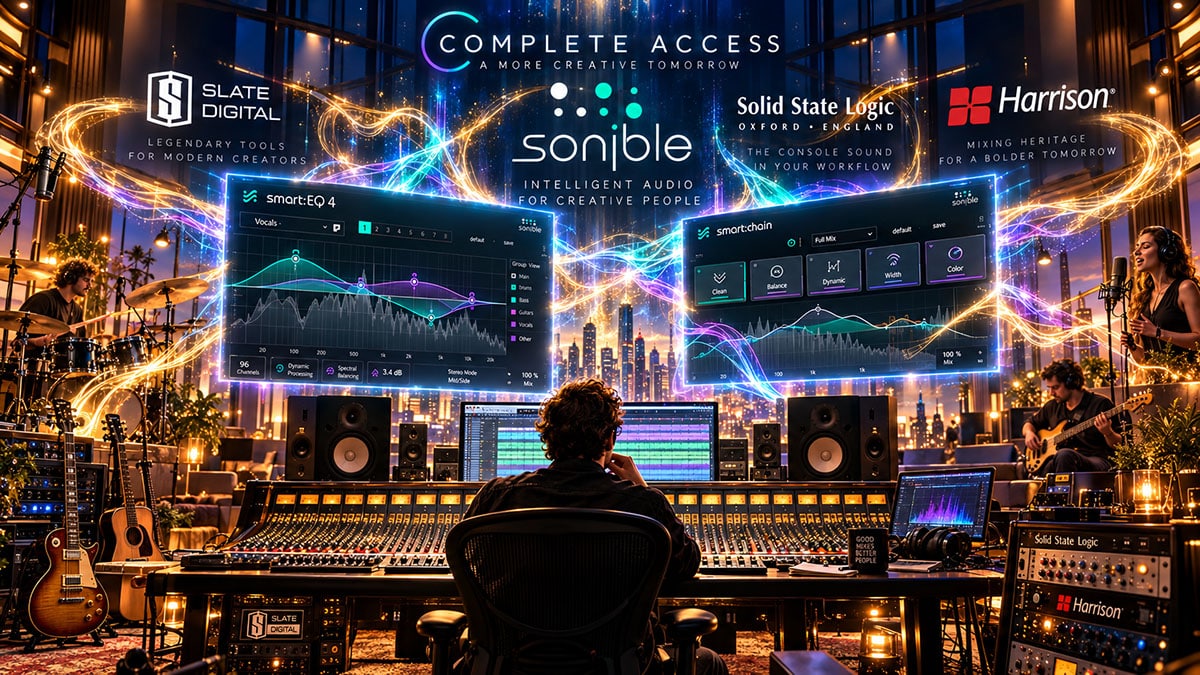
Sonible’s intelligent mixing tools have joined a powerful subscription ecosystem alongside Slate Digital, Solid State Logic, and Harrison Audio. For independent musicians and recording engineers, the deal offers exciting new ways to work faster and produce better recordings. But it also raises an important question about the future of music production: Are we building studios we control, or renting the tools we need to keep them running?
Your Studio Just Got a Lot Smarter. But Who Owns the Toolbox?
There was a time when putting together a professional recording studio meant spending a small fortune on equipment. You needed a good mixing console, racks full of compressors and equalizers, expensive effects processors, and enough patch cables to qualify as a small telecommunications company. If you wanted the sound of a world-class recording facility, you generally needed the equipment, the room, and the budget to match. Independent musicians could make excellent recordings with modest gear, but access to the more sophisticated tools remained an expensive proposition.
Digital audio changed that equation dramatically. Computers replaced entire rooms of equipment, software plugins brought sophisticated processing to home studios, and musicians discovered that professional recording was no longer reserved for artists with record-label budgets. As the technology improved, the cost of entering the recording business fell. A musician with a decent computer, an audio interface, a few microphones, and a good pair of monitors could produce recordings that would have been difficult to imagine in an affordable home studio a generation earlier.
Now another transformation is underway, and this one involves artificial intelligence and the way we pay for our recording tools.
On October 15, 2026, Austrian audio software developer sonible announced that its intelligent mixing and mastering plugins had joined Complete Access, the subscription ecosystem bringing together tools from Slate Digital, Solid State Logic, Harrison Audio, and other audio software developers. Existing subscribers received access to sonible’s collection without an increase in the advertised subscription price.
At $19.99 per month or $199.99 per year, Complete Access now offers a remarkable collection of professional recording tools for what amounts to the price of a modest monthly utility bill. That sounds like excellent news for independent musicians, and in many situations it genuinely is. There is something attractive about giving an artist working in a spare bedroom access to software associated with professional recording studios without demanding thousands of dollars before the first microphone is plugged in.
But beneath that attractive price is a bigger story about where professional recording technology is heading. AI-assisted audio processing is becoming more accessible, software companies are building increasingly powerful subscription ecosystems, and independent recording engineers are being asked to make a choice between access and long-term control.
For Making a Scene, that last distinction deserves serious attention. We have spent years arguing that independent musicians should own their recordings, publishing rights, audience relationships, and the information that makes their careers valuable. It would be a strange turn of events if artists finally gained control of their music businesses only to discover that the tools required to maintain their recordings had become permanently dependent on somebody else’s subscription service.
The arrival of sonible inside Complete Access is worth examining because it demonstrates both the tremendous promise of AI-assisted recording technology and the financial questions that accompany the growing subscription economy.
What Actually Happened on October 15?
The announcement itself is straightforward. Sonible’s intelligent audio processors have become part of the existing Complete Access subscription, joining the tools already provided through Slate Digital, Solid State Logic, Harrison Audio, and other participating developers. Subscribers can explore sonible’s processing tools alongside conventional compressors, equalizers, reverbs, analog-inspired processors, and sound-design effects.
According to sonible’s official announcement, the company sees this as an opportunity to combine intelligent audio analysis with traditional hands-on sound shaping. Engineers can use AI-assisted processing to establish a workable starting point and then reach for conventional audio tools to refine the recording according to their own taste.
That approach is important because many working recording engineers are not particularly interested in surrendering their creative decisions to a computer. They want assistance with the repetitive technical work that consumes time without necessarily making the music more interesting. If software can identify a troublesome frequency buildup, suggest a useful compression setting, or help create separation between instruments, the engineer has more time to concentrate on musical balance, emotion, and the personality of the recording.
The commercial arrangement is equally significant. Existing Complete Access customers do not need to move to a more expensive subscription tier simply to obtain the added sonible tools. The advertised monthly and annual prices remain unchanged, although future prices and contract terms can always change. Sonible also continues to offer individual perpetual licenses, giving customers an alternative to obtaining the software through a recurring subscription.
That final detail should not be overlooked. This is an expansion of subscription access, not an announcement that sonible has eliminated individual software ownership options. Musicians who prefer to purchase selected plugins can still investigate that route.
The new collection includes sophisticated processors such as smart 4, smart 3, smart, smart 2, smart, smart, and the newer smart channel strip. It also includes simpler processing tools and audio-analysis utilities. For an engineer who has never used sonible’s software, the expanded subscription offers an opportunity to explore several different approaches to intelligent mixing without buying every processor separately.
The subscription also reaches beyond conventional plugins. Complete Access advertises educational material, sample libraries, production tools, and mastering services, creating something closer to a complete production environment than a collection of unrelated effects.
That is where the story begins to get interesting. The more useful services a subscription includes, the more attractive it becomes to build an entire workflow around that collection. What initially looks like a convenient collection of audio tools can gradually become an important part of how a studio operates.
And once a workflow becomes dependent on a particular collection of software, changing that relationship may become more complicated than simply canceling a monthly payment.
What AI-Assisted Mixing Actually Does
Before exploring the business implications, we need to understand what sonible means when it describes its plugins as intelligent.
Artificial intelligence has become such a broad marketing term that almost anything involving software automation seems to qualify. Music technology companies use it to describe everything from generating entire songs to cleaning unwanted noise from recordings. These are very different activities, however, and treating them as interchangeable creates unnecessary confusion.
Sonible’s intelligent processors are primarily audio-analysis and processing tools. They examine the audio passing through them and use their algorithms to recommend or apply adjustments related to equalization, compression, dynamics, spatial effects, or other engineering tasks. The musician still supplies the performance, and the recording engineer remains responsible for judging the results.
Consider a typical independent recording session. A blues band has just finished tracking drums, bass, electric guitar, keyboards, and vocals. The performances are good, but the mix feels crowded. The guitar and keyboard compete in the middle frequencies, the bass and kick drum are fighting for space, and the lead vocal occasionally disappears behind the band.
A traditional engineer listens carefully, identifies the overlapping frequency ranges, adjusts equalizers, experiments with compression, and gradually creates room for every instrument. Experienced engineers can perform this work efficiently, but complex mixes still require careful attention. Less experienced musicians may spend hours making adjustments without understanding exactly why the recording continues to sound muddy.
An intelligent processor can analyze parts of that problem and propose a starting point. Instead of requiring the engineer to discover every troublesome frequency through trial and error, the software can identify possible areas of conflict and apply a suggested correction. The engineer can then decide whether that correction serves the music.
This is closer to having a technically knowledgeable assistant than hiring a robot to produce the record. The assistant may notice problems quickly, but it does not automatically understand whether the band wants a polished contemporary sound or a rough, powerful recording that feels like five musicians playing together in a crowded bar.
Those artistic decisions still matter, and they are often the difference between a technically acceptable mix and a recording that people actually want to hear.
AI assistance becomes most valuable when it reduces repetitive labor without flattening the personality of the music. It becomes less useful when the engineer begins treating every recommendation as a rule that must be followed.
The goal should not be to make every recording sound the same. It should be to give independent musicians the technical freedom to make recordings that sound more like themselves.
Smart Equalization: Finding Room for Every Instrument
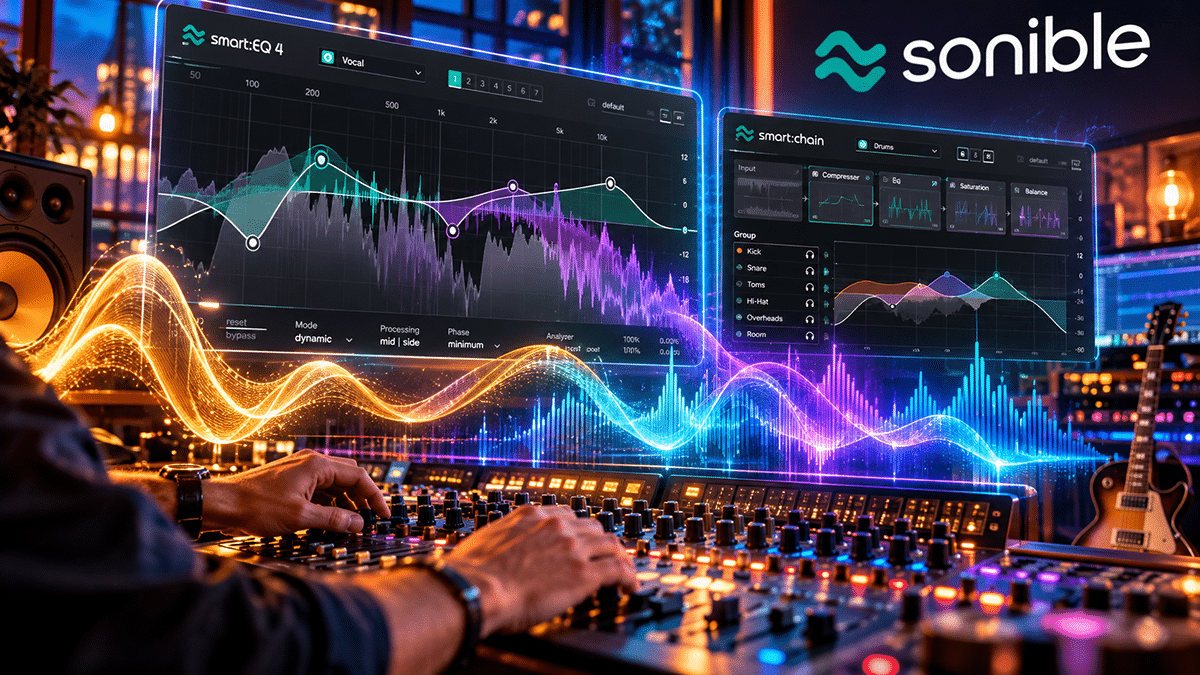
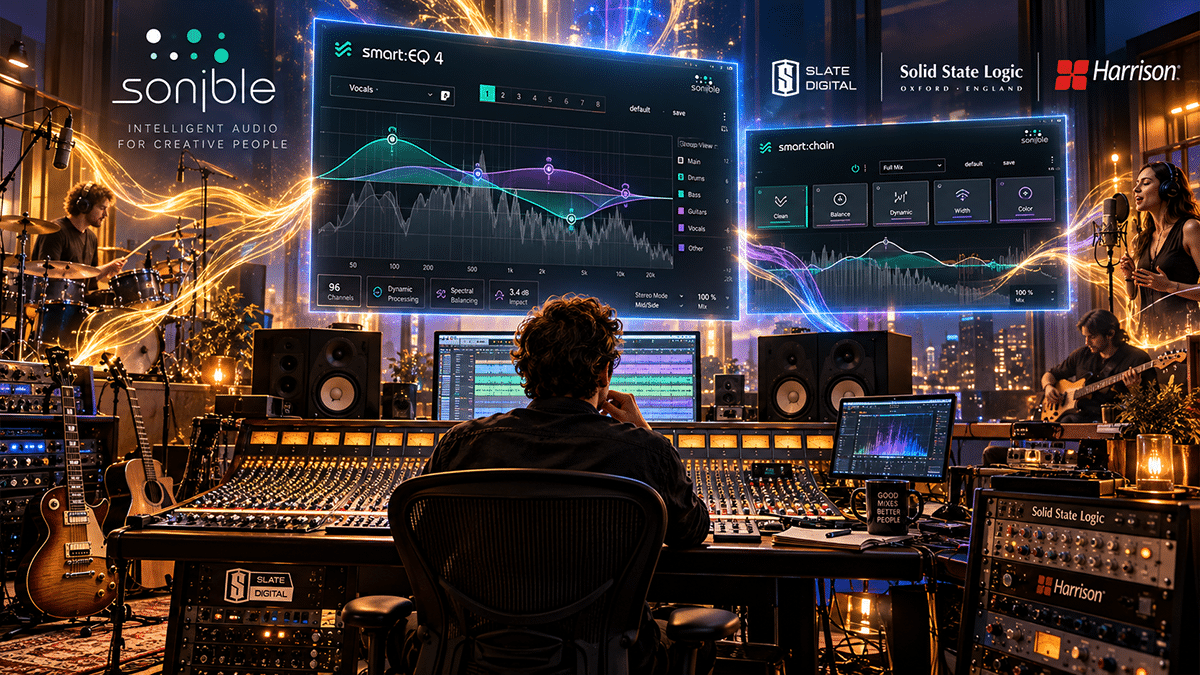
One of sonible’s most interesting tools is smart 4, an intelligent equalizer designed to analyze tonal balance and help engineers address overlapping frequencies between tracks.
Equalization is one of the foundations of mixing. By changing the level of specific frequency ranges, an engineer can reduce muddiness, improve clarity, soften harshness, or help an instrument occupy its own place in a recording. The challenge is that instruments rarely exist in isolation. A guitar that sounds wonderful by itself may interfere with the vocal once the entire band starts playing.
Smart 4 attempts to address this relationship by analyzing audio and offering frequency adjustments based on the material being processed. It also supports communication between instances of the plugin, allowing the software to consider how several tracks interact. Sonible describes a grouping system that can organize up to ten tracks for intelligent spectral mixing.
Imagine working on a recording with acoustic guitar, piano, electric guitar, and a lead vocal. All four instruments contain energy in overlapping portions of the frequency spectrum. If every track is processed without considering the others, the result may be an attractive collection of individual sounds that somehow refuses to become a balanced mix.
With grouped intelligent equalization, the engineer can establish priorities between tracks and use the analysis to help reduce masking. The lead vocal might receive greater priority, while the guitars and piano are adjusted to leave it more space. Instead of blindly removing frequencies, the process can respond to the relationship between the instruments.
That capability could be particularly helpful for musicians learning to mix their own recordings. It provides a practical way to hear what happens when instruments stop fighting for the same sonic territory.
There is a danger, however, in assuming that every overlapping frequency is a mistake. Rock guitars often sound powerful precisely because they occupy some of the same sonic space. A Hammond organ and distorted guitar can create a wonderful wall of sound, even when a frequency analyzer suggests that things are getting crowded.
The engineer still needs to decide whether the suggested correction improves the record. Sometimes the best technical adjustment is the one you choose not to make.
For independent artists, the financial value of intelligent equalization comes from reducing unnecessary mixing time, making revisions easier, and helping recordings reach a professional standard without requiring expensive outside assistance for every project. Better technical results can support stronger releases, more effective promotional material, and a catalog that is useful for licensing.
Compression That Understands More Than Volume
Compression is another area where intelligent software can make a meaningful difference.
A compressor controls the dynamic range of audio, reducing the difference between louder and quieter parts according to its settings. Used properly, compression can make vocals more consistent, give drums greater impact, and help instruments sit comfortably in a mix. Used carelessly, it can make recordings sound lifeless, aggressive, or strangely disconnected from the natural performance.
Traditional compressors require an engineer to make decisions about threshold, ratio, attack, release, and other controls. Those parameters determine how the processor responds when the music changes in level. Experienced engineers develop an instinct for these adjustments, but learning compression can be challenging for someone working on their first serious recordings.
Smart 3 uses intelligent analysis to recommend suitable compression settings and offers spectral processing intended to manage changes in tonal balance. Rather than expecting an inexperienced engineer to understand every parameter before getting started, the plugin can establish a useful foundation that the user can refine.
Picture a singer whose performance moves from a quiet, emotional verse into a powerful chorus. The engineer wants the voice to remain present throughout the song without destroying the excitement of the louder sections. An intelligent compressor can suggest a reasonable approach, but the final decision still depends on the emotional shape of the performance.
A vocalist leaning into a powerful note should not necessarily sound as though someone quietly turned down the excitement. Sometimes those louder moments are the entire reason the recording works.
The same principle applies to drums. A live blues drummer may deliberately play behind the beat and vary the force of individual hits. Excessive compression can erase some of those differences, replacing a human groove with a more controlled but less interesting performance.
Intelligent compression is useful when it provides a faster starting point and helps engineers understand the behavior of the processor. It becomes a problem when speed replaces careful listening.
Independent musicians should welcome tools that reduce technical frustration, but they should be suspicious of any workflow that encourages them to stop making musical decisions.
The Rise of Connected Mixing
Perhaps the more revealing development in sonible’s collection is smart, introduced in August 2026. Unlike a conventional plugin dedicated to a single processing task, smart brings several audio-processing functions into one connected environment.
Its processing capabilities include equalization, compression, de-harshing, gating, input riding, saturation, and leveling. These functions share an analysis of the audio rather than behaving entirely as unrelated processors. The software also offers communication between plugin instances, helping engineers manage aspects of the mix across multiple tracks.
To understand why that matters, consider how a conventional plugin chain works. An engineer inserts an equalizer, follows it with a compressor, adds saturation, and perhaps finishes with another processor. Each adjustment can affect the behavior of the processors that follow. Changing the equalizer may alter how the compressor responds, while additional saturation can change the perceived tonal balance.
This is not necessarily a problem for experienced engineers. In fact, the interaction between processors is part of the creative process. But it can become tedious when a session contains dozens of tracks and multiple plugin chains requiring constant adjustments.
Connected processing attempts to simplify that relationship. By sharing information between processing stages, the software can provide starting settings that consider how the individual functions affect one another.
Smart also introduces broader mix-management concepts, including automatic leveling and depth staging. Instead of thinking only about each instrument in isolation, the engineer can begin making decisions about how different parts of the recording should relate to one another.
For a songwriter producing an album at home, this could reduce the time spent setting up processing chains. For a professional engineer handling multiple projects each week, it could shorten repetitive preparation work and create more time for meaningful listening.
The economic impact depends on how that saved time is used. A studio charging a fixed price per song may improve its effective hourly earnings by completing routine technical work more efficiently. An artist mixing their own album may free up time for rehearsals, performances, promotion, or creating additional music.
There is another benefit that deserves attention. Intelligent processing can also become an educational tool when the user examines why the software made particular suggestions. A musician who studies the relationship between the recommended settings and the audible result may gradually become a better engineer.
That is a much healthier relationship with AI than simply clicking a button and trusting whatever happens next.

AI Cannot Tell You What Your Music Is Supposed to Feel Like
The biggest misunderstanding surrounding AI-assisted audio technology is the assumption that better technical analysis automatically creates better music.
It does not.
A perfectly balanced frequency spectrum does not guarantee an exciting recording. A vocal that sits at the ideal measured level can still lack emotional impact. A mastering processor can help control loudness and dynamics, but it cannot decide whether a song has something meaningful to say.
Music is full of technically imperfect recordings that became classics because of the performances, arrangements, and personalities captured within them. A rough guitar tone may carry more character than a beautifully balanced replacement. A vocal that occasionally pushes above the band may communicate urgency rather than a mixing mistake.
For independent musicians, preserving that personality is especially important. Major commercial productions often have enormous resources devoted to achieving a particular sound. Independent artists frequently compete by offering something different: a recognizable voice, unusual instrumentation, a distinctive recording atmosphere, or the feeling of being present with real musicians.
AI should help protect those qualities rather than automatically polishing them away.
A practical approach is to compare the intelligent processing against the unprocessed recording at similar listening levels. Louder audio frequently seems more impressive during quick comparisons, even when the processing has introduced unwanted changes. Matching the level allows the engineer to judge whether the plugin genuinely improved clarity, balance, or emotional impact.
The engineer should also listen to the processing in the context of the complete song. A guitar may sound slightly thin when isolated but fit beautifully with the bass, drums, and vocal. Conversely, a huge guitar tone that sounds wonderful by itself may leave no space for the rest of the arrangement.
The best use of AI-assisted mixing is to accelerate technical problem-solving while keeping the musician’s artistic intentions at the center of the process.
There is no shortage of software that can make a recording cleaner. What remains valuable is knowing which parts of the recording should remain wonderfully messy.
The Subscription Price Is Attractive. The Long-Term Math Is More Interesting.
Now we arrive at the part of the announcement that deserves a calculator.
Complete Access currently advertises a monthly subscription of $19.99 and an annual plan of $199.99. At first glance, either option appears inexpensive compared with purchasing a large collection of professional audio plugins individually.
For musicians who want access to a wide range of tools immediately, the monthly option lowers the initial financial barrier. Someone setting up a home studio does not need to make a large equipment purchase before experimenting with sophisticated processors.
The annual plan offers a lower equivalent monthly cost for someone expecting to use the software consistently. But recurring payments change the economics of studio ownership, especially when several subscriptions become part of the same workflow.
Consider what happens when those payments continue over time. At an unchanged monthly rate, Complete Access would cost $239.88 over twelve months. Five years of continuous monthly payments would total $1,199.40, while five annual payments at the current annual price would total $999.95. These figures do not include taxes, potential changes in subscription rates, or any additional software expenses.
That does not automatically mean a subscription is a bad deal. If a studio regularly uses dozens of included processors, the collection may cost less than purchasing and maintaining equivalent perpetual licenses. Updates and newly included tools can also provide ongoing value.
The comparison becomes different when a musician uses only two or three processors regularly. If those particular plugins are available through perpetual licenses, purchasing them may cost less over a longer period. Sonible continues to offer individual purchases, making this a real choice rather than a purely theoretical alternative.
The important question is not how many plugins appear in the subscription catalog. It is how many of them actually improve the work being done.
An engineer with fifty plugins installed may still use the same compressor and equalizer on almost every project. Adding another hundred processors will not necessarily increase productivity or improve the finished recordings.
For working independent musicians, software spending should be evaluated the same way as any other business expense. It should improve the quality of the product, reduce the time required to deliver it, or create an opportunity to earn additional income.
If a subscription helps an engineer finish projects faster while maintaining quality, it may justify its cost many times over. If it mainly encourages endless experimentation with software that rarely gets used, the subscription becomes another monthly bill quietly draining money from the music business.
And independent musicians already have plenty of those.
When Saving Time Actually Means Earning More Money
One of the strongest arguments for intelligent audio processing is that time has measurable economic value.
Imagine an independent recording engineer charging $300 to mix a song. The figure is only an illustration, since actual mixing rates vary considerably by engineer, market, complexity, and experience. If a project requires six hours, the engineer generates $50 per hour before expenses and taxes.
Now imagine that intelligent processing reduces the time required for routine setup and corrective work by one hour without reducing quality. The engineer can complete the project in five hours, bringing the effective gross revenue to $60 per working hour.
The client still receives a carefully mixed song, and the engineer gains an hour that can be devoted to another project, business development, or simply avoiding an unnecessarily long workday.
If this happens consistently across multiple projects, even a relatively inexpensive subscription may provide meaningful value. The benefit is not the software’s ability to produce a finished mix automatically. It is the engineer’s ability to spend less time on mechanical tasks and more time on work that requires professional judgment.
The economics are slightly different for musicians who record and mix their own material. They may not receive a direct payment for every hour saved, but those hours still have value.
An artist who finishes an album sooner may be able to release it earlier, organize a tour, prepare merchandise, pitch songs for licensing, or spend more time communicating directly with fans. A faster workflow can reduce the cost of production and make it easier to create new recordings.
That does not mean every hour saved automatically becomes income. A faster mix does not guarantee additional customers, larger audiences, or better sales. But greater efficiency can create opportunities that would otherwise be lost to technical work.
There is also a potential business opportunity for musicians who develop genuine engineering skills. Affordable intelligent processing can support services such as demo preparation, podcast editing, vocal production, remote mixing, and independent release mastering. Those services still require skill, quality control, suitable monitoring, and clear communication with clients.
The software should help an engineer deliver more value. It should not become an excuse to promise professional results without understanding the work involved.
The Hidden Dependency Inside a Modern Recording Session
Subscriptions introduce another concern that is easy to overlook when a product is inexpensive and convenient.
A modern recording session is more than a collection of audio files. It may contain hundreds of settings describing how instruments, effects, automation, and processing interact. When those settings depend on particular plugins, the ability to reopen and reproduce the finished mix can depend on continued access to the same software.
Imagine an independent artist finishing an album using several subscription processors. The project is completed, mastered, and released. Six months later, a licensing company requests an instrumental mix for a television production.
That should be a wonderful opportunity. The artist controls the recording, owns the appropriate rights, and has access to the original recording session.
But what happens if the software subscription was canceled after the album was completed?
The original audio tracks may still be available, but the processing used to create the final mix may no longer function as expected. Reopening the project could require reactivating the subscription, replacing unavailable processors, or reconstructing parts of the original mix.
This problem is not unique to sonible or Complete Access. It is a general consequence of relying on software that requires continuing authorization. Even perpetual plugins can create compatibility problems when operating systems, plugin formats, and computer hardware change.
Subscriptions simply add another possible dependency.
The answer is not to avoid useful technology. It is to build a recording workflow that preserves access to the finished work independently of the tools used to create it.
When a project is completed, the artist or engineer should retain the original multitrack recordings, final mixes, instrumental versions where applicable, and stems or other deliverables useful for future production and licensing. Processing decisions can also be preserved by rendering important tracks or effects into audio files.
These files should be clearly identified and backed up so that the artist is not forced to reconstruct an old recording from memory.
A recording session that can be reopened ten years from now is valuable. A set of properly organized audio assets that can be used even when the original plugin collection is unavailable may be more valuable still.
For an independent musician, the long-term asset is not the plugin chain. It is the music, the performances, the finished recordings, and the ability to use them in future business opportunities.
The iLok Detail That Could Matter at the Worst Possible Moment
There is another practical limitation in the Complete Access announcement that recording engineers need to understand before building their workflow around the new sonible collection.
According to Slate Digital’s official activation guidance, the sonible subscription licenses initially support activation through iLok Cloud or a compatible second- or third-generation USB iLok device. Direct machine-based activation for this particular license collection is not yet available.
Slate Digital says machine-based activation support is being developed, but the company has not announced a firm release date.
That distinction matters because the broader Complete Access environment includes licenses with different activation options. An engineer familiar with activating another included collection directly to a computer should not assume that the new sonible subscription licenses work the same way.
For someone using iLok Cloud, the software may fit comfortably into an existing studio. But cloud licensing introduces a dependence on the availability of the required online licensing session. That can become inconvenient in recording environments where internet service is unreliable.
Consider a musician recording at a remote location or an engineer using a dedicated audio computer that is deliberately kept away from the internet. If the studio depends on cloud licensing, the licensing environment becomes another part of the technical system that must function for the session to proceed.
A compatible USB iLok offers another activation route. Engineers who already use iLok hardware may find this perfectly acceptable, particularly when working across different computers. But musicians who prefer not to use additional licensing hardware should consider that requirement before subscribing.
The physical device can also become a practical concern. A small USB licensing key may be easy to transport between studios, but it is another piece of equipment that must be protected, available, and functioning when the session begins.
Slate Digital’s offline-system guidance also makes clear that subscription users need to consider periodic license refreshes. Engineers planning an offline workflow should examine those requirements rather than assuming that an activated device will necessarily operate indefinitely without internet access.
None of this makes Complete Access unsuitable for professional work. Many studios use iLok licensing successfully every day. It simply means that software authorization deserves the same consideration as microphones, audio interfaces, computers, and storage systems.
A professional studio should not discover its licensing limitations ten minutes before a paying client arrives.
Renting Software Is Not the Same as Owning Your Music
The subscription discussion connects directly to a much larger issue facing independent artists: the difference between owning an asset and paying for access to a service.
When an artist subscribes to recording software, the payment generally provides access under the terms of a license. It does not transfer ownership of the software itself. When the subscription ends, access to the licensed tools may end as well.
That is a reasonable commercial arrangement when both sides understand what is being exchanged. Software developers need revenue to maintain products, fix problems, support changing operating systems, and create new technology. Recurring subscriptions can help finance that ongoing work.
The problem begins when independent musicians fail to account for how many recurring services their creative businesses now depend upon.
A musician might pay for recording plugins, digital distribution, a website, email marketing, cloud storage, promotional tools, design software, and other services. Individually, the payments may appear manageable. Together, they can become a substantial fixed operating expense.
This matters because independent music income is rarely consistent. A strong month of performances and merchandise sales may be followed by several quieter weeks. Subscriptions continue billing whether the artist is on tour, recovering from illness, recording a new album, or waiting for the next paying job.
The sensible approach is to distinguish between services that produce ongoing value and services that simply remain active because nobody has bothered to cancel them.
A subscription used daily in a busy mixing studio may be an excellent investment. The same subscription used twice a year by a songwriter who occasionally records a demo may make far less economic sense.
This is why the continued availability of perpetual software licenses matters. Musicians should be able to choose between paying for ongoing access and purchasing tools they expect to use for years. Neither model is automatically better for everyone.
Independent artists benefit when companies compete to provide flexible access rather than requiring every customer to adopt the same payment structure.
The most powerful music business is not necessarily the one with the most expensive collection of technology. It is the one that makes deliberate decisions about which tools produce enough value to justify their cost.
What Happens When the Major Recording Brands Share One Subscription?
There is a larger industry story behind sonible’s arrival in Complete Access.
Professional audio software was once sold primarily as individual products or collections associated with particular manufacturers. Engineers built their plugin libraries over time, selecting favorite tools from different companies and developing workflows around those choices.
Subscription ecosystems are changing how that marketplace works. Instead of asking customers to purchase individual processors, companies can offer access to large collections under a single recurring payment.
Complete Access demonstrates how attractive that model can become when it combines several recognizable recording-technology brands. Slate Digital contributes a broad range of mixing and production tools, while Solid State Logic and Harrison Audio bring established engineering traditions and software associated with professional audio workflows. Sonible now adds a substantial collection of intelligent processors.
For the customer, the immediate attraction is obvious. A single subscription can provide a range of processing approaches without requiring separate purchases from every developer.
For competing software companies, the consequences may be more complicated.
When a subscription collection already provides an engineer with multiple compressors, equalizers, reverbs, and AI-assisted processors, another developer must work harder to justify a separate purchase. Smaller companies may need to offer genuinely distinctive technology, more flexible licenses, exceptional support, or a different creative experience to attract customers.
That could encourage innovation, but it could also create pressure toward larger distribution partnerships and bundled software arrangements. We should be careful not to confuse this trend with proof that every participating company has merged or changed ownership. A shared subscription collection does not, by itself, establish a corporate acquisition.
What it does show is a growing concentration of customer access within large software ecosystems.
For independent musicians, that creates a familiar tradeoff. Broad distribution can make sophisticated tools more affordable, but dependence on a small number of subscription platforms may reduce flexibility if pricing, licensing policies, or product availability changes.
The recording industry has already watched similar changes take place in digital music distribution. Large platforms made it easier to reach listeners while creating new dependencies involving audience access, data, and revenue.
Professional audio software is not the same business, but the underlying question sounds familiar.
Convenience is valuable, especially when it lowers costs. It becomes less attractive when convenience quietly develops into dependency.
AI Technology Should Teach Engineers, Not Replace Their Judgment
One of the overlooked opportunities created by intelligent audio tools is education.
For decades, musicians interested in recording faced a steep learning curve. Understanding microphone placement, gain structure, equalization, compression, acoustics, and mastering required time, experimentation, and usually a fair amount of frustration.
There is no substitute for developing listening skills, but modern analysis tools can make some technical concepts easier to understand.
A musician who uses smart 4 to examine a muddy arrangement can learn how frequency masking affects instruments. Someone experimenting with smart 3 can listen to how different attack and release settings influence the movement of a performance. Reverb processors that present spatial concepts in more intuitive ways can help beginners understand the relationship between distance, ambience, and clarity.
Sonible’s smart 2, for example, uses intelligent audio analysis and perceptual controls to help shape the sense of space around a recording. Instead of concentrating entirely on traditional technical parameters, the interface encourages decisions about how close, wide, or spacious the sound should feel.
These tools can be educational when musicians use them to connect what they hear with what the processing is doing. They become less educational when the user simply accepts every recommendation without understanding the result.
The difference is curiosity.
A musician who asks why an intelligent equalizer reduced a particular frequency may discover something useful about the arrangement or the original microphone placement. That knowledge can improve future recordings before any plugin is inserted.
This is especially important for independent engineers who cannot afford expensive formal training. Affordable software, manufacturer tutorials, and carefully designed learning resources can make recording education more accessible.
But an intelligent processing suggestion should never be confused with an absolute rule. There are many legitimate ways to mix a song, and musical context can make an otherwise unusual technical decision entirely appropriate.
The best engineer is not the person who knows how to use the largest number of plugins. It is the person who understands what the recording needs and can make informed decisions about how to get there.
AI can help shorten the path toward that understanding, provided the musician remains interested in learning rather than merely producing faster results.
The Fan Does Not Care Which Compressor You Used
There is a business reality that recording engineers occasionally need to hear, particularly after spending several hours comparing subtle differences between processors.
Most listeners do not care which compressor, equalizer, or reverb was used to make the recording.
They care whether the song moves them.
A fan purchasing an album at a concert is responding to the artist, the performance, the emotional connection, and the experience surrounding the music. The quality of the recording matters, but the specific tools used to achieve that quality are generally invisible.
For independent musicians, this should help establish priorities.
Professional audio technology has tremendous value when it makes recordings more engaging, reduces production costs, and helps artists deliver music that fans want to own. But the equipment and software are supporting players in a much larger business.
A finished recording can create income through direct digital sales, physical products, licensing, publishing, streaming, memberships, and fan-supported releases. The recording can also support live performances by introducing listeners to the artist’s music.
Those opportunities depend on much more than technical processing. They require good songs, compelling performances, appropriate rights management, effective marketing, and relationships with listeners.
An artist who spends six months exploring new plugins but never releases a recording has not created a new income-producing music asset. The technology may have provided an entertaining learning experience, but the business has not necessarily moved forward.
A faster, more efficient mixing process becomes meaningful when it helps musicians finish work, retain control over the resulting recordings, and bring those recordings to an audience.
This is where the conversation about AI-assisted recording should eventually lead. The purpose of intelligent software is not to impress other engineers with increasingly complicated processing chains. It is to help music reach the people who might connect with it.
And if the technology can accomplish that while reducing the artist’s expenses, even better.
Connecting Intelligent Recording Tools to an Artist-Owned Music Business
For Making a Scene, the future of recording technology is closely connected to the future of artist ownership.
A musician should be able to move from recording a performance to organizing the finished audio, establishing accurate recording information, preparing licensing materials, and bringing the music directly to fans without surrendering control of the underlying assets.
AI-assisted mixing can improve the first part of that journey. It can help musicians create professional recordings more efficiently, but the benefits become much greater when those recordings enter a properly organized business system.
Consider an independent artist who finishes mixing a new single. The artist should retain the final master, the instrumental version, relevant stems, and the information identifying the performers, songwriters, producers, publishers, and recording owners. That material becomes the foundation for distribution, licensing, physical releases, and future promotional opportunities.
A system such as the Making a Scene Artist Ecosystem is being developed around the idea that these assets and business relationships should remain connected to the artist’s own operation. Its broader direction includes organizing artist information, supporting direct-to-fan relationships, and helping musicians develop revenue opportunities around the music they control.
That approach creates an important distinction between the recording tools and the resulting music assets.
A sonible processor may help create the final mix, but the artist’s catalog management system should not depend on continued access to that processor. The completed audio, its identifying information, and the associated rights records need to remain usable independently of any particular software subscription.
The same principle applies to AI more broadly. Intelligent analysis can assist the artist, but the artist needs to maintain authority over the finished work and its commercial use.
As recording tools become more automated, there may be opportunities to connect audio analysis with better asset preparation, quality control, and catalog management. A future artist-centered workflow could help identify missing deliverables, confirm that alternate mixes exist, organize mastering information, and prepare recordings for licensing opportunities.
These are potential workflow improvements, not features that should be assumed to exist in sonible’s Complete Access integration.
The business opportunity lies in making the entire process more efficient while keeping ownership of the songs, recordings, and fan relationships where it belongs.
A musician should be free to change recording software without losing the ability to manage and earn money from recordings already created.
A Smarter Buying Decision for the Independent Studio
So should an independent musician or recording engineer subscribe to Complete Access now that sonible has joined the collection?
The answer depends less on the promotional announcement than on the studio’s actual workload.
For someone already paying for Complete Access, the addition appears particularly attractive. The existing subscription now includes additional intelligent processors without an advertised price increase. Those engineers can evaluate the new tools against their established workflows and determine whether the added capabilities help them work faster or achieve better results.
For someone starting a home studio, the collection may offer an affordable way to experiment with a broad range of professional processors. Instead of committing substantial money to individual purchases before understanding which tools are useful, the musician can explore different approaches at a relatively low initial cost.
Complete Access currently advertises a 14-day trial, which provides an opportunity to examine compatibility, licensing requirements, and actual workflow benefits before committing to a recurring payment.
An engineer who already owns a reliable collection of plugins should approach the subscription differently. The deciding factor should be whether the new tools solve problems that existing software cannot handle efficiently enough.
If intelligent EQ and compression reduce the time spent on repetitive corrections, that may justify the expense. If a musician only wants one particular sonible processor, an individual perpetual purchase deserves serious consideration.
The licensing environment also matters. Engineers working with unreliable internet access or dedicated offline recording systems need to account for the current sonible activation limitations. Those restrictions are not simply technical trivia; they can determine whether a recording session runs smoothly.
Before making a decision, it is worth testing the software on real projects rather than relying exclusively on demonstration videos. A plugin that sounds impressive on a carefully selected promotional example may be less useful when confronted with a difficult vocal recording, an uneven live performance, or a crowded arrangement.
The strongest evaluation comes from using familiar recordings, comparing the results against existing tools, and considering whether the improvements are meaningful enough to justify the cost.
A subscription is valuable when it contributes to a sustainable recording business. It is considerably less valuable when it becomes another expense added to an already crowded collection of software.
The Bigger Future: AI Processing Becomes Part of the Normal Studio
The inclusion of sonible in Complete Access suggests that intelligent audio processing is moving from a specialized feature toward a more familiar part of everyday production.
That does not mean every recording studio will suddenly surrender its mixing decisions to artificial intelligence. Experienced engineers will continue to rely on their ears, musical judgment, and preferred processing techniques. Traditional analog-inspired tools will remain relevant because they offer specific sounds and creative behavior that musicians appreciate.
What may change is the amount of routine technical work engineers are willing to perform manually.
If software can identify a likely frequency conflict in seconds, some engineers will no longer want to spend several minutes locating the same problem. If an intelligent channel strip can create a sensible starting point, a busy producer may prefer to begin there rather than configuring every processor from scratch.
This is a natural development in the history of recording technology. Engineers once made edits with razor blades and recording tape. Digital audio workstations made precise editing dramatically easier. Automatic tuning, noise reduction, and other forms of software assistance changed how recordings were produced.
Intelligent mixing tools represent another step in that progression.
The challenge is ensuring that technological efficiency does not reduce creative control or introduce avoidable financial dependence.
Independent artists should have access to sophisticated tools without being forced into business arrangements that undermine their ability to maintain their catalogs. They should be able to choose between subscription and perpetual licenses when available, preserve their finished work, and make informed decisions about the financial cost of their technology.
The arrival of sonible inside Complete Access offers a particularly useful example because the collection combines modern intelligent processing with familiar professional audio tools. It creates opportunities for experimentation and efficiency while also demonstrating how recording workflows can become connected to large subscription systems.
Neither development needs to be treated as entirely good or entirely bad.
The real question is whether independent musicians can use these systems to strengthen their own creative businesses without allowing the systems themselves to become indispensable gatekeepers.
Making a Scene: Build a Better Studio, Not a Bigger Collection of Bills
Sonible joining Complete Access is a meaningful development for independent recording technology. The addition gives subscribers access to a broad range of intelligent processing tools alongside established professional audio software, and it does so without increasing the advertised subscription price.
For musicians who have struggled with the cost and complexity of professional recording, that is worth celebrating. Intelligent equalization, compression, channel processing, and mastering assistance can reduce repetitive work and help artists develop better recordings with fewer technical obstacles.
But the advantages should be measured against the actual needs of the studio.
A monthly subscription is not automatically cheaper than owning selected plugins. A large collection is not automatically more useful than a carefully chosen group of familiar processors. And an intelligent mixing suggestion is not automatically the right decision for a particular song.
The strongest independent recording businesses will be the ones that understand those distinctions.
They will use AI to handle repetitive technical work while preserving the musical decisions that give recordings their character. They will calculate software costs against real income opportunities rather than marketing promises. They will preserve their sessions and finished audio assets so future releases, licensing deals, and remixes remain possible regardless of what happens to any particular subscription.
Most importantly, they will remember that recording technology is only one part of building a sustainable music career.
The real business begins when a finished recording becomes something the artist can own, sell, license, perform, and share directly with people who care about the music. The better the recording workflow, the easier it becomes to create those opportunities.
Sonible’s intelligent processors may make that workflow faster, and Complete Access may make the tools more affordable for many musicians. Those are genuine benefits worth exploring. The artist’s responsibility is to make sure that the convenience strengthens the business rather than creating expenses and dependencies that quietly weaken it.
The future recording studio will almost certainly be filled with more intelligent tools. Independent musicians should take full advantage of that technology, but they should remain just as intelligent about the business arrangements that come with it.
After all, the point of building an independent studio was never to collect the largest possible number of plugins. It was to gain the freedom to create music, maintain control over the recordings, and turn that creativity into a sustainable living. AI can help make that possible, provided the artist remains in charge of the music and the business behind it.
For additional information, see sonible’s October 15, 2026 announcement, the official Complete Access product and pricing page, and Slate Digital’s explanation of sonible’s iLok activation requirements. Pricing, included products, and licensing requirements reflect the published information available in October 2026 and may change.
Making a Scene believes the future of independent music belongs to artists who control their recordings, understand their business, build direct relationships with fans, and use technology to create a sustainable music industry middle class.

Subscribe to Our Newsletter
Discover more from Making A Scene!
Subscribe to get the latest posts sent to your email.


